
Richard Osman introduces BBC Four's Classic Game Shows Collection, a nostalgic assortment of game shows from the BBC archives.
Here are a few questions for you:
- Who is the longest-serving UK TV quiz host of all-time?
- How many episodes of Countdown have there been?
- Who created the notorious quiz show flop 24 Hour Quiz?
- Why have quiz shows remained so popular on British television?
I’ll give you the answers to the first three at the end of this introduction. And if you’re thinking about them right now, then you already know the answer to the last one.
I love quiz shows, I’ve been making them for many years, and now I have accidentally stumbled into hosting them too. They rarely win Baftas, they never get reviewed in the posh papers, but the enduring ones capture a place in the hearts of the nation in a way that very few shows do.
There are a number of reasons for this, but two are particularly key.
Firstly they are, by their very nature, incredibly interactive. Viewers can’t help but play along, whether it’s trying to name the most obscure member of Westlife (Nicky) on Pointless, or punching the air in delight if you ever get a single question correct on University Challenge. I have always likened quizzes to sport for competitive people who are terrible at playing sport, myself included.
Some shows I’ve produced have been successful, some spectacularly unsuccessful, but the development process is always the same. You get an idea, a little hook, and then you play it over and over again. You play it with good quizzers, you play it with bad quizzers, just to spot any little holes in the format, anything that seems unfair or confusing. You then make little nips and tucks to address these problems.
Usually these little nips and tucks make the format even more complicated, or drag it too far away from the initial concept and the format is abandoned. But very occasionally something comes along that is robust enough to survive the process, and that’s when the ‘play-along’ question becomes key. Is it fun to play, and, much more importantly, is it fun to watch?
I remember pitching The Million Pound Drop to the head of Channel 4, and he loved playing it so much he kept asking more and more colleagues into his office just so he could watch them play it too. That is exactly what makes a hit quiz show.

Victoria Coren-Mitchell has hosted 10 series of Only Connect to date
The second reason for the success of quizzes is their sheer volume. Quizzes have always been inexpensive and quick to make. As you have the same set for every episode, you could make many, many episodes of Pointless, for example, for the same money and in the same time frame that you could make one episode of a high production drama.
Therefore quizzes become a ‘perfect storm’ for channels. Something economical and relatively quick to make, that viewers actually love. For example, two of BBC Two’s highest rating shows, week in, week out, are two of their most low-cost shows to produce: University Challenge and Only Connect.
So how does this perfect storm come about? Viewers usually spot low-cost TV a mile off and will sometimes run for cover. Well, quizzes are inexpensive and quick to make, but they are made with great attention to detail and great enthusiasm. There has always been a wonderful sub-set of people who work in TV, who simply love making quiz shows. Great producers, great format-tinkerers, and, most importantly the great unsung question writers. You might call us geeks, I couldn’t possibly comment.
This sheer volume means that quizzes become part of our daily routine. A regular workout for the brain. Every time Countdown started, my Grandad would take out his pen and his notebook, cup of tea by his side, and play along. I know people do the same with Pointless (maybe not with the pen and pad) and that always makes me feel incredibly lucky, and I know he’d be watching if he were still around. That connection with viewers is very special.
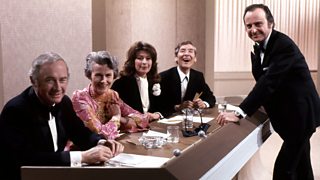
Kenneth Williams chuckles on the What's My Line? panel, with host David Jacobs in 1974
Watching some of the wonderful archive the BBC has brought together in the BBC Four Classic Game Show Collection proved to me that this has always been the case. Mostly low-cost, but such an utter joy to watch. It’s impossible to not play along with an episode of Quiz Ball from the 60s, What’s My Line from the 70s or Ask The Family from the 80s.
And because they often lack gloss or pizzazz, they also provide a peculiarly moving snapshot of Britain through the years, from the gasps of the What’s My Line studio audience on discovering that a contestant is a Woman Detective, to the wonderful sight of people answering quiz questions while smoking pipes.
So I hope you’ll dip in and gain great enjoyment from some of the shows featured. On a side-note, I would like to commend Quiz Ball for having quite the most complicated rules explanation I have ever heard. It takes about three minutes and is utterly incomprehensible. Promise me you’ll treat yourself.
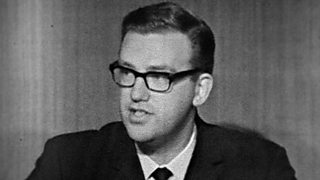
David Vine presents the first episode of Quiz Ball in 1966
I’ll leave you with the answers to the questions I set.
- According to the wonderful ukgameshows.com website the longest running UK TV quiz show host was Magnus Magnusson, who hosted Mastermind for just 10 days shy of 25 years. If you said Bamber Gascoigne, you’ve been unlucky, as Magnus beat him by just eight days! The record could be under threat soon however, as Jeremy Paxman is in his 21st year as University Challenge host and Sue Barker in her 18th year on A Question Of Sport.
- Over 6,000, more than any other British TV quiz or game show. The French show on which it was based has clocked up over 20,000 episodes. Weakest Link managed 1,693, and so far Pointless is just over 800, but we’re not planning to give up any time soon.
- Me. Sorry.
Richard Osman curates the BBC Four Classic Game Shows Collection, available to watch now on BBC iPlayer.
More from Richard Osman:
Pointless: How I became the co-host
Comments made by writers on the BBC TV blog are their own opinions and not necessarily those of the BBC.
