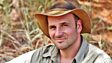
Wildlife film-making is a high-risk business. We make our own luck the best we can – good research, the best locations, a great team.
But nothing can hide the fact none of our cast can read the script, let alone take direction.
I'm the series producer on Africa: the latest landmark wildlife series from the BBC's Natural History Unit.
Watch the trailer for Africa
One of my responsibilities is the health and safety of crews in remote and sometimes hostile locations.
Our team was trained by ex-Special Forces medics. We included on our hazard assessment list: Ebola virus, landmines and piracy.
Attacks by wild animals were well down the risk list but an ever-present potential threat.
In all, the production took four years to make with the main filming period lasting around two and a half years.
In order to get the perfect shot, one cameraman had to sit in the water beside a dead whale while it was being eaten by some 30 great white sharks.
Cameraman Richard Matthews describes filming great white sharks next to a whale carcass
Another was trapped up a tree all night in the line of duty.
Most forest elephants were relaxed around us, but for four hours, one unusually aggressive elephant tried to shake him out of his tree platform!
Two crew members strayed into minefields whilst answering calls of nature.
Fortunately, everyone has come home safely.
One of the main reasons people enjoy wildlife series is for the sense of escapism - there's an expectation of beauty, fascination and wonder.
Sometimes, when watching the films, it's easy to forget that a film crew was there at all.
In these landmark series, sumptuous photography is something we know our audience expects - yet it relies on oblivious wildlife and on the patience and skill of the camera operators.
No great shot is ever a given. And few great shots come without great effort.
We helped drive the development of a new HD starlight camera system, used in the opening episode to film a night-time rhino party in intimate detail.
And super-slow motion allowed us to capture a giraffefight that will change your view of these 'gentle' giants forever.
Technology not only transforms how we perceive Africa's iconic animals, it can also make things a little safer.
Remotely operated HD cameras can go where we cannot. We used them with lions in the Serengeti, with shoebills in Zambia and with a massive five metre long python in Uganda.
The remote HD cameras proved too interesting for the curious big cats
No matter how intrepid and determined the team, the director is not going to send anyone into a burrow belonging to such a massive snake.
Pythons have a severe bite, not to mention the power to crush their victims to death.
Fortunately we were lucky enough to have the opportunity to film a wild, but rescued snake in a wildlife sanctuary.
She'd laid eggs and we carefully recreated her natural environment inside a special filming burrow.
Sometimes for safety or welfare reasons we film in controlled conditions, as it's the only way to glimpse some great new behaviour - in this case, her surprisingly tender maternal care.
Cameraman Rob Drewett describes filming an African rock python rearing her young
Macro filming - the filming of insects and tiny animals - is a particularly tricky part of the craft, because you need lots of light and because the faintest breath of wind renders the whole image bouncing in and out of frame.
So there will always be a need to control those conditions to some extent, with lights and special lenses.
It's not something that we will detail every time but we show an example of this in the Eye To Eye section at the end of episode five, when a five-minute sequence of silver ants is painstakingly built-up over 30 days under the blistering Saharan sun.
We know that there is increasing interest in our various filming techniques and some of you will want to know when we do this sort of filming.
So we have adopted a more explicit style of commentary. And throughout the series, we'll illustrate our techniques in more behind-the-scenes clips like the ones in this blog post.
Aside from filming in controlled conditions, we're confident our audience are familiar with much of the wildlife film-maker's craft and don't need to highlight it all, in favour of maintaining the sense of escapism.
Our goal is to tell nature's stories in a dramatic and factually accurate way. And what we show is always the biological truth.
James Honeyborne is the series producer of Africa.
Africa begins on Wednesday, 2 January at 9pm on BBC One. For further programme times, please see the episode guide.
Comments made by writers on the BBC TV blog are their own opinions and not necessarily those of the BBC.
