Growing up around elephants opened my eyes to the magic of nature
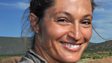
Saba Douglas-Hamilton
Presenter and conservationist
Tagged with:
As a child, Saba Douglas-Hamilton grew up around wild elephants in Tanzania and Kenya, thanks to her father, Iain Douglas-Hamilton's conservation work. Now a mother herself to three young daughters, Saba is raising her family in a similar environment and is the subject of BBC Two documentary This Wild Life.
The more you watch elephants, the more you slip into their mind-scape and begin to see the world through their eyes. Most of what I know about them I learnt by osmosis - growing up amongst them while my parents did their research in the 70s and 80s. Later on, I was able to match my intuitive interpretations with what I read, which opened my eyes to the deep magic of the natural world.
Spending time with elephants, you appreciate how tender they are to one another: how independently minded each can be; the daily challenges faced by a matriarch as she tries to persuade her family to follow her lead, or her courage in times of danger.
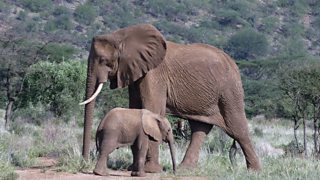
Perhaps what I've learnt most from growing up in the bush is how everything in nature is interconnected and how important wild spaces are for our sanity. It was perhaps this realisation that prompted us to relocate to Samburu district, Kenya, to bring our three kids up at Elephant Watch Camp.
Both my husband Frank and I are deeply committed to the cause of saving elephants, but we also felt it was an amazing opportunity to open our kids' eyes to a very different way of life and give them time to explore their imaginations and creativity while their brains were still uncluttered.
At first they were scared by the monkeys stealing mangos at breakfast or howled when thorns pricked their baby-soft feet, but it was merely a matter of learning the ropes. Pump-action water pistols work a treat at keeping monkeys at bay, so the sharpshooters are now locked and loaded in time for tea, and they’ve learnt to scuff their feet in the dust to get rid of most thorns.
On one occasion, when one of the twins was being rather disobedient, tromping off on her own not looking where she was going, she almost bumped into the backside of an elephant bull called Sarara. He whirled around with a great whoosh of annoyance and sent her scampering for cover, luckily into the arms of our ‘security’ - a local warrior called Mporian who was keeping an eye on her. It was a very close call that made the hair on my arms stand on end, and afterwards I could feel her little heart fluttering in her chest like a trapped bird. So far Sarara has proved to be more bark than bite, but you can never take elephants for granted.
The fact that elephants come into camp at all is the most amazing show of trust, and is thanks to the protection they get here in Samburu reserve and the gentle touch of the staff at Elephant Watch Camp. Even better is their inclination to seek out comfortable sand banks close to our tents at night and lay down for a snooze, so that you can hear the calm of their deepening breath as they succumb to elephant dreams under the stars.
Now and then leopards also pad through camp, which sets the vervet monkeys into a frenzy of alarm calls, and the monkeys like to tell us about the presence of civet cats, wild dog, servals, and hyena too. This wakes us up quite a lot at night, but since they are our extra eyes and ears it's always good to listen to what they are saying.
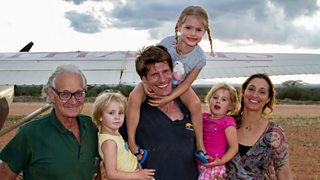
Saba's family, including her father Iain (left) and husband Frank (centre)
But camp is a lot of work, and it isn’t always easy. Trying to keep the standards high is an enormous challenge – vehicles break down, people get sick, nomads go on walkabout, termites gnaw through the infrastructure, and sadly, every now and then we find that an elephant has been killed - but that’s just part of life in the northern frontier.
Samburu National Reserve is a pocket-handkerchief of a protected area that’s part of a much greater wilderness that stretches all the way up to the Ethiopian border. Part of Frank’s work at Save the Elephants is to monitor where the elephants go in that wilderness and why. So we don’t often find time to put our feet up. This only happens during the rains when we pack up camp completely and take a proper break, heading down to the coast for a week or two of swimming in the Indian Ocean.
I know that nothing can last forever, but right now I'm very happy with this particular wild life.
Saba Douglas-Hamilton is a presenter and conservationist.
This Wild Lifestarts on Monday, 31 August at 7pm on BBC Two. Each episode will be available in BBC iPlayer for 30 days after broadcast on TV.
Comments made by writers on the BBC TV blog are their own opinions and not necessarily those of the BBC.
