
When I was a young medical student, it was felt that the best way to get a really good understanding of the workings of the human body was by dissecting a corpse.
Altruistic individuals would leave their bodies for students, like me, to tremblingly dissect.
These days you can get a more intimate and revealing understanding of the workings of the body by other methods.
This is largely thanks to improvements in scanning technology and far more sophisticated microscopy.
Inside The Human Body, a series I have just finished making for BBC One, does what it says in the title. We decided to turn our cameras on the animal we love best - ourselves.
I was chosen to present the series because I have a background in medicine.
I trained as a doctor and have more than 20 years experience as a science journalist. I've presented a number of series for the BBC, including recently, The Young Ones and Blood And Guts: A History Of Surgery.
In this series we showcase the latest scientific images of the body, including a fabulous sequence of a human face forming inside the womb.
We also reveal some of the more unusual and surprising ways in which your body, minute-by-minute, struggles to keep you alive.
To illustrate the latest science we also filmed people who have managed to get their bodies to do some pretty amazing things, like breaking the world free-diving record or teaching their eyes to see with perfect clarity deep underwater.
I was particularly impressed by a magician who could do the most unbelievable tricks with his hyper-flexible hands.
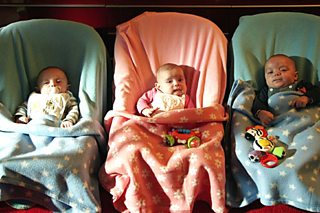
The series covers the human experience from conception to death.
So, not only do you see the moment when sperm enters egg, detonating a series of violent explosions, viewers also see the moment when 84-year-old Gerald, surrounded by his family, draws his last breath.
In the programme that features Gerald, First To Last, we learn about all the things that the body does to keep itself in balance (homeostasis), and what happens when this balance is lost.
Gerald had terminal cancer but what ultimately killed him was probably his body's inability to maintain his red blood cell count.
Gerald agreed to be filmed because he thought it would be helpful to show that it is possible to pass away painlessly, at home, surrounded by your loved ones.
It's a series I greatly enjoyed making, partly because of the people in it like Gerald, partly because I learnt so much about the workings of my own body. I hope you get the time to watch.
Michael Mosley is the presenter of Inside The Human Body.
Inside The Human Body begins on BBC One and BBC One HD at 9pm on Thursday, 5 May.
You can watch the making of the programme on red button after each episode.
For further programme times, please visit the upcoming episodes page.
Comments made by writers on the BBC TV blog are their own opinions and not necessarily those of the BBC.

