Apart from the volcanic eruption, what do we really know about the ancient town of Pompeii?
In her documentary Pompeii: New Secrets Revealed, Mary Beard finds out what life was like in the bustling town - from what the people enjoyed baking to where they spent their free time…
The ancient ruins of Pompeii are full of surprises. Whether it is the suites of Roman baths in almost working order, the seedy town brothel, or simply the deserted streets - where you can almost imagine that a resident from 2000 years ago might any minute appear round the corner.
I have been visiting Pompeii for over 40 years now, and every time I go I find something I haven’t seen before. But making our documentary, Pompeii: New Secrets Revealed, I got a chance to see – and to share – all kinds of things that surprised even me.
The volcanic eruption that destroyed the town in AD 79 preserved some very unexpected treasures. One of the highlights of the programme was my first visit to the bio-archaeological deposit on the site. That doesn’t immediately sound very exciting, but the “deposit” is something close to an Aladdin’s cave containing all the food-stuffs that were carbonised when the burning volcanic debris fell on the town, and recovered by archaeologists hundreds of years later.
There are literally jars and jars of dates, figs, pomegranates and olives, all straight from the Pompeian kitchens. There are even baskets of eggs and a few very overcooked loaves that were still in the oven when the bakers decided to run for their lives.
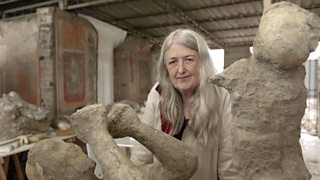
It’s hard not to feel a bit moved at the thought that daily life was going on, some of the bakeries still in full swing, when it was all suddenly cut short by the devastating eruption. Even more affecting are the actual remains of many of the human victims.
Very respectfully, and with the help of a medical CT scanner, we were able to examine some of these remains much more closely than had ever been done before. We wanted to find the answers to some big questions about the real people of Pompeii – about how old they were when they perished, for example, or about their state of health, particularly their teeth.
We managed to bust a few myths. It wasn’t just the old and infirm that were the victims, while the young and fit escaped. There were plenty of twenty-somethings among the remains of the people we looked at. And, despite the wholesome diet we had glimpsed in the deposit, there were a good few whose teeth looked like they’d been drinking the ancient equivalent of fizzy drinks (honey and wine, perhaps).
Pompeii is inevitably a world tinged with sadness and death. But we explored the places where people had fun too, from the swimming pools to the saunas, the bars to the brothel (though I’m afraid “fun” isn’t what the working girls had there).
And I got my very first chance to impersonate a Roman launderer. In one large-scale laundry that has only recently been carefully restored, I actually managed to climb into large vats where the launderers used to spend their days trampling the clothes underfoot in the best cleaning and treatment substance that the Romans knew: human urine, collected in industrial quantities in vats at the front door.
That is how you got your toga clean – and it’s a nice reminder that the Romans were not quite as much like us as we sometimes imagine.
Professor Mary Beard is a classicist and the presenter of Pompeii: New Secrets Revealed with Mary Beard.
Pompeii: New Secrets Revealed with Mary Beard is broadcast on Thursday, 3 March at 9pm on BBC One.
It will be available to watch in BBC iPlayer for 30 days after broadcast on TV.
Comments made by writers on the BBC TV blog are their own opinions and not necessarily those of the BBC.
