BBC TV blog - BBC TV blog

Archives for September 2011

BBC Two Mixed Race Season: Shirley

Blog comments are currently unavailable. Find out more.

Post categories:

Katherine LannonKatherine Lannon|17:51 UK time, Thursday, 29 September 2011

In February, I had a phone call to say Prospect Cymru was developing a factual drama about Dame Shirley Bassey for BBC Two, to be included in the channel's Mixed Race Season.

Would I be interested in meeting the Executive Producer Charles Thompson to discuss? How could I refuse?

It sounded like a dream job and just up my street: I'm Welsh for starters, and Shirley is a national institution after all.

And I have some experience of biopics, having worked on dramas about Stephen Hawking, Beethoven, Mrs Beeton and John Lennon.

The script for Shirley was beautifully written by Shelagh Stephenson.

As producer your role is to translate the script to the screen working with your director - the super-talented Colin Teague - and together develop a creative vision for the project.

Ruth Negga as Shirley Bassey

Ruth Negga performs on stage as Dame Shirley Bassey

We quickly gathered our team together and started the all important casting process.

We were so lucky that the divine Ruth Negga agreed to play Shirley.

We were also lucky to find all the locations we needed in and around Cardiff and Swansea, including London night clubs!

I thought I knew a fair bit about Shirley - the girl from Tiger Bay, the extraordinary voice, the Bond songs, the glamour, the gay icon and that fabulous Glastonbury performance.

The sheer power and endurance of this amazing woman means it was a real responsibility to deliver a brilliant portrayal which captures the essence of Shirley.

The very wonderful Ruth Negga really did deliver this.

Ruth immediately submerged herself in Shirley - researching her and studying her to perfect the Welsh accent, the body language, the power of Shirley's performances and her emotional journey.

As well as reading two major works, the most recent biography of her by John Williams and the autobiography of her late personal manager Mike Sullivan, as a production team, we read old newspaper articles, looked at interviews, archive footage and performances.

After sifting through an enormous amount of material, it became clear that the story we wanted to tell was the one of Shirley's childhood, and her rise to international stardom in the 1960s.

It was while working on this project that I discovered so much more about Bassey's early years.

Even as a young woman, her life had all the stuff of drama.

She grew up as part of a large mixed race family living in poverty. Her father disappeared from her life while she was still a baby. Then there was the birth of her first child when Shirley was only 17, her relationship with her ambitious manager and her controversial first marriage to Kenneth Hume.

Lesley Sharp as Eliza Jane, Shirley Bassey's mother

Lesley Sharp plays Shirley's mother, Eliza Jane

Poignant themes of the relationship between mothers and daughters emerged strongly for me, with Shirley's mother Eliza (played by the superb Lesley Sharp) along with Shirley as mother to her daughter, Sharon.

Shirley's is a powerful and uplifting life story.

This project had lots of challenges, not least because of the timescale.

The drama had to be ready for September to launch the Mixed Race Season and we were starting the preparation for the shoot in June.

In drama terms this is a very tight deadline - dramas can take years and years to develop and appear on the screen.

The shoot was just 13 days and waking up every morning hoping above hope that we would achieve everything we needed was one of the big pressures.

We did this through the sheer dedication and professionalism of everyone involved, especially Director Colin Teague, First Assistant Director Lee Trevor and Line Producer Catrin Lewis Defis - and of course Ruth herself.

Watching Ruth being filmed as she performed This Is My Life looking sensational in the beautiful Brangwyn Hall in Swansea (which doubled as a 1960s TV Studio) was completely magical and moved members of the crew to tears.

It is in the final moments of the film and it was a coming together and representation of all the talent on this project - from Shirley to Ruth, to every member of the cast and crew.

Katherine Lannon is the Producer of Shirley.

Part of BBC Two's Mixed Race Season, Shirley is broadcast on Thursday 29th September at 9pm.

Comments made by writers on the BBC TV blog are their own opinions and not necessarily those of the BBC.

Eastenders: E20

Blog comments are currently unavailable. Find out more.

Post categories:

Himesh PatelHimesh Patel|11:45 UK time, Friday, 23 September 2011

I've been playing Tamwar Masood on EastEnders for four years.

Together with Charlie G Hawkins, who recently left EastEnders after playing Darren Miller for eight years, I have written the second online episode of EastEnders: E20 series three.

Faith Olubumni (Modupe Adeyeye), Donnie (Samuell Benta) and Ava (Sophie Colquhoun) in Albert Square.

The latest additions to the Albert Square spin-off: Faith (Modupe Adeyeye), Donnie (Samuell Benta) and Ava (Sophie Colquhoun).

I had always written ideas and scripts since my GCSEs, having studied drama and creative writing, so I was thrilled when my application to write for E20 was successful.

Writing was always something that Charlie and I thought about and talked over, but E20 was our first real attempt at writing together.

We were huge fans of both series one and two, and were chuffed when we heard the producers liked both of our applications.

Luckily we already knew Emer Kenny and Arinze Kene as they had both been actors on EastEnders - Emer played Zsa Zsa Carter, and Arinze played Connor.

They had both previously written for E20, so they helped familiarise us and helped us adjust between the two shows, but all the writers were fantastic at bumping ideas together.

Performing is obviously something we've both done for a long time with EastEnders, so the things we've learnt there have helped us overcome a lot of the challenges that acting entails.

But there are many differences in terms of writing, particularly the challenge of finding the balance between your ideas and the direction the producers want to take the series in.

It's our job to accommodate their ideas and our own in the best way - a challenge that can be tough, but just as rewarding.

When writing our episode, both Charlie and I actually made a conscious effort to avoid using our own characters because we like to think of ourselves as actors and writers as separate entities.

There's always a danger that writing what you'd like to perform might overshadow what's best for the episode.

Of course we have our own favourite characters from the main show and it was great to work out where we could potentially use some of them in our episode, but we were conscious of not using them just for the sake of it.

It is important that they fit in to the narrative of the episode, because in our capacity as writers the priority is E20 and the brand new characters that drive the series.

In order to see this content you need to have both Javascript enabled and Flash installed. Visit BBC Webwise for full instructions

Introducing E20's three brand new characters

However, there's no denying it's great being able to use characters from EastEnders!

Sadly our EastEnders filming schedules meant that we just didn't have time to get involved with the bags of extra online content which sits online alongside the 15 episodes.

It's fantastic, so viewers should definitely look forward to that as well as the main drama.

We've been fortunate enough to have worked with a really great team who work hard on every aspect of the story of E20.

Can't wait for you all to see it!


Himesh Patel plays Tamwar Masood in EastEnders which continues on BBC One and BBC One HD on Mondays, Tuesdays, Thursdays and Fridays. You can catch up with episodes on the EastEnders website.

Series three of EastEnders: E20 launches this week. Episodes are available on Tuesdays, Thursdays and Fridays on the E20 website, with an omnibus on BBC Three on Fridays at 8.30pm.

Find out more about this unique commission from BBC Learning on the About the BBC Blog.

If you are aged 16-22 and are interested in writing a future episode of E20, you should submit a piece of fictional writing for a character you have created. You should write either a blog entry, a diary extract or a monologue for that fictional character (no longer than 400 words) and send it to: EastEnders: E20 Script Development, BBC Elstree Centre, Clarendon Road, Borehamwood, Herts, WD6 1JF

Comments made by writers on the BBC TV blog are their own opinions and not necessarily those of the BBC.

Last Night of the Proms: the best seat in the house?

Blog comments are currently unavailable. Find out more.

Post categories:

Phil HallPhil Hall|13:45 UK time, Monday, 12 September 2011

OK, I admit it.

I was a young, foolish, impressionable 16-year-old who spent a week sleeping rough on a street in South Kensington just so I could hang over the rail at the front of the arena on the Last Night of the Proms in 1982.

Just don't tell anyone.

But my abiding memory of that concert was that next time I didn't want to stand up for three and a half hours.

I wanted a seat.

Audience members waiting for the music to start at the BBC Proms

Audience members waiting for the music to start at the BBC Proms

Not any seat. Not a seat in the auditorium: I wanted one on the stage.

Fortunately fate conspired to make that a reality and ten years later I stepped out onto probably the world's most viewed stage (the concert is broadcast worldwide) with a palpable sense of arrival.

Twenty years on and sitting on the front desk of the viola section, some of the novelty has inevitably worn off but the party atmosphere in the hall for the second half hits me between the eyes every time (while the viola section's party poppers hit the back of my head!).

Controversial though some of the antics of the Last Night of the Proms are, (a former controller of the Proms tried to ban the off-putting klaxons and whistles) let us not forget that as well as a celebration it is still a concert.

The 74th consecutive concert in the world's biggest music festival.

A long concert to boot that needs just as much preparation as the eleven others the BBC Symphony Orchestra has done this season.

We still have the pressure of microphones, cameras in your face (literally) and numerous solos to perform to the millions listening and watching.

After a long, hot summer sweating in the Albert Hall it's no wonder that sometimes there can be a few grey faces in the orchestra!

It's been interesting comparing the different conductors who have accepted the 'poisoned chalice' various Proms controllers have offered them over the years.

I'm too young to recall Malcolm Sargent so for my money I'd say Andrew Davis was positively born for the task.

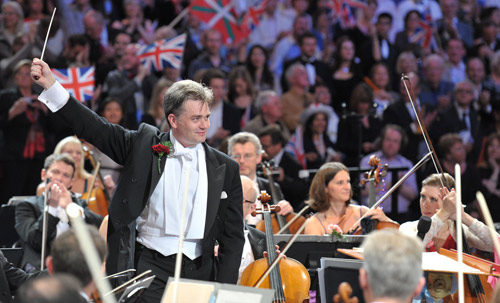
This year we had the youngest ever maestro to take on the challenge since Henry Wood himself: step forward English National Opera's Music Director Edward Gardner.

Plus he's also a Brit, which some people think is important.

I don't think it is particularly; the Vienna Philharmonic play their waltzes just as well if the conductor is Indian, American, French or Japanese.

We can similarly manage an Elgar march and Parry's Jerusalem.

In fact, Ed let slip in rehearsals that he has never conducted Pomp and Circumstance or Jerusalem before.

Edward Gardner conducting at the Last Night of the Proms

Edward Gardner conducting at the Last Night of the Proms

I got to the hall at 10am on Saturday only to find Roger Wright watching the England rugby team three points down to Argentina in the artist's bar.

I silently hope that's not a bad omen... we had a quick chat and he seemed remarkably fresh considering he'd attended all the Proms and had to deal with the inevitable last minute artist cancellations.

Ed Gardner too looked pretty relaxed. Just as well as this was just about the most frantic general rehearsal there is, what with three hours to rehearse two and a half hours worth of music.

But he kept his cool - and even finished five minutes early.

More importantly he was splendid on the night itself: cutting a dash on the podium, his easy manner was always going to be a hit with the crowd (I mean, audience).

Not a bad speech either. I'd wager this won't have been his last Last Night, although he still has quite a few years to do until he catches up with some of us...

Phil Hall is the BBC Symphony Orchestra's sub-principal viola player. He is a regular contributor to the BBC Radio 3 Blog.

Part one of The Last Night of the Proms was broadcast on Saturday 10th Sept at 7.30pm on BBC Two and BBC HD.

Part two of The Last Night of the Proms was broadcast on Saturday 10th Sept at 9.10pm on BBC One.

Watch a video of Conductor Edward Gardner and the orchestra preparing for The Last Night of the Proms on the About the BBC Blog.

25 years strong: the idea that defined Casualty

Blog comments are currently unavailable. Find out more.

Post categories:

Paul Unwin and Jeremy BrockPaul Unwin and Jeremy Brock|15:05 UK time, Wednesday, 7 September 2011

We met at Bristol University, in 1979, where we were both studying drama.

We then went on to work together in the theatre, when Paul directed Jeremy's play In Times Like These for the Bristol Old Vic.

Both of us had spent time in hospital - Jeremy after illness and Paul after an accident - and although neither of us had worked in TV, we were really excited by it as a medium.

Ian Bleasdale as Josh, Kwame Kwei-Armah as Finlay, Michelle Butterly as Mel and Donna Alexandra as Penny

Some of the Casualty cast from 2000 - Josh, Finlay, Mel and Penny

We shared a love of American shows like Mash and Hill Street Blues, both of which had demonstrated a thrilling use of multi-strand storylines and a free-wheeling movement between drama and comedy.

Having both spent time in hospital, we were deeply concerned by what we saw as the Thatcherite attack on our National Health Service.

We knew just how unique the NHS was, how hard the staff worked, the incredible pressure they were under.

In 1985 it felt like all that good work was about to be dismantled. We were determined to make a stand.

Passionate, over-confident and sure of our political agenda, we wrote a pitch document that set our drama in the world of A&E.

From the very beginning, we defined this department as the frontline in the battle for the soul of the NHS. Looking back, that single idea defined the series.

It put the nurses at the centre, it demanded multiple storylines and it embraced scenarios that ran from the comic to the tragic, from the familial to the political.

Casualty was born.

The cast celebrating the millennium

The cast celebrating the millennium

To our complete amazement, we were commissioned.

Aged 25, with zero experience of writing television drama, we were suddenly faced with creating characters and storylines that would hold a BBC One audience on primetime.

We knew we wanted to get away from the cosy world of Angels, the 1970s drama about hospital nurses.

We knew we wanted to tell stories that had the political issues of the NHS at their heart and we knew we wanted to present the staff as fully rounded human beings, with all their strengths and faults on show.

But how to put all that together?

Our biggest challenge was lack of experience.

We needed to ally our energy and ambition to people who could help and guide us through the frantically fast development of those early scripts.

Two key figures stood out.

Early in our research, we'd met a charge nurse working nights at the Bristol Royal Infirmary. Peter Salt was an object lesson in calm.

He dealt with the throbbing, real life drama of the casualty department with a grace and wit that was intrinsically British and heroic all at once.

We saw him navigate his vulnerable patients through grief, recovery, folly and all the myriad scenarios that make up a night in A&E.

In order to see this content you need to have both Javascript enabled and Flash installed. Visit BBC Webwise for full instructions

Derek Thompson who plays Charlie Fairhead recalls his favourite moment's from the last 25 years.

Charlie Fairhead is not Peter, and he is not Charlie, but his inspiration is buried deep in the values that drive Charlie's feet-firm integrity.

Many weekends were spent around a kitchen table with Peter, while we suggested storylines that were increasingly outlandish, if not medically impossible.

Smiling gently, Peter would nudge us towards a better idea.

He became the series' medical advisor.

25 years on, he remains Casualty's touchstone for all medical issues.

The other key figure, in those early days, was the producer Geraint Morris.

A charming, passionate and life-loving Welshmen, he set the tone for the show.

With experience of helming classic series like Softly Softly and The Onedin Line, he knew how to create a family of characters that would generate the loyalty and emotion that our more political agenda sometimes missed.

What he knew, instinctually, we had to learn. He was a patient and affectionate teacher.

His great skill was in managing to make the production feel special and owned by everyone who worked on it.

That infectious enthusiasm has never been lost.

The series may have grown more sophisticated, the cast may have expanded, but at heart, Casualty is still about a family of characters battling it out on the frontline of the NHS.

25 years on, with the government threatening even greater cuts than in the 1980s, Casualty seems more pertinent than ever.

That a show can still feel relevant after so many years gives us a sense of real pride.

Jeremy Brock and Paul Unwin are the creators of Casualty.

Watch interviews with the cast about Casualty's 25th anniversary on the clips page.

Comments made by writers on the BBC TV blog are their own opinions and not necessarily those of the BBC.

Reel History of Britain: Selecting the films

Blog comments are currently unavailable. Find out more.

Post categories:

Robin BakerRobin Baker|11:50 UK time, Tuesday, 6 September 2011

It's perhaps not surprising that I became a film curator.

I come from a family who documented their lives through home movies over a period of almost 60 years.

Every few years we hold a grand screening, projecting the films onto a sheet at the bottom of the garden.

Melvyn Bragg inside the mobile cinema

Melvyn Bragg inside the mobile cinema

When I watch them now, the pleasure is not just about seeing my parents when they were young, but the way the films connect our lives so potently to the times in which they were shot.

That's what I love so much about Reel History of Britain.

It uses film to tell very personal, individual stories, but connects us all to the monumental history of the last 100 plus years.

The series came into being through a happy coincidence.

BBC Entertainment Manchester were looking to develop a people's history of Britain.

At the same time the BFI - working with Britain's other national and regional film archives - was completing work on an epic undertaking to safeguard our film heritage and to make it available to people no matter where they live.

Reel History of Britain, commissioned by BBC Two daytime controller Liam Keelan, is one of the first steps towards ensuring that this access happens.

The BFI looks after the national collection of film and TV.

It's a remarkable collection of almost 1,000,000 titles - from the original negatives of Alfred Hitchcock's silent films made in the 1920s to The King's Speech.

But many of the stars of the collection are not the famous features, but the non-fiction films - the newsreels, documentaries, travelogues and home movies that capture life in Britain over the last 116 years.

In order to see this content you need to have both Javascript enabled and Flash installed. Visit BBC Webwise for full instructions

Melvyn Bragg looks at films of the World War Two evacuation.

I work with the BFI's team of curators and, led by my colleagues Jan Faull and Simon McCallum, we selected hundreds of films that were shortlisted for use in the series.

Among my favourites that made it to the final cut is the brief, but evocative footage of the 1895 Derby (the oldest surviving British film); SS Olympic (1910), a spectacular film about the building of the Titanic's sister ship and We Are the Lambeth Boys (1959), a groundbreaking documentary focusing on the lives of a group of working class teenagers in south east London.

Seeing the boys reunited for the series 52 years later is remarkable and emotional - their lives having moved in directions that their teenage selves could never have guessed.

It is this connection between the films and the original participants that makes the series so compelling for me.

The sequence that I enjoyed the most was from the episode celebrating the British seaside holiday.

Here we see extracts from Holiday (1957), an exuberant portrait of ordinary people enjoying the kiss-me-quick pleasures of Blackpool.


On board the rollercoaster at the beginning of the film and screaming for all she's worth is a teenage girl, clearly making the most of her 15 seconds of fame.

I've seen the film a number of times over the years and for some reason the young woman's face stuck in my memory.

Remarkably, the production team managed to track her down.

The screaming girl is Sandra Burslem (now Dame Sandra) who grew up to become Vice Chancellor of Manchester Metropolitan University and even has a building named after her.

Sandra was not planning to ride the rollercoaster that day.

She was out for a walk in Blackpool, spotted by the director and asked if she'd pose on the rollercoaster for the camera.

You get the impression that screaming was really not Sandra's style, but that was what the director wanted, so that was what Sandra did.

And very convincing she was, too.

It's only a brief and seemingly insignificant moment, but it tells us a lot about filmmaking: don't believe everything you see.

Even if a film purports to be factual, it will be riddled with little fictions.

Robin Baker is the head curator of the BFI National Archive.

Reel History of Britain started on BBC Two on Thursday 5th September at 6.30pm and continues at the same time every weekday.

For further details, please visit the upcoming episodes page.

Comments made by writers on the BBC TV blog are their own opinions and not necessarily those of the BBC.

Elegance and Decadence: The Age of the Regency

Blog comments are currently unavailable. Find out more.

Post categories:

Lucy WorsleyLucy Worsley|13:00 UK time, Monday, 5 September 2011

A ballroom, pretty dresses, couples twirling round the floor to the swelling music of the Waltz. What could be more genteel?

Well, as I discovered in my new series Elegance and Decadence: The Age of the Regency, the waltz was the Regency equivalent of dirty dancing.

Lucy Worsley in front of group wearing Regency dress

When it first appeared in the 1810s, this new dance from Germany caused a scandal.

Obviously, when I was offered a dancing lesson, I couldn't wait to have a go.

Equipped with a red Regency dress and a pair of dancing pumps, I got myself to the Royal Pump Rooms of Leamington Spa.

The Pump Rooms were used for Regency parties and balls, but are actually named for the pump there that produces some rather nasty-tasting spa water.

This water's supposedly health-giving properties lay behind Leamington Spa's spectacular growth as a tourist resort in the Regency period.

At the Pump Rooms I met the dance historian Robin Benie.

He told me how the country dances of the eighteenth century involved men and women standing in long lines, each person forming a couple briefly, in turn with all the other members of the set.

In the waltz, by contrast, you remain clasped in the arms of just one partner throughout, perhaps taking the opportunity for private conversation.

The Times newspaper condemned the new dance for its 'voluptuous intertwining of the limbs'.

In order to see this content you need to have both Javascript enabled and Flash installed. Visit BBC Webwise for full instructions

Historian Robin Benie gives Lucy Worsley a lesson in waltzing

Waltzing also played a sad part in the unstable Lady Caroline Lamb's tempestuous relationship with the poet Lord Byron.

Lady Caroline was one of Lord Byron's many groupies, and for a while he indulged her in a scandalous affair.

He made her swear never to waltz, as it made him so jealous to see her in the arms of another man. (He couldn't waltz himself because he had a bad foot.)

After their break-up, though, they ran into each other at a ball, and she said to him that 'she supposed she might waltz now'.

Yes, he said, she could dance with anybody she liked.

Poor Caroline was devastated by this evidence that their relationship was really over.

She immediately got hold of a knife, cut herself, and blood went all over her gown.

I myself managed to get through my waltz lesson without bloodshed and can now twirl very nicely indeed.

And I really enjoyed my afternoon as a Regency Rihanna.

Lucy Worsley is the presenter of Elegance and Decadence: The Age of the Regency.

Elegance and Decadence: The Age of the Regency continues on BBC Four at 9pm on Monday 5th September.

For further programme times, please visit the upcoming episodes page.

Comments made by writers on the BBC TV blog are their own opinions and not necessarily those of the BBC.


Fostering Nature's Miracle Babies

Blog comments are currently unavailable. Find out more.

Post categories:

Dominic WormellDominic Wormell|12:20 UK time, Friday, 2 September 2011


I suppose it's not the average day at the office when you get to bring home two tiny little endangered monkeys in your bag.

Not just tamarins but baby bats have shared my bedroom at various points over the last 20 odd years that I have been working at Durrell in Jersey.

In order to see this content you need to have both Javascript enabled and Flash installed. Visit BBC Webwise for full instructions

Feeding time: Dominic Wormell cares for the tamarins

I must admit, I usually get a groan and a look of 'oh no, not another one' from my wife when I turn up with a travelling crate, a steriliser and some powdered baby milk, as it usually means she will be getting up in the middle of the night to do some of the feeding duties.

Intelligent and fascinating, but often challenging to breed, many tamarins and marmosets are threatened with extinction.

Over the years we've faced many problems with these monkeys and as a result have learned a lot about how to keep them healthier and happier in captivity.

This led the BBC to contact us about doing some filming with our tamarins.

Walking around with Stuart Armstrong and talking about our experiences, it became obvious that pied tamarins had a great story to tell about what zoos can do to help endangered species.

I always wanted to work in conservation.

I came to Jersey on the ferry with my bike thinking I would stay for a year or so, but after starting work with the large marmoset and tamarin collection for which Jersey was famed, I became hooked.

They are wonderful little animals and there is always something going on in their full social lives.

Pied tamarins, very threatened in the wild, first came to Durrell in 1990 and it was immediately obvious that they were very different to other species.

When they jumped out of the crates they had travelled in from Brazil, they began to vocalise in a strange and aggressive way that I hadn't heard before.

They were angry little creatures, confrontational and ready to challenge any perceived threat.

This obviously posed some problems if we were to breed them in captivity and establish a safety net population.

In order to see this content you need to have both Javascript enabled and Flash installed. Visit BBC Webwise for full instructions

More of the cute baby animals featured in the series.

To say that those first pied tamarins were poor parents would be an understatement:

In the early years I was often greeted with the gruesome sight of tiny headless corpses on the enclosure floor.

Not only that, but they seemed to be very susceptible to illness.

Over the years we changed the way they looked after them, finely adjusting everything from diet to housing, reducing stress and enriching their environment, to put the troublesome tamarins at ease.

Gradually things improved, and we have now bred many tamarins and sent them elsewhere so that the population is safer.

William was the first pied tamarin that I hand-reared.

His mother was a notorious baby killer and one day I walked into the enclosure to see a small, dark, wet, lump on the floor, covered in wood shavings and squeaking incessantly.

Meanwhile his mother had killed his twin and was now looking down at him - she would probably have finished him off if I hadn't been there.

William had a series of health problems, including a large inguinal hernia which the vet said was untreatable. But we made some tiny plastic shorts out of a fairy liquid bottle which held the hernia in place, and it soon healed itself.

William is now an infamous character, having a few favourite people but taking every opportunity to nip anyone else - and tamarin bites hurt a lot!

Despite this he is now a proud father several times over, and though an old man at the age of 17, is due to become a parent again. (The oldest pied tamarin on record is 21. He is called Mr Tumnus and is still living here at Jersey!)

William took a long time to integrate into a foster family because of his health problems, but we've learned over the years that it's really important to get hand-reared babies back into a group when they are still very young, as that way they grow up to be much more socially adept.

Baby pied tamarin

A baby pied tamarin

Unlike many primate species, tamarins have a very sophisticated system of group care and are usually perfectly happy to foster unrelated babies.

The ideal group will have adults that have had lots of experience with infants, either their own siblings or as parents themselves, and be likely to breed again so that the foster kids can learn about how to look after babies correctly.

One of my first visits to Brazil was to help reintroduce the first captive-born black lion tamarin, one of our Jersey successes, to the Atlantic forest in southern Brazil.

However, reintroducing any of the pied tamarins we are breeding now is unlikely to be feasible, as the last remaining bits of forest they live in already have tamarins living in them.

So we are working on their conservation in the wild with Marcelo Gordo and other conservationists in Brazil to try and put a brake on the destruction of the forest that pied tamarins and many other species live in.

With Manaus continuing to engulf the forest, it's very sad to see how much more has gone every time I visit.

It's also really heartening to see how Marcelo is trying to build up tree corridors through the city, and the tamarins in Jersey and in Europe are helping to raise funds for this.

Surely there must be a space for these tiny little primates in our world - we can't let them be steamrollered out of existence.

Dominic Wormell is the Head of Mammals at Durrell Wildlife Conservation Trust

Nature's Miracle Babies is on BBC One at 6:30pm on Sunday, 4th September.

For further programme times, please visit the upcoming episodes page.

Comments made by writers on the BBC TV blog are their own opinions and not necessarily those of the BBC.
The Killing on BBC Four

Blog comments are currently unavailable. Find out more.

Post categories:

Richard KleinRichard Klein|16:30 UK time, Thursday, 1 September 2011

The Killing is back! Well, we're repeating all of the first series in its entirety, at least.

The whole original and best version in one mad block of programmes so that fans and newcomers, people who missed the series first time around, and those hungry to watch it again, can submerge themselves in an ocean of Danish criminal procedure, Faroese pullovers and riveting whodunnit tension.

I loved it the first time round.

Deputy Superintendent Sarah Lund and Jan Meyer

Deputy Superintendent Sarah Lund (Sofie Gråbøl) and Jan Meyer (Søren Malling)

Such an original piece of work, classy and beautifully plotted, the real draw of The Killing is its masterful and unyielding determination to stay focused on that single murder, that single investigation and that single (not to say singular) police investigator, Sarah Lund.

Yet at the same time it does not shy away from the mass of rippling consequence that comes to so many individuals when an act of brutality comes smashing into otherwise relatively still lives.


I feel, and have always done, that BBC Four is the place to showcase the best of television from around the world, and that language - ie not English - isn't a barrier to the channel's audience.

In some ways, oddly, The Killing's sub-titles actually help.

It allows us to focus and concentrate and really absorb the other-worldness of the programme.

BBC Four is the premier channel for people who like to think, for whom authorship, intelligent comment and entertaining perspective on mainstream subjects is their way of enjoying television.

And, perhaps, in Sarah Lund there is a character who reflects something of these traits in her own character.

Pernille Birk Larsen and Theis Birk Larsen

Pernille Birk Larsen (Ann Eleonora Jørgensen) and Theis Birk Larsen (Bjarne Henriksen)

Singular, often unpredictable but always inquiring and as a consequence, both interesting and attractive.

There will be some who say that this should be noted even more because she is a woman. I disagree.

Though the actress Sofie Gråbøl explains she treated the role of Lund by acting like a man to start off with, in the drama her gender is, in my view, noteworthy only because it actually doesn't matter.

She is a police officer with an utter fascination for detective work, and in that one compulsion, her personal life suffers - an always watchable trait in our television police dramas.

At the same time, The Killing is most definitely a story of our times in whatever society we live in.

The family dramas, the workplace frictions, the media pressures, the modern politics: I feel we can all relate to that.

So enjoy this chance to watch The Killing again, and prepare yourselves for the return of Sophie Lund in The Killing II later this year, exclusively on BBC Four.


Richard Klein is the controller of BBC Four. He recently wrote about the channel's new role as curator of archive BBC content on the About the BBC Blog.

The Killing series one continues on BBC Four daily at 10pm until September 15th.

Comments made by writers on the BBC TV blog are their own opinions and not necessarily those of the BBC.

More from this blog...