BBC TV blog - BBC TV blog

Archives for April 2011

Songs Of Praise: Our royal wedding special on Anglesey

Blog comments are currently unavailable. Find out more.

Post categories:

David TavinerDavid Taviner|16:00 UK time, Thursday, 28 April 2011

As one of my daughters was married last year, I know what it's like to walk down the aisle, witness the vows and keep smiling for the cameras all day long.

Wedding days are always memorable. Royal weddings become moments in history. We will always remember where we were on Friday, 29 April 2011.

So, knowing that more than two billion eyes would be focussed on William and Kate, with all the pomp and ceremony of the Westminster Abbey service in London, how could Songs Of Praise capture the spirit of the day in our own unique way?

Having been series editor for the last 18 months, which involves overseeing all the programmes - and having produced many editions of the programme during the previous 10 years - I knew we needed to mark the day in one particular community for whom the marriage would have particular significance.

In order to see this content you need to have both Javascript enabled and Flash installed. Visit BBC Webwise for full instructions

I made a decision some months ago that Songs Of Praise should join in the celebrations with a special programme from a beautiful part of North Wales, where William and Kate would begin their married life.

William is a helicopter pilot with the RAF's Search and Rescue crew based on Angelsey.

So it followed that we should make contact with those who live on the island - neighbours, in a sense, of the couple - and invite them to be part of this television event.

And it wasn't a difficult decision to suggest that our popular presenter Aled Jones introduces the programme.

After all, he grew up on Angelsey and began his singing career as a choirboy in nearby Bangor Cathedral.

In fact, when we recorded the hymn singing in the parish church in Beaumaris in March, Aled was quick to remind the congregation that the last time he stood in the church was when he was 12.

Opportunities to return to his roots are pretty rare, so the warm welcome he received made him feel as if he'd returned home.

He said to me, during a pause in the recording, how special it was to come back and be reminded where it all began for him.

Following some careful research, Anglesey turned out to be the perfect place for a newly married couple.

A nearby island was once inhabited by the Welsh patron saint of lovers, so we decided to interview a local resident about this.

We also found a fascinating craftsman who made traditional Welsh lovespoons and we commissioned him to produce a unique wedding gift that will be sent, with our best wishes, from Songs Of Praise.

And then it transpired that the classical singing group Blake, who had recorded a romantic song for the royal wedding called All Of Me, were available to film with us on Anglesey as well as talk about their association with William and Kate.

Jules and Ollie from the group studied at St Andrews University when the couple were courting, and share their own impressions of that early relationship.

Aled Jones and the congregation in the church of St Mary and St Nicholas in Beaumaris, Anglesey.

I'm often asked who chooses the hymns featured in the programme and how the selection is made.

Well, the producer always thinks carefully about the music, partly based on the stories to be told by those being interviewed and partly on the nature of the programme.

This time, classic wedding hymns such as Praise My Soul The King Of Heaven and Love Divine almost chose themselves.

But I have a sneaking suspicion that Julie, the producer, might have included one or two of her own favourites as well.

With only weeks to go before our Anglesey recording, the pretty church of St Mary and St Nicholas was selected and singers of all ages quickly recruited from the local area.

Songs of Praise is always a community event. Local congregations are invited to the church that hosts the television recording and in the Land of Song, as Wales is affectionately known, we were spoilt for choice with so many wonderful voices.

There is always a choir rehearsal a week or so before when our conductor runs through the hymns.

On this occasion he had been told that men from a local male voice choir would be there to help swell the tenor and bass parts but, due to some crossed wires, they'd double-booked to travel to Cardiff for a rugby match.

Fortunately, they did turn up for the recording itself, and to stand behind them during a spine-tingling rendition of the Welsh favourite Cwm Rhondda was an experience I'll never forget.

The recording day arrives and the evening light is perfect.

Anglesey on a sunny day is a breathtaking place to be. The scenery is stunning where the sky meets the sea.

The choirs and congregation start to arrive and there is a real buzz in the air.

We have booked members of the RAF Band to help accompany the singing and conductor Paul Leddington Wright is ready to take everyone through each hymn.

It rarely happens in one take because, sometimes for technical reasons, we have to record the hymns several times.

The evening goes very well, everyone is in such good voice, and the music sounds fantastic.

But it doesn't end there. There's more to be done. And I know that the filming on location that compliments the singing often looks very straightforward.

But life is never simple. The producer wanted to film with Prince William's RAF colleagues to illustrate the work they do.

Aled Jones

So Aled was volunteered to be winched from an Anglesey beach into the helicopter.

As a TV presenter you can be asked to do all sorts of things. And the great thing about Aled is that he's willing to do almost anything.

One camerman was dispatched to be in the chopper and one of the BBC team was waiting with Aled on the beach, camera at the ready.

Weather conditions weren't perfect, Aled was a little apprehensive, and then it all happened.

One second, he was recording a short link to camera. The next, he was whisked off his feet and was lifted hundreds of feet into the air and ceremonially dropped into the waiting helicopter.

You'll see in the short film that there's no television trickery. Aled really did put himself in the skilled hands of the Royal Air Force crew.

And you can tell by the lump in his throat that he was truly grateful for the work they do. I think it's a magic moment. See what you think.

David Taviner is the series editor for Songs Of Praise.

Songs Of Praise: Anglesey's Royal Celebration is on BBC One at 5.10pm on Sunday, 1 May.

For further programme times, please visit the upcoming episodes page.

For the latest on the royal wedding, please visit BBC News's special royal wedding site.

Comments made by writers on the BBC TV blog are their own opinions and not necessarily those of the BBC.

Inside The Human Body

Blog comments are currently unavailable. Find out more.

Post categories:

Michael MosleyMichael Mosley|12:01 UK time, Wednesday, 27 April 2011

When I was a young medical student, it was felt that the best way to get a really good understanding of the workings of the human body was by dissecting a corpse.

Altruistic individuals would leave their bodies for students, like me, to tremblingly dissect.

These days you can get a more intimate and revealing understanding of the workings of the body by other methods.

This is largely thanks to improvements in scanning technology and far more sophisticated microscopy.

In order to see this content you need to have both Javascript enabled and Flash installed. Visit BBC Webwise for full instructions

Inside The Human Body, a series I have just finished making for BBC One, does what it says in the title. We decided to turn our cameras on the animal we love best - ourselves.

I was chosen to present the series because I have a background in medicine.

I trained as a doctor and have more than 20 years experience as a science journalist. I've presented a number of series for the BBC, including recently, The Young Ones and Blood And Guts: A History Of Surgery.

In this series we showcase the latest scientific images of the body, including a fabulous sequence of a human face forming inside the womb.

We also reveal some of the more unusual and surprising ways in which your body, minute-by-minute, struggles to keep you alive.

To illustrate the latest science we also filmed people who have managed to get their bodies to do some pretty amazing things, like breaking the world free-diving record or teaching their eyes to see with perfect clarity deep underwater.

I was particularly impressed by a magician who could do the most unbelievable tricks with his hyper-flexible hands.

Three babies, from the Creation episode of Inside The Human Body

The series covers the human experience from conception to death.

So, not only do you see the moment when sperm enters egg, detonating a series of violent explosions, viewers also see the moment when 84-year-old Gerald, surrounded by his family, draws his last breath.


In the programme that features Gerald, First To Last, we learn about all the things that the body does to keep itself in balance (homeostasis), and what happens when this balance is lost.

Gerald had terminal cancer but what ultimately killed him was probably his body's inability to maintain his red blood cell count.

Gerald agreed to be filmed because he thought it would be helpful to show that it is possible to pass away painlessly, at home, surrounded by your loved ones.

It's a series I greatly enjoyed making, partly because of the people in it like Gerald, partly because I learnt so much about the workings of my own body. I hope you get the time to watch.

Michael Mosley is the presenter of Inside The Human Body.

Inside The Human Body begins on BBC One and BBC One HD at 9pm on Thursday, 5 May.

You can watch the making of the programme on red button after each episode.

For further programme times, please visit the upcoming episodes page.

Comments made by writers on the BBC TV blog are their own opinions and not necessarily those of the BBC.

United: Busby Babes and the Munich air crash

Blog comments are currently unavailable. Find out more.

Post categories:

James StrongJames Strong|10:00 UK time, Sunday, 24 April 2011

"We've found the penalty spot," is the cry I hear from one of the art department as he manfully digs at the vast white blanket of snow, under which is a football pitch - apparently.

This poses a slight problem as we're attempting to film a scene for United with the Busby Babes in pre-season training, which usually takes place in August.

It was always going to be dicey, weather-wise, to film in the north in late November and early December, but to encounter the worst winter since records began was rather testing to say the least.

Jimmy Murphy, played by David Tennant, leads the Manchester United team through the snow.

But, sat in the slightly warmer edit suite a month later, I was almost glad of the extremes we faced. It gave the film a hard-foughtness I really liked.

It was a cold, hard and difficult shoot and it shows on the faces of the cast - but it works.

The people they are portraying were tough and heroic and their story so remarkable, so emotional, and so inspiring. If it had been too easy it wouldn't have felt right.

United and the story of the Busby Babes and the Munich air crash is sacred ground to many. And, more than any film I've ever done, I felt the responsibility to do the best job possible.

We were dealing not just with real people but legends in every sense, and I wanted to honour and celebrate the lives and achievements of those involved, so every decision had to be carefully considered.

Thankfully, with the incredible cast and crew we'd assembled, we were able to attempt to be as true to the real story as possible, but it's a constant consideration.

For example, we know the exact fabric that was used on the seats of the plane - so in our film this is correct.

But what people exactly said and did is impossible to be definitive about.

Yes, there are plenty of personal accounts and testimony, and we have studied them forensically, but they differ greatly, even between two people sat next to each other, because human memory is personal, subjective and unreliable.

So Chris Chibnall, our brilliant writer, had to find a way through that was truthful and balanced but also worked in its own right as a film. And he did so magnificently.

In order to see this content you need to have both Javascript enabled and Flash installed. Visit BBC Webwise for full instructions

Also, in making a drama rather than a documentary, we had to make editorial choices.

We never intended this film to be the definitive story of the Babes and the crash - that would be impossible.

For me, drama works best when it focuses on one or two people. So our film is only one story, one aspect.

We could have told 50 other stories, focused on 50 different people. And they all would have been as valid.

But we chose, at the beginning of the project, to focus on the stories of Jimmy Murphy and Bobby Charlton, which means many people associated with the club and the crash don't appear or feature in the film.

That's not because they weren't as important, or because we didn't research our facts, but because in this one film we can only tell one story.

I kept getting asked if we cast actors who could play football?

But although it's a film about a football club, we consciously avoided most 'actual' football.

Not that our cast weren't quite tasty with a ball. Some were, in fact, very good players, but the football is not really the point.

This is the story of a team, a band of brothers, who experience a tragedy and then attempt to survive. In a sense they could have been soldiers, miners, or any group or family.

United is a human story of how, in the face of terrible loss, the human spirit endures. And we were blessed with a quite extraordinary cast to deliver this.

In David Tennant and Jack O'Connell I don't think we could have asked for two finer leads, ably supported by all the other cast.

Bobby Charlton, played by Jack O'Connell, and Jimmy Murphy, played by David Tennant.

I sat and watched the film alone in a cinema yesterday and I wept again - it still gets me every time, and trust me I've seen it hundreds of times.

Every time I cry at just how sad and shocking the events we are portraying were and how incredible it was and how big an impact it had not just on those involved, but the whole country.

As one fan I spoke to said, It was the Diana of its day, in an era not given over to false sentiment or emotion.

So I'm very pleased with the film, but more relieved that it is the vision we wanted to portray.

Others will no doubt pick holes and have their opinions - but my intention in making this film was to be as truthful as possible to the facts, and to honour the people by making the best film possible, to be enjoyed and remembered.

Everyone involved in the film gave 110% (to borrow a footballing cliché) and worked tirelessly to achieve this, sometimes in the most difficult conditions.


I thank you all and salute your genius - I truly believe it was worth all the effort.

I hope United will be seen by millions of people (fingers crossed) so everyone will know of the incredible Busby Babes, their amazing achievements and their memory will live on.

Back on set, the good news is the diggers have managed to clear the penalty area - the bad news is it has started snowing again.

James Strong is the director of United.

United is on BBC Two on Sunday, 24 April at 9pm.

As a companion piece to United, BBC Two will be showing a documentary, Sir Bobby Charlton: Football Icon on Thursday, 28 April at 9pm.

John Motson has written an overview of Sir Bobby Charlton's career for Inside Sport.

Comments made by writers on the BBC TV blog are their own opinions and not necessarily those of the BBC.

Anne Robinson says goodbye to the Weakest Link

Blog comments are currently unavailable. Find out more.

Post categories:

Liam KeelanLiam Keelan|10:30 UK time, Saturday, 23 April 2011

After 11 years fronting the Weakest Link, Anne Robinson has today announced that she has decided to relinquish her title as the Queen Of Mean and step down as its presenter.

You can read more about her decision to leave the show in an interview in today's Guardian.

Anne Robinson

The Weakest Link has been a hugely important and much-loved part of the BBC's schedules for well over a decade, but without Anne's iconic persona and acerbic wit (some of which I've been on the receiving end of as a commissioner), we have decided that we won't be recommissioning any new episodes following her departure.

I was working on BBC Two as its scheduler when Anne first started her incredible run of Weakest Link programmes.

By the end of its final series an amazing 1,693 episodes will have gone out with over 15,000 contestants who will have been asked over 235,000 questions.

I remember seeing the pilot episode and not being at all convinced she was right for the show.

Luckily, Jane Lush, who was the controller for daytime then, and head of entertainment David Young had other ideas and the rest is history.

In order to see this content you need to have both Javascript enabled and Flash installed. Visit BBC Webwise for full instructions

Of course the series has not been without its controversy, with some of Anne's remarks at times causing a media storm, not least in Wales.

Like me, Anne's from Liverpool, but that hasn't stopped her aiming a few quips at Scousers and it's that side of her which would be impossible to replace.

Fans of Anne will, of course, continue to be able to see her in Watchdog.

I'm also pleased to announce that Anne will be back in the daytime schedules next year as we have just recommissioned another run of My Life In Books.

In terms of what will replace the Weakest Link, well, that's all still up for debate at the moment.

However, we've been really pleased with how some of our new quizzes on BBC Two have been doing, such as Pointless with Alexander Armstrong. A twittering Stephen Fry has already confirmed himself a keen viewer.

I, for one, am incredibly grateful to Anne in making this quiz such a brilliant watch over the years.

If you'd like to take a trip down memory lane, you can take a look at the very first episode that went out, on the Weakest Link site.

We're planning some special episodes to see the series out, which will be filmed in Glasgow in December 2011, and the show will continue to be on air until Spring 2012.

Liam Keelan is the controller of BBC daytime.

The Weakest Link is on BBC One on weekdays at 5.15pm. For further programme times, please visit the upcoming episodes page.

Comments made by writers on the BBC TV blog are their own opinions and not necessarily those of the BBC.

If Walls Could Talk: what did we do without bathrooms?

Blog comments are currently unavailable. Find out more.

Post categories:

Lucy WorsleyLucy Worsley|11:24 UK time, Tuesday, 19 April 2011

When the BBC suggested that I temporarily leave my usual rather grand surroundings at Britain's Historic Royal Palaces, where I work as a curator, in order to present If Walls Could Talk: The History Of The Home, I was thrilled.

This BBC Four series explores the history of British homes at all levels in society, from peasant's cottage to palace.

The series started last week and its four episodes examine the living room, bathroom, bedroom and kitchen respectively.

We cover the whole period from the Normans to the present day, examining shifting attitudes to privacy, class, cleanliness and technology.

Episode two tells the story of the bathroom, the room with the shortest history as it only developed in the Victorian period.

Lucy Worsley - If Walls Could Talk

While making this film last March, I found myself shivering in a Georgian swimming costume (a long white linen shift, with lead weights sewn into its hem so that it wouldn't float up and reveal a lady's legs), about to take a freezing dip from Bognor Regis beach.


I was trying to imagine the Georgian urge to bathe in cold water - an urge that the Tudors and Stuarts before them had failed to feel.

As well as enjoying a chilly sea dip as a presumed cure for infertility, constipation and impotence, the Georgians were the first people to bathe regularly at home. But they still had no separate bathrooms, and washed in tubs in a bedroom or kitchen.

In cities the tub might be filled from the exciting new plumbed-in taps now to be found in Georgian basements.

The bathroom's laggardly development is one of the things that surprised me most about the home's history, and bizarrely it was society's attitudes towards personal hygiene rather than technology that set the pace. 

Despite Sir John Harrington building and writing a book about the flushing toilet in Elizabethan times, it wasn't until the 19th century that the flush became widespread.

For If Walls Could Talk, we spent several (very cold) months recreating different bits of historic domestic life - and every time I learned something new about what it was really like to live in the past.

Episode two also reveals exactly how well urine works as a Tudor stain-remover, when bubble bath was invented, and even how Georgian ladies went to the loo (they used a jug rather like a gravy-boat - easy to use discreetly in a big hooped skirt). 

I even used Sir John Harrington's detailed instructions to build his 1590s design for a toilet. To my amazement, it really worked, successfully flushing down a handful of cherry tomatoes.

Having made this series, I see my own home with new eyes. And when I look at my clean, convenient, cholera-free toilet - the john - I thank its namesake Sir John Harrington. 

Lucy Worsley is chief curator of Historic Royal Palaces and presenter of If Walls Could Talk: The History Of The Home.

Episode two, The Bathroom, is on Wednesday, 20 April at 9pm on BBC Four and 9.50pm on BBC HD.

For further programme times, please see the upcoming episodes page.

Comments made by writers on the BBC TV blog are their own opinions and not necessarily those of the BBC.

EastEnders: I worked on the car crash scripts

Blog comments are currently unavailable. Find out more.

Post categories:

Samantha PsykSamantha Psyk|11:36 UK time, Monday, 18 April 2011

I was lucky enough to spend three months working on EastEnders as part of the BBC Production Trainee Scheme.

I was working as their assistant script editor, and was also shadowing an experienced script editor to follow a week's worth of scripts from commissioning through to filming.

These episodes will just have gone out on TV, so I'm only allowed to talk about them now!

In order to see this content you need to have both Javascript enabled and Flash installed. Visit BBC Webwise for full instructions

EastEnders is a truly unique environment. It's hard to describe the atmosphere, but because the set and production offices are all in one location, there's a constant buzz about the place, and a real sense of community.

It becomes normal to pass the actors on the way to the canteen, or in the production office as you nip into a meeting.

There's a real sense of the EastEnders 'company'. It feels to me like an old-fashioned repertory theatre company - pretty distinctive in this day and age.

My job was to monitor character and story continuity across all scripts. This involved a lot of reading - at any one time I could be reading up to 20 new drafts each week, tracking each character's pick-up from their last appearance to make sure it all made sense.

Luckily, I absolutely love reading scripts and could quite often be found at my desk laughing out loud, gasping with shock or even shedding a tear. I felt privileged to be reading scripts from a show I've watched since I was a kid.

I also had to write long-term character and story trails, charting storylines across several months of scripts to help script editors and writers have as much context for storylines as possible.

Attention to detail is taken very seriously at EastEnders and all this work helps keep the richness to the scripts.

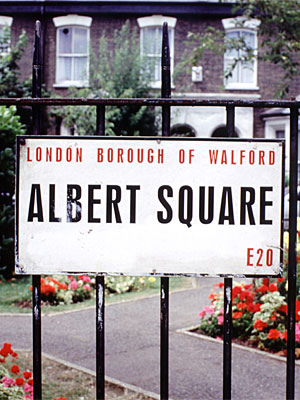
All the characters are treated as real people, so everything - from what their usual drink in the Vic is, to what hours they work - is recorded and tracked. This level of detail is what helps Albert Square feel vibrant and alive.

One of my favourite parts of the job was going along to the monthly long-term story meetings where everyone sits round a big table to discuss the upcoming stories and the Writers pitch new ideas.

It was amazing to see how passionately everyone would debate things, and to see storylines develop in front of me.

After this meeting the story team would go away and work on the ideas that had been given the go-ahead.

Then, once the writer delivers a draft of their script, this is discussed at a script meeting.

If anything isn't working these notes are fed back to the writer who then works on another draft.

Albert Square

It might be that a particular character's voice isn't quite coming through, or that a storyline doesn't quite flow from the previous block of scripts, and the script editor's job is to work with the writer to help fix this sort of thing.

The scripts I was shadowing really started to come to life in the production meetings with the designer and director.

You will have seen that there is a dramatic stunt sequence when Max and Abi are involved in a car crash. Hearing the director discuss how he intended to stage this was fascinating!

Everything, from what cars would be involved, to what Abi and Max's injuries would be, to how they were going to schedule the shoot around the stunt, was discussed.

These dramatic sequences really lift a script off the page and after hearing the director talk about it, I knew this episode was going to be memorable.

The filming of these episodes only began in my final week on EastEnders, but I made sure I got to go along and watch some!

It really was one of the highlights of my time on the show. I just couldn't believe I was on the EastEnders set!

Watching Jo Joyner, Jessie Wallace and the rest of the cast film a hen party scene was one of those surreal "pinch yourself" moments!

Reading these scripts for the first time gave me goosebumps, so I can only imagine how they came across on screen. By the time you read this, I'll know! How exciting is that...?

Samantha Psyk was a trainee assistant script editor on EastEnders.

EastEnders continues on BBC One and BBC One HD on Mondays, Tuesdays, Thursdays and Fridays, with an omnibus on Sundays. You can catch up with episodes on EastEnders website.

More information about training for a career at the BBC is available on the BBC Production Trainee Scheme website.

Comments made by writers on the BBC TV blog are their own opinions and not necessarily those of the BBC.

Watchdog's Big Money Test

Blog comments are currently unavailable. Find out more.

Post categories:

Martin LewisMartin Lewis|20:00 UK time, Thursday, 14 April 2011

Last year, the BBC Lab UK team left MoneySaving Towers (my offices) with their hands bitten off.

They'd come to me saying they wanted to conduct another of their mammoth experiments, this time working with Watchdog on finance, did I want to get involved?

Yes, yes, yes, yes, yes - was my understated response and by the end of the sentence, talking 19 to the dozen as usual, I'd already suggested a mass of things to focus on.

It seems hardly possible that after all of the debates and discussions, it's finally time to go for it.

The Big Money Test has been six months in development and it's a completely unique experiment, designed to assess your financial capability.

You can do the test now on Lab UK's website.

Money expert Martin Lewis

Are you brave enough?

It has always struck me as slightly odd that people are nervous about doing things with money, even when they know it'll help.

So I suspect this test will be no different, some out there will feel nervous about it.

And in part, that's exactly what the test is about.

While it's easy to think of money as a suited and booted practical problem, it's far more than that.

It's an emotional subject that stretches into every area of our lives - families, habits, relationships, stress levels, lifestyle and even mental health.

The Big Money Test doesn't just examine your knowledge, but your money motivation, financial emotions, capability, attitudes and more - then tells you how you fared and what you can do to improve.

A nation educated into debt, but never about debt

Yet I've a hidden remit too. For years I've campaigned for financial education. It's a disgrace that in the 20 years since the introduction of student loans, we've been a nation that's educated its youth into debt when they go to university, but never educated them about debt.

In the last six months I've been heavily involved in setting up the All Party Parliamentary Group on Financial Education.

We've cajoled over 200 MPs into joining, and the investigations as to how we improve the country's financial capability and ensure all pupils leave school equipped, are about to start.

A substantial number of people in the UK lack the financial literacy and skills needed to thrive in our increasingly complex consumer economy.

That's why for me, the joy of the Big Money Test is that underneath the polished BBC interactive exterior, the engine driving this is a serious academic experiment, designed by some big brained psychologists in the hope it'll point the way to making us, as a nation, better with money.

And it's that type of authoritative analysis that's crucial right now.

Hopefully it'll establish a picture of the nation's strengths and weaknesses across the financial capability landscape.

And it's a chance to get nasty...

Yet don't think this is some po-faced academic survey.

For me the most fun part, apart from again working with Annie on Watchdog (the adrenaline always pumps - I'm never quite sure whether it's fear or excitement) is that I get to put a few nasty quiz type questions of my own in, to test people's real life money knowledge.

It'll be interesting to see if the psychologists' tests, designed to examine people's view of how good they are with cash, match the results of my more practical questions.

Do those who think they're good really have the knowledge? We'll see.

Martin Lewis presents the Big Money Test on Watchdog on BBC One at 8pm on Tuesday, 14 April.

Comments made by writers on the BBC TV blog are their own opinions and not necessarily those of the BBC.

Is Breast Best? Cherry Healey Investigates

Blog comments are currently unavailable. Find out more.

Post categories:

Cherry HealeyCherry Healey|13:15 UK time, Tuesday, 12 April 2011

Filming my most recent programme for BBC Three has been full of surprises.

I hadn't realised quite how contentious the subject of breastfeeding is.

After I had my daughter I tried to breastfeed and ended up with mastitis - a breast infection - and was admitted into hospital.

I was quite defensive when I gave up breastfeeding. I made sure everyone knew that I'd been in hospital, that I'd had an infection and that I'd tried really, really hard.

This all stemmed from my guilt.

Presenter Cherry Healey

Whilst I was ill-informed about the mechanics of breastfeeding, I was well aware of the breast v bottle debate.

With slogans such as breast is best and research showing the benefits of breast milk, I felt that I had failed and potentially put my baby at risk.

I realised that I was incredibly ill-informed about how breastfeeding actually worked.

I wondered, was I alone or were other women also struggling with, as I had assumed, this easy and natural act?

I wanted to find out whether the guilt I felt at not succeeding was valid or unnecessary.

Is Breast Best? is part of the Bringing Up Britain season on BBC Three, which is all about young parents and their experiences.

Over the course of three months I spoke to a wide variety of people, all of whom felt passionately about this subject.

I quickly realised I had greatly underestimated how strongly people felt about the topic.

Breastfeeding pops up in the media fairly regularly but almost only with regards to the debate between breast vs bottle.

If our breastfeeding rates are to ever increase - they are one of the lowest in Europe - then it has got to be more visible.

I don't think I have ever seen a picture or footage of a woman breastfeeding on television or in a magazine. It is utterly bizarre.

I even met a woman who thought it was illegal, in the same way as indecent exposure, because she'd never seen it being done in public.

The first time I saw breastfeeding was when I was 26 and I didn't know where to look.

I felt embarrassed yet was confused by my reaction.

This was clearly a natural act yet I felt so uncomfortable.

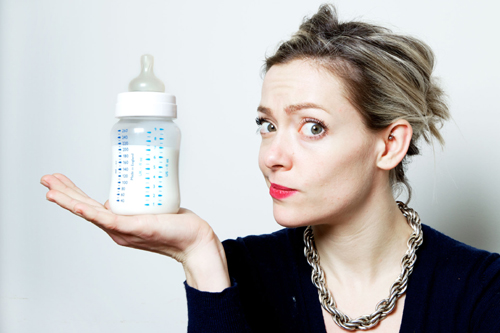
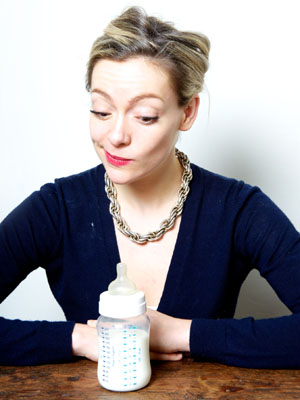
Cherry Healey with a baby's bottle full of milk

Whilst making the film I met a group of teenagers who, like half of women and girls under 20, didn't want to give it a try.

For them, boobs are for one thing only: sex.

They admitted that they are greatly influenced by what the celebs are doing and they had never seen a famous person breastfeeding.

To them it was clearly not something to celebrate

And it wasn't just the teens that felt this way.

I also met older mums who felt so embarrassed at breastfeeding in public that they would find some ingenious ways to conceal it.

Whether we like it or not, the media has a huge influence on our cultural trends, and perhaps if breastfeeding was more visible on television it would begin to lose its social stigma?

However, while making the film I found that my feelings of guilt waned.

Sadly, I discovered that my experience was a very common one - I actually felt very reassured that many other women find breastfeeding really tricky.

I also realised that, even with the best will in the world, without support and information, women who encounter problems are often fighting a losing battle.

But there is good news. In the UK there is actually a huge amount of breastfeeding support available - if you know where to look. (A good starting point is the Bringing Up Britain help and advice page.)

One of the most prominent lessons I learnt whilst making this film is not to suffer in silence.

Previously, I had no idea that there were breastfeeding groups, help-lines, one-on-one support and websites that existed exclusively to help mums who are breastfeeding.

I also realised that if you can't breastfeed, for whatever reason, then feeling wracked with guilt isn't useful.

Most mums make the best decision they can with the information they have at the time - and so subsequent guilt isn't constructive - increased information is constructive.

I do believe that the best, most effective support comes from women sharing their experiences and learning from each other.

Plus, women often have very funny tales - leaking milk in meetings, spraying family members and cabbage leaves in bras - just to name a few.

Cherry Healey is the presenter of Is Breast Best? Cherry Healey Investigates.

Is Breast Best? is on Tuesday, 12 April, at 9pm on BBC Three.

Cherry took part in a live online question and answer session about breastfeeding with Dr Tricia Macnair during and after the show's first broadcast. You can read the Q&A at the BBC Three blog.

Is Breast Best? Cherry Healey Investigates is part of BBC Three's Bringing Up Britain Season.

Other programmes in the season include: The Gatwick Baby: Abandoned at Birth, Misbehaving Mums to Be, So What if My Baby is Born Like Me?, Fast Food Baby and Meet The Multiples.

Comments made by writers on the BBC TV blog are their own opinions and not necessarily those of the BBC.

A Home For Maisie: Why we adopted our ninth child

Blog comments are currently unavailable. Find out more.

Post categories:

Sue CliffordSue Clifford|11:30 UK time, Monday, 11 April 2011

My husband Jim and I have always enjoyed a challenge.

Having adopted eight children over 18 years, all placed with us as older children and each with differing needs, we were already reasonably challenged.

But then we saw Maisie's profile in Children Who Wait magazine published by Adoption UK and couldn't resist putting ourselves forward just one more time.

In order to see this content you need to have both Javascript enabled and Flash installed. Visit BBC Webwise for full instructions

As a seven-year-old who had already had two failed adoptive placements, we felt she deserved a chance at having a family who might just be able to make it work.

All of our eight children understood that Maisie would struggle to trust and become part of our family, but they all wanted to help her make the journey which they had, each in their own way, made.

By filming part of her journey, with her and all the children's agreement, of course, for BBC Two's A Home For Maisie, we hope that Maisie will have something to look back on, which will remind her that she is special and that we all believe in her.

We hope that the film will also encourage others on their journey of adoption.

For Maisie, her early life of abuse and neglect, together with the various moves she had experienced, had left her with an inability to trust and engage in relationships with anyone.

She had put up a protective wall around herself and would hit out at anyone who tried to break through.

It has been very painful for all of us to see just how much early rejections have affected Maisie.

However, with persistence, we have gradually helped Maisie to remove that protective wall and enjoy the pleasures of being a little girl.

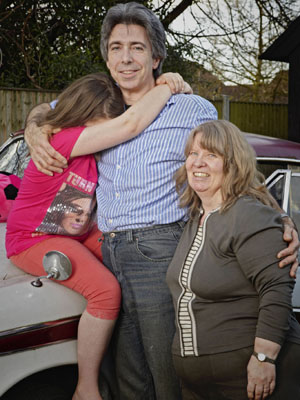
Maisie, held by her adoptive father Jim, and her adoptive mother Sue

We have been supported in helping Maisie with therapy provided by the adoption support agency Family Futures and funded by social services.

To help us record Maisie's journey on film, Family Futures have, for the first time, allowed cameras inside the therapy sessions.

One of the things we recognised immediately was that Maisie, like all of our other children, had missed the early childhood experiences of nurture - being made to feel special, safe exploration of her environment and other play experiences that children get from growing up in a caring, loving and safe family.

So although she was seven when she joined our family, she was still a baby in terms of her life experiences.

As a family we have helped Maisie not only to trust, but also to experience feeling cared for, nurtured and we have given her the play experiences that as a baby and toddler she should have had.

You'll see in the programme that she really enjoyed us spoon feeding her at the table and being bounced on the trampette to create the same fun and developmental effects as a baby being bounced on a parent's knee.

As a result she is now beginning to allow herself to be part of our family and enjoy having parents who love her, and brothers and sisters to play with.

It has been a hard road over the last two and a half years and there will be more rocky patches to come but for now we can all enjoy the funny, cheeky, loving and caring child that Maisie is becoming.

Sue Clifford is Maisie's adoptive mother and features in A Home For Maisie.

A Home For Maisie is on BBC Two at 9pm on Monday, 11 April.

Comments made by writers on the BBC TV blog are their own opinions and not necessarily those of the BBC.

Filthy Cities: My summer in the sewers

Blog comments are currently unavailable. Find out more.

Post categories:

Dan SnowDan Snow|15:14 UK time, Tuesday, 5 April 2011

When the BBC got in touch with me and suggested a series about the history of filth I was suitably nervous.

In Filthy Cities, they wanted a series which explored the idea that we humans create a huge amount of waste that, if left untreated, can destroy us.

By looking at how human societies have overcome the problem of their own filth we can understand a huge amount about the changes that have taken place in our society: the rise of the mega-city, lengthening life expectancies, less disease and the far better sanitation that we take for granted in the UK now.

In order to see this content you need to have both Javascript enabled and Flash installed. Visit BBC Webwise for full instructions

I said yes, knowing it would be an adventure and that I would learn a huge amount about a part of history that I do not know enough about.

Filth may be less glamorous than kings, queens, castles and politics but I knew it would turn out to be just as fascinating and arguably more important.

Each city - London, Paris and New York - had not only to have had a filthy past but had to have been instrumental in developing modern systems of waste management: sewers, government regulation or scientific breakthroughs.

For the first time in history the majority of humanity now lives in cities. These three cities tell us how this became possible.

During the series - which really is immersive history at its best - I spent time in sewers, studied the skeleton of a plague victim, shovelled tons of horse poo, was bitten by a rat, fed to leeches, and used dog poo and urine to treat leather hides.

I used rancid meat to make mince, cleaned an apartment that had not been cleaned for thirty years, butchered a pig and used its entrails to make sausages, and was eaten alive by bed bugs and lice.


It was a busy summer and friends could not believe what I was getting up to.

I had great fun and learned a good deal. Perhaps my most important realisation was simply the debt that we owe the people who get rid of our waste and ensure we have clean water.


Without sewage works or bin collectors, we would drown in our waste within days.

Dan Snow prepares to go into a sewer.

They make life in big cities possible. That is why the absence of these services in the past has led to massive outbreaks of disease or even revolution.

One of my favourite experiences was driving an electric car around New York. It was 100 years old.

Incredibly many of the early cars were electric. It was only when Henry Ford successfully produced the Model T that the combustion-engined car became the obvious choice for millions of people.

I came very close to scraping this precious vehicle and I think the owner seriously regretted letting me use it.

People often ask me, now that I've been through it all, whether I am permanently scarred.

I must say that I have had quite enough of the smell of raw sewage, but in fact it has made me more interested in the hidden realities of our existence.

Thanks to Filthy Cities I peeled back a bit of the sanitised veneer of our society and it simply fired my enthusiasm to learn more.

I hope you really enjoy the series, which peels back the layers of time to give you the opportunity to experience our filthy past.

Dan Snow is the presenter of Filthy Cities.

Filthy Cities starts on Tuesday, 5 April at 9pm on BBC Two and BBC HD.

For further programme times please visit the upcoming episodes page.

You can press your Red Button at the start of episodes one and two for extra filthy footage and facts, and you can get a special scratch and sniff card to experience the smells of the past.

Comments made by writers on the BBC TV blog are their own opinions and not necessarily those of the BBC.

The Crimson Petal And The White: Subverting expectations

Blog comments are currently unavailable. Find out more.

Post categories:

Marc MundenMarc Munden|11:54 UK time, Monday, 4 April 2011

I directed a serial called The Devil's Whore, set during the English Civil War, for Channel Four a couple of years ago, which had a heroine haunted by the devil.

David Thompson, one of the producers of The Crimson Petal And The White, had liked that piece.

Years before, I had made an adaptation of Vanity Fair for BBC One, which had been called "costume drama for the MTV generation".

When he called, I guessed he wanted something a bit different.

In order to see this content you need to have both Javascript enabled and Flash installed. Visit BBC Webwise for full instructions

We met. He said "We want it to be really different."

I said "Really different?"

He said "Yes."

I said "I'm not sure about that. I can give it to you a bit different."

He said OK, thus saving BBC audiences from the spectacle of a post-modern novel about Victorian prostitution told through the medium of English folk dance.

In the way that Michel Faber, who wrote the book, set himself up against Victorian literature, continually borrowing its clichés but then subverting his readers' expectations, I thought there was an opportunity to set ourselves up similarly against TV period drama.

There was a chance to play with the grammatical elements of different genres. In the serial there are elements of documentary observation, sequences that are more classic and formal, bits that look like pop videos.

Episode three, for instance, has horror film references as Sugar finds herself in William's house, full of dark history, his wife semi-imprisoned by her doctor.

I loved Lucinda Coxon's script. It started with Sugar, a prostitute from the slums of St Giles narrating.

"You may imagine from other stories you've read that you know this world well - but those stories flattered you. You are an alien from another time and place altogether."

Amanda Hale as Agnes Rackham

So there was the first challenge. Trying to create a world that was credibly Victorian but was unrecognisable from any cosy historical world we had seen on TV before.

I imagine that St Giles, the slum where Mrs Leek's brothel is situated, was a hellish place. I was afraid to portray it as anything less - dangerous, unsanitary, desperate.

I was struck, when travelling in India, by the way that the grand spaces of the old imperial world - Edwardian New Delhi and Victorian Calcutta - had been appropriated and colonised by its modern inhabitants, divided up and adapted for their own use, bits built on and carved up.

That became the starting point for our vision.

We filmed in the courtyard of Manchester Town Hall - a Victorian gothic cathedral-like space - and brought in tons of mud, built slums and open sewers within it - colonised it ourselves.

Gustave Doré's illustrations of London, where the light barely makes it to the ground through the narrow chasm of terraces was another reference.

The Crimson Petal is a piece that deals with the mechanics of prostitution. It's not Pretty Woman. I like the fact that Sugar's motives are opaque and puzzling.

The sex is transactional and less interesting in many ways than the base things Sugar puts her body through.

Romola Garai, who plays Sugar, was unflinching in her depiction of that.

Romola Garai as Sugar in The Crimson Petal And The White

William Rackham, the protagonist who is besotted with Sugar, is a spoilt boy and a fool. He's a would-be writer who hasn't written anything except an unpublished small pamphlet and is resisting participating in his father's business.

To follow him, I felt that you needed to put that foolishness in a comic context, otherwise you'd lose interest in him.

I am in awe of comedians. There is a different creative energy that's present on set with a comedian, a risk of anarchy that I love.

I'd seen Chris O'Dowd in the film Festival and in Vera Drake. He's just got this incredible charisma and charm. He came in to see me and just made William really human in his foolishness.

As a director you're a bit like a conductor of an orchestra.

It's your job to have a clear and vivid dream for the film and be able to communicate that in a very concrete way that people can respond to.

You need to inspire all those heads of departments - production design, sound, costume, make-up to embrace your vision.

I like to push and push people to come up with more extreme ideas to the point where the ideas don't work.

Either that or they lose their temper and hit me.

Then I get them to rein in the ideas to the point where they do - that's the way you get interesting work.

Marc Munden is the director of The Crimson Petal And The White.

The Crimson Petal And The White is on BBC Two and BBC HD at 9pm on Wednesday, 6 April. For further programme times, please see the upcoming episodes page.

Listen to a review of The Crimson Petal And The White on Radio 4's Front Row.

Comments made by writers on the BBC TV blog are their own opinions and not necessarily those of the BBC.

Candy Cabs: Playing the lead with Jo Joyner

Blog comments are currently unavailable. Find out more.

Post categories:

Lisa MillettLisa Millett|08:40 UK time, Friday, 1 April 2011

When the scripts for Candy Cabs landed on my doormat - well, pinged in my inbox - I read them in one go, laughed, cried, read them again to make sure I wasn't dreaming, then said out loud to myself - I have to play this part!


Candy Cabs is bold, bright, beautiful and aspirational. A deliberate move away from the "it's grim up north" approach.


We filmed in some glorious settings; Lymm in Cheshire - a gorgeous, friendly village, and West Kirby which provided our seafront shots and some of the best ice cream I've tasted!


Bet the tourist board are delighted.


The story takes us on a bumpy ride with two women who set up an all-female taxi service with, you guessed it, bright pink taxis.


Like all great double acts they drive each other crazy, but at the heart of their relationship is the bond of freindship, loyalty and love that makes them a force to be reckoned with.


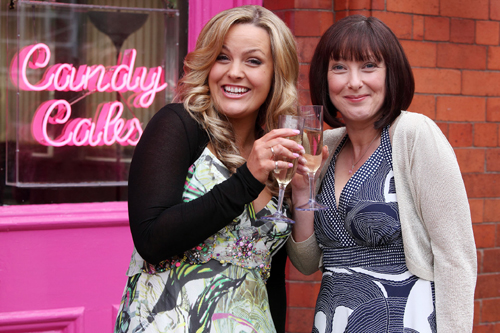
Jo Joyner as Jackie and Lisa Millett as Elaine in Candy Cabs

It's not just a girly show; the male characters are brilliant too.


Paul Kaye is exquisite as Dennis (look out for a bit of improvised business with me, Paul and a hosepipe in episode two) and there's also Daniel Ryan, Paul Nicholls and Dennis Lawson.


There is something for everyone - clowns, villains and heroes. It's the kind of show that blokes are made to watch then end up loving.


Jo Joyner, who plays co-owner Jackie, and I had worked together briefly before on No Angels. I was a bit bonkers in that too - hmmm, a pattern seems to be emerging!


I knew she was a real team player, a brilliant actress and, as importantly, someone I could laugh with.


Casting Elaine and Jackie was about chemistry - a bond that translates on screen in every conversation, every raised eyebrow and every look. Jackie often knows what Elaine is thinking before she knows herself.


I knew in my head that the combo of Jo and director Minkie Spiro was the dream team.


The call came, it was a sunny day - no, honest - I ran up and down the garden like a lunatic, singing, victory dance - the lot!


The challenge playing Elaine is to make her funny whilst keeping her real, she's fragile but not a victim.


She takes huge risks and is business savvy, but her OCD and panic attacks sometimes overwhelm her.


Elaine always has her Rescue Remedy on standby and her trusty Marigold glove!


In order to see this content you need to have both Javascript enabled and Flash installed. Visit BBC Webwise for full instructions. If you're reading via RSS, you'll need to visit the blog to access this content.


I became acquainted with the Marigold glove right from the casting process - the scene in episode one with me, Jo and Elaine's "five fingered friend" was one of my audition scenes.


Let me tell you, hyperventilating into a rubber glove (a bog standard brown paper bag won't do for Elaine!) is no mean feat.


You can't really fake the breathing, so you end up kind of having a hyper episode for real - not to mention the taste!


My relationship with Marigolds was a love-hate thing; it's a fantastic character tool, but I haven't washed up since!


The mixture of comedy and pathos is what I love about Elaine.


She's definitely out there, I've met plenty of Elaines and being honest, there are parts of Elaine that resonate with me - I always follow the arrows in Ikea!


Hope you'll be as tickled pink watching it as we were making it.


Lisa Millett stars as Elaine Partridge in Candy Cabs.


Candy Cabs begins on Tuesday, 5 April at 9pm on BBC One and BBC One HD. For further programme times, please visit the upcoming episodes page.


Listen to an interview with Candy Cabs writers, Elliot Hope and Johanne McAndrew on Radio 4's Front Row.


You can put your questions to the Candy Cabs actresses by leaving a comment at the BBC Comedy blog.


Comments made by writers on the BBC TV blog are their own opinions and not necessarily those of the BBC.




More from this blog...