BBC TV blog - BBC TV blog

Archives for February 2011

Let's Dance For Comic Relief: I've had four micro-cries already

Blog comments are currently unavailable. Find out more.

Post categories:

Andi OshoAndi Osho|10:20 UK time, Friday, 25 February 2011

I've shot myself in the foot. Not literally, of course. That would make Let's Dance For Comic Relief too big a challenge even for me, and I love a challenge.


It's the final week of training and I'm beginning to realise quite how difficult my routine is. Problem is, I chose it.

Andi Osho rehearsing her routine on stage for Let's Dance For Comic Relief

Nothing highlights the limitations of your body than a physical test like this, especially when you're working alongside a trained dancer, svelte in body and light of foot.

I'm slightly reassured as all around me, from other rehearsal rooms, I can hear the near-silent swish of the choreographer demonstrating the moves then the thunderous thumping of us Let's Dancers trying to copy them.

I have a new found respect for dancers. How do they remember all those moves?

I'm constantly forgetting what comes next, panicking, then doing anything which can be as random as a star jump or just sticking out my tongue.

I boldly declared on the first day, "Yeah, I'm more of a freestyler."

Translation: I usually just jerk around vaguely in time to the music and hope it looks planned.

So far, my biggest issue has been turns. Dancers make them look so easy but they could well be my Waterloo.

Watch on the night as I do a turn and you'll see a flicker of surprise when, or if should I say, I find myself facing forward and upright.

In order to see this content you need to have both Javascript enabled and Flash installed. Visit BBC Webwise for full instructions

I'm surprised how far outside of my comfort zone this has been. I've had four micro-cries already. One was brought on by telling someone about the first three cries.

There's been a fair few times when I've been curled up on the cold wooden floor asking if I could just tell jokes for my two minute routine. You know, in the style of the act I should be dancing as. No one will spot the difference, I've whimpered.

Alternatively, I may suggest the BBC change the name of the show to Let's Just See Shall We?

Andi Osho is a contestant on episode two of Let's Dance For Comic Relief.

Let's Dance For Comic Relief continues on Saturdays on BBC One and BBC One HD. For programme times please see the upcoming episodes page.

Comments made by writers on the BBC TV blog are their own opinions and not necessarily those of the BBC.


Romancing The Stone: The Golden Ages Of British Sculpture

Blog comments are currently unavailable. Find out more.

Post categories:

Alastair SookeAlastair Sooke|11:05 UK time, Wednesday, 23 February 2011

When the BBC asked me to present the BBC Four series Romancing The Stone: The Golden Ages Of British Sculpture, I jumped at the chance - because I have long believed that sculpture in this country suffers unfairly from neglect.

Our towns and cities are full of civic statuary that we routinely ignore - in part, admittedly, because so much of it is stiff and lifeless, or bound up with propaganda, extolling the virtues of a wealthy and powerful individual or the state.

In order to see this content you need to have both Javascript enabled and Flash installed. Visit BBC Webwise for full instructions

In my experience, art historians have often taught us that British sculpture isn't a patch on our native painting, and that it pales in comparison with the European tradition.


But I believe that the triumphs of our sculpture occupy the zenith of British art - up there with paintings by great artists such as Blake and Hogarth, Turner and Constable.

It saddens me that sculptors such as Flaxman, Chantrey and Alfred Gilbert (who designed Eros in Piccadilly Circus) have been largely forgotten.

So if there is an underlying subtext to Romancing The Stone, it is this: to restore British sculpture to its rightful place, playing a central role in the evolving drama of the nation's art.

I felt thrilled to be working with such a talented team - I don't know about you, but I think that some of the shots of the works themselves, captured by the director Mark Halliley and the cameraman Ian Salvage, are nothing short of magnificent.

For instance, the footage, from the second episode, of Flaxman's marble The Fury of Athamas, at Ickworth House in Suffolk, transforms the sculpture from an embarrassingly overblown, youthful aberration, as it is occasionally characterised in the textbooks, to a defiant tour de force, challenging an august tradition of sculpture stretching all the way back to the Laocoon of ancient Rome.

Flaxman's early masterpiece features in the trail for the series that can be seen across the BBC at the moment - accompanied by some simply beautiful, haunting music by Erik Satie.

We filmed the series last summer. We were blessed with the weather - and a relaxed and sunny feeling graced the close-knit group working day-to-day on the three films, even in moments of potential crisis.

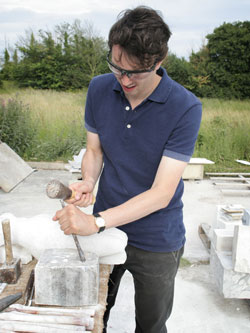
Alastair chisels the alabaster

I remember one incident in particular, when a charming sculptor called Kim Meredew, who features in the first two episodes, was demonstrating how easy it is to carve alabaster, which was a very popular material in the Middle Ages and is almost as soft as goat's cheese when it first comes out of the ground.


To begin with, Kim got me to hack at a slab of granite, in order to feel the difference.

There was a horrific, heart-in-my-mouth moment, which you can see in the first film, when I gave the chisel an almighty cack-handed thump with a mallet, forcing it to slip and graze Kim's fingers.

I was terrified I'd chopped them off.

But - thank God - Kim just gave me a big grin, assuring me that he's always accidentally savaging his fingers with heavy-duty tools, and carried on.

Kim came along to the launch of the series at the Royal Academy; when I shook his hand, I couldn't help checking that it was intact (thankfully, it is).

I like to think that Kim's cheery, happy-go-lucky attitude reflected the mood of all of us working on the series. I hope you are enjoying the programmes as much as we all enjoyed making them.

Alastair Sooke is presenter of Romancing The Stone: The Golden Ages Of British Sculpture.

Romancing The Stone continues on BBC Four as part of the Focus On Sculpture season. For programme times, please see the upcoming episodes page.

The series is also available in iPlayer until Wednesday, 2 March.

As deputy art critic at the Daily Telegraph, Alastair has written this article about the series.

Comments made by writers on the BBC TV blog are their own opinions and not necessarily those of the BBC.

Mrs Brown's Boys: I love the lines that are not in the script

Blog comments are currently unavailable. Find out more.

Post categories:

Brendan O'CarrollBrendan O'Carroll|14:05 UK time, Tuesday, 22 February 2011

Welcome to the world of Agnes Brown. It's a world where family comes first, authority is to be challenged, and everything always works out in the end.

What began in 1999 as a five minute comedy series for RTÉ 2fm (Ireland's equivalent of Radio 2), and then became a five-part stage trilogy, has at last reached BBC TV screens all over the United Kingdom.

In order to see this content you need to have both Javascript enabled and Flash installed. Visit BBC Webwise for full instructions

Thanks to the team the producer Stephen McCrum has put around me, I am involved in every aspect of the TV show.

As well as being the writer, and playing the lead female role of Mrs Brown, Stephen allows me to have an opinion on the overall look and feel of the show.

The series, which is set in Dublin, features Agnes Brown, a widow since 1986, and her family.

The family is made up of Agnes' sons Mark, Rory, Dermot, Trevor and her only daughter, the ever-suffering Cathy.

All of Agnes' children are in their early 30s, but to Agnes they will always be five years old.

As the family live their day to day lives, we see how Agnes attempts to solve all of their problems - especially the ones she has created for them.

Agnes is a complete contradiction of herself, for instance chastising her children for the slightest use of strong language, but having a fishwife's tongue herself.

With Agnes it's very much a case of "don't do what I do, do what I say."

Do you know, when people asked if Agnes was influenced by my own mother, I used to answer "no" and let me explain why.

My mother was quite an extraordinary woman. She began as a nun with a Bachelor Of Arts degree from Galway University, left the Order, married my Dad and had 11 children.

She was also the first woman elected to the Irish parliament for the Labour party and, indeed in that year, the only woman in parliament.

However, as I have gone on with Agnes Brown's life, I am beginning to realise that the only difference between the two is that my mother had an education.

Mrs Brown, played by Brendan O'Carroll, sits on the sofa next to Dermot Brown, played by Paddy Houlihan, who is dressed as a penguin.

So I suppose Agnes is my mother - with all of her wisdom, but not her education. And, as my mother would say, don't confuse education with intelligence.

And she was so right. I am a member of Mensa but I left school at 12 years of age, and I am dyslexic.

If ever there was anyone that was not going to be a writer or performer it was me.

I didn't do my first stand-up gig until I was 35 years old. For the 22 years before that, I was a waiter (five times Waiter Of The Year, I might add).

I swear to you that I still wake up every morning thinking, "This is the day they will find out I am really a waiter and not a writer, and they'll want their money back."

But I think people confuse being a writer with things like using the correct tense or being able to spell properly, and it has nothing to do with that.

Those are all things you can learn. Being a writer is about being able to tell a story - that's it, nothing else - and you can't learn that.

I'm very lucky in that I have always had a wonderful memory, particularly for dialogue, but I have absolutely no idea how the jokes come to me.

I hear things, I see things and they make me laugh. Somehow my brain stores them away and just when I need them they pop out. Does that make any sense?

Filming in front of a live audience was a condition I insisted upon when Stephen and I began developing the series.

We both agreed that we wanted as close a representation of the stage show as possible, and obviously a live audience is one of the key ingredients of that.

Also I knew that myself and the actors who would be transferring their performances from the stage to the screen depended on the live audience for the rhythm of our performances, so it would keep that element for us.

In order to see this content you need to have both Javascript enabled and Flash installed. Visit BBC Webwise for full instructions

The upside for me as a comedy writer is that television allows me to include more slapstick stuff than the early radio series did.

I'm a sucker for good old-fashioned fall-about comedy, and I don't care if it's old fashioned, it makes me laugh.

I have convinced myself that I always write better when I am under pressure, which is just a cover-up for leaving everything to the last minute.

I have always written alone but I have no discipline whatsoever.

My wife Jenny (Agnes' daughter Cathy in the series) is the one that drives me, as well as being an exceptional muse. Without her I would sit and read all day.

Sometimes it comes really easy, just flows. But then there are those horrible, horrible times when it is just word by word and wonder why you ever told anybody you were a writer, because you just write shite.

On the series, Stephen, realising my inexperience in writing for television, brought in a script editor to work alongside me - Paul Mayhew-Archer.

I was nervous at first of having someone kind of looking over my shoulder, so to speak. I need not have been. The man is genius.

Ever so gently, and with great encouragement, Paul eased me over the line, making a writer out of me in the process.

If this series is a success, I'm sure I will get great recognition, but truthfully, without Stephen and Paul there would be no series.

I love the lines that come to me when we are filming, that are not in the script - and, thanks to the director Ben Kellett letting me have the room to do this, there are lots and lots of them.

See if you can spot them. Hint: Watch the face of the cast when they happen - it's either a look of terror or restrained laughter.


Brendan O'Carroll is the writer of Mrs Brown's Boys and plays Agnes Brown in the show.

Mrs Brown's Boys continues on BBC One and BBC One HD on Mondays. For national variations on times, please see the upcoming episodes page.

Episode One is now available in iPlayer until Tuesday, 5 April.

You can ask Mrs Brown to solve your problems - find out how at the BBC Comedy blog.

Also producer Stephen McCrum tells the story of how he first discovered Mrs Brown on the BBC Comedy blog.

Comments made by writers on the BBC TV blog are their own opinions and not necessarily those of the BBC.

Raymond Blanc's Kitchen Secrets

Blog comments are currently unavailable. Find out more.

Post categories:

Melanie JappyMelanie Jappy|14:38 UK time, Monday, 21 February 2011

There's a kitchen in a manor house on the edge of a village called Great Milton that has been my home for much of the last two years.

If you saw the last series of Raymond Blanc's Kitchen Secrets, it's the little bit of heaven where we film most of the show and where we've been lucky enough to film a second series for BBC Two.

Raymond Blanc

Now, I know what you're thinking: How great must that be... all that lovely food, nice and cosy?

And for the most part it really is wonderful.

But I need you to picture a scene: two huge camerablokes, an equally ginormous soundy, moderate sized director, delightful home economist and me, all standing against two giant chillers on a piece of floor the length of two baguettes and as wide as a pie dish.

You see, Raymond's kitchen is real. Not a set built in a studio.

And that reality brings with it the enormous fun of working in one of the best kitchens in the world as well as a few tiny issues. One of them is there isn't much space.

This year we've had the added joy of the weather, which has reduced the ambient temperature of the kitchen to one in which my morning cuppa resembles a frothy sorbet in five minutes flat.

We filmed Heston's Perfect Christmas Dinner in Siberia with Heston Blumenthal and I swear the crew needed fewer clothes.

But it does have one advantage and that is my key job as series producer is cuddling Raymond Blanc to keep him warm.

It isn't in my contract but sometimes a producer just has to do these things to keep the team happy.

I told him he could cook wearing his salopettes and ski jacket but he insisted on wearing in his whites.

That's the kind of sacrifice Raymond will make for you viewers. The man is fearless in the face of adversity.

In order to see this content you need to have both Javascript enabled and Flash installed. Visit BBC Webwise for full instructions

But you'll notice the camera never sees Raymond's feet.

That is because while cooking he is standing in a heated foot muff.

No sock warmers for the rest of the location team, which I like to think of it as small but perfectly formed.

In addition to Raymond's assistants (the gorgeous Adam Johnson and new boy Kush), our crew consists of the guys I mentioned before and one more without whom we would be lost.

He's the chap who comes in first and leaves last and that is our runner Rob.

As Raymond's kitchen is a working environment, most evenings when we leave at around 7pm, the kitchen is used to service the private dining room of Raymond's restaurant.

This means that all those bits of set decoration you see on the show - the copper pans, bottles of oil, posters etc - are all taken away and stored overnight.

We all help out to get it done as fast as possible, but it is Rob who is there in the mornings putting it all back out again exactly where it was the night before.

It's his hard work that means that I don't have to answer letters telling me that the poster of mushrooms in the background at the beginning of the tarte tatin recipe has morphed into Great Fish Of The World by the time the tarte comes out of the oven.

My gratitude to Rob knows no bounds.

And, as if he isn't treasure enough, he does the washing up, which deserves some kind of recognition, possibly from the Queen or, failing that, the people who own Fairy Liquid.

Particularly as being from Cheshire, he refuses to wear rubber gloves. They are for soft southern runners apparently.

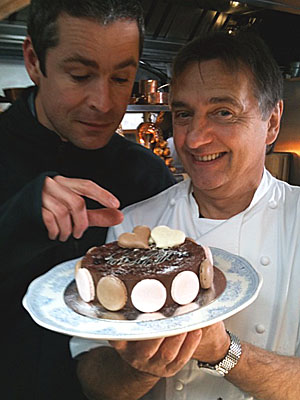
Cameraman Andy Smith stands next to Raymond Blanc, who is holding a chocolate macaroon cake

Unsurprisingly we do generate terrific amounts of washing up.

That's partly because Raymond, being a man, has a need to use every utensil and bowl in the kitchen once before requiring it to be washed.

(I have to qualify that by saying that Raymond himself washes up beautifully and did so after Sunday lunch at my house despite my protestations.)

And as we usually film two recipes in a day you can imagine it piles up pretty quickly.

We try to shoot one recipe in the morning and another in the afternoon.

It may interest you to know that my rule of thumb is the simpler the recipe appears to be, the longer it will take to film.

Don't ask me why. I truly have no idea. It's a space, time, ingredient dimensional shift the answer to which may be uncovered in a kitchen far, far away.

Watercress soup took the record last year. Several basic ingredients, not including water - five hours and a nervous breakdown. Mine, not Raymond's.

Oh how we laughed. Not.

We film everything just once on two cameras so what you see is what we filmed at the time with a few extra shots that we charmlessly call 'dumps' or 'throw ins'.

Those are the close up shots of things going into pans or blenders that help us knit the programme together.

Making a cooking show is a lot like cooking itself. It requires lots of attention to detail, good ingredients, patience and most importantly, a whole lot of love.

And that, let me tell you, is what you get when you work with the kind of team I am blessed to have had on this show. I'm the luckiest producer in the world.

I really hope you enjoy watching it as much as I have enjoyed making it.

It means a lot to get feedback from people who watch the show and I'll do my best to respond to as many of your queries as possible.

Melanie Jappy is the series producer for Raymond Blanc's Kitchen Secrets.

Raymond Blanc's Kitchen Secrets is on BBC Two and BBC HD at 8.30pm on Monday, 21 February.

For further programme times, please see the upcoming episodes page.

Read more from Melanie at the BBC Food blog about Raymond Blanc's trip to Fife for the first episode of Raymond Blanc's Kitchen Secrets.

Comments made by writers on the BBC TV blog are their own opinions and not necessarily those of the BBC.
South Riding and one of the greatest literary heroines

Blog comments are currently unavailable. Find out more.

Post categories:

Kate HarwoodKate Harwood|10:07 UK time, Friday, 18 February 2011

When, as a voracious teenage reader, I first read South Riding I took many of its themes for granted and thought it was a great story folded around a great love story.

But re-reading it when I was wondering whether to develop it as a drama, I found the resonances go so much deeper.

Anna Maxwell Martin as Sarah Burton in South Riding

I am the controller of series and serials for BBC Drama production and, just occasionally, I get the chance to help push a passion onto the screen.

As the title suggests, South Riding is a portrait of a community.

But, as Andrew Davies has so brilliantly realised in this three-hour adaptation, this is a community into which blows one of the greatest literary heroines ever created.

Sarah Burton, superbly played by Anna Maxwell Martin, is as real a character as ever lived: modern, quixotic, romantic, intelligent, infuriating, elegant, colourful and as wrong as often as she is right.

She bursts into the story - and onto the screen - like the "little firecracker" the older, wiser Mrs Beddows describes her as.

Having lost her fiancé in the First World War she has turned her back on the past to become a teacher, throwing herself into the cause of female education.

Full of hope, she thinks she has it all worked out, but life has other plans and she finds herself sideswiped by love - love for a man who ironically cannot escape his own past, and it is this love that almost undoes her.

The great novelist and journalist Winifred Holtby wrote the novel in 1934 and died in 1935, only for it to be published in 1936 and become a huge success.

Often novelists write about the recent past but Winifred - maybe seeing her world with an intensity born of the fact her health was failing - set this novel right slap in her present.

Yet she still managed to give it an epic sweep and a tone that is hopeful, determined, campaigning and optimistic.

Anna Maxwell Martin as Sarah Burton in South Riding, surrounded by schoolchildren

When I read it as a girl I connected with the love story but now, just as much, it is the themes that move me.

It is astonishing to be reminded that, when young women are doing so brilliantly at school and at university, only 70 years ago, a proper aspirational education for all girls was a novelty.

As one of the Holtby family told me at a screening a few weeks ago, Winifred was, at the time, disparagingly referred to as "clever".

She also reminded me that, in the 1920s, "farmers' daughters didn't go to Oxford".

But, as Winifred shows us, female education isn't about feeding the mind of the bluestocking but about making women a relevant, dynamic part of society.

I hope that you find this a thrilling, involving, passionate drama but I also hope it brings you to read Winifred's brave, moving, pioneering novel.


Kate Harwood is controller of series and serials for BBC drama.

South Riding is on BBC One and BBC One HD at 9pm on Sunday, 20 February.

For further programme times, please see the upcoming episodes page.

Watch exclusive behind-the-scenes interviews with cast and crew, and a special video on the costumes on the South Riding programme page.

Comments made by writers on the BBC TV blog are their own opinions and not necessarily those of the BBC.
The Toughest Place To Be A Paramedic

Blog comments are currently unavailable. Find out more.

Post categories:

Angie DymottAngie Dymott|15:23 UK time, Monday, 14 February 2011

Last summer I was browsing my emails, when I came across an interesting one from the College of Paramedics looking for a paramedic to take part in an exciting new BBC Two programme: The Toughest Place To Be A... series.

It appealed to me straight away so I sent a reply never thinking in a million years that I'd be chosen!

In order to see this content you need to have both Javascript enabled and Flash installed. Visit BBC Webwise for full instructions

My part in the programme was to travel to Guatemala City to work and live alongside the bomberos (combined paramedics and fire-fighters) for two weeks.

I would be experiencing their day-to-day working life and getting to know their families and the culture.

When I was told by the BBC it was going to be Guatemala, I was very excited, I have done quite a bit of travelling before but never to Central America, and so a whole new set of challenges and experiences awaited me.

When I arrived in Guatemala City I was very tired and just saw a hot and very busy city spread out in front of me.

I was determined before I went to savour every single moment of the opportunity I'd been given and I'd like to think I did that and have come away with wonderful memories.

It was difficult at times - having a film crew ever present was a totally new experience for me but one I had to learn to get used to.

From the moment I met my Guatemalan colleagues, Archie and Wilfredo, I felt very comfortable. They were so warm and welcoming and knowledgeable also.

I was slightly shocked by both the lack of equipment and the condition of the equipment they have to work with.

Angie and her Guatemalan counterpart, Wilfredo

The ambulances are very basic and a lot of the equipment is reused, items such as oxygen masks and airway supports. I soon realised we take a lot for granted back home.

Guatemala City is a violent place to be. Although I did deal with some horrendous jobs, particularly the shooting of a young boy in a busy street, I never once felt in danger myself.

The bomberos are very well respected and have never been a target themselves.

At no point did I doubt my decision to be part of the programme. I learned so much and made some very good friends.

It was emotional at times and also very exhausting but I got so much out of it. I felt very emotional when I attended church with Archie and his family.

I think it was because the previous night had been quite bad and then I was transported to a different place. Very overwhelming.

It made me view my work back in Cardiff very differently and realise how lucky we are and how we moan and whinge about the slightest thing when really there is no need... I made sure I let my colleagues know that as well!

I am now back working my normal shift pattern. I love my work as a paramedic wherever it may be... but my Guatemalan experience was very special!

Angie Dymott is the real life paramedic in The Toughest Place To Be A Paramedic.

The Toughest Place To Be A... series continues on BBC Two and BBC HD on Sunday evenings.

For further programme times, including repeats and national variations, please see the upcoming episodes page.

The series is also available to watch and download in iPlayer until Sunday, 6 March.

Comments made by writers on the BBC TV blog are their own opinions and not necessarily those of the BBC.

Faulks On Fiction: Exploring classic characters in literature

Blog comments are currently unavailable. Find out more.

Post categories:

Mary Sackville-WestMary Sackville-West|11:22 UK time, Monday, 14 February 2011

Historically television has tended to focus on the relationship between the author and their work. This has always worked well - think of Bookmark, Arena, and Omnibus - and is a very accessible way into literature.

From the outset, we wanted to do something different and came up with an unusual and original approach: to focus on the characters.

In order to see this content you need to have both Javascript enabled and Flash installed. Visit BBC Webwise for full instructions

Great literary characters have a life beyond the page. You don't need to have read Wuthering Heights or Robinson Crusoe to know who they are and to care about them.

By looking at these characters we get a better understanding of how our ideas about heroism, love, snobbishness and evil have been shaped.

Faulks On Fiction is an exploration of the connection between characters in the novel and how they are shaped by their times, and how they have shaped us.

By choosing an author to present the series we get a privileged perspective from a real practitioner.

We were very lucky to have Sebastian Faulks on board to front the series - a successful and highly regarded novelist, who has created some memorable characters of his own.

Novels exist mainly in the mind's eye, so how best to illustrate the series?

We took Sebastian to locations that were relevant to each character or their spirit - a desert island called La Selva Beach, Fajardo, Puerto Rico for Robinson Crusoe.

We went to the Yorkshire Moors for Emily Bronte's Heathcliff and to the east end of London for Charles Dickens' Fagin.

In order to see this content you need to have both Javascript enabled and Flash installed. Visit BBC Webwise for full instructions

And Sebastian talked to others, ranging from other novelists like Monica Ali and Helen Fielding, to poets such as Simon Armitage and philosophers such as Alain de Botton, who were passionate about these fictional characters too.

There were even people who could throw light on a character because they had been in a similar situation, like the former hostage Brian Keenan, who spoke thoughtfully about Robinson Crusoe.

We decided to use both readings and adaptations to illustrate the text.

For many people, adaptations on the small or big screen can be their first encounter with a particular character.

We wanted to harness that by reflecting some of the wonderful characters stored in the BBC's rich archive of dramatisations.

One of the main intentions of making a television programme about novels is not to distract from the act of reading the novel itself but to complement and even encourage it.

The greatest accolade for any programme-maker is to hear that someone has decided to re-read or read for the first time one of these classic texts.

I hope you will go away from Faulks On Fiction inspired to do just that, and that you are encouraged to explore Books On The BBC - a year of books-related programmes across BBC television, radio and online.

Mary Sackville-West is the series producer of Faulks On Fiction.

Faulks On Fiction continues on BBC Two and BBC HD on Saturdays at 9pm and is available in iPlayer until Saturday, 5 March.

For further programme times, please see the upcoming episodes page.

Comments made by writers on the BBC TV blog are their own opinions and not necessarily those of the BBC.

Fig Leaf: The Biggest Cover-Up In History

Blog comments are currently unavailable. Find out more.

Post categories:

Stephen SmithStephen Smith|09:59 UK time, Thursday, 10 February 2011

When I was approached to make a documentary about the fig leaf in sculpture, I sensed a cloud no bigger than a man's hand - or other prominent feature.

Was the subject too slight?

But it turned out that hidden within the roomy folds of this humble frond was an eye-popping story of sex, religion, censorship. Oh, and of art too, of course.

Stephen Smith holding a fig leaf

I've been looking at statues in the great cathedrals and galleries of Europe, in a bid to uncover what's behind the fig leaf, so to speak.

And I learnt that it first appeared on Adam and Eve, as the early church emphasised the link between sex and sin.

But I also discovered that the fig leaf has flourished - and wilted - according to the prevailing morality of the day.

In Florence, I was astonished to find that Michelangelo's David was pelted with rocks when it was first unveiled.

The most famous statue in the world shocked Florentines with its nakedness and it was covered by not one fig leaf but an entire shrub of them.

The sculptors of ancient Greece and Rome, whom Michelangelo adored, were entirely relaxed about public nudity. Not so the Vatican of the Renaissance.

In order to see this content you need to have both Javascript enabled and Flash installed. Visit BBC Webwise for full instructions

The only time the Church encouraged bare flesh was to reinforce the eternal message that the wages of sin are death.

On the carved façade of Orvieto Cathedral, for example, the lost and the damned writhe in hell, without so much as a stitch on.

You might imagine that Queen Victoria took a similar line on the naked form. In fact, historians now think she was much more amused in that department than we give her credit for. But only in private.

In a little-visited vault under the Victoria and Albert Museum in London, I gazed agog at an outsize fig leaf made especially for the monarch.

Not for the royal person herself, you understand, but to shield her eyes from the full glory of a replica of Michelangelo's David, which she used to inspect in the galleries above.

In a square elsewhere in the capital, a statue of Priapus, the god of fertility, is complete in every detail - apart from the all-important one of his defining feature.

That lies 350 miles away, in a drawer in Paisley, where it was reluctantly stashed by its creator, the sculptor Sandy Stoddart.

As Sandy showed me around his studio, the manhood of Priapus was the elephant in the room, if that's the phrase I want.

Yes, contemporary artists can - and do - present sculptures of naked figures in exhibitions now if they wish.

But, as Sandy told me, he could face prosecution if he left Priapus as he'd intended, fully endowed and ready for action.

If only he'd clothed him in a fig leaf instead, I couldn't help thinking.

Nature's jockstrap remains an impressively elastic device, two millennia after it was first twanged into place. And it's not stretching things too far to say that it can still be a snug fit for 21st century sculpture.

Stephen Smith is the presenter of Fig Leaf: The Biggest Cover-Up In History.

Fig Leaf: The Biggest Cover-Up In History is on BBC Four at 9pm on Thursday, 10 February, and is part of Focus On Sculpture, a season of programmes on BBC Four.

Comments made by writers on the BBC TV blog are their own opinions and not necessarily those of the BBC.

My passion for A History Of Ancient Britain

Blog comments are currently unavailable. Find out more.

Post categories:

Neil OliverNeil Oliver|09:50 UK time, Wednesday, 9 February 2011

My original interest in history - and then archaeology - started with childhood curiosity about my own family.

I felt a need to know where we had come from. Why did we live where we did? Who were my grandparents and great-grandparents, and why did they have the lives they did?

From that grew a need to reach further and further back, to understand who first lived in Scotland, and where they had come from before they arrived here.

Neil Oliver looking at footprints in the mud in Newport

When Cameron Balbirnie - the series producer on A History Of Ancient Britain - came to me and asked whether I would be interested in presenting a big, all-encompassing series examining the pre-history of these islands, I jumped at the chance.

The opportunity to present a major series on a subject I'm passionate about was a dream come true for me, and I think the fact that I had a background in archaeology meant I was a good fit for the project.

I dived in headfirst, getting involved early on in discussions with the production team that helped to shape the series.

Back in my student days it was the Mesolithic period that attracted me most strongly. Its special power lay, I think, in my basic desire to dig back into time as far as possible.

And that brought me, in the end, to the Scottish Mesolithic, the earliest known human habitation of my own country - between 10,000 and 6,000 years ago.

At this time people hunted red deer, harvested and processed hazelnuts. They also fished.

Mesolithic people, although still nomadic, lived quite local lives, being born, living, and dying perhaps in the same general location.

Having said that, I'd have to admit that during the making of A History Of Ancient Britain I was lured into even deeper time.

Neil Oliver looking at a skull

In England and Wales there have been tantalising finds of human occupation reaching even further back.

I was therefore blown away by the sight of the so-called Red Lady of Paviland.

This was in fact the bones of a young mammoth hunter who lived and died in what is now South Wales, before the onset of the last Ice Age. His remains are more than 33,000 years old.

Also profoundly moving was the sliver of horse bone found in a cave near Sheffield that had been the canvas for an artist around 13,000 years ago.

That piece of rib bone - sometimes known as the Creswell Crags horse engraving or the Robin Hood cave horse engraving - has on it an etching of a galloping horse.

It is, by any standards, a work of genius. It is composed of just a few confident lines and yet the end result is an image of a living breathing animal.

To come so close to the way some individual, man or woman, was thinking all those millennia ago, while the Ice Age waxed and waned, was very moving for me.


Neil Oliver is the presenter of A History Of Ancient Britain.

A History Of Ancient Britain is on BBC Two and BBC HD at 9pm on Wednesday, 9 February.

For further programme times, please see the upcoming episodes page.

Find out about ancient sites you can visit around the UK and find activities relating to ancient Britain on the BBC Hands On History website.

Comments made by writers on the BBC TV blog are their own opinions and not necessarily those of the BBC.
The inspiration behind Outcasts

Blog comments are currently unavailable. Find out more.

Post categories:

Ben Richards|15:17 UK time, Monday, 7 February 2011

"Look at the pig!" I shouted to my wife as she came in, while I was watching rushes of Outcasts early on in the shoot. "It's a real piglet."

As if to prove the point, the pig farted, squealed and peed on the floor of the set.

"Cut!" shouted Bharat Nalluri, the director, a little wearily.

Danny Mays - playing Cass Cromwell - giggled. And I smiled.

Pigs In Space: The porcine inspiration and driving creative imperative behind all those long and lonely nights working on the scripts.

In order to see this content you need to have both Javascript enabled and Flash installed. Visit BBC Webwise for full instructions

They weren't of course. The inspiration behind Outcasts was the desire to tell a pioneer story, and the only place you can do that really now is in space.

I wanted to explore second chances, most fundamentally whether humanity is genetically hardwired to make the same mistakes again and again.

The stories that kickstart the series are intense, and hopefully moving, but the world view is never cynical or wilfully pessimistic.

Part of my inspiration was to write against the kind of world view developed by William Golding in Lord Of The Flies, and the planet of Carpathia is not a dystopia - it is named after a rescue ship.

It would be silly to think that a pioneer community wouldn't have all kinds of conflicts and problems - the drama lies precisely in those political and emotional challenges.

But ultimately, it is a show about hope and human dignity.

Ashley Walters as Jack Holt and Hermione Norris as Stella Isen

It is about one of the most attractive aspects of our species - our ability to think morally, to empathise with the suffering of others, to sacrifice self-interest for our loved ones or even people we don't know.

One of the most enjoyable aspects of any new show is meeting actors I have not worked with before.

I knew Hermione Norris from Spooks, where I had loved writing her character of Ros Myers.

But I hadn't worked with any of the others and they brought an energy and enthusiasm, which I really think shines through in the show.

I particularly love the dynamic between Cass and Fleur, played so beautifully by Amy Manson and Danny Mays.

But all the actors brought something special to their parts.

In order to see this content you need to have both Javascript enabled and Flash installed. Visit BBC Webwise for full instructions

I always have lots of favourite scenes, such as Jack (played by Ashley Walters) and Cass bound together and bantering in episode two, and the conflicts between Tate (Liam Cunningham) and Berger (played by Ugly Betty's Eric Mabius).

Then there's Tipper remembering his dead sisters, Stella's face as the transporter in episode one nears the end of its journey, and Cass and Fleur's agonising last scene together in the final episode.

But it is the piglet, of course, that wins by a snout.

Snatched from the barbecue coals by Protection And Security (PAS) officer Cass Cromwell - an image of survival against the odds that lies at the heart of our show.

Ben Richards is the writer of Outcasts.

Outcasts starts on BBC One and BBC One HD at 9pm on Monday, 7 February.

For further programme times, please see the upcoming episodes page.

You can follow updates from @BBC Outcasts on Twitter, and also share your thoughts on the show with the production team on the BBC Outcasts Facebook page.

Comments made by writers on the BBC TV blog are their own opinions and not necessarily those of the BBC.

More from this blog...