BBC TV blog - BBC TV blog

Archives for June 2010

Writing Reunited was an easy job, but just don't ask Ed Byrne to play squash

Blog comments are currently unavailable. Find out more.

Post categories:

Mike BullenMike Bullen|15:16 UK time, Wednesday, 30 June 2010

The idea of Reunited was given to me by an Australian friend who'd recently been invited to the reunion of a house-share he'd been a part of.

I could immediately see the potential for writing a comedy drama - the idea of former friends with a shared history but whose lives have gone off in different directions.

I gave the characters a juicy back-story as to why they'd lost touch, and a reason for why they were reuniting at this point in their lives. The rest followed from there.

The cast of Reunited

Some scripts are easier to write than others. This one came together quite quickly and didn't change massively between the first and final draft. That's either a sign of extreme laziness on my part or - hopefully - an indication that we were in good shape from the start.

So what was I trying to achieve? The same as always - to amuse and entertain and along the way maybe toss in some observations about life.

In Reunited the central character, Martin, is engaged to be married when an old flame steps back into his life. I wanted to explore the powerful pull that the past exerts - particularly when the past in question was your first love.

I was more involved in Reunited than any other show I've written. So much so I think people cringed when they saw me coming.

Although I've worked for the BBC before, when I made Sunburn with Michelle Collins, Cold Feet and Life Begins were for ITV so I had come to think of ITV as my spiritual home. But you go where the love is, you know? And the BBC has been fabulous.

They were really keen to help me realise my vision for the script. To that end they insisted I should be on location throughout the shoot so I could keep an eye on things.

Martin, played by Joseph Millson, with Sophie, played by Jemima Rooper

In the past I've rarely visited the set because for the writer it's deadly boring - he or she is largely redundant. But the director, Simon Delaney, was really collaborative and embraced my input.

It was the best experience I've had on a production. Though Simon might have a different view!

Casting in particular was a collaborative process. But without the right actors you're stuffed. We spent months choosing our cast. Not only did we have to get the right person for each part, we had to be confident that the chemistry between them would work.

At the time casting the stand-up comedian Ed Byrne amongst an ensemble that boasted serious acting chops felt like a risk. Watching the show I wonder why there was any debate - like the others, he absolutely nails it.

I wanted the friendship of the central male characters to have an element of competition underlying it, so I decided they'd be squash buddies. Unfortunately, I hadn't counted on our actors (Joseph Millson and Ed Byrne) being - how shall I put this - less than county standard.

In order to see this content you need to have both Javascript enabled and Flash installed. Visit BBC Webwise for full instructions. If you're reading via RSS, you'll need to visit the blog to access this content.

In the end the director thought it best to dispense with a ball. So in the (brief!) squash sequence, many of the shots are air-swings, with the sound effect of ball hitting racquet added later. And I added some lines so that, if we go to series, they can play poker instead.

I guess it's inevitable that people will ask if this is the new Cold Feet but I'd rather avoid any comparison.

It is the first time I've returned to writing about that age group, but this is a very different crowd. For starters, they're not even sure they're that keen on each other. I hope people will judge Reunited on its own merits and, once they've seen this episode, want to see more!

Mike Bullen is the writer of Reunited.

Reunited first airs at 9pm on Wednesday, 30 June on BBC One.

Disappearing Dad: is fiction better off without fathers?

Blog comments are currently unavailable. Find out more.

Post categories:

Andrew MartinAndrew Martin|16:08 UK time, Tuesday, 29 June 2010

When I had the chance to write and present the documentary Disappearing Dad, about fathers in fiction, I immediately knew which way I wanted to go.

I had just been trying to invent a plot for a novel, and I'd been thinking it would be useful if the villain of the piece had been psychologically damaged by his evil father.

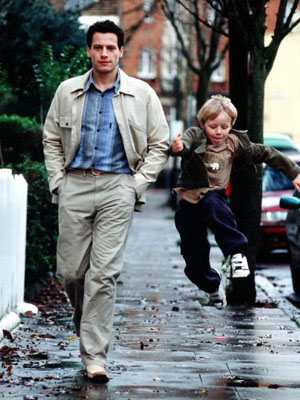
Ioan Gruffudd as Harry and Dominic Howell as Pat in Man And Boy

Then I'd thought, 'Hold on, I can't do that again' and looking over the plotlines of my first half dozen books it had struck me how often the father was mad, bad, just generally useless, or entirely absent.

Perhaps this explained why my latest novel has been on my father's bookshelf for the past six months with the bookmark at page 20.


In fact, I have a perfectly good relationship with my dad; it's just that if a father does play his paternal role correctly, there can be no story. He would, by means of his restraining hand, his wise counsel or financial support, step in to prevent any misadventures occurring. Much better to kill him off in chapter three, as Robert Louis Stevenson does with Jim Hawkins's father in Treasure Island.

Dad is usually dead in any decent children's story, whether it be Harry Potter or The Tale of Peter Rabbit, whose father was not only killed but also eaten by Mr McGregor.

In the course of filming, I looked at a whole library-shelf full of children's books, and dad had been killed off in almost every one.


As clips in the film will show, Mr Bennet, of Pride and Prejudice is laid-back to the point of negligence, whilst my favourite author, Dickens, specialised mainly in orphans.

Benjamin Whitrow as Mr Bennet, a father

Of the fathers who do take centre stage in his books, Mr Dombey of Dombey and Son causes disaster by playing the role of the unbending paterfamilias, whereas Mr Micawber (David Copperfield) and William Dorrit (Little Dorrit) are more childish than their own children.


In the second half of the 20th century, it wasn't just authors who were against fathers, it was the whole of society. The youthquake of the 1960s, the rise of feminism, and the culture of 'cool' mean that any male hoping to exert familial authority was ripe for a kicking.

In the kitchen-sink novels of the fifties, 'father' has become dad, a risible figure who's wasted his life down a coal mine, and never had sex with anyone except the woman he married.

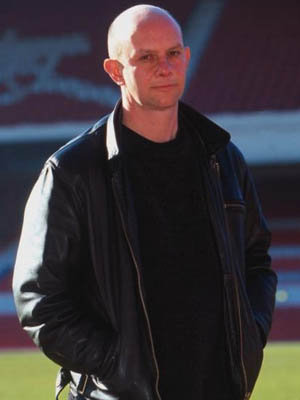
Nick Hornby, author of About A Boy

At least he didn't aspire to be like his children, but today's father has capitulated to youth culture. He wears shorts in summer; he drinks his coffee from a mug marked Cool Daddy; he reads books telling him to become his children's 'best mate'.

The film features clips from Man and Boy, from the novel by Tony Parsons, and About A Boy (Nick Hornby), both featuring middle aged men learning life lessons from young boys, and very excruciating is the process.

My advice to any author is: despatch dad quickly and cleanly early on, before he starts killing all the magic of your story with his male-pattern baldness, his dodgy knees, and his unsympathetic and uncomprehending or - worse still - his sympathetic and comprehending attitude towards the modern world and the beautiful young people in it.

Andrew Martin is the presenter of Disappearing Dad.

Disappearing Dad is broadcast on Tuesday, 29 June at 9pm on BBC Four, part of the Fatherhood Season.

BBC Four controller Richard Klein has also written for the BBC TV blog on the Fatherhood season.

My Glastonbury 2010 experience from behind the scenes

Blog comments are currently unavailable. Find out more.

Post categories:

Edith Bowman|16:00 UK time, Monday, 28 June 2010

Driving away from Glastonbury, I always find a really emotional moment. None more so than this weekend as Stevie Wonder utterly captivated the thousands of festival goers who had gone the distance and had a stupendous weekend.

I love Glastonbury for so many reasons and it really is unlike any other festival, it's so much more than the music. With Glastonbury, expect the unexpected.

Edith Bowman interviews Florence Welch from Florence And The Machine at Glastonbury

I have only great memories of my numerous years of either working there or just being a punter. That first year is the one that always springs to mind, pegging it onto site as Coldplay took their place headlining the Pyramid stage on the Friday night.

Finding my friends was the last thing on mind, as was remembering to bring a tent. I got my head down in the boot of my car for a few hours that year.

Five years ago - yes that year of rapids dragging tents across the site - I woke up in a foot of water. Soggy pants didn't stop me from having an awesome time.

There was something even more magical this year. I bumped into Kele Okereke as he was heading back stage at the John Peel stage. As we sauntered down the dust track down the back of the Pyramid stage we both noted the indescribable atmosphere that permeated differently from other years.

It wasn't just the sun, so what was it? I can't answer you unfortunately, but what an amazing weekend!

Reggie Yates and I have the pleasure of doing all the TV stuff for the summer of live music on BBC Three and I just have the best time with him. Reg is a great friend and so easy to work with. We laugh so much and it really doesn't feel like work.

I've managed to convince him to come back and do T In The Park again this year, it's really interesting how different each one is. Radio 1's Big Weekend back in May is nice small festival that you can get about easily, and we did a bit of roaming, rather than have a set.

Stevie Wonder performing on the Glastonbury stage

Glastonbury is huge, while T In The Park is the best fun. The crowd is loud and lively and the bands are all together in the dressing room area, where our set is, so you really get the sense of being one of the gang. Reading is very much about the music.

At Glastonbury we normally come off air after the headliners jar finished their sets, so it's then about finding those gems around site after hours.

I always seem to gravitate toward the Park area. It's quite new to the site but has become a hot spot for it's chilled out party vibes.

Kissed by the light of the Glastonbury sign you can watch bands, dance to various DJs, have tea or discover secret venues buried underground.

I spent a lot of time up there as did quite a few well known faces. I saw the Arctic Monkeys' Alex Turner and his missus, Ed Simons from the Chemical Brothers, The XX, Frankie from Frankie and The Heartstrings, and I bought Emily Eavis her well deserved first drink of the weekend on Saturday night.

I don't get to see as much as I would like as I'm working quite a bit but still managed to catch a bit of Snoop Dogg, These New Puritans, We Are Scientists, Willie Nelson, Bombay Bicycle Club, Midlake, The XX, Miike Snow, Muse, The Flaming Lips, and a few others.

Florence Welch from Florence And The Machine dressed in all white performing at Glastonbury 2010

I thought Florence and the Machine was incredible on Friday, she totally owned that stage. I was lucky enough to chat to her before and she was so up for it. Love her.

I was so proud of my other half, Tom Smith, on Saturday - his band, Editors, had such an incredible set. It was very very special.

It can just get a bit tricky when you have to interview your partner, though, which I've done about eight times now. Tom came up after they played the Other Stage - he was with Russell, the bassist from the band.

I don't know why but it's just weird. I have to say this time was the easiest, maybe because I told him about five seconds before we went live "to say loads and be nice".

I haven't camped for a few years but I think we're planning on it for next year. It's not been easy to do the last few years, what with the small child and all, but there is something special about staying on site and living in that atmosphere for the entire weekend. That said I only left site for about five hours each day.

The good thing is next year will be here before we know it.

Edith Bowman is a Radio 1 DJ and the co-presenter of Glastonbury 2010 on BBC Three.

The BBC's coverage of Glastonbury is available on the iPlayer until Monday, 5 July.

Olivia Colman: Vicar's wife in Tom Hollander's Rev

Blog comments are currently unavailable. Find out more.

Post categories:

Gary AndrewsGary Andrews|14:12 UK time, Friday, 25 June 2010

Rev is a new six-part sitcom for BBC Two, written by James Wood and co-created with In The Loop star Tom Hollander. Tom plays Adam, a country vicar who's relocated to a parish in inner-city London, while Olivia Colman plays his solicitor wife, Alex.

Olivia talked to me just after she'd watched the completed version for the first time, to find out what it was like on the set of Rev, how she hoped it would be received and why comparisons to the Vicar Of Dibley are wide of the mark.

Olivia Colman as Alex in new sitcom Rev

Can you tell us a bit about Rev, and your character, Alex?

Rev follows a vicar - an inner-city vicar, who's moved from the countryside - and the trials and tribulations of his very little congregation, and he and his wife. You know, normal stuff that shows he's a normal, human person - a married man with normal problems but also a dog collar.

It was lovely playing Alex. She's quite ballsy but they're both very good people - they're helping people in different ways.

I kind of felt that Alex thought that Adam made her want to be a better person because he really does turn the other cheek and try to see the best in everybody and she's maybe a bit more keen to just say "Agh, let's just go home!"

But she's lovely to play and they're a lovely, lovely couple. I mean, it's sort of from their back story. We think they met when they were quite young - before he went into the cloth - and she just followed him wherever he went because they're soulmates.

What were your thoughts when you first saw the script?

I really like quite dark comedy and I like the fact that it could stir people up. I don't think that's a bad idea, ever.

Some people are quite precious about vicars and vicars who can get erections [laughing]. But he's human, we're all nothing but humans and that's what I like about it, it really did deal with the humanity, the spit and dribble of everyday life. But you'd be disappointed it you're wanting the Vicar Of Dibley!

In order to see this content you need to have both Javascript enabled and Flash installed. Visit BBC Webwise for full instructions. If you're reading via RSS, you'll need to visit the blog to access this content.

There's a great bit in the second episode where, in an effort to spice up their sex life, Alex walks into a supermarket dressed as...

A prostitute!

Yes! That part had me in stitches. What was that like to film?

It was quite embarrassing! The shop had security cameras so they guys who owned the shop were standing there looking really bored watching us on security cameras and me tarting around in high heels. It was embarrassing! But fun. I like the waist the corset gave me!

What were your impressions now that you've seen it properly on the screen for the first time?

I'm really proud of it - I loved it! Sometimes you watch things after it's been through the editing process and you worry that people have cold got feet and have wanted to jazz it up for an audience.

The original script was just so beautiful on its own, it was dark and there were gaps, you know, spaces for thoughts to happen - I sound a bit pretentious now - but what I love is they haven't tried to change it, they've just left it as it was.

It was called something different while we were working on it, and Rev really suits it. I much prefer the name, as it was originally called Handle With Prayer. Rev's right for it - it's snappy and modern.

Tom Hollander as the Reverend Adam Smallbone on his bike, wearing a yellow luminous jacket

As you say, it's dark but it's also quite accessible to somebody who's come to it cold and likes mainstream comedy.

Absolutely! Because they're funny characters and Tom does funny - he can do it easily. And then there's his reactions, and you know that he's battling with his thoughts, and you can watch it all unfold. It's a classic comedy in terms of what someone does in an awkward situation.

How does your character progress as the series goes on?

They're always trying to find time for each other. What else? There's more attempting to have a sex life. And the fact that she says "Don't wear the dog collar in the bedroom!" I mean you would do that, wouldn't you? You'd say "Don't do that!"

[The interview takes a quick break at this point as Olivia composes herself after collapsing into a fit of giggles]

There's a lovely episode where a friend of Alex's, who is a Muslim girl, asks if she and her Muslim friends can borrow some space to pray in the church. Adam's like: "Of course, of course," and then he's battling with how people feel about that.

It's like, "There are Muslims in my church!" You know, it's saying out loud everything what everyone thinks. Adam just goes, "Don't be ridiculous," it's just... it's great.

The cast of Rev outside the church, from left to right: Simon McBurney as the Archdeacon, Miles Jupp as lay reader Nigel, Tom Hollander as Reverend Adam Smallbone, Olivia Colman as Alex Smallbone, Ellen Thomas as Adoha, and Steve Evets as Colin

What kind of reaction are you hoping for when people see it for the first time?

I hope they're going to warm to the characters and love them.

Colin [played by Steve Evets] is a homeless smelly guy and you wonder are people going to love him? But he's lovely! And the fact that Adam might well be his only friend in the world.

There's one episode where he lets himself in, or he breaks in, we don't really know, and he has his morning dump in the downstairs loo of the Vicarage and you're not really sure how Adam and Alex cope with that!

But I hope the audience warm to these people and they want to know, I don't know... after seeing it they think, 'I want the people to do well in it. I hope they're going to be OK'. And I think these characters are strong enough and lovable enough that people want to get really involved. It's much more than a comedy about religion and vicars.

Gary Andrews is the assistant content producer for the BBC TV blog.

Rev starts at 10pm on BBC Two on Monday, 28 June. To find out further episode times please visit the upcoming episodes page.

Lennon Naked: Getting under the skin of John Lennon

Blog comments are currently unavailable. Find out more.

Post categories:

Robert JonesRobert Jones|11:32 UK time, Wednesday, 23 June 2010

I stick to a routine when it comes to writing. I can't write in a café or a park. I get to my desk around nine and set myself a target for the number of pages to get done in a day.

At the place where I work they take the mickey out of me for always making coffee at exactly 11 o'clock. It's like a promise to myself - get those pages down and There Will Be Caffeine.

In order to see this content you need to have both Javascript enabled and Flash installed. Visit BBC Webwise for full instructions. If you're reading via RSS, you'll need to visit the blog to access this content.

Writing Lennon Naked took a long time. I worked very closely with the director, Ed Coulthard, for a good two years before filming started.

We'd wanted to work on something together for quite a while and were both interested in John Lennon, particularly the period around the time of his famous interview with Jann Wenner for Rolling Stone magazine in 1970.

It seemed to us that the song Imagine had come to define the mercurial Lennon in a way he would have found confining. This film shows a different side to the man.

In terms of capturing how John spoke, I watched the Beatles films and listened to dozens of hours of interviews on YouTube - and I read everything I could both by and about him.

After a while, I felt I had a grasp of how he turned a phrase. Of course, he was famously witty, so it's a challenge.

John Lennon, played by Christopher Eccleston, set ballons free in a white hall

My favourite line got edited out when we changed the structure of the opening. I'd had the American psychotherapist Art Janov saying, "Do you feel a lot of pain, John?" John replied, "I felt a lot of pain when I realised what it was going to cost me to fly you over from California."

I can still hear Christopher Eccleston saying it. He captured brilliantly the way Lennon loved to undercut pomposity. In fact, he captured Lennon full stop.

His performance is immense - he's in every scene. When I heard he'd read the script and was keen to do it, I knew we were moving into another league.

The key characters featured in the film were contacted by the production company, Blast, but I didn't interview them before writing.

From everything I'd read, I got the strong sense that those who knew John best had very different and often contradictory ideas about what he was like and what made him tick.

John Lennon, played by Christopher Eccleston, and Yoko Ono, played by Naoko Mori, face the press with peace signs in the background

Rather than adopt any individual's take on him, I just absorbed everything I could and then made up my own mind. I stuck to the facts of his life but obviously what you see is an interpretation - mine, the director's and Christopher Eccleston's.

The film was shot on a low budget in a short time. I'm amazed by the amount of work that everyone involved in it was prepared to contribute, both cast and crew. They made every penny and every minute count.

I hope they're as proud of this film as I am. It'd be great to hear what you think of it too.

Robert Jones is the writer of Lennon Naked.

Lennon Naked will be shown on BBC Four at 9.30pm on Wednesday, 23 June.

Puppets, sex and Paul Kaye: The birth of Mongrels

Blog comments are currently unavailable. Find out more.

Post categories:

Adam MillerAdam Miller|12:48 UK time, Tuesday, 22 June 2010

When asked to describe Mongrels, as I often am by bemused people at parties who've been told I work 'with puppets' and who are humouring me, I normally say, "It's an adult puppet comedy show."

This inevitably makes them ask about the puppets: How big are they? Have you met Kermit? Then they ask if there's going to be puppet sex.

And that's my big mistake, because actually the whole idea of Mongrels is that after watching it for about five minutes, you forget that you're watching a puppet show, and you start watching a sitcom about a fox, a dog, a cat and a pigeon who live in the back garden of an east London pub.

In order to see this content you need to have both Javascript enabled and Flash installed. Visit BBC Webwise for full instructions

It's a story that just happens to be told with puppetry. Although there is a bit of puppet sex. Classy sex, mind you.

Mongrels really began when I was working on a kids show for ITV and where two things became obvious. Firstly, that the adults making the show were laughing at the puppets at least as much as the children. And secondly, that when you shot them with hand-held camerawork they came to life in the most extraordinary way.

A few years after that and I'd re-mortgaged my house to buy some camera and editing kit and was working on a series of TV comedy pilots that used puppets in a very basic fashion.

Then one day Andy Heath, a puppeteer who I'd met on the self-same kids show years before, agreed to help me out.

Watching him pick up some terrible store-bought puppet wolf and seeing what he could do with it was a revelation. The man's a genius by the way. You hear about Tiger Woods picking up his first golf club while still in the womb, well Andy's the same, but with puppets.

Next thing I know I've written this bad script about a metrosexual urban fox called Nelson, and Andy and his business partner Iestyn have designed and built the puppets and we've shot and edited a pilot.

That's a glamorous way of saying that we spent two months lying in puddles and dog crap all over south London.

At the time I'd been working as an assistant director with producer Stephen McCrum at the BBC and plonked the resulting pilot on his desk.

In order to see this content you need to have both Javascript enabled and Flash installed. Visit BBC Webwise for full instructions

Little did I know that he shared a love of puppetry, and suggested we got on board a hugely talented young writer, Jon Brown. Together we tried over four and a half years to nail the essence of Mongrels.

We wanted to make something that had the pace of an American animation but with British sensibilities, that was adult, but not crude, that was based in the realities of the animal world, and that didn't rely on the puppets to do the comedy.

Later another brilliant writer Danny Peak joined us and after several scripts, one teaser and a pilot, we got a series commissioned.

Once that terrifying hurdle was cleared the fun bit started: designing the puppets and putting voices to thecharacters. This was tricky for Andy and Iestyn because sometimes they'd be trying to work out the look of a character without knowing what he or she sounded like.

Only the amazing Paul Kaye has been with us from the beginning of the BBC process (voicing the original Nelson and latterly Vince and a host of other characters) but as Rufus Jones, Lucy Montgomery, Ruth Bratt and Katy Brand came on board so the characters shaped up more easily.

The last voice to be cast was Marion, so late in the day in fact, that we had to take a complete punt on what the puppet would sound like.

Marion the cat from Mongrels, voiced by Dan Tetsell

I'm told the body was based on James Corden's in the end. The voice however is all Dan Tetsell, and now I can't imagine anyone else doing him.

Puppets are a right bugger to film, and comedy is notoriously tight on the amount of time you have to shoot stuff. This made the production process very tricky, but such great fun.

When you walk on to a set at eight o'clock in the morning and there are four puppets dancing to Beyoncé, then you know you're going to have a ball.

And so we did, but we were trying to shoot something that hadn't really been done before outside of the Muppet movies - filming puppets in a drama style, with drama coverage, but using hand-held cameras. It was, to put it mildly, a learning curve, but a rewarding one.

Mongrels has been the most collaborative project I've ever worked on, every member of the team (affectionately known as Mongrels) has, without exception, contributed creatively to the finished product.

Now at the final hurdle, and five years down the line, we are hoping that there's a bunch of other Mongrels out there that we haven't met yet, but who will like the show enough to give us the feedback we need.

Most of all though, and despite the cliché, I really do hope people have half as much fun watching it as we had making it.

Adam Miller is the creator and director of Mongrels.

Mongrels starts on BBC Three at 10pm on Tuesday, 22 June. To find out times of all upcoming episodes please visit the upcoming episodes page

The craft of making Being Human and Later With Jools Holland in High Definition TV

Blog comments are currently unavailable. Find out more.

Post categories:

Danielle NaglerDanielle Nagler|11:44 UK time, Monday, 21 June 2010

As any of you who has bought a High Definition (HD) television - or just read the claims about them - will know, HD can give you five times more detail in your television picture.

Most of us don't watch standard definition TV and notice the absence of all that detail, but it is true that watching HD pictures can show you things on television you have never seen before (and may not want to).

When HD television first started, ripples of terror ran through the communities of people who help make the television illusion real for us - the make up artists, set designers, costume designers, props people, and so on.

In order to see this content you need to have both Javascript enabled and Flash installed. Visit BBC Webwise for full instructions

But they are, of course, highly skilled craftspeople, and have learnt to understand HD and to adapt the ways they work to suit.

We wanted to show you a little more of what HD involves and to share with you the talents of some of those who make it all possible. So we've made a series of short films to give you some insight into how programmes are made in high definition.

They'll be shown on TV in some of the gaps between programmes on BBC HD - and available on the BBC website - but I wanted to share the first two with you here.

In order to see this content you need to have both Javascript enabled and Flash installed. Visit BBC Webwise for full instructions

They take you to visit the model makers at Aardman in Bristol who care for CBBC'sShaun The Sheep (I'll update this post with a link to this video when it becomes available) and the make-up artists who spend hours creating werewolf wounds on BBC Three'sBeing Human, as well as the sound engineers responsible for the full (5.1) musical experience on Later with Jools.

I hope they help you to appreciate the often unsung heroes who make HD TV work for the BBC, and for you.

Danielle Nagler is controller of BBC HD

Fatherhood season: Celebrating dads through time

Blog comments are currently unavailable. Find out more.

Post categories:

Richard KleinRichard Klein|19:28 UK time, Thursday, 17 June 2010

I remember the day my father died. I was suddenly aware that there was no ceiling above me, just the heavens, and I realised that I too would someday die.


Not the cheeriest start to your Father's Day reading and it gets bleaker before (I promise) some sunshine. I then had to go to Germany to sort out a flat that my father kept in the small north Schleswig Holstein town where we grew up. I dreaded going.

But it was there between the tears that I began to feel better. Because, perhaps for the first time, I began see the father that this man really was. He had kept every payslip, every school report, every photo of his life and the lives of his family.

I saw that this detached, quite difficult and certainly non-hugging man was every bit a loving, concerned and conscientious father who had seen as paramount in his life the task of dutiful father.
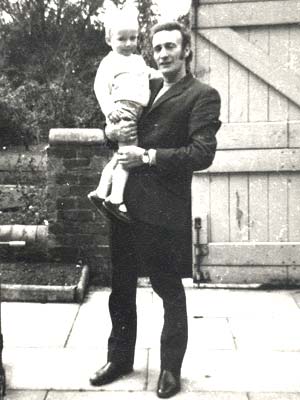
A Century Of Fatherhood: Peter Lambert and his daughterOver the next three weeks BBC Four is running a Fatherhood season celebrating fathers and the concept of fatherhood.

BBC Four prides itself on attaching a new lens to familiar subject matter and stimulating viewers to reconsider that world through a different prism. Call it intelligent television entertainment.

So this season highlights the story of a revolution that hasn't been celebrated enough. But it also recalibrates the story of fathers in what might seem a rather counter-intuitive way.

Contrary to popular myth fathers have always been involved, interested and caring about their families.

What attracted me to creating the season is how the 20th century has seen enormous changes in family life, the role of parents, the role of women and so forth - including my one (I am divorced and a single father).

But it has also seen an extraordinary change in the role of fathers. Or at least that's what you'd think reading the avalanche of magazine articles and opinion pieces that take a view on useless dads, absent dads and, more recently, new dads.

Judging by some newspaper yardsticks dads are either too stupid to tie their own shoelaces or too awful to be let near children. Sometimes both.

Countering this view of cruel idiocy is also a sense that the modern father has finally come home, got in touch with his inner self and embraced his family, ending up walking off in the sunset, children in his arms, possibly weeping gently with the emotion of it all, but at long last a part of the family - and now no longer the ogre, the distance, cold authority figure that we all know is what they used to be before we discovered, wait for it, ourselves.
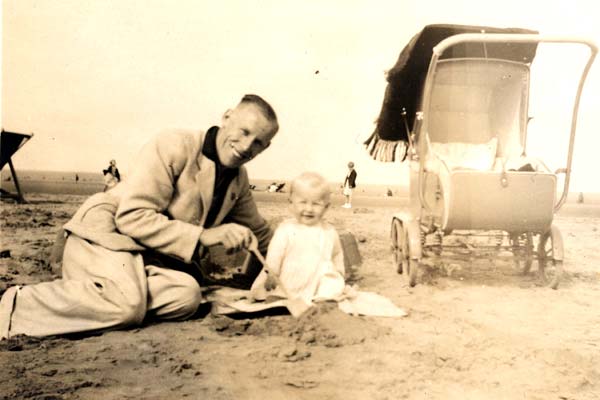
A Century Of Fatherhood: Cliff and daughter Thelma

But according to producer Steve Humphries in his heartwarming three-part documentary series A Century of Fatherhood, that view is simply wrong. Fathers were always close to their families when they could be.

They were always striving to provide the best they could for their children. And they were approachable, generous men who were much loved - not feared - by their sons and daughters.

And perhaps the most radical idea Humphries proposes is that the cold detached Edwardian father is a myth, that fathers then were as committed to their duties as fathers as any other generation and that they created loving and warm close personal attachments to their children.

Professor Joanna Burke comments in the programme: "The image we have of fathers in the past is absolutely, totally wrong. If you actually look at dads in the past the vast majority are loving, warm fathers."

Dr Julie-Marie Strange adds: "In Edwardian Britain we think very much of fathers being absent from family life - and they're absent because they're in work being providers."

It turns out that the First World War, the pernicious propaganda of the temperance movement and some rather traumatised upper class writers have portrayed fathers in a way that isn't wholly accurate.

Either fathers were away because they had to be - work, there was a war on and a nationhood to be saved; or else it simply suited some to portray men - especially those unwashed working classes - as feckless swine drinking away their children's very bread and butter.

When writing about their own class, the posh lot held sway with their portrayal of cruel and distant fathers who sent children away to boarding school while they ran empires and lorded it on the estate, rattling around big country houses. Reflecting, so it seems, their own lives rather than the lives of the vast majority.
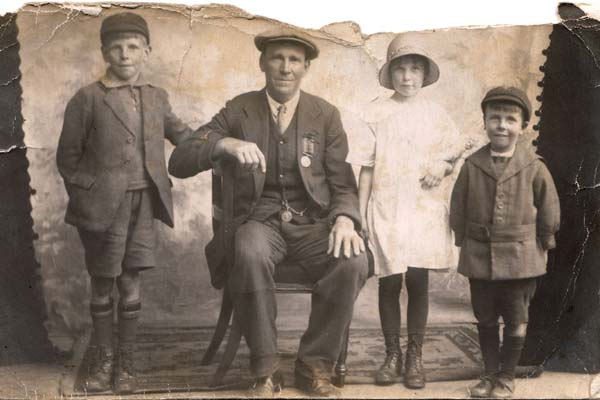
A Century Of Fatherhood: left to right - Alec Haines with his dad, brother and sister

The Second World War didn't help either, by all accounts. It had a devastating effect on family life in Britain, and in particular on fathers.

Some were away for years on end and ended up hardly knowing their children upon their return. Others were damaged by their war time experiences at a time when the impact of post traumatic stress was little known and, if anything, belittled.

These men struggled to fit in to a world that had changed in their absence. It is well recorded that the divorce rate after WW2 escalated as couples discovered two lives had simply grown apart.

And of course the birth of the teenager meant that fathers who had a traditional view of their role in the house suddenly found that they were not longer in control.

And as extra-marital affairs, divorce, and the impact of a sexual revolution crashed in on human lives, it seemed to some that the new freedoms of post war Britain were destroying the institution of marriage and fatherhood themselves.

But despite all this change, what is surprising is not just that fathers have had a much closer and more loving relationship with their children than you might think from popular literature, newspaper columns or television.

It is that the bond and love between father and child has remained, for most dads, most of the time, an enduring and powerful bond.

Of course, it's not just in the real world that fathers have a role to play. Writer Andrew Martin's sharp-eyed film, Disappearing Dad, takes a witty approach to the whole subject.

It seems, he suggests, we need our fictional fathers to be dramatised in a certain way to make the story dramatic. In fiction you have one of three choices. Either your father is just plain absent - The Railway Children, for example. Or he's the cold distant stern authority figure - think Dickens, Frances Hodgson Burnett and just about every other Victorian and Edwardian novelist.
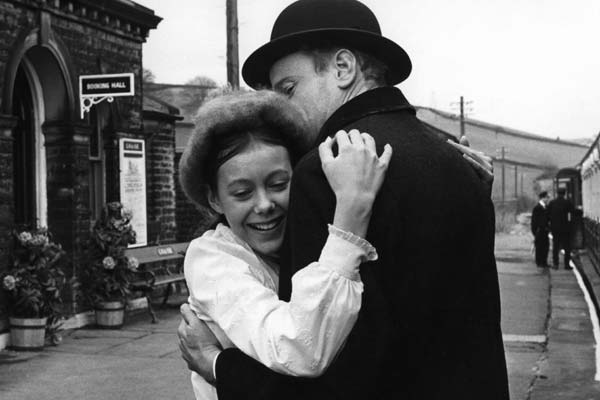
The Railway Children: Jenny Agutter as Bobbie and Frederick Treves as Father

Or, more recently, the late twentieth century dad: dim, out of touch and beleaguered by life. Interestingly the outcome in all three cases is usually the same. At some point dad will finally, duh, see the light and, er, bond. It is a staple you will recognise in any half-witted American comedy or drama. All is well after all.

I also wanted to try and see if there is any science in fatherhood too, so I asked scientist Dr Laverne Antrobus to take a look.

What has been really surprising is the discovery that men, fathers-to-be in fact, literally do change when their wives or partners get pregnant and give birth to their children. Dr Antrobus' film, Biology of Dads, suggests that when their wives have babies men go rather gooey (hormonally speaking) just as their womenfolk do, which makes them rather good at picking up the tot and empathising with them.

Finally a bit of drama. The season also features a new film, Lennon Naked, a searing portrait of John Lennon, played by Christopher Eccleston, as a man who struggles to come to terms with his unloved childhood.

In order to see this content you need to have both Javascript enabled and Flash installed. Visit BBC Webwise for full instructions

In the late 1960s Lennon met up with his father for the first time after 17 years. Shortly afterwards he meets Yoko Ono, leaves his wife and own son, breaks up the Beatles and leaves Britain, forever, for America.

It is a drama that seeks to explore what happens when a great artist comes face to face with his own, painfully unloved childhood - and emphasises the importance of fatherhood in a shocking way.


I am a single father these days. My daughter is the apple of my eye and I do plenty of hugging and kissing - far too much for her liking, in all probability.

But while my father never did that with me - and, frankly, I wouldn't have wanted it, I often remember that day in his flat clearing up his things and I like to think it helps me to hold true to his version of fatherhood of commitment, duty and, where possible, a reliable presence.

Tree-hugging it ain't, and nor is it a very visible, modern, form of emotional intelligence. But, to steal a phrase, it is a kind of loving.

Richard Klein is controller of BBC Four

The Fatherhood season begins on Monday, 21 June.

Novelist Andrew Martin has also written for the BBC TV Blog on his documentary for the Fatherhood season, Disappearing Dad.

Battle Of Britain season: What's on BBC TV

Blog comments are currently unavailable. Find out more.

Post categories:

Martin DavidsonMartin Davidson|18:32 UK time, Thursday, 17 June 2010

As commissioning editor for BBC History, I get to choose many of the great history programmes that make it to your screens - everything from Victorian Farm and Who Do You Think You Are? to History Cold Case and Empire of the Seas.

We have just put together a short film here of the history highlights coming up on the BBC over the next year or so, with snippets from me talking about the various things that made me commission them.

In order to see this content you need to have both Javascript enabled and Flash installed. Visit BBC Webwise for full instructions
I've always been fascinated by history, and the questions it throws up. It gets written by the victors, it's bunk, and it repeats itself as farce - these are just a few of the things that great minds have been saying about history over the centuries.
In other words, some stories get favoured, others ignored; it promises insights into the future that don't come true; and nothing ever really changes. So why make television about it?

For me, the answer is obvious. Because few other subjects offer as many great stories, or provoke such powerful questions, often at the same time.

One timely example is whether the RAF won the Battle of Britain, and what difference it makes. Twice a day I pass the Spitfires standing guard at RAF Northolt, on the A40 just outside London, and find myself pondering just this.

Well, one film I have commissioned for this year's 70th anniversary of the Battle of Britain will certainly shed light on it.

Called First Light, it's the dramatisation of Geoff Wellum's best-selling and astonishingly vivid good read, a book of the same name that was published in 2002.

The manuscript had lain in a drawer for decades until thrust into the hands of a publishing scout, who only had to read a few pages to see that this was one of the most exciting - but also sobering - first hand accounts of what it was like being 19 years old and at the controls of a Spitfire, surrounded by over 100 German fighters.

I loved the book when I read it, and when it was offered as a drama, snapped it up.

The film combines drama on the ground and action in the air, with computer graphics and real-time Spitfire flying that really captures the claustrophobia of the cockpit and the frenzy of combat - you can see some very early footage in the clip above.

We're going to be using James Holland's brilliant new book on the Battle of Britain as the basis for a documentary to supplement and illuminate the drama.

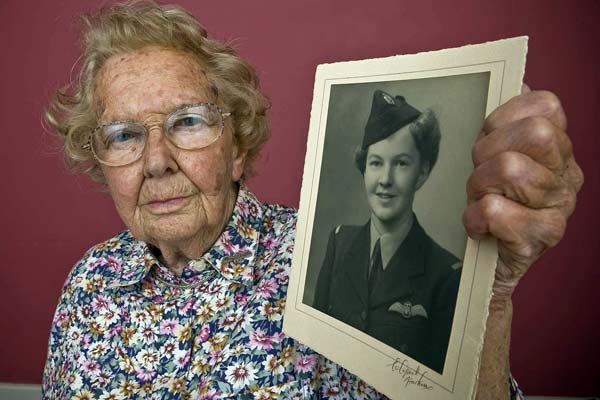
Spitfire Women: Margaret Frost, one of the Air Transport Auxilary pilots

And there will be more programmes besides across BBC One, Two and Four, including a very exciting documentary featuring Ewan McGregor and his RAF pilot brother Colin called The Real Battle of Britain. They'll be getting very hands-on experience, flying through our skies, reliving the experiences of young airmen. For Colin it's a chance to see if his modern jet-fighter training compares to the seat-of-the-pants skills needed to master a Spitfire.

A BBC Four documentary I'm looking forward to is Spitfire Women, which tells the remarkable story of the women who flew planes for the Air Transport Auxiliary - the unsung heroines as it were.

I hope that together all these programmes will help persuade even the stoniest old sceptic that this aerial conflict, fought over the second half of 1940, really was as historically significant, and as personally resonant, as all the myths would have us believe.

Martin Davidson is commissioning editor for BBC History

The Battle Of Britain season will be on air in September to mark the 70th anniversary of the WW2 air campaign.

Laura's documentary continues BBC Three's tradition of thought-provoking shows

Blog comments are currently unavailable. Find out more.

Post categories:

Danny CohenDanny Cohen|12:22 UK time, Monday, 14 June 2010

I was surprised to read the stories in the press over the weekend regarding the documentary we are making with a young girl call called Laura Hall on excessive alcohol intake.

The documentary will tell the story of Laura, who has been drinking too much and has received an ASBO related to her alcohol-fuelled behaviour.

This programme is being made with the co-operation of both Laura and her family, and they are not being paid for their involvement.

The family are regularly offered money by newspapers to tell their story but have chosen instead to work with the BBC for no financial gain because they understand the serious, responsible nature of the BBC's documentary approach.

Both Laura and her family are desperate for her to change her behaviour, and the programme will document her attempts, and examine how they cope as a family.

The documentary will follow Laura over time - it is not a snapshot - and observe whether Laura can make good on her ambition to turn her life around. Laura plans to undergo therapy for the first time and the programme will thoughtfully monitor the success of this.

Laura, of course, is not alone. There are a great many young people in Britain who are not drinking at safe levels. BBC Three has a strong track record of making thought-provoking and sensitive documentaries about the big social issues that face young people.

It is absolutely in keeping with the BBC's public service values for these kind of important subjects to be explored on BBC Three, whether it be youth unemployment, teen pregnancy, or alcohol abuse.

Crucially, we have put a working protocol in place to ensure that sensitive documentaries of this nature are made with thoughtfulness and responsibility at their heart.

In this case these measures include no payment to those involved in the filming, carefully controlled filming hours, and a firm commitment to preventing Laura harming herself or anyone else during filming.

One further footnote. The Sun also carried an editorial piece, criticising the programme and BBC Three. I have outlined above the reasons why their criticism of the programme is misplaced. But The Sun also claims that BBC Three is 'a channel nobody watches'.

A screenshot from Blood, Sweat and Luxuries on BBC Three, an example of the channel's documentaries

This is a factually inaccurate statement. BBC Three reaches 15 million people a week, and just under 30 million every month. It is now the most watched digital channel in the hours it broadcasts as a result of hit programmes that include Being Human, Blood Sweat and Luxuries, Russell Howard's Good News, and the channel's recent in-depth general election coverage.

In the coming months and years, we will continue to work hard to provide thought-provoking and compelling programmes for young licence fee-payers.

Danny Cohen is controller of BBC Three

The history of Rude Britannia - from Chaucer to Little Britain

Blog comments are currently unavailable. Find out more.

Post categories:

Alastair LaurenceAlastair Laurence|09:10 UK time, Monday, 14 June 2010

People might ask why we made Rude Britannia - well you might!

As is sometimes the case with television projects, Rude Britannia had a long gestation period.

Nearly three years ago we made a series called Comics Britannia in which we celebrated, among other things, the rude genius that was - and still is - the magazine Viz. It got us interested in Britain as a fundamentally naughty nation.

In order to see this content you need to have both Javascript enabled and Flash installed. Visit BBC Webwise for full instructions. If you're reading via RSS, you'll need to visit the blog to access this content.

Then I read a big, bold and brilliant book by a former university tutor of mine Vic Gatrell - City of Laughter - Sex and Satire in Eighteenth Century London. This stimulated us to start thinking more historically about the rude roots of our history.

But we didn't just want to confine ourselves to a series about satire. That had been done quite ably before. We wanted to roam further and do something quite new.

So after much discussion and document writing it suddenly came to us. It's all in one word: rude. So why not do a history of British rude? We thought that would be fun.

Of course now the challenge was to define what we meant by rude. I hope that our solution was not too restrictive or prescriptive when we decided on an investigation of the satirical, the bawdy, the lewd and the downright offensive in British history.

With these categories in mind we began to do our rude research. A crack team of rude scholars - 'Professor' Andy Hall and 'Dr' James Harrison - got to work. We knew we would end the series with today's rudeness but where would we begin?

In any historical programme you have to start somewhere. This is where the idea of Britannia helped us set our historical compass.

Of course before the eighteenth century there was much rudeness from Chaucer to Restoration Theatre and the rakish poet Rochester. But it was in 1707 with the Act Of Union that the whole idea of Britishness - Britannia - began. So that became the starting point for our rude history.

A second decision was to make Rude Britannia multi-media in focus. We would look at the rude traditions of graphic art from Hogarth, Gillray, Rowlandson and George Cruikshank through to the current cartooning of Gerald Scarfe, Steve Bell and Martin Rowson.

We would also look at the rude postcard art of Donald McGill and the first rude hero of British comics - the Victorian anti-hero Ally Sloper. In exploring all the rude media we could think of we found even more naughtiness and filth than we had imagined.

A Martin Roswon cartoon, especially commissioned for the Rude Britain series

In the eighteenth century, ballads and songs were most certainly rude. This tradition continued into the music hall of the Victorian and Edwardian eras. But British theatre also has fine rude credentials from the Beggars Opera to the plays of Joe Orton.

And new and changing technology created a mass produced rudeness to horrify prude Britain. Rude photography created its own moral panic in the nineteenth century and the seaside peepshows of the early twentieth century - the mutoscopes - gave holidaymakers just the right kind of sauciness they wanted.

And of course in the last fifty years we have lived in what our last programme explains is a mass democracy of rude. Here first radio and then television have given us rudeness in the front rooms of Britain from Round the Horne to Little Britain.

All of this you will find in Rude Britannia - we hope you enjoy the programmes!

Alastair Laurence is the series producer of Rude Britannia.

Rude Britannia starts at 9pm on Monday, 14 June on BBC Four. To see all programme times for this show please visit the upcoming episodes page.

Rufus Hound: The story of Hounded featuring ice creams, pigeons, CBBC

Blog comments are currently unavailable. Find out more.

Post categories:

Rufus HoundRufus Hound|09:41 UK time, Friday, 11 June 2010

So. Tonight's the night. The show I've been involved with for the last three years finally goes out for people to see with their real eyes. Sorry to state the obvious, but I really hope you like it.

I really love telly. Always have, always will and when I think of my favourite telly, it's generally stuff that I watched when I was young. From The Muppets and The Getalong Gang to Dogtanian and Gamesmaster via any number of quizzes, soaps and sit-coms, I watched it, I loved it and clearly, on some level, I decided I wanted to be on it.

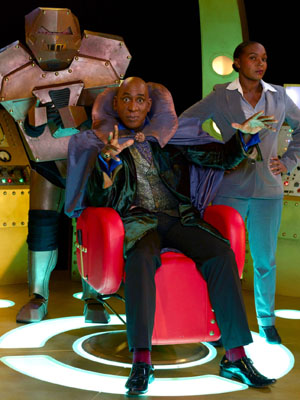
From left to right: Gelina, Rufus Hound and Buckton stand on the planet Flotsam

Fast forward a bit and I was, which was nice (for me - you may disagree), and stood on Parliament Hill in London in the freezing cold and drizzle making a pilot for a sketch show on BBC Three.

The channel liked the pilot but were less keen on my part in it. The show was commissioned. I was decommissioned.

But that pilot was seen by the very super people at CBBC and they said "Yes".

This was an odd thing to have said, as no one had asked them anything, but it was assumed that they were saying that they wanted something funny, with loads of special effects and a real sense that I have no idea what I'm doing.

The evil Dr Muhahaha with his sidekicks KETH and Steve

What with them having said yes, it seemed only polite for us to go away and actually write something. Well, we would have done but it was nice out so instead we went and got ice creams and shouted at pigeons, then we wrote something.

What we came up with is Hounded and it starts on CBBC on Friday, 11 June. I play a man called Rufus Hound who is blasted into parallel universes by his future self to defeat the evil machinations of Dr Muhahahaha and his pernickety sidekick Steve.

I know what you're thinking "Not that old chestnut!" but, like I say, we were a bit busy shouting at pigeons and eating ice cream.

I mean, there are those who think that children are an incredibly discerning audience and that to do the opportunity justice we'd have had to create whole armies of Ninja Teddy Bears, Evil Clones, Broccoli Monsters, Pizza Space Ships, Wool ships, blah blah blah, but clearly we just dialled it in, opting instead for an army of Ninja Teddy Bears, Evil Clones, Broccoli Monsters, Pizza Space Ships, Wool ships and stuff like that.

So look, I hope you enjoy it. For me, it'll bring back memories of all the ice-cream I ate and all the pigeons I shouted at.

Hopefully though, you'll think that what actually happened was that some of the most creative people you'll never meet spent years of their lives bringing this insane vision to the screen.

Now, would anyone like an ice-cream?

Rufus Hound is the writer and star of Hounded, which starts on CBBC on Friday, 11 June at 5.15pm.

To find out what times Hounded is on CBBC please visit the show's upcoming episodes page.

How we plan for Glastonbury, the World Cup and a summer of live events

Blog comments are currently unavailable. Find out more.

Post categories:

Jana BennettJana Bennett|12:32 UK time, Tuesday, 8 June 2010

This Friday sees the kick off of the 2010 World Cup in South Africa. This month-long tournament is just one of a huge number of sporting and musical events to hit our screens across the BBC this summer.

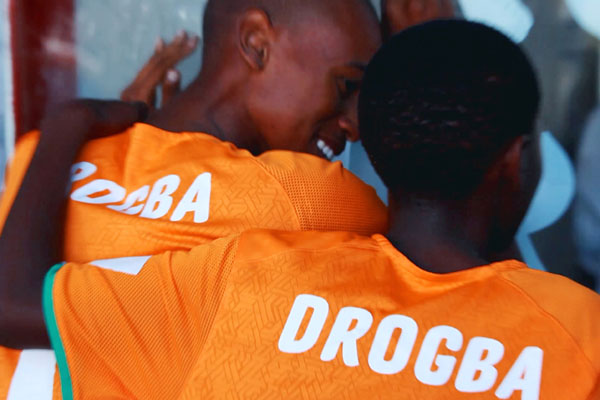
Two young Ivory Coast fans, complete with Didier Drogba shirts, look forward to the World Cup in a shot from the BBC's World Cup marketing promo

Continuing on the sporting side, we will also be showing, amongst others, The Open and Women's Open, the Rugby League Challenge Cup Final, European Athletics Championships, Royal Ascot, the Rowing World Cup and of course the latest rounds from this year's Formula One championship, which may yet see a British driver crowned world champion for the third year running.

From the musical festivals we will have coverage from Reading & Leeds, T In The Park from Balado, Kinross-shire and, of course, Glastonbury from the Eavis' farm in Somerset. The Proms are also back in July and will this year be presented by Katie Derham.

One of the main reasons the BBC exists is to broadcast events that bring communities and the nation as a whole together. I can't imagine a better line up to do just that.

It is worth bearing in mind however, that since many of these events are live, there may be occasions when some of the nail-biting sporting action or musical performances will run a little longer than originally scheduled.

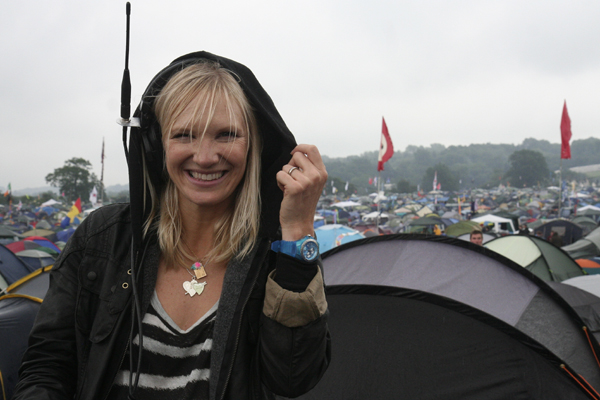
BBC presenter Jo Whiley presents coverage from Glastonbury 2009

We saw this happen in a different arena just last month where we watched extraordinary developments unfold following the election results.

On this occasion, political drama took over from fictional drama in our schedules as EastEnders and Holby Citywere moved to bring viewers news of Gordon Brown's resignation and the announcement of the new coalition government took place in front of 10 million viewers on BBC One.

When events overrun or turn into edge of your seat moments, we may decide to either alter the schedule so we can stay with them, or move their coverage from BBC Two to BBC One so that we ensure the largest amount of people can see them.

That is after all what we are here to do - to share these big moments with as many people as possible.

We don't take that decision lightly though. We are very aware of the disruption it can cause to the rest of the schedule, including things like the regional news.

That is why this year we have decided, wherever possible, to steer clear of moving events from BBC Two to BBC One until after 7pm so as to avoid disrupting the regional news services. That is the one thing that we cannot swap onto BBC Two owing to technological restrictions.

I cannot say we won't ever change the schedules or move things earlier than 7pm - after all no-one would thank us for leaving a performance, an historic sporting battle or a change of government before its conclusion. But where we do, it will be done whilst trying to cause the minimum of disruption to all our viewers.

For now let's sit back (or jump up and down) and enjoy what looks set to be an incredible summer of live events on the BBC.

UPDATE Thursday, 1 July:

Last night we had just such a situation where we wanted to ensure the biggest possible audience could see the culmination of Andy Murray's battle for a semi final place at this year's Wimbledon.

In order to do that we moved the match from BBC Two to BBC One at 6.40pm.

Although this meant the news hour was slightly shortened I felt the importance of the match justified the move.

As I have said above, we don't take these decisions lightly but having seen that around 5.5m people tuned in it seems like our audience shared the view that it was worth doing.

Jana Bennett is director of BBC Vision

Getting to know the cast of When Romeo Met Juliet

Blog comments are currently unavailable. Find out more.

Post categories:

Paul RosebyPaul Roseby|10:05 UK time, Monday, 7 June 2010

I was feeling a touch of 'ye olde first night nerves' as the first of the three episodes of When Romeo Met Juliet aired on BBC Two last Friday evening.

It was almost a year ago since we started auditioning well over 150 potential young actors - all expectant hopefuls ready for the chance to be in one of the world's best known plays. Or did they just want to be on TV?

In order to see this content you need to have both Javascript enabled and Flash installed. Visit BBC Webwise for full instructions. If you're reading via RSS, you'll need to visit the blog to access this content.

Well, whatever their expectations were, nothing could prepare any of us for what lay ahead in the next few weeks. And that's the point.

For mentors and actors Adrian Lester and Lolita Chakrabarti, and for me, artistic director of the National Youth Theatre and director of Romeo and Juliet, this was all new territory and I'd be lying if I said at times I was not out of my comfort zone!

Some of these young people have never done theatre before, let alone Shakespeare. Some had never even been to the theatre. Not so uncommon, perhaps, with a generation high-wired up to instant communication, but the complete lack of understanding of the challenges of staging a live show in a professional theatre was, at times, to test my control freak-like nature!

Our chosen location was Shakespeare's county of Warwickshire but it was a thousand miles away from the tourist-trod cobbled streets of Stratford-upon-Avon. Cleverly, our home was to be Coventry - a town with a dramatic history and a perfect place to stage our own dramatic challenge.

Hustle star and When Romeo Met Juliet mentor Adrian Lester offers advice to the young cast

We were all made incredibly welcome by the two contrasting schools we auditioned in and I remember being bombarded by cake, biscuits and bowls of fruit heavily laden on the audition panel table, like a scene from an old Derek Jarman movie.

Would the children be able to take the pressure and the discipline of the next few weeks or would the tragic tale of Romeo and Juliet be mirrored by some tragic behaviour in the rehearsal room?

It is brilliant that the BBC has committed to such a challenging, collaborative, and life-changing programme using Shakespeare and theatre as the hook. And for me, it was also great to sit on the BBC Breakfast news sofa to have the chance to discuss the virtues of the show.

Paul Roseby is artistic director of the National Youth Theatre and is the director of the play Romeo and Juliet within the TV programme When Romeo Met Juliet.

Part one of the show is available on iPlayer until Saturday, 19 June. Parts two and three air on BBC Two at 9pm on Friday, 11 June and Saturday, 12 June respectively.

For details on repeats and upcoming shows see When Romeo Met Juliet

Enter the City Of The Daleks in Doctor Who's new adventure games

Blog comments are currently unavailable. Find out more.

Post categories:

Simon Nelson|10:57 UK time, Friday, 4 June 2010

My kids love CBBC - they play it all the time. Sure, they like the TV channel as well, but it's the website and the games that come first. That's not to say that TV doesn't matter to them any more.

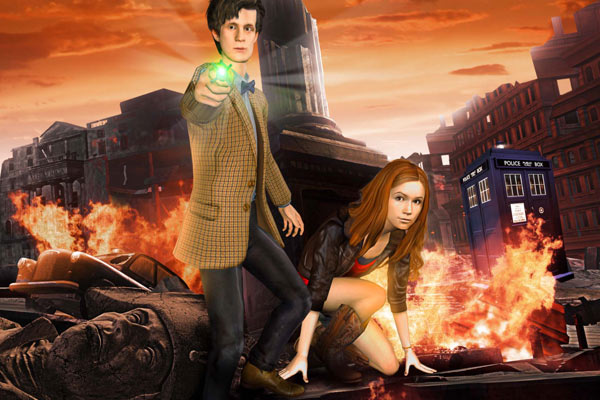
Once a week, the programme we all sit down for, as a family, is Doctor Who. But that's not enough for them - they want to play as well as watch. That's why we've created the Doctor Who Adventure Games.

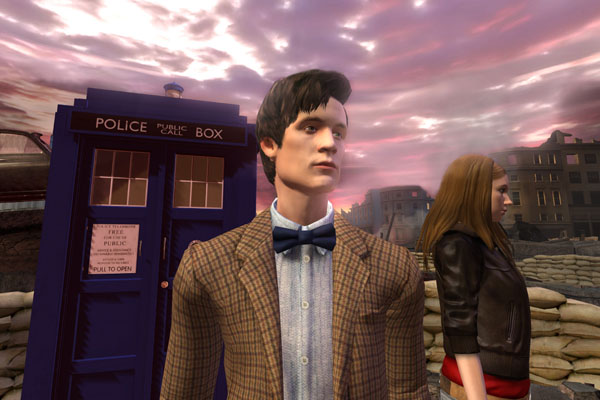
Amy and the Doctor in the Doctor Who Adventure Games

In our house, given a choice, my kids will always head for the computer first, the games console second before turning on the TV - books sadly come a distant fourth, which is why they rarely do get a choice.

My four-year-old can easily navigate and play on the CBeebies site; the older ones choose the worlds of Little Big Planet, Club Penguin and Moshi Monsters over most the TV has to offer. When they do watch TV, they want to watch programmes which have games they can also play, such as the brilliant Horrible Histories.

Our aim with the Doctor Who Adventure Games is to enable all Doctor Who fans - kids and adults, experienced and uncertain gamers - to enjoy four new episodes where they can play and interact with the action, rather than just watch.

City Of The Daleks, the first interactive episode is available to play now on the Doctor Who website and will be followed a few weeks later by the second and third episodes. You'll get to play the fourth and final game later in the year.

City Of The Daleks

We know that our audiences are demanding and if we do something on this scale, it has to be high quality, it has to be innovative and it has to work as a game.

So we joined forces with experts from the games world. We put Charles Cecil, creator of titles such as the Broken Sword franchise, and Sumo, a Sheffield-based games development company together with the writers and producers of the new series of Doctor Who - Phil Ford and James Moran. They were overseen by Steven Moffat and the producers of the TV series.

The results have been extraordinary - both teams have learned from each other. The TV teams have had to learn about how storytelling works in game environments.

Trafalgar Square, London

The game developers have had to deal with a hero who breaks many of the rules of traditional game play - he won't use violence, must rely on ingenuity and stealth to achieve tasks and effectively already has a skeleton key to open every door he encounters - his sonic screwdriver.

Matt Smith and Karen Gillan have learned all about rotoscoping, as their real-life movements and actions have been captured for use in the game.

Set designs on TV have been influenced by the game designs and within the Adventure Games we've have been able to take audiences to environments which would be impossible on TV - frozen worlds, underwater worlds, inside the Tardis and in the first episode, to a devastated Trafalgar Square in London and then to the Dalek home planet of Skaro.

You'll be able to download them, for free, from the Doctor Who website (unless you're abroad in which case we're making arrangements for other sites to offer them).

We've tried to make this process as simple and painless as possible and one that will work on as many computers as possible (the Mac version will unfortunately be a week or so late but be assured - it's coming!).

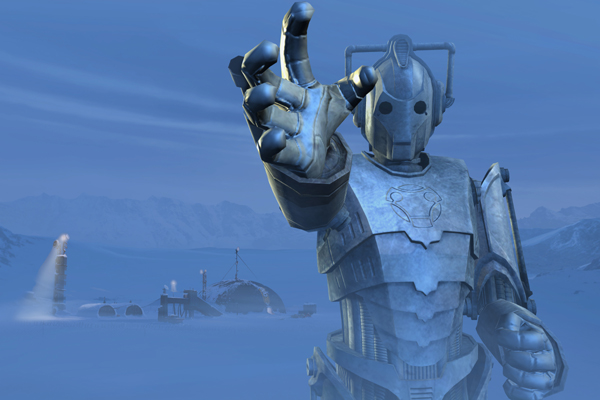
A virtual Cyberman in the snow

We think we've created stories and an extension of the Doctor Who world and mythology that can proudly sit alongside the best episodes and storylines of the past and present - but this time you control the action, you are the Doctor (except when you're Amy!).

I hope those new to games will take their first steps in an environment which will show that games are a wonderful creative medium in their own right.

And, a place where occasionally they might like to join their kids for some good, old-fashioned playtime.

Please do let us know what you think.

Simon Nelson is controller, portfolio and multiplatform, BBC Vision

Last Of The Summer Wine: Farewell to the world's longest running sitcom

Blog comments are currently unavailable. Find out more.

Post categories:

Cheryl Taylor|10:35 UK time, Friday, 4 June 2010

For a show that was about its characters' last hurrah even when it started in 1973, that really is some achievement. There are many other superlatives for Last Of The Summer Wine - surely this is the most decorated sitcom ever, with writer Roy Clarke OBE and several of the distinguished members of the cast receiving royal approval over the years.

It's almost certainly the only television programme in the world that, according to the press, can count both Her Majesty the Queen and the President of Afghanistan amongst its fans. Hamid Karzai likes to watch it with his son to unwind, apparently.

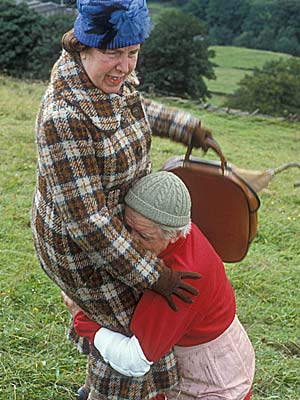
Nora Batty and CompoOver the years we've waved fond goodbyes to Compo, Nora and all the distinguished 'Third Men', and yet the series has endured.

That's because Roy and the team were smart enough to top up the Summer Wine with the very best British comic actresses and actors - Thora Hird, Jean Alexander, Bill Owen, Frank Thornton, Stephen Lewis, Burt Kwouk, Russ Abbot and many more.

But as you may have heard, after decades of the series' heartwarming, life-affirming comedy, we've decided that the next series, this summer, should be the last.

Accompanied by special episodes of Songs Of Praise and Countryfile, celebrating the hills and dales of Yorkshire, we're determined that Clegg and the oddball old folk who have populated the series down the years are celebrated as the series comes to an end.

We're sure that the coach parties who come to pay tribute at Ivy's tea shop and Nora Batty's front step in Holmfirth will be turning up for a few years yet.


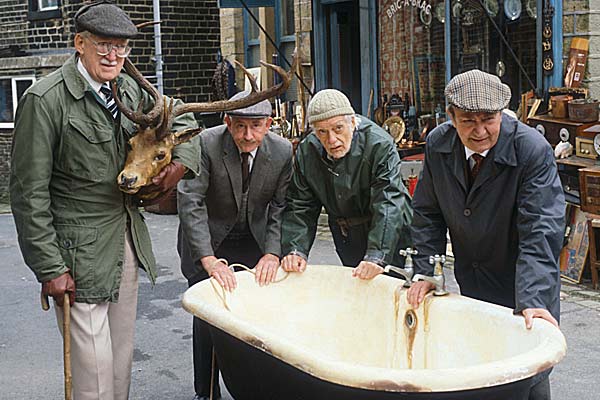
When a show has run to nearly 300 episodes, it's impossible to pick out a favourite moment, but Nora Batty's stockings and Compo's wellies, as well as the almost mythical runaway bath-tub will live forever in the comedy pantheon. And Ronnie Hazlehurst's evergreen, evocative theme tune is now an established part of the nation's cultural soundtrack.

Brian Wilde as Walter Foggy Dewhurst, Robert Fyfe as Howard, Bill Owen as Compo, Peter Sallis as Norman Clegg

And let's not forget the series' heroes. Compo, Clegg, Foggy, Cyril, Truly, Seymour, Tom, Hobbo, Entwistle, Alvin... the reckless, feckless oldies forever young at heart, metaphorically and sometimes literally beaten by their formidable women, are proud upholders of a long tradition of northern British humour stretching back to music hall and beyond.

Deserving of a special mention are the iconic talents that have been there from the start alongside Roy Clarke - on screen Peter Sallis and off screen, producer Alan JW Bell.

It wasn't an easy decision to end a national institution, and we thought long and deep before we made it. But there are more than 30 series of the show to look back on and enjoy and they all bear testimony to the show's warm and whimsical appeal.

So let's join the show's millions of fans, including (if they'd care to partake!) both Her Majesty and President Karzai, in raising a final toast to this most enduring and loved of comedies, and drink deep of the Last of the Summer Wine. 1973 was obviously a very good year.

Cheryl Taylor is controller, comedy commissioning

More from this blog...