BBC TV blog - BBC TV blog

Archives for April 2010

Introducing Luther - with love to Detective Columbo

Blog comments are currently unavailable. Find out more.

Post categories:

Neil CrossNeil Cross|15:14 UK time, Friday, 30 April 2010

The character that became Detective Chief Inspector John Luther was pinging round my head long before he had a name - or I had any idea how to use him.

He started as means to connect two ideas from different genres within the broad church of crime fiction. Luther has some of the Sherlock Holmes about him - some of that disinterested analytical genius.

But he's also got the emotional complexity and moral ambiguity more commonly found in the psychological thriller. It seemed to me that combining these properties - deductive brilliance and moral passion - in one man could make for a powerful and damaged, deeply heroic character.

In order to see this content you need to have both Javascript enabled and Flash installed. Visit BBC Webwise for full instructions. If you're reading via RSS, you'll need to visit the blog to access this content.

As for the format of the show - I grew up loving Columbo, and still love it. But Columbo's format - the 'howcatchem', or inverted detective story - wasn't really played to accentuate the drama.

Lieutenant Columbo was rarely at any personal risk (because that's not we wanted to see) and we knew he'd always get his killer in the end.

What we didn't know was how - which played a big part in making that show so incomparably satisfying.

The inverted detective story format hadn't really been revisited since Columbo ended, not that I know of anyway. So I thought it might be exciting to portray it as a kind of psychological duel between this driven, half-mad cop and the depraved criminals he hunts.

So we know who Luther has to catch. What we don't know is how on earth he's going to do it.

The process of making the show, from writing the scripts to seeing it reach the screen, has been exhilarating and sometimes petrifying. As these things go, Luther moved very quickly indeed. At times it felt like I was strapped to the nose cone of a rocket.

In the weeks leading up to take-off, I could feel the constant, seismic rumble of all those barely reined-in pounds per square inch of thrust. And once it started to actually move, all I could do was hang on and hope the teeth wouldn't get rattled from my head.

In a situation like that, you don't get writer's block. Or sleep much, either. But I did get to work with people I like, admire and trust. We were a proper team and we were on a mission. I revel in that feeling of camaraderie.
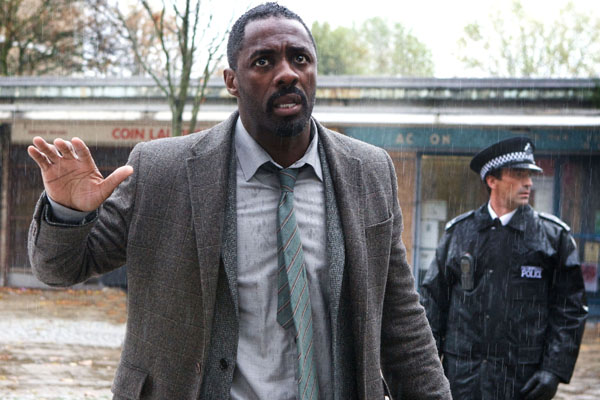
Detective Chief Inspector John Luther played by Idris Elba

The cast is so good I was terrified of meeting them as individuals, let alone as an ensemble - but that's essentially what happened. With the exception of Indira Varma (who couldn't be there) I met them all at the episode one table-read, a kind of first read-through rehearsal, where I was a gibbering wreck.

That night we went out for drinks.

The first hour or so, talking to Saskia Reeves, all I could think was: 'I'm talking to Saskia Reeves!'.

By 10pm, I was a few gin and tonics into the evening and Warren Brown - who plays Detective Sergeant Ripley - was doing his Lily Savage impression. I was able to relax somewhat and just revel in the fact that we'd brought together such an astonishing cast.

People often ask me what was the best moment, but to be honest it's hard to elect just one or two.

In the run-up to production and during production itself, I spent a lot of time laughing with my colleagues: in retrospect, given the time pressures involved, that seems remarkable. But a particular high point has to be casting Idris Elba.

We wanted the show to be special, so when it came to casting our leading man we'd decided to be ambitious, to set the bar high, thinking: don't ask, don't get.

Idris was on the list... because Idris is pretty much on everyone's list. But his name was waaaaaay up there, up above the cloud line. So when I got the phone call saying we'd got him - that was a good moment; as good as these moments get, I think.
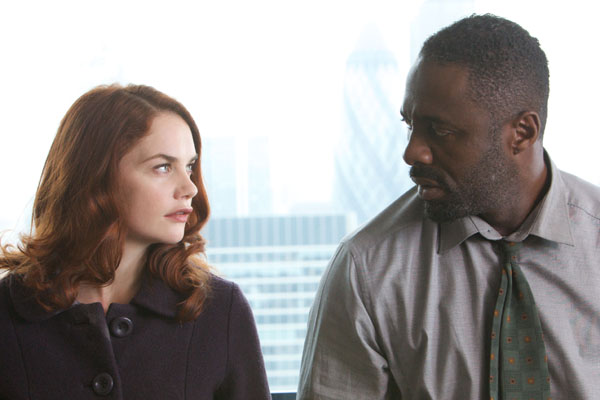
Detective Chief Inspector Luther, played by Idris Elba, sits with Alice Morgan, played by Ruth Wilson

Then there was watching the rushes at the end of the very first day's shooting. It had taken place outside episode one's "Morgan House" crime scene.

I saw Idris walk into shot, duck under the tape, and I thought: 'There he is, then. That's Luther.'.

I love John Luther, naturally. But I also love unreservedly the character of Alice Morgan. In fact, on that first night out with the cast I seem to recall telling Ruth Wilson (who plays her) that in many ways I considered Alice to be the perfect woman. She looked at me, it has to be said, with a degree of horror.

Alice was a formidable role - chilly and flirtatious, murderous and vulnerable, high-minded and caustic, sometimes in the same sentence. But Ruth makes her absolutely real, and utterly riveting. There's a moment in episode four where she truly frightens me.

I was on set when Idris and Ruth filmed their first scene together. It was a spine-tingling event - but I don't think it's good for me to hang round on set, because that's just not where a writer belongs. So I made myself scarce and let them get on with their jobs.

As for what you can expect from Luther and where he goes next ... well, if I told you, it wouldn't be a surprise. Let's just say, the pressure on him doesn't let up. Not for a second.

Neil Cross is the writer of Luther. Luther starts on BBC One at 9pm on Tuesday, 4 May

Modern Masters with Alastair Sooke: Do the walking tour

Blog comments are currently unavailable. Find out more.

Post categories:

Mark BellMark Bell|17:12 UK time, Thursday, 29 April 2010

Just a few days to go until Warhol, the first of BBC One's Modern Masters series, is broadcast. It feels like we are paddling into uncharted territory - putting modern art and a new presenter Alastair Sooke into primetime BBC One. What are we trying to do?

The history of western art more or less makes sense until about a century ago when everything seemed to go a bit crazy. The normal rules of painting suddenly ceased to apply. Suddenly artists were less interested in making straightforward pictures of the world around them.

In order to see this content you need to have both Javascript enabled and Flash installed. Visit BBC Webwise for full instructions. If you're reading via RSS, you'll need to visit the blog to access this content.

Maybe it's partly because the world got more complicated. Einstein rewrote the laws of physics and Freud labelled the unconscious. Photography seemed to be able to do the job of straight depiction quicker and better. And because the art got weirder, knowing what to make of it got more difficult.

New artistic movements arrived at dizzying speed - impressionism, expressionism, Dadaism, futurism, surrealism - it's not surprising that people looking at this new art started to feel a bit alienated. And even now, 100 years later, I think many people still feel confused.

By concentrating on the work of four key artists - Warhol, Matisse, Picasso and Dali - we give a sense in Modern Masters of what happened to art in the 20th Century.

They each changed art in their own way: Warhol as a pop artist, Dali as one of the original surrealists, Matisse as the master of colour and simple form, and Picasso, who could probably have invented modern art on his own. (It's said that a normal day for Picasso would be to paint three masterpieces before breakfast, then spend the day on the beach seducing beautiful women.)

Modern Masters presenter Alastair Sooke

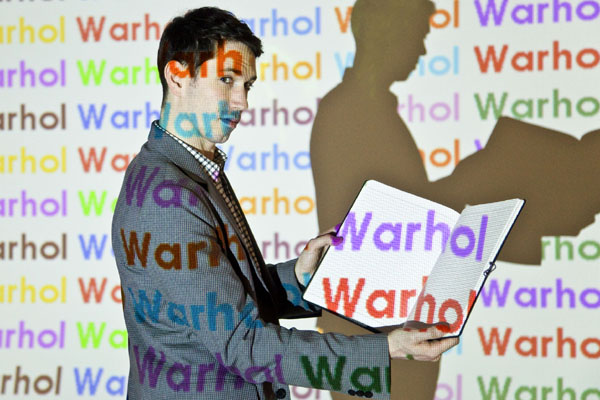
Alastair Sooke is new to presenting, and he's a natural communicator. He knows about the art and talks about it in a clear and memorable way. And he's a good sport too - dressing up as Andy Warhol, trying his hand at a Matisse cut-out, and taking Dali's hovering fried egg for a walk.

Alastair goes to meet artists, biographers and curators and also talks to designers, advertising gurus and people from the fashion world to find out how these artists influenced culture more broadly.

The designer Paul Smith reveals that he gets a lot of his inspiring colour combinations from Matisse. Noel Fielding from the Mighty Boosh talks about how Dali's surrealism influenced his comedy and one of Picasso's models reveals how she inspired the actress Brigitte Bardot.

Hopefully you get a sense that these revolutionary, cheeky, inspired artists did more than paint a few pictures and make a lot of money - they really did change our world. I hope the series will inspire people to go out and discover all the art that surrounds us, much of it there to be enjoyed for free.

In order to see this content you need to have both Javascript enabled and Flash installed. Visit BBC Webwise for full instructions. If you're reading via RSS, you'll need to visit the blog to access this content.

Alongside the series, BBC Online have a great website which includes a series of walking guides around some of the country's modern art landmarks. Viewers who can get to London's Victoria and Albert museum in May and the first half of June will be able to see rarely-seen works from their collection by our four masters Warhol, Dali, Matisse and Picasso.

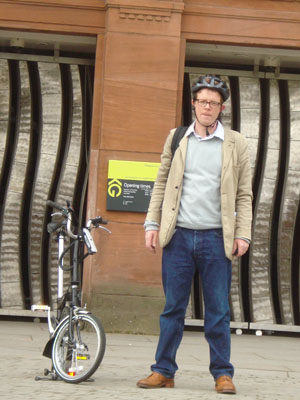
I tried out the Glasgow and London walks myself, armed with a print-out art walk from the BBC website. First off, I headed for the central London one last Sunday, accompanied by my bike and a musician friend.

By Marble Arch we came across the monumental sculpture of a horse's head. The absurdity of it - a horse balancing on the tip of its nose - makes me think of Dali, as well as the faithful anatomical rendition. Of course, as I have the guide with us, I know it's not balancing, it's drinking.

Heading back along Bayswater Road, you notice the influence of the modern masters in the artwork hanging for sale on the railings of Kensington Gardens.

Mark Bell with his trusty bike on the walking tour

There is Dali, Matisse and Picasso in the heavy nudes and erotic dreamscapes. There might be a bit of 1970s music album cover art in there as well. Some very British nods to Warhol with paintings of Colman's Mustard, Marmite and Flake bars. There are also butterflies and spin paintings, which makes me realise that what Damien Hirst, one of today's most celebrated modern artists, does is perhaps not quite so easy as he makes it look.

On Tuesday, it was off to Glasgow, where I took my folding bicycle on the sleeper train. The Walk of Art (or in this case bike of art) was a great way to see some of the best of the city on a crisp spring morning.

There is some great modern sculpture on the city's streets and in public places. On the way back down Sauchiehall Street I spot an elegant-looking sweet shop, prominently featuring the Dali-designed Chupa Chups logo along with some Warhol screenprint-inspired graphics.

The very act of embarking on a walk with art appreciation as your goal makes you see the world in a different way. I hope that the series too will persuade people to look at the work of these and other modern artists afresh.

A hundred years ago modern art was in its infancy. By now it has proved it is here to stay, though it will be interesting to see what the art it has inspired looks like in 100 years' time.

Mark Bell is the commissioning editor of BBC Arts. Modern Masters starts at 9pm on Sunday, 2 May on BBC One
Five Daughters: Why their story had to be told

Blog comments are currently unavailable. Find out more.

Post categories:

Susan HoggSusan Hogg|14:46 UK time, Monday, 26 April 2010

We were all watching with horror at what unfolded on the news when five women in Ipswich were murdered back in December 2006. As the women started to go missing, I was one of those mums sitting on the sofa, looking on with fear.

Then Paula Clennell gave an interview where she was asked why she was still working as a prostitute after her friend, Gemma Adams, had gone missing. Paula said she was frightened but needed the money and there's no other way of getting it.
In order to see this content you need to have both Javascript enabled and Flash installed. Visit BBC Webwise for full instructions. If you're reading via RSS, you'll need to visit the blog to access this content.

And it struck me that this story was about drug addiction, not prostitution. Obviously the women were putting themselves in a vulnerable position. Even after their friends had gone missing. Even after Gemma Adams' body was the first to be discovered and they knew there was a murderer, they were still getting into cars because they needed the money to buy drugs.

Then Paula, who had given that interview, went missing herself. We'd watched her explain why they were still working the streets and then her body was discovered.

That was where we all became involved in a different way. And something changed in me - I desperately wanted to find out more about these young women's lives.

Apart from a few broadsheets, which went into the background of why these women were on the streets, most of the media were simplistic, characterising the women as two-dimensional prostitutes.

The BBC had complaints about it and I felt that public empathy was changing. Rather than seeing them as prostitutes and therefore somehow deserving of what happened to them, people like me were seeing these women as real people and were terrified for them.

It kept nagging at me, long after the situation was finished and the murderer, Steve Wright, had been arrested.

Five months on, I decided I would like to start researching. I was supported by BBC Drama Productions who thought there was an important story to tell.

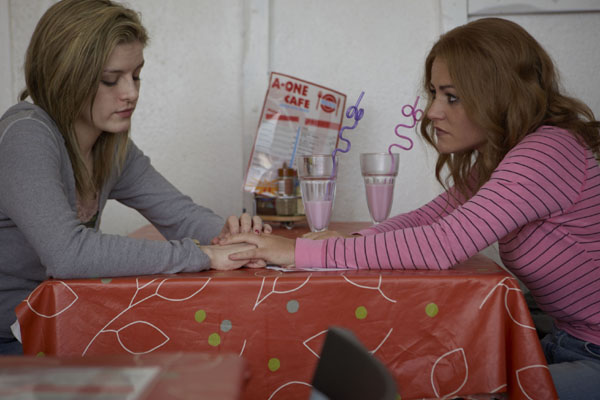
Gemma Adams and Anneli Alderton, played by Aisling Loftus and Jaime Winstone respectively, sit at a cafe table

First, we went to Suffolk Police because they were the holders of the story. They'd been inundated with requests from makers of documentaries and factual dramas. They found all the requests difficult to cope with but, eventually, the police press officer agreed to meet us and he was impressed with the way we wanted to tell the story.

We wanted to focus on the young women and reclaim aspects of their lives. They weren't only prostitutes - they were ordinary young people with hopes and dreams and ambitions, just like anybody else. They were like my kids, anybody's kids.

It's too cosy to say that this kind of horror happens over there to someone else on an estate somewhere. Because it's absolutely not true.

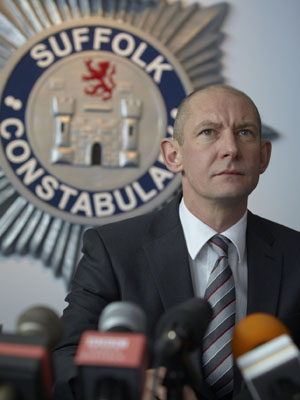
Then we met Chief Superintendant Stewart Gull, who led the investigation. If you look at the press coverage, he gave a lot of interviews and never once referred to the victims as prostitutes.

He always called them by their names, or collectively as young women. He showed an immense amount of respect. The families deeply appreciated that. He treated them with a lot of care.

Chief Superintendent Stewart Gull, played by Ian Hart, faces the press

Stewart wanted to help us and so director Philippa Lowthorpe approached the relatives through their family liaison officers.

Three of the families wanted to be involved - those of Anneli Alderton, Annette Nicholls and Paula Clennell. So Philippa, producer Simon Lewis and scriptwriter Stephen Butchard spent time talking with the three families about their lost sisters and daughters.

Gemma Adams' family didn't want to be involved but had no objection to us making the drama. And there's minimal representation of Tania Nicol in the drama, in line with what her family wanted.

I didn't meet the relatives because my responsibility as executive producer is to step back and take an overview of the drama. You can get close to people and feel responsible for telling their stories when you're doing this kind of work. It's emotional. Someone has to stay objective, outside the process and make sure the drama works as a piece of drama.

Some people asked why we haven't gone into more detail about how the women first got into drugs.

It can be the simplest of reasons, and sometimes there isn't a reason at all. You take a wrong turn, and then another wrong turn. It can be experimentation or it can be because you've just got the wrong boyfriend. It can be lots of reasons but once you're hooked, getting off heroin is extremely tough.

I certainly had no idea how hard it is to get off heroin and crack until I did this programme. Those women really, really tried. And their mothers tried hard to help them. I had thought you do a bit of cold turkey and you just need to be disciplined. But it's not like that, it grips you.

We didn't set out with an agenda, but now that it's done, I would like this drama to be shown in schools. I think it shows how easy it is to get into drugs and how unbelievably difficult it is to get off them.

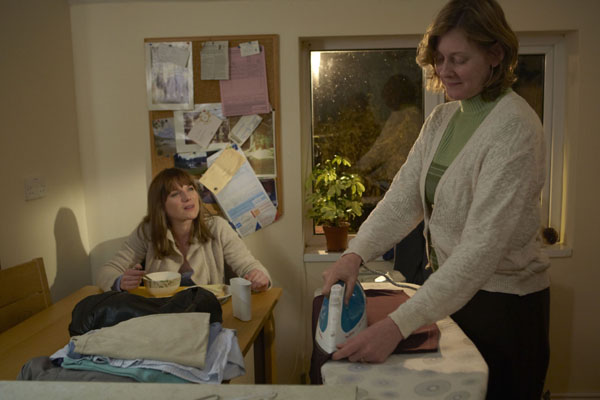
Rosemary Nicholls and her daughter Annette, played by Sarah Lancashire and Eva Birthistle respectively, chat as Rosemary does the ironing and Annette eats

The drama hangs on how the police worked the investigation. The families told us how impressed they were with Suffolk Police's support. They trusted them and how they had handled the case.

The detail was important and we got that absolutely right. It was researched with Stewart and other officers, like WPC Janet Humphreys.

Janet knew the women well. Her onscreen involvement with the local drugs project, Iceni, is absolutely accurate.

The performances from everyone are fantastic and yet I don't think I want to highlight a moment or an actor standing out, because honestly the whole production has to speak for itself. It unfolds in three parts and each plank of the storytelling is important.

You'll notice it's not shot like a traditional crime drama. It's much more muted and real. We did that on purpose.

What we really, really did not want to do and absolutely all areas of production were so aware of this - costume, make up, lighting - we would never be salacious, ever. We were never going to go for the cheap shot. It's about real people and their lives. That's the tragedy.

Stephen set out to capture the poetry in these young women's lives and their tragic loss. And I think that he and Philippa have achieved that.

Susan Hogg is the executive producer of Five Daughters. The first episode can be watched on iPlayer, episodes two and three are on BBC1 tonight (26 April) and tomorrow (27 April) at 9pm.

Doctor Who: The return of the Weeping Angels

Blog comments are currently unavailable. Find out more.

Post categories:

Steven MoffatSteven Moffat|17:32 UK time, Thursday, 22 April 2010

Good Doctor Who monsters have to come back - it's a rule. But my feeling is that you always have to bring back a monster and do something different with it. So although Blink was a very popular episode, it was also a very spooky, cerebral episode.

These Weeping Angelsepisodes are really the polar opposite, these are like a big action movie - albeit an action movie with bad guys that can't actually move! It's a very different feeling.

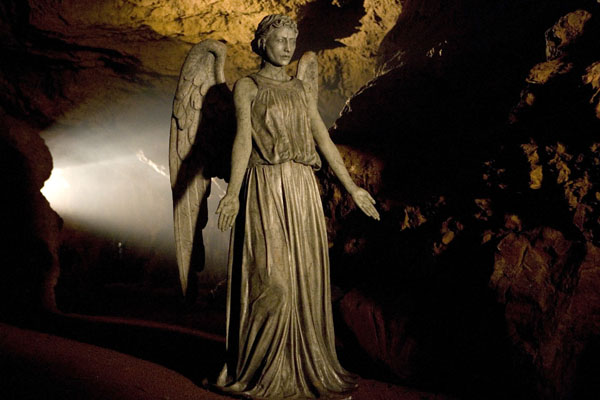
A Weeping Angel bares its fangs in a cave in The Time Of Angels episode

Last time, the implication was that they were hiding out on earth, as scavengers who are just surviving - they didn't have a big terrible plan. This time there really is a big terrible plan which goes beyond mere survival, and is almost like a war.

The best way to explain the difference between Blink and these two episodes would be to say that I think the best conceived movie sequel ever was Aliens following Alien. It took the same monster into an entirely different type of film.

That is very roughly the model for this. Blink was a small, low-key one and this is the highly coloured, loud, action-movie one.

In order to see this content you need to have both Javascript enabled and Flash installed. Visit BBC Webwise for full instructions. If you're reading via RSS, you'll need to visit the blog to access this content.

Filming this scene (above) was a completely surreal experience. I'm used to the fact that in television the first day of filming will probably be something fairly inconsequential and involve a minor character getting shot, or a close up of a hand or something. It's not usually something big and iconic.

But, by sheer chance, the very first scene that we shot involved The Doctor and Amy arriving on a planet with River Song and looking at the crashed spaceship.

So it couldn't have been more iconic - the Tardis was there! It was also perfect paparazzi fodder because it had everything you could possibly have, which wasn't intentional actually.

I vividly remember arriving on that beach. I saw the Tardis in the distance, which was very much the culmination of all that time waiting to get started - which you could argue was two and a half years, or 40 years for me.

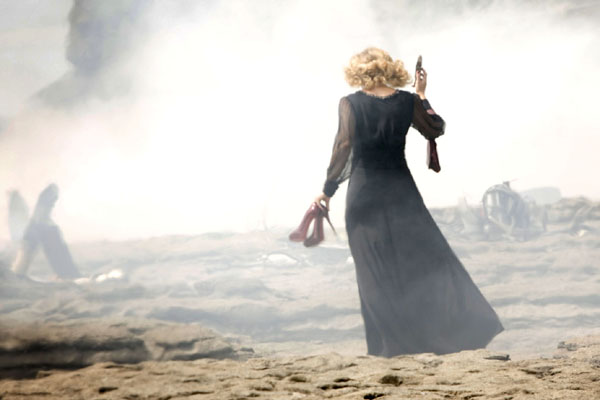
River Song, played by Alex Kingston, walks across the beach with red high heels in hand

First walking onto a big, grand, typical Doctor Who location and seeing the bright blue box waiting was so odd for me. We'd be so careful up to that point, and not put the Doctor Who name on any of our signs but still the paparazzi and fans found us within about 20 minutes!

I was stood on set with my phone, looking at pictures of myself which fans had taken already on the web. On one occasion I saw a photograph of myself watching the filming, which had been uploaded so quickly that I hadn't moved from the position I was in by the time it was on the web!

My other memory is of this day ending early because the tide came in unexpectedly. I did slightly wonder if this would be the shape of things to come.

That scene on the beach was about three pages longer originally. The rain on the second day of filming was so torrential that I suggested I could cut three pages, provided I could relocate them in a new Tardis scene.


I ended up adding the scene which sits immediately after the credits, with River flying the Tardis better than The Doctor. That's a lovely scene, and a much better start to the show, but it's all a consequence of torrential rain and the tide coming in.

On the second day I ended up sat in the production van, very grumpy, hastily rewriting scenes. The story of those two days is really about the plunge from the extraordinary romantic beginning with the Tardis and the big iconic scene, to the reality of actually trying to film it. It was a great lesson in having to cut pages and deal with the reality of the challenges we face.


Later on in the episode there's a really nice accidental moment where The Doctor hangs from the strap on the ceiling and it breaks. The very first time Matt did it, it was an accident - he wasn't supposed to do that, it's just typical Matt, breaking everything - but the director liked it, so he kept it in.

The version we see on screen isn't the real accident, it's him doing it on purpose, but I do think it is very funny. I think particularly the looks from the girls and the fact that he doesn't mention it at all - he just tries to carry it off as a sort of Stan Laurel moment. It's extremely charming.


I think the thing that has come back with Matt is the idea that The Doctor is a bit silly at times. He's a slightly silly old buffer in a few ways.

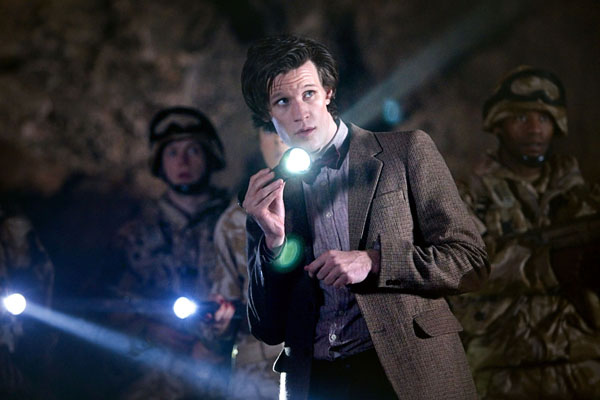
Matt Smith as The Doctor looks around a cave in The Time Of Angels episode

We find out he's a bit rubbish at flying the Tardis and he trips over his feet and breaks things. Both Chris and David were quite cool Doctors, and while Matt certainly isn't short on cool, he has an amazing clumsiness. He's halfway between Indiana Jones and Stan Laurel.


The Doctor has a belief that he is cooler than he actually is. For instance in that first episode where he yells "Who da man?" and everybody cringes.


It's those moments that really show where the old man comes through in Matt's performance, because there is nothing wrong with a young man shouting that, the awkwardness is when your dad tries to say it. That's The Doctor through and through.

Steven Moffat is executive producer and lead writer for Doctor Who. The Time Of The Angels can be viewed on iPlayer. Part two of the story - Flesh and Stone - will be broadcast on BBC One at 6.25pm on Saturday, 1 May

Welcome to Lagos - it'll defy your expectations

Blog comments are currently unavailable. Find out more.

Post categories:

Will AndersonWill Anderson|13:18 UK time, Thursday, 15 April 2010

When my friend rang to ask me out for a drink, I was already in Heathrow Terminal 5. "I'm not going to be around for the next four months or so," I told him. "I'm going to Lagos."

His immediate reaction - "Why? What's wrong? Are you in trouble? Is it the police?" - was typical. Nigeria, and Lagos in particular, seems to have a terrible reputation in Britain.

Everyone thinks of it as a noisy, dirty, dangerous city, probably because all we ever hear about it on the news is the corruption, religious violence, and dodgy email scams. I was convinced there was more to it than that, which is why four of us were heading out there for such a long period of time.

Our insurers had insisted that we were met at the airport by a team of armed police men, who would escort us and all our expensive filming equipment safely to our hotel. I have never been so embarrassed in my life.

As our convoy sped through town, sirens wailing, blue lights flashing, it seemed to me that this was by far the best way to advertise our arrival to all the criminals in the city.

The next day, feeling sheepish, we dispensed with all policemen, armed guards and security advice, and decided to go it alone.

We were heading for the ghettos and slums, which make up three quarters of Lagos, to find strong characters who could would let us into their lives, and present them to an audience in the UK. We had no idea what to expect or how we'd be received.

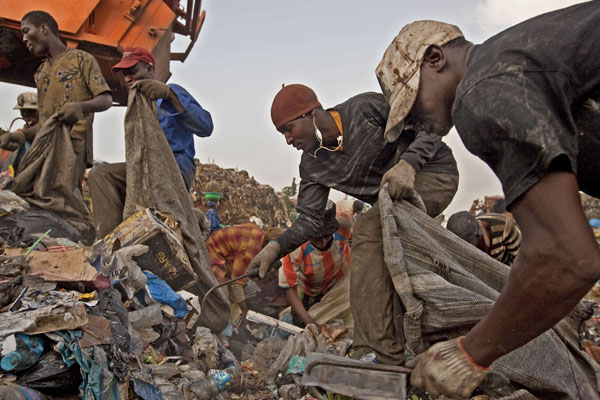
First stop was the city's main dump site, Olusosun. This definitely isn't on the tourist trail of Lagos, but then Lagos doesn't have much of a tourist industry at the moment. Some 5,000 people work on the dump, and we were immediately struck by how organised and efficient everything was.

As well as all the scavengers working behind the dump trucks, grabbing anything and everything they could to re-sell to the re-processing factories, there were shops, bars, restaurants, a mosque, a barbers, and even a cinema.

100413_dumpscavengers_600.jpg

The longer we hung out on the dump (it very soon became one of our favourite places to film, because the people were all so friendly there) the more astonishing it became. It turned out that the scavengers even had their own form of democratically elected chairman, who sorted out any arguments or disagreements.

The dump became symbolic of everything we were trying to achieve in the films. It looks at first sight like a rough, lawless, dangerous place, and most people in this country will be horrified to see people working there.

But in actual fact, through the eyes of the people who actually DO work there, it's a well-organised place where there's good money to be earned. Decent, honest people choose to work there, preferring a life of grime to a life of crime. Some of them are university graduates.

They are proud of the fact that they earn an honest living, and are making a better life for themselves and their families through sheer determination and hard work.

We realised the scavengers were people to be admired rather than pitied, and it changed our whole perspective on the place. They didn't feel sorry for themselves, so why should we feel sorry for them? We decided that the films should celebrate their resourcefulness, and challenge our audience's views of what poverty is.

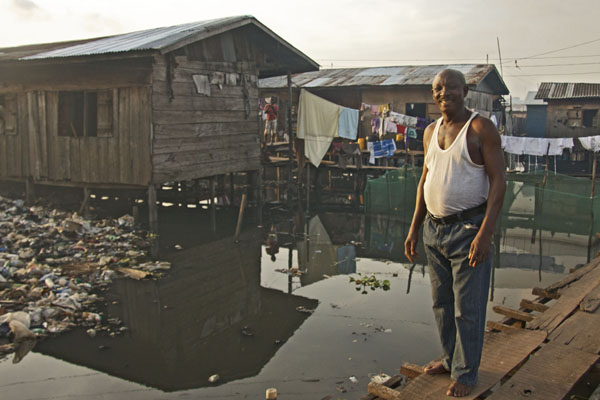
After the dump we went to Makoko, an extraordinary floating slum, where everyone travels round in boats. Some people call it Lagos's version of Venice.

Programme two's star Mr Chubbey outside his home on the floating slum of Makoko

There's 100,000 people living on houses built on stilts, and after a week or so of drifting around in boats, stopping at people's houses and talking to them, we stumbled across Mr Chubbey, who went on to become the star of programme two.

He has 18 children to look after, and is always on the look out for some scheme or another which will help him make more money. He's like a character from Only Fools And Horses, buying selling, wheeling and dealing, doing dodgy deals and getting by on his charm and his luck. All that's missing is the camel skin coat.

The last film is set on a beach right in the heart of the swankiest part of town. It sounds idyllic - white sands, clear blue Atlantic waters, baking hot sunny days - and in many ways it is.

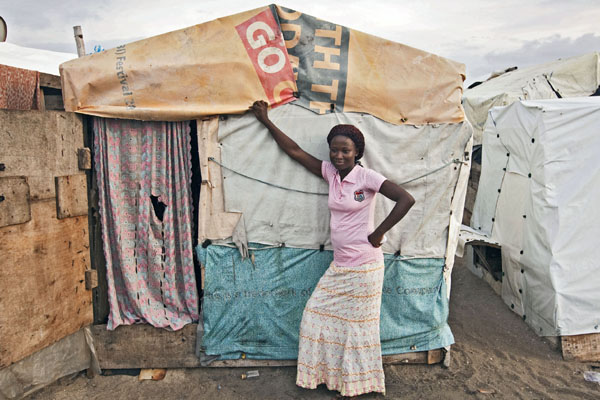
But it is also home to 1,000 or so squatters, who have built homes on the sand because they have nowhere else to go. After a couple of trips, walking along the sands, explaining what we were doing to the inquisitive children, we met Esther, a sparky, intelligent, beautiful young woman who had been staying on the beach for the last six years.

She lived with her husband Segun in a little house which they had built themselves out of scrap wood, cardboard and old tarpaulins. It probably cost them about £80.

Esther, the star of programme three, outside her house on the slum on the beach

But when Esther and her husband started to have problems in their marriage, and it looked like they were going to split up, they used to have terrible arguments about who was going to get the house - every bit as vicious as they would be if they were living in a mansion in Beverley Hills.

We realised then that all our characters, wherever they lived, however extreme their working environment, went through all of the same things which we do in the West - love, heartbreak, marriages, births, deaths etc. It's just that they live on a different scale to us, in the slums of the fastest growing city in the world, and with no money. This forces them to be more resourceful, energetic, and optimistic than most people in the West.

And yes, they may be terribly poor, but that doesn't stop them being human and, if the films have succeeded, then I hope they've succeeded in showing that.

Will Anderson is the series producer of Welcome To Lagos. Welcome To Lagos is a three-part series on BBC Two, Thursdays at 9pm, from 15 -29 April.The first episode is now available on the iPlayer

How to get the best out of HD TV

Blog comments are currently unavailable. Find out more.

Post categories:

Danielle NaglerDanielle Nagler|15:04 UK time, Wednesday, 14 April 2010

Over the last few weeks, this BBC TV blog has tried to bring you insights on a diverse selection of programmes: From the final return of Ashes To Ashes, it has travelled to new children's series ZingZillas , by way of Cracking Antiques, and Over The Rainbow.

It is a selection that highlights the breadth of programming on the BBC at any one time. But all those programmes were also made in High Definition (HD) and are shown on the BBC HD channel in addition to standard definition channels as a result.

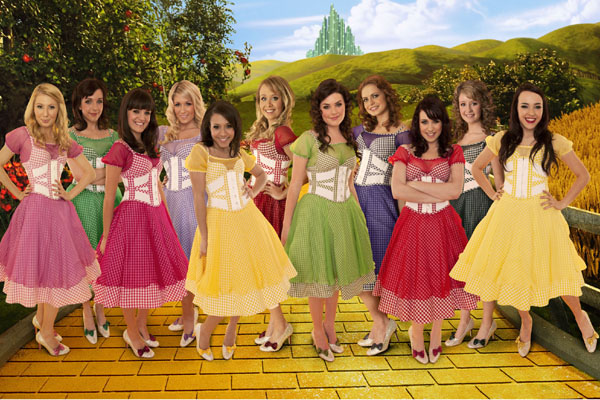
The young hopefuls vying to play Dorothy in Andrew Lloyd-Webber's production of The Wizard Of Oz line up in a publicity show for Over The Rainbow - one of the shows broadcast on the BBC HD channel

HD is undoubtedly buzzing this spring - take a look at any advert for anyone who sells TVs and associated boxes, or wander around your local shopping centre or supermarket.

A few years ago HD was specialist television - it is now pretty much everywhere. Around 23 million HD-ready TV sets are estimated to have been sold in the UK, and 70% of the TVs sold in the last three months of 2009 were HD-ready according to the broadcasting regulator Ofcom.

But there are millions of people across the UK who mistakenly believe that once they've got their HD-ready TV they are watching HD pictures, regardless of whether they've installed an HD set-top box or Blu-ray player as well, according to the British Video Association.

So in case you are thinking of investing - either for programmes you are passionate about experiencing in true HD, or perhaps because you want to see the World Cup in June shown in full in HD for the first time - I thought it might be helpful to explain what you need to do, because getting HD pictures to the screen you want to watch them on is not absolutely straightforward.

An HD-ready TV is the first step. But you will also need an HD tuner. That could be built into your television set - the popularity of integrated TVs for general digital television viewing means that there are integrated Freesat HD TVs available, and a range of Freeview HD TVs have already arrived in shops, with more expected.

Alternatively, you will need an HD set-top box, which may or may not be combined with a hard disc recorder (like Sky Plus HD for example). And the days of the Scart lead are numbered - you will need the HD version, known as an HDMI lead - to connect your box if you have one to your television.

You can get HD from all the main digital television providers. Freesat, Sky and Virgin have had HD available for some time. Freeview has just launched a selection of HD channels, with availability across the UK increasing steadily, and a developing range of alternative equipment.

Choosing the right equipment and getting it into your home gives you the ability to watch HD television, but doesn't mean that everything you watch going forward will be HD. HD channels require more capacity than standard definition - so broadcasters need to create them specially and additionally to existing services. So BBC HD, and the other broadcasters' HD channels are separate entries on the channel guide (for the BBC Channel 50 on Freeview HD, 108 on Freesat and Virgin, and 143 on Sky).

Even then, you should not assume that everything on an HD channel is in fact in HD. The BBC HD channel only broadcasts programmes made in HD. To count as an HD programme, the vast majority of the pictures have to have been shot using broadcast-quality HD cameras (not usually the HD camcorders that you might use at home). The pictures then have to have been processed as HD too.

Within an HD programme there may be a small amount of standard definition material - the BBC, in common with most other broadcasters, allows up to 25% of a finished HD programme to be non-HD.

We don't do that to save money - but because sometimes we need to use library pictures or sections of old films which were not made in HD, or we need to use very small cameras - for example for secret filming - which have been slow to develop in HD at the quality level needed.

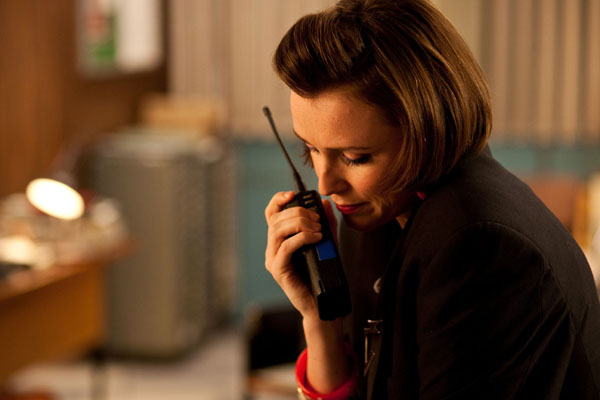
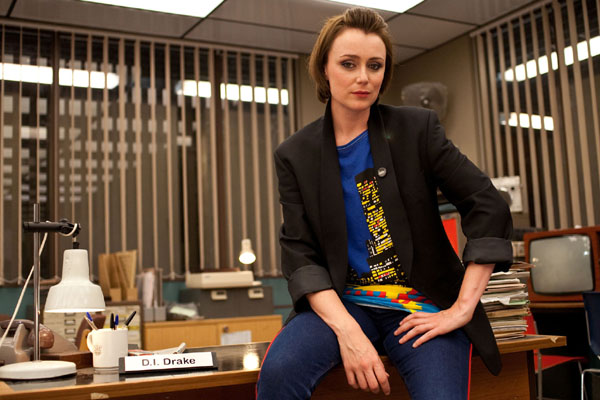
Keeley Hawes as Detective Inspector Alex Drake in Ashes To Ashes, a programme also shown on the BBC HD channel

When the BBC started out in HD television, we wanted to use the channel we had available to offer as much HD programming as possible. We also guessed that we would find programmes we wanted to make in HD across our channels. So BBC HD does not follow the schedule of just one of our existing services but pulls in HD programmes from all of them.

This means that you can find Doctor Who (BBC One), and Doctor Who Confidential (BBC Three) on the channel, as well as Who Do You Think You Are? (BBC One), and Dragon's Den (BBC Two), and the World Cup (largely BBC One), Wimbledon (largely BBC Two) and Glastonbury (BBC Two and BBC Three) this summer.

But the majority of HD channels available in the UK are "simulcast channels". This means that they show exactly the same programmes at the same time as standard definition channels but when the programmes have been made in HD you will be able to view them in HD.

Most sport and much drama are now produced in HD, but it is still developing as a way of making programmes and therefore you will see a certain amount of "upscaled" programme. Upscaling means that the number lines in the Standard Definition (SD) picture are effectively doubled - from 576 to 1080 - to fill the HD screen.


In some people's opinion - and depending on the size of screen and the cameras used to make the programme - this can produce better pictures than on the equivalent SD channel. But it is not HD (and on BBC HD we don't do that).

So, to sum up, if you want to watch HD programmes, they need to be made in HD, shown on an HD channel, and you will need an HD TV coupled with an HD tuner inside the TV or in a box connected with an HDMI lead. There is more detailed advice on our website and trust me - you need no more technical expertise than is required to operate a remote control.

I believe - like many others who watch HD - that HD can deliver simply incredible television. I'd like every HD viewer to experience that, rather than feel let down by pictures that feel rather ordinary, and may in fact be standard definition.

Not every programme will blow you away - I've never found that to be the case in any medium with any range of content, and as programme producers I know that we're still learning how to get the best out of the technology in every situation. But I hope as you travel into HD you will find some outstanding examples of HD.

As someone once wrote to me, it can be like the excitement of the move from black and white to colour, seeing the television screen transform, and the world inside it come alive.

Danielle Nagler is controller of BBC HD

The inspiration for my Passionate Woman

Blog comments are currently unavailable. Find out more.

Post categories:

Kay MellorKay Mellor|09:38 UK time, Monday, 12 April 2010

I must have been about 28 when my mother told me. She was at the sink washing up at the time and I was drying the pots. It's hard to remember what's fact and what's fiction now, but I'll try.

"We had a bit of a thing," was how she described her affair with the Polish neighbour that lived in the two-roomed flat below her. I thought I was hearing things. One minute we were talking about me and my husband having a bit of a fall out and somehow the conversation turned to Mum telling me how she'd committed adultery with a Polish fairground worker.

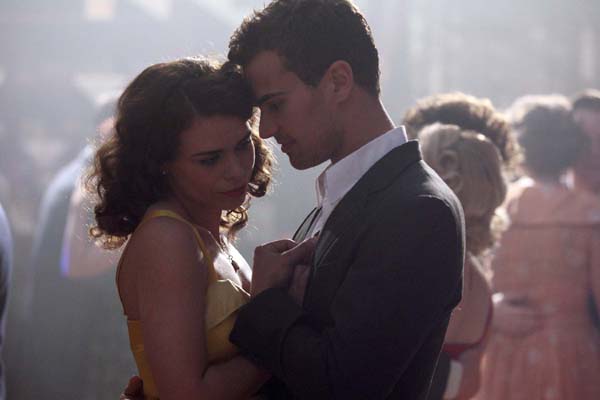
Billie Piper as Betty and Theo James as Craze dance with each other

Now you'd have to have known my mum to realise how shocking that was. She was the most ordinary woman, very mumsy, not a vain bone in her body. She wasn't one to show her emotions, she was strong but affectionate with me and my brothers. She wasn't a man's woman, she had three sisters and was, in her own way, a bit of a feminist - way ahead of her time.

My dad had a violent streak and she divorced him when I was three, refused to wear a wedding ring, wouldn't accept money off him and refused to take 'handouts' from the state, preferring to work full time as a tailoress instead. It sounds nothing now, but you've got to remember this was the 1950s, people didn't get divorced. You married and that was it - for better or worse. I remember the other kids off the council estate making fun of me and my brother, saying we didn't have a dad.

Anyway I digress.

"His name was Craze and I loved him with every breath in my body," she continued. She'd mentioned a man and the word love in the same breath - it was unheard of for her to say that; even her second marriage had not been successful.


But even more shocking than that, I realised that tears were falling from her eyes into the washing up bowl. I tried to reassure her.

"I'm happy for you Mum, I'm glad you found someone to love."

"He was murdered."

"What? In Leeds?"

"In a fairground brawl. I've never been able to tell anyone."

It was hard to take it all in and then I realised that not only had Mum never told anyone about this affair, she'd never been able to grieve properly for the man she'd loved and lost.

For the best part of thirty years she'd held onto this grief - it had been locked in. No wonder her marriages hadn't worked and she found it difficult to show emotion. She had no trouble showing emotion now - 30 years of tears cascaded into the washing up bowl as she continued with her story. At the end of it she was exhausted.

"You won't ever tell anyone will you?" She made me promise. And I didn't - for 10 years. Then it was my younger brother Philip's wedding and I could see this really pained her as she faced a life alone with my stepfather Alan.

He was a good man and the marriage should've worked. He was the same religion (my dad was a Catholic, Alan was Jewish) and he was political - a strong socialist, but they clashed.

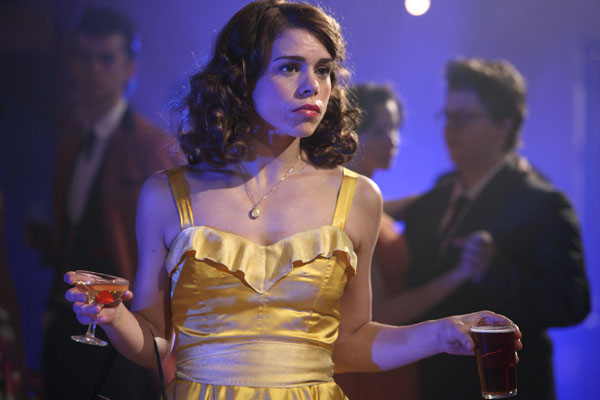
Billie Piper as Betty holds a gass of wine and a pint of beer in A Passionate Women

The look in my mother's face reminded me of the day she told me about Craze. Somehow these two events - my mother's affair and her youngest son getting married - were linked.

A play was burning inside of me and I started to write it for the West Yorkshire Playhouse. I called it A Passionate Woman - because I realised that's what my mother was.

I set it on the day of her son's wedding. Betty climbs into the loft to escape from all the arrangements and chaos and drops the flap shut! Her dead lover Craze comes to her and she relives her time again with him. Her son and husband realise she's in the loft and try and coax her down to the wedding, but she's not going anywhere - except up!

The play went into rehearsal with the glorious Anne Reid playing the middle-aged Betty. Two days before press night, I thought I should take Mum to see the play. It was essentially Mum's story, but I'd changed loads of things and I was interested to see if she realised it was her story. She absolutely loved it, wanted to see it again.

The second time she saw it, she turned to me at the end and with tears and bewilderment in her eyes she said: "This is my story."

I reassured her. "Yes, but I'm not going to tell anyone and you're not, so who's going to know?"

Then came the opening night of the show. All the press were there. The play went well and as is customary with a new play, the cast, myself and the director David Liddiment all sat on the stage to answer questions. One particular journalist kept asking me where I got the idea for the play - "Did something or someone inspire it?"

I could see my mother sat in the middle of the audience - I had to protect her and keep my promise. I replied: "Yes, someone did inspire me to write it, but I'm not at liberty to say who it was."

And then from the middle of the auditorium came -

"It was me!"

I looked up. My mother was waving her hand in the air; her eyes were gleaming with pride. "It's MY story!"

And as the press turned to interview her, I watched the years of shame and secrecy drop away. My mother came out publicly - she'd had an affair, she'd known love, she had a sexual awakening, she was A Passionate Woman.

Two years later the play opened in the West End to rave reviews. The play ran for a year at the Comedy Theatre and has toured extensively all over the world. Film rights were fought for, but I held on to them tightly as I didn't want Cher playing my mum on a rooftop in Detroit.

It's still running in Poland I think.

Kay Mellor is the writer of A Passionate Woman. The first episode is available on BBC iPlayer until Sunday, 25 April. Part two will be broadcast on BBC One at 9pm on Sunday, 18 April

What I love about being in Outnumbered

Blog comments are currently unavailable. Find out more.

Post categories:

Tyger Drew-HoneyTyger Drew-Honey|11:04 UK time, Thursday, 8 April 2010

The funniest moment of filming the third series of Outnumbered was when there was a rather confused pigeon flapping around the family kitchen. It was absolutely hilarious to watch the pigeon's trainer failing to maintain control and even funnier watching Dan squirm and yelp any time the pigeon came close.

But I think I'd have to say my favourite scene of series three was one featuring myself and Kelly, a young good looking waitress that Jake has his eye on.

It was filmed in a tiny little corridor and it was a real squeeze to get two cameras, a boom and its operator, and the clapper-board loader all in such a small space. The gist of the scene is that Jake is infatuated and he and Kelly literally bump into each other in this small corridor and it's really awkward.

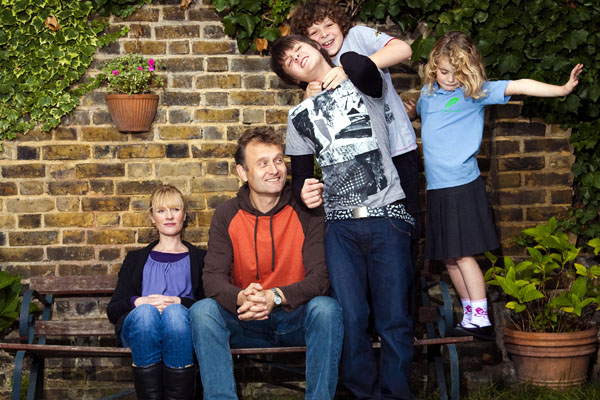
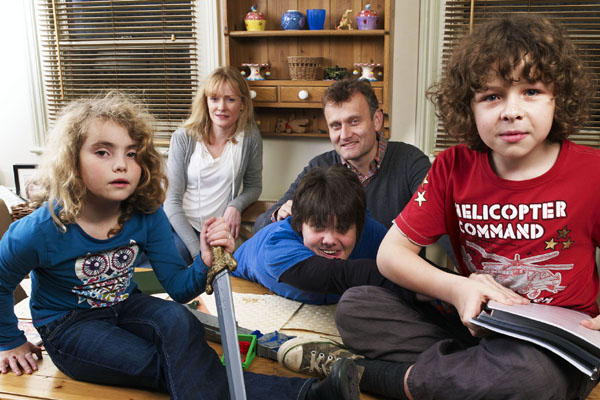
The Outnumbered family in the garden

The bits that I enjoy most about filming Outnumbered are the people and the food. On set we are all just like a big family. Everyone is lovely and having spent seven weeks with them day in, day out, it's truly sad to have to say goodbye to everyone at the end of the series.

But OH MY GOD, the food! We have an amazing cook called Pam and every single day we're served delicious meals. My personal favourite is her heavenly banoffee pie.

The way the improvisation works with Jake is that one of the directors would come up to me and give me a script a few minutes before the scene, so I have time to familiarise with the script but not to memorise it.

Maybe halfway through filming the scene they'll suggest we have a chunk of improvisation, which consists of the camera running, while the actors basically say whatever they want - usually it's hilarious.

The number of takes needed to finish a scene can differ extraordinarily depending on the complexity of the scene, how many actors are in it, how many camera angles are needed and the surrounding environment etc. But usually I'd say we finish a scene in five takes.

I think at first most of my friends were a bit overwhelmed when they saw me on TV but now they've just gotten used to it and think it's really cool.

The cast of Outnumbered around the table in the family home

One of the reasons why I think people like the show so much is, because first and foremost, the writing is brilliant, with storylines that everyone seems to be familiar with. Also, the improvisation aspect is quite unique and I think the cast members all work well together.

I'd like Jake to get a serious girlfriend, and maybe I'd have an on-screen kiss! And perhaps Jake could get really, really drunk. It would be really fun to play him drunk - it would be just acting, obviously!

Jake isn't really that much like me in real life. In series three he becomes very teenage and moody - I'm not really that bad!

Tyger Drew-Honey plays Jake in BBC One's Outnumbered

My cracking time on Cracking Antiques

Blog comments are currently unavailable. Find out more.

Post categories:

Kathryn RaywardKathryn Rayward|10:19 UK time, Wednesday, 7 April 2010

Filming Cracking Antiques was such a hoot that I don't know where to start. It was brilliant fun meeting all of the different contributors - I love snooping around people's houses. I'm incredibly nosy - in fact, I always say that was why I became an interior designer.

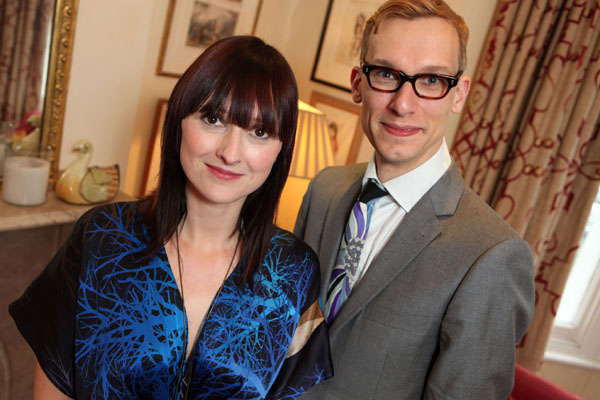
Mark Hill's my co-presenter and we've been called the TV Newlyweds, which is appropriate as we didn't know each other before the show. I had to go on a round of 'blind dates' (which, even more bizarrely, were filmed) with male antique specialists until I found my Mister Right.

The TV Newlyweds: Kathryn Rayward and co-presenter Mark Hill pose for the cameras

My blind date with Mark was at Spitalfields Market in East London, one of my favourite places to shop. He was there already with the production crew when I arrived, but I would have guessed who he was anyway. He wears the most striking, natty outfits. They're very beatnik, smart tailored suits, like a young Michael Caine - very Alfie!

We hit it off immediately and forgot the cameras were rolling. He bought a vase in about two minutes (no change there) then we had great fun looking at a bergere chair and some Lucienne Day fabric.

Unlike a lot of men, he's very at home with soft furnishings, so I knew he was the one for me. We were obviously a match made in vintage heaven as we always turned up on location in matching outfits - there must be a touch of telepathy going on somewhere

With having Mark as my sidekick we're kind of antique Good Cop, Bad Cop, although I'm not saying who's who. We disagree on stuff all the time which makes the show, and life, more interesting.

There was an ongoing joke that as I can't stand "brown furniture" I always wanted to slap a bit of paint on anything that I thought was too "brown". In the end, I would threaten it with practically everything we looked at just to make Mark cross. (I honestly never would tamper with anything beautiful, but if a piece is cheap and cheerful and in need of a bit of TLC then I'm all for it)

He's so brilliant at knowing everything there is to know about old things and I find him endlessly fascinating and entertaining.

The first episode is broadcast on Wednesday April 7 at 8.30pm on BBC Two and is all about how to create a French boudoir, a style very close to my heart having been bitten by the vintage bug whilst living in France.

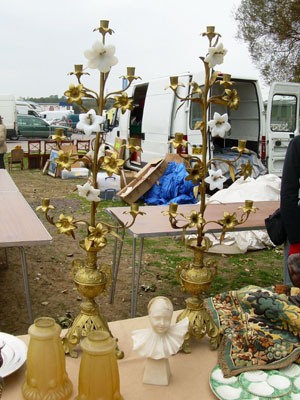
Candlesticks at an antique depot that Kathryn found for Rebekkah in the first episode

From my experience, having lived just outside Toulouse, it seemed as though a lot of the French had sold their crumbling farmhouses and were busy filling their new houses with brand spanking new furniture - leaving all their gorgeous antique furniture for collectors like me.

I went back for a holiday last year and things hadn't changed. Unfortunately I had left my rusty old Transit van back at home, otherwise I would have filled it up with stuff. The vide-greniers and brocantes, or French garage sales and flea markets to you and I, were still as exciting as ever.

I was trying to work out how to fit a particularly nice little gilt sofa, that I'd found in a brilliant little junk shop in Castres, into our car (could it fit on the kids' laps...?) but fortunately for all of us, despite numerous trips back, the shop never opened again.

Disheartened I was checking out an online auction site to see if it had been the bargain I thought it was when I spotted a beautiful red gilt sofa for only £120 including delivery. It was delivered the day we got back from holiday, my French sofa, online in England, while away in France!

It came from a brilliant little place just outside Hastings and it seemed the most obvious place to take Rebecca, our first contributor, to find her original Marie Antoinette-style boudoir bed. She was apprehensive about the "fluids and bugs" but it was a great buy and a fun experience.

That's what Mark and I really want to do with the series - we want to drag antiques from their pedestals, blow the dust off them, and open them up to a much wider audience, showing how they can be more affordable, stylish and better made than much of what the high street has to offer.

I really hope you enjoy the show as much as Mark and I enjoyed making it. And remember, as a sage old vintage expert once said, you only regret the ones you didn't buy!

Kathryn Rayward is the co-presenter of Cracking Antiques on BBC Two

The daily dilemmas for doctors at Great Ormond Street

Blog comments are currently unavailable. Find out more.

Post categories:

Charlotte MooreCharlotte Moore|13:47 UK time, Tuesday, 6 April 2010

Almost 10 years ago I produced and directed a BBC television series called Living With Cancer. The team and I spent two years at the Middlesex Hospital following the experiences of a group of patients as they confronted the realities of living with a life-threatening disease. One of the most remarkable people we met was a 15-year-old boy called Jonathan.

When I started filming with him, I was there in the room when he was told that his bone cancer had come back. The doctor explained that they couldn't cure him any more but they could prolong his life - and they offered him another bout of chemotherapy to keep the tumours at bay. His mother Vicki was naturally very keen for him to agree to the treatment if it meant a few more months with her son.

But Jonathan felt differently. He decided what was important was the quality of his life. He wanted to live out the remainder of his days on his own terms, away from the hospital and the gruelling effects of cancer treatment.

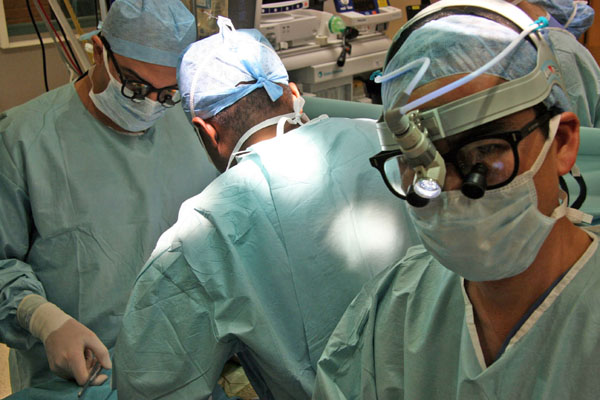
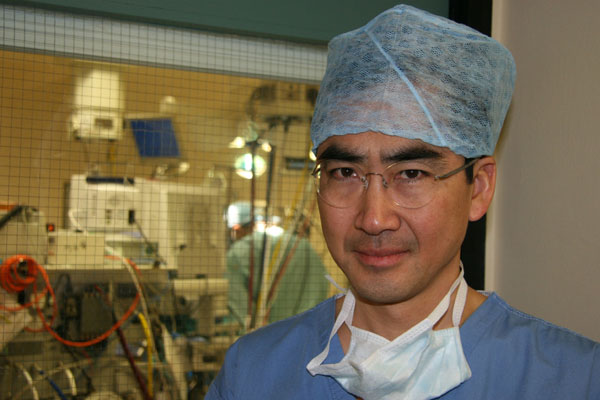
Cardiologist Doctor Victor Tsang and the team at Great Ormond Street at work on another operation

Jonathan was an extraordinary young man and I'm still inspired by his courage and strength. But what also struck me about his case was the way the decision was made.

Gone were the days when doctors would decide on the best course of action without consultation with the patient. Gone also were the days when the parents' will would automatically prevail. And whilst this is all undoubtedly a good thing, it made me think about how difficult decisions are made in hospitals across the country on a daily basis.

When Films of Record approached us with an idea to make a series in Great Ormond Street Hospital, I was keen to see if we could explore this complex issue further.

We knew we wanted to follow patients' stories, but we also wanted to see if we could focus on the side of the story we rarely see - the perspective and point of view of the doctors as they wrestle with the most complicated dilemmas.

One of the most powerful things that documentaries can do is to give viewers an insight into a situation that they wouldn't usually have access to. Although there has been no shortage of series in the past featuring doctors talking about their work, this series' director Ricardo Pollack and his production team managed to forge such a level of trust with hospital staff that they were allowed to film the meetings where teams of doctors discuss individual cases candidly and try to reach a consensus on what the best course of action is for the patient, both medically and ethically. The doctors allowed them to film when not everyone agreed on a course of action. And they allowed them to film their differences of opinion.

I don't believe Great Ormond Street's doctors have ever allowed this level of access before, and this is what is so compelling about the series. We are witness to conversations that you or I would never normally hear. And the doctors have been brave enough to let the cameras in to capture the raw honesty of their discussions.

What's extraordinary is that you are there in the moment with the doctors as they make the decisions, and what comes across most clearly is that these decisions are not always black and white - there are huge grey areas.

When medical science has come so far, it's often not a question of can they save a child's life. It's much more a matter of should they really keep the child alive.

Cardiologst Dr Victor Tsang outside the operating theatre

In the first film we follow the cardiac team as they attempt to treat four very difficult cases. In one case the doctors decide that there's nothing they can do for a little eight-month-old baby girl called Aicha who's suffering from a very rare and serious heart condition.

In their view the risks associated with the operation are too great. But her parents are adamant that there's still hope for their daughter and plead with the doctors to reconsider their decision.

Their cardiologist is Dr Philip Rees and he agrees to bring their case back to the cardiac team to see if there is anything at all that can be done. He feels it's important to push the boundaries and try to do everything possible to help Aicha, but he also has to be careful not to embark on treatment that could be regarded as futile.

This is the crux of the dilemma, and we see Dr Rees admit to the team that he recognises he has become too emotionally involved in the case to make an objective decision.

The team agonise over the right thing to do - before deciding to get a second opinion from a number of teams in other hospitals who will be able to look at the case through fresh eyes. That way the parents won't waste their time raising money to take their child for treatment abroad. And that way the doctors can take the decision to try out a new surgical technique. The outcome is a welcome development for Aicha's parents.

Now that patients - and in most cases at Great Ormond Street the parents as well - have a say in the treatment they receive, doctors' jobs have inevitably become much more complex.

Add to this the fact that advances in medical technology now offer parents hope that wasn't there in the past, and you begin to get a sense of the pressures that doctors are faced with. But what I hope people will take from this series is a greater understanding of these ethical dilemmas and how doctors go about making some of the most difficult decisions you can ever imagine.

Charlotte Moore is the BBC commissioning editor, documentaries

Putting the Zing into children's musical education

Blog comments are currently unavailable. Find out more.

Post categories:

Tony ReedTony Reed|10:17 UK time, Tuesday, 6 April 2010

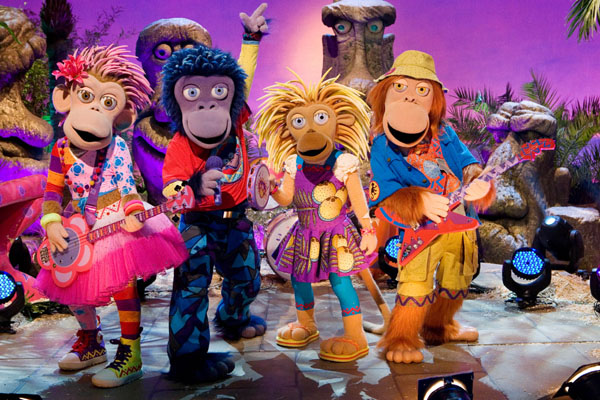
You may have seen ZingZillas on CBeebies yesterday (Easter Monday). It's a brand new music show all about a band of four primate friends who live on a tropical island and make wonderful music together and has taken four years to get from concept to screen!

Each episode follows the ZingZillas (Zak, Tang, Panzee and Drum) as they create a new song for their daily performance called the Big Zing. The show is for four to six-year-olds but I think adults will love it too.

The ZingZillas on set. From left to right: Panzee, Zak, Drum and Tang

A great deal of time was spent developing the idea, with production starting about 18 months ago. Head of CBeebies production Kay Benbow spearheaded this.

Kay knew that it would be a great show for our audience and a fantastic show for CBeebies in-house production to produce with unprecedented access to other areas of the BBC such as the BBC Concert Orchestra.

It was a very moving experience recording the orchestra playing the opening title sequence. How fantastic to have the sound of all those real instruments in the opening of every show not to mention all the other pieces of music they played throughout the series.

ZingZillas has been a really interesting show to create and I still find some of the behind the scenes detail really fascinating even after being so close to the project for so long.

I'm not a particularly techie person but I love how clever the animatronic heads are. All the heads have a lot of technical kit inside to make all the lips, eyes and eyebrows work.

Even with everything getting lighter and smaller, they are still very heavy - I guess on average about 4.5kg. On top of that is the weight of the wigs which is another 2.5kg so you're looking at around 7kg sitting on top of your head!

The character heads fit very closely to the actors' own heads. In theory the actors see out of the mouths, but in their line of sight there are all sorts of mechanical bits and bobs, a black gauze which stops us from seeing their faces and, of course, the mouths are moving all the time as the characters talk.

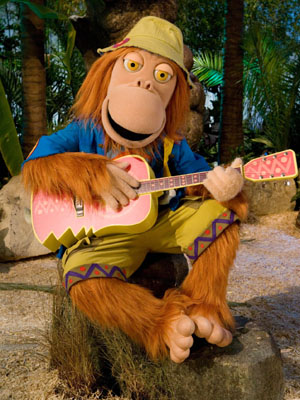
Tang with ZingZilla sat with his guitar

That isn't enough discomfort though! The motors all make quite a racket, plus the actors have the dialogue and music from the show as well as the voice of the director in their ears.

They can hear very little else around them. So they can't see, they can't hear and they're supporting an unnatural weight balanced on the top of their heads.

I then tell them I'd like to see them swinging on a vine, riding a banana car or cart-wheeling through shot - oh yes, and they need to be able to play the instruments their characters play!

This is a massive ask for any actor and of course a health and safety nightmare, especially when part of the set is nine feet in the air!

We did work out a way of achieving everything we wanted though. Each costume character had essentially a bodyguard. That person looked after them, dressed them, made sure they always looked tip top and were also responsible for giving the actors air and water.

The bodyguards are like the A Team - tooled up with water packs with a long feeding pipe and a very powerful fan which was made using a cordless drill.

The characters' facial movements are operated remotely by another set of actors - the voiceover artists. They're hidden away in a dark corner of the studio from where they use these very industrial looking, Atari-like controllers to move the mouths and eyes etc as they record the dialogue.

The thing with this type of technology is that very little can be just bought off the shelf - pretty much everything has to be bespoke made.

Something I still find amusing is that the remote controls for the characters' heads were made using the bits of a JCB digger.

That may sound extreme but the controllers have to be incredibly durable as well as able to do very fine and delicate manoeuvres - exactly the same requirements as a huge digger!

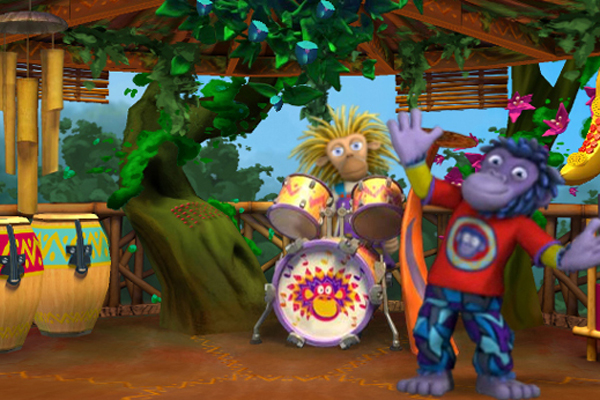
A screenshot from the interactive online aspect of the ZingZillas as Drum and Zak make music in the clubhouse

I'm proud of so many bits of the show but the one thing that is most important is the music. We were so lucky to be able to get so many fantastic musicians involved, especially when I think about the absurdity of some of the situations they'd be in.

A great example is opera singer Sarah Connolly singing opera with a madcap mandrill character who can only sing when he's in the bath! It sounds ridiculous but what better way to make opera accessible for very young children?

It was quite nerve-wracking at times with some of the guests. I remember we were all nervous about meeting Evelyn Glennie. She's a world-renowned musician and a Dame - and there we were asking her to come and play with a group of monkey-like characters.

What we wanted to do was bring great music to our audience and of course all the musicians involved had the same goal, so we needn't have worried.

You do wonder, though, what if they turn up thinking it was a classical recital and find themselves jamming with a group of colourful primates?

Evelyn was absolutely lovely to work with and loved what we were doing so much she asked if she could come back and do another episode.

FormerJamiroquai bassist Stuart Zender didn't even question playing bass for a track all about the love of bananas and Sir James Galway knew his grand children would just love the song we'd asked him to play. All the guests were great sports and totally got what we were trying to do.

Our composers, Chris and Wag, worked very closely with the guests to make sure their involvement was a collaborative experience. It's so fantastic that such a broad range of musicians were able bring their knowledge and experience to the show.

I don't think Chris will ever forget the day the late Sir John Dankworth called him up from his kitchen with Dame Cleo Lainescatting in the background. We picked guests who really care about their music and their particular genre and I think this really shines through in the Big Zings.

ZingZillas isn't just a TV show - it is also a brilliant website. My colleague Helen Stephens was charged with coming up with something fantastic for the web and she's certainly done that.

I have a three-year-old son so I'm pretty familiar with the CBeebies website but I really noticed a massive difference with the ZingZillas site. It's moved to a different level.

I don't know a huge amount about constructing websites and often find myself sitting in meetings just nodding my head as the jargon whizzes over the top of it.

What I do know, though, is that websites have to be fun, easy to use and engaging. The ZingZillas site is all of these things. An interactive buzz phrase is 'immersive experience'.

It means the producers want the people using it to feel like they are really there and really part of the experience. The Big Zing part of the site certainly does that with a section where you can use your webcam.

I have a PC and very half-heartedly plugged in my webcam, not expecting it to work. I was amazed when I appeared on my screen, onstage performing with the characters in the Big Zing.

The virtual version of Todd the Zingzilla poking his head round the front door

It's a great bit of technology. As I waved my arms around like a lunatic, the instrument I selected played along with the track. The stage backdrops I'd painted earlier in the game in Todd's garden were also there behind me.

I had a go at all 20 of the instruments, which range from the Taiko drums through to the Theremin, but I really got carried away with the guitar - I think we all instinctively love to air-guitar!

I also wondered what it was like without a webcam and actually it's just as much fun playing the instruments with the mouse - as you move the mouse over the instrument it plays so it's equally easy to get carried away.

My three-year-old absolutely loves the site. Not only the games and the Big Zing but all the regular things we come to expect as part of the web package - printing out pictures of the characters (Make & Colour) or being able to play the theme song (Song Time) or a Big Zing from the show (Watch & Listen).

When we make telly shows we always hope that there is a little something of interest for our adult audience so they can enjoy it with their children. This clearly follows through to the website too.

There are so many things to do on it which are great fun for adult and child. In web language it certainly is an 'immersive experience' but in my language it's just great fun.


Tony Reed is the series producer for ZingZillas

Ashes To Ashes: From beginning to The End

Blog comments are currently unavailable. Find out more.

Post categories:

Matthew GrahamMatthew Graham|10:07 UK time, Thursday, 1 April 2010

Roehampton. Wednesday, 10 February. 10pm.

"This is the end - beautiful friend... "

Jim Morrison and The Doors there folks. The end is always beautiful to a writer. It means you've done it. It's finished. Story is told. Switch off the computer and go to the pub.

So am I forlorn, perched on a camera box on the edge of set on a freezing cold night in Roehampton, south west London as director David Drury shoots the last ever close up of Gene Hunt? No, I'm not. Sorry. Je ne regret rien as they say in parts of Somerset. The story is told. I think two of my toes have fallen off inside my boots and the icy camera box has put my bum under local anaesthetic but I feel... well... satisfied.

In order to see this content you need to have both Javascript enabled and Flash installed. Visit BBC Webwise for full instructions. If you're reading via RSS, you'll need to visit the blog to access this content.

It is a hard but acceptable reality that shows will run and run not until the race is won but until the network blows the whistle and calls the event off. Usually between series. With Ashes we set ourselves the task of telling a three year story. This meant running over the line even if the cheering crowds wanted the race to carry on.

It may also have meant panting to the finish whilst the stadium cleared out early. Don't know why I'm sounding so cocksure - that may still happen. Stay in the stadium folks! It's neck and neck on the final straight, I swear!

Where did this story start? Not in Blackpool with Tony Jordan and Ashley Pharoah. For me, it started with Uncle John. He wasn't a real uncle; he was a drinking mate of my dad's, the kind you were made to call "uncle" in the 70s. He wore a camel-hair coat and smelt of fags and bitter and High Karate. He played darts and would say things like "Be a good boy Matty and pass uncle's Panatellas off the table."

In my world of boyhood fears and fantasies he was a rock of self-assurance, smelling of crafty pints and one hundred-and-eighty and masculine camaraderie. He was a god. And like all gods, I knew he would live forever. And that was Gene Hunt.

He wasn't called Gene Hunt for many years but when Tony, Ash and I were discussing our 70s cop show - Ford Granada - I realised there might be a context for Uncle John. Uncle John with his coat, his slip-ons, his fags, his beer-breath, his dart-throwing arm... and this time with a gun and a fast car too.

Go get 'em Uncle John!

Keeley Hawes as DI Alex Drake

And so there was Life On Mars. Tone, Ash, Matty - three soap opera oiks who met on EastEnders and decided to write a show about coma-cops falling into episodes of The Sweeney. And Uncle John had become Gene Hunt. And Gene Hunt had become ruddy iconic. Like the Colossus Of Rhodes with a beer-gut bestriding the land.

So now we reach the middle of the story. Mars ends. But there are still questions. Is Sam dead? What is this world? Who is Gene? Will Ray ever shave off that 'tache?

Ashes To Ashes was our response to a question from the BBC: Is there any more Gene Hunt? But honestly, we were thinking about Gene and the 80s whilst we were finishing Mars. Because if the 70s forged him, the 80s were only ever going to betray him. In an age of crass, shallow opportunism, Gene was going to be cast adrift. A dinosaur in a rapidly changing world. And THAT'S drama.

And whereas the 70s were mythical to us because we had been kids then, the 80s were ironically more knowing, more grown up, because we were. Not that we started that way. We had Alex Drake - our gorgeous, confident, intelligent police psychiatrist (I mean psychologist - although it's the same thing). Shot in the head and back in time surrounded by characters created by Sam Tyler. Why?

A new mystery started to unfold, with this feisty, smart-mouth woman going nose-to-nose with the Guv. And as soon as Keeley squared up to Phil, we had to put on our sunglasses before the crackling of sexual energy blinded us.

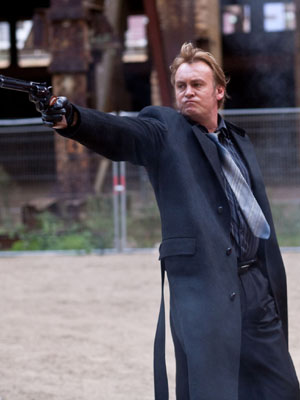
Philip Glenister as Gene Hunt aims a gun

Sitting here in the cold on my camera box, I smile as I recall that lighting test - the first time Phil and Keeley played a scene. Keeley - vulnerable yet defiant. Phil - domineering yet wary. And she reaches out to feel his heartbeat. To see if Gene can be real. And the script calls for him to do the same. And Phil goes for it. They have met as actors only 10 minutes ago yet he reaches out and grabs her right breast with one large hand, uttering the elegiac line "Fandabbydozey."

And then they both fall into each other, giggling like kids. And we're all giggling. But with relief. There's chemistry. And we need chemistry to sustain us through three series.

And so we set sail. Series one - frothy, arch, silly and fun. Yes, fun. Some thought too much fun. But it's the 80s, it's the Quattro, it's New Romantics. Come ON. What, you want Ibsen? Then go see Ibsen, cos we're having fun over here dancing to Adam And The Ants.

Then series two - darker, shadier. Alex now feeling consumed by this world and by her growing fear of, yet attraction to Gene. And Super Mac trailing corruption in his wake. Culminating in Gene threatening publicly to kill Alex himself if she crosses him again. And then shooting her - accidentally - he swears accidentally. And Alex slipping into a coma within her coma and finding herself back home with Gene leering at her from every hospital monitor - on the run for her attempted murder - and shouting at her to WAKE UP!

And so to series three - where the two worlds of Mars and Ashes begin to collide. Where the stakes have never been higher. The dark is rising now. There's still plenty of fun but it's the kind of fun one has in defiance of the cold wind blowing through. And why are we bringing it all to an end? Because a story needs an end. A journey needs a destination. And this show has been a journey for all of us.

In true filming style, we shot the last ever scenes in the story last week. God, our cast were on fire. I mean they were outstanding. And now, tonight, we're ending on a scene from episode seven. Mood is good. Champagne is cracked and waiting for toasts as soon as David shouts "Wrap."

What will I miss most? Writing a show where one can hop from comedy, to action, to pathos, to supernatural, to romance - all in one episode. The freedom, the space to evolve a tale in the way that only television can do.

Because, whatever I write next, I know this is the big story of my career. And I thank you for listening to it. Am I sad? Nope. This story has a start, a middle and an end.

That's a wrap.

The End.

Pub?

Pub.

Matthew Graham is co-creator, co-writer and co-executive producer of Ashes To Ashes

More from this blog...