

The planet in a pebble
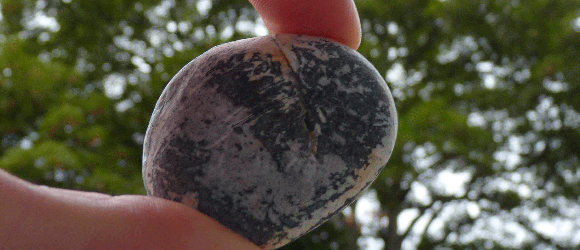
As first sentences go the opening salvo of The Planet in a Pebble has to be amongst the most banal and unassuming ever written.
Of course that's the whole point. Pebbles are dull - solid, implacable, mundane.
Until, that is, you look a little closer, and begin to unpack the stories frozen in their structure. And here Jan Zalasiewicz's account comes dramatically to life, launching us on a journey into the deep history of the universe.
In order to see this content you need to have both Javascript enabled and Flash installed. Visit BBC Webwise for full instructions. If you're reading via RSS, you'll need to visit the blog to access this content.
It's a tale of the birth - and explosive death - of stars and galaxies, of the upheaval of planetary formation, and the violent convulsions of the earth's geological history.
The pebble at the heart of Jan Zalasiewicz's story is a piece of welsh slate, picked up near Aberystwyth, and shot through with veins of white quartz.
It has a history, he says, that can be traced back through more than a billion years of the earth's geological evolution, but there will be atoms within it that are even older, atoms forged in the white heat of exploding supernovae billions of light years across space.
"Every pebble really does have a story. We're surrounded by history, enormous, deep and varied history, and it really is readable from material as simple as pebbles".
And of course the story is not finished. Those dull, unassuming pebbles on the beach today may one day form part of a new ocean floor or mountain range.
Sadly the story unfolds so slowly that none of us will be around to see it.
 I'm Tom Feilden and I'm the science correspondent on the Today programme. This is where we can talk about the scientific issues we're covering on the programme.

Comment number 1.
At 15:49 25th Oct 2010, BluesBerry wrote:The planet in a pebble:
Such a poetry!
It reminds me of William Blake:
"To see the world in a grain of sand, and to see heaven in a wild flower, hold infinity in the palm of your hands, and eternity in an hour."
"It's just an ordinary pebble." This is not a banal statement. It is amazingly insightful statement. This ordinary pebble carries the extraordinary history of the universe.
It's a tale stars and galaxies, violent convulsions...a history that can be traced back through more than a BILLION years.
Here I am to assist you out of your sadness that the story unfolds so slowly that none of us will be around to see the end.
There is an very exciting, very fast-moving story unfolding that will come to fruition during your lifetime and mine.
Have you heard about the: STAR-CHILD SKULL?
This unique 900-year-old bone skull found in Mexico in the 1930s. The owners Ray and Melanie Young, asked Lloyd Pye to head research efforts to determine what caused the unusual shape and properties of the bone. The results uncovered by Pye’s team ruled out all known deformities, and presented the scientific community with a genetic and physiological profile NEVER BEFORE SEEN ON EARTH.
DNA recovery was successfully used to recover coherent segments of the Starchild Skull's nuclear DNA. Of the (approx.) 3 billion base pairs in the skull's genome, many thousands have been recovered. These nuclear DNA fragments have been analyzed by the National Institutes of Health BLAST program, and a substantial percentage of that DNA has (Are you ready?) "no significant similarity" to any DNA previously found on Earth. i.e. DNA that is not human. So this child was human + "alien".
These results have been verified and repeated; however, much more DNA needs to be recovered and analyzed before a formal report can be completed. Estimated time in weeks and months, not years.
This may be the proof we need to validate statements such as occur in the Book of Genesis: the sons of God went in to the daughters of men who bore either "mighty men" or "giants" (depending on the text you read). Otherwise these were called Nefilim.
Complain about this comment (Comment number 1)