

The planet in a pebble
As first sentences go the opening salvo of The Planet in a Pebble has to be amongst the most banal and unassuming ever written.
Of course that's the whole point. Pebbles are dull - solid, implacable, mundane.
Until, that is, you look a little closer, and begin to unpack the stories frozen in their structure. And here Jan Zalasiewicz's account comes dramatically to life, launching us on a journey into the deep history of the universe.
In order to see this content you need to have both Javascript enabled and Flash installed. Visit BBC Webwise for full instructions. If you're reading via RSS, you'll need to visit the blog to access this content.
It's a tale of the birth - and explosive death - of stars and galaxies, of the upheaval of planetary formation, and the violent convulsions of the earth's geological history.
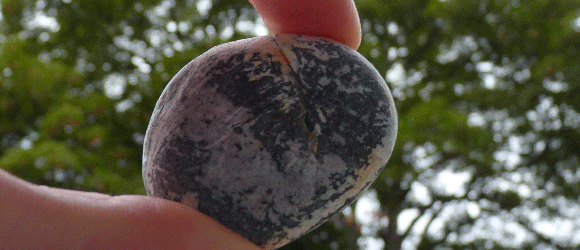
The pebble at the heart of Jan Zalasiewicz's story is a piece of welsh slate, picked up near Aberystwyth, and shot through with veins of white quartz.
It has a history, he says, that can be traced back through more than a billion years of the earth's geological evolution, but there will be atoms within it that are even older, atoms forged in the white heat of exploding supernovae billions of light years across space.
"Every pebble really does have a story. We're surrounded by history, enormous, deep and varied history, and it really is readable from material as simple as pebbles".
And of course the story is not finished. Those dull, unassuming pebbles on the beach today may one day form part of a new ocean floor or mountain range.
Sadly the story unfolds so slowly that none of us will be around to see it.
 I'm Tom Feilden and I'm the science correspondent on the Today programme. This is where we can talk about the scientific issues we're covering on the programme.
