

Body, heal thyself
 It's a sad fact that - despite the ingenuity of modern medical science - most treatments only stave off disease, preventing further deterioration or suppressing symptoms, rather than actually "curing" patients and restoring them to full health.
Regenerative medicine holds out the prospect of changing all that, revolutionising health care by exploiting the body's innate ability to heal itself, repairing or replacing tissues and organ function lost due to age, disease or congenital defects.
The idea springs from our increasingly sophisticated understanding of stem cells, and the basic biological and developmental processes going on in the body.
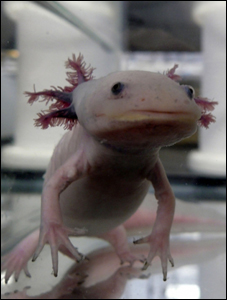
It's been known for some time that amphibians like newts and salamanders retain the ability to regenerate lost limbs. It's a trick shared with higher vertebrates - including humans - in the womb, but unlike salamanders we lose the knack of limb regeneration in later life: the genes responsible are still there, but they're dormant, or switched off.
In order to see this content you need to have both Javascript enabled and Flash installed. Visit BBC Webwise for full instructions. If you're reading via RSS, you'll need to visit the blog to access this content.
Working at the Australian Regenerative Medicine Institute, Professor Nadia Rosenthal is trying to isolate the genetic mechanisms involved in tissue and organ generation and to work out how we might reactivate and control these processes.
"Regenerating entire human limbs is still a long way off" she says, "but what we're trying to do is to work out how these processes work in newts and salamanders and to apply the lessons to our own slightly less efficient regenerative capacities".
But the potential of regenerative medicine is not limited to developmental genetics. As anyone who's ever cut themselves or broken a bone knows, the human body retains some ability to repair itself through autologous, or adult, stem cells.
In her lab at Imperial College's Institute for Biomedical Engineering professor Molly Stevens is developing new materials - synthetic polymers and nanofibres - designed to stimulate and enhance this inherent regenerative capacity.
"Our approach is about restoring the body to its natural state. So what we're doing is designing materials that we can put into the body that will encourage stem cells to populate that material and to grow and form new tissue".
Another approach, being pioneered by Professor Andrea Brand at the Gurdon Institute in Cambridge, explores the biological processes that regulate the activity of adult stem cells in the brain.
Using fruit flies to model neurological function, Professor Brand is trying to reactivate quiescent neural stem cells. It's hoped the results could lead to new treatments for stroke and degenerative neural conditions like Alzheimer's and Parkinson's disease.
It's early days, but regenerative medicine at least holds out the prospect of being able to restore patients to full health. Something that has long been the ultimate goal of medical science.
In order to see this content you need to have both Javascript enabled and Flash installed. Visit BBC Webwise for full instructions. If you're reading via RSS, you'll need to visit the blog to access this content.
Speaking on the programme this morning Professor Sir Ian Wilmut, who heads the MRC's Centre for Regenerative Medicine in Edinburgh, said we should be, "excited and optimistic about the opportunities being created in this area." But he warned that "We should be under no illusions that a lot of basic research will be required to take this knowledge through to the clinic. That effort must be underpinned by investment and funding for that research".
 I'm Tom Feilden and I'm the science correspondent on the Today programme. This is where we can talk about the scientific issues we're covering on the programme.

Comments Post your comment