

Communicating with patients in a vegetative state
It's hard to imagine anything worse than being trapped in a useless body. Fully aware of what's happening around you, but unable to move or communicate.
In order to see this content you need to have both Javascript enabled and Flash installed. Visit BBC Webwise for full instructions. If you're reading via RSS, you'll need to visit the blog to access this content.
That was the situation for the French journalist Jean-Dominique Bauby after a severe stroke left him physically paralysed, or "locked-in". The only function Bauby retained was the ability to blink his left eye - a skill he painstakingly exploited to dictate The Diving Bell and the Butterfly, letter by letter.
It was assumed the patients involved in a new study on Persistent Vegetative States, and published today in the New England Journal of Medicine, didn't even retain that limited level of physical ability or any mental awareness. Unlike locked-in syndrome, patients in a vegetative state appear to be awake, but are unresponsive and there's no sign of intellectual activity.
In order to see this content you need to have both Javascript enabled and Flash installed. Visit BBC Webwise for full instructions. If you're reading via RSS, you'll need to visit the blog to access this content.
The team, lead by Dr Adrian Owen at Cambridge University, used a functional MRI scanner to test the brain activity of 23 patients thought to be in a vegetative state.
To their astonishment they were able to detect awareness in four of the subjects, and one man (a 29 year old Belgian who had sustained severe brain injuries in a car accident five years earlier) appeared to understand what was going on in the experiment, and was able to answer a series of questions about is life by directing his thoughts to signal yes or no.
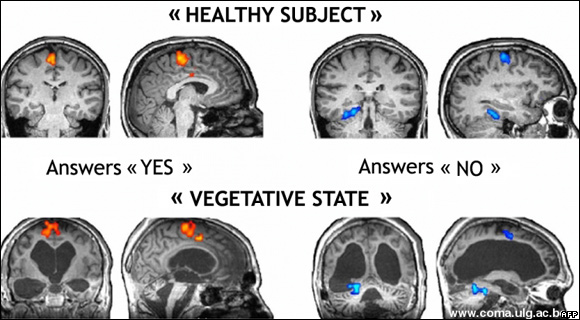
Functional Magnetic Resonance Imaging picks up on minute changes in the activity of protons in the brain.
Thinking about different things produces different patterns of neural activity that can be "read" by the scanner.
In this experiment researchers asked each patient to imagine playing a shot in tennis for yes, and walking from one room to another at their home when they wanted to indicate no.
The discovery has profound implications - not least for the diagnosis of PVS.
"Not only do these scans tell us that the patient is not in a vegetative state" Dr Owen says, "but more importantly, for the first time in 5 years it has provided him with a way of communicating his thoughts to the outside world."
The discovery that some patients previously thought to be in a vegetative state are actually aware of their surroundings might be unsettling for friends and relatives, but the researchers hope it can be exploited to address important clinical questions.
It might be possible for patients to indicate if they are in pain, for instance, or to be consulted over decisions about their treatment.
"It's early days," says Dr Steven Laureys, a co-author from the University of Liege, "but in the future we hope to develop this technique to allow some patients to express their feelings and thoughts, and to increase their quality of life".
 I'm Tom Feilden and I'm the science correspondent on the Today programme. This is where we can talk about the scientific issues we're covering on the programme.

Comment number 1.
At 19:25 6th Feb 2010, vicki timms wrote:I want to start by saying that in no way do I consider myself religious - I'm not sure how I would classify my belief - Perhaps it is best described by my question - 'But what was there BEFORE the Big Bang filled the space? Where did the space come from?' ...That way lies madness! I suppose I'm a mixture of bits of Buddhism and a feeling that there must be one all encompassing 'Being' for want of a beter word - a source of goodness and love. I believe that the essence of who we are is far too amazing to simply vanish when our physical body dies. Anyway, what I would like to ask is this: If we have now found a way to communicate with a part of a person, call it what you will, their mind, their consciousness - a part that forms who they are, that exists independently of the body and does not require the brain to provide any obvious sign of it's existence but as we now know can be identified by means of an MRI scan coupled with specific 'markers'......then how can we be sure that this illusive, ephemeral, magical 'spirit' (I'm sorry, no other word will do)does not still exist even after all signs of Life have been extinguished? Have we finally begun to touch on the difference between Body and Soul? Are we peering through the fragile curtain that may herald a gigantic change in how we view the concept of what makes us 'who we are' and if so, can we trust that 'the powers that be' will be honest enough to tell us the truth - or will they decide that 'it is not in our best interests' to be made aware of whatever amazing discovery lies ahead?
Complain about this comment (Comment number 1)
Comment number 2.
At 11:22 25th Jun 2010, Teychin wrote:Good article.
Complain about this comment (Comment number 2)