

Observing the sun
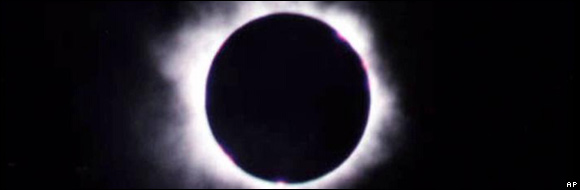
If all goes well NASA's latest piece of kit - the Solar Dynamics Observatory - will blast off from Cape Canaveral on an Atlas V rocket later today. You can watch the countdown on NASA's launch blog.
The SDO mission is the first in the space agency's new "Living With a Star" programme, and promises to supply unprecedented high-definition images of the Sun's roiling surface, picking out sunspots and solar flares - violent eruptions in the sun's atmosphere known as Coronal Mass Ejections.
Scientists hope the prodigious rush of images that should follow a successful deployment - images with resolution 10 times better than a high definition television - will help them to understand, and improve predictions of, solar activity.
"A Coronal Mass Ejection can carry billions of tonnes of material into space" says the Rutherford Appleton Laboratory's professor Richard Harrison, "Such events can disable satellites, cause power grid failures on earth, and expose astronauts to deadly particle releases".
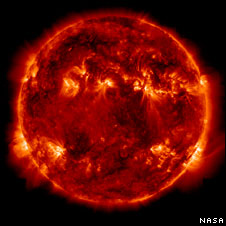 All the signs are the Solar Dynamics Observatory could be in for a bumpy ride. Images from space telescopes released last week show that the Sun's activity is picking up again after a long period of relative dormancy.
Astronomers have studied the sun for hundreds of years, and the level of solar activity is known to follow a cyclical pattern. It's longest phase of inactivity - known as the Maunder minimum - was in the 17th Century and coincided with a mini ice age.
This latest quite spell - the longest since 1913 - has baffled scientists. No one knows why the Sun's activity should drop off in this way, or when it might "wake up" again.
A key goal for the SDO will be to study the inner workings of the solar dynamo - the deep network of currents that generate the sun's tangled and, at times, explosive magnetic field. It's this dynamo that drives the sun's activity, giving rise to solar flares and the sun spots that meander across its surface.
And if, as scientists believe, the current minimum is coming to an end, the Solar Dynamics Observatory will have its work cut out.
 I'm Tom Feilden and I'm the science correspondent on the Today programme. This is where we can talk about the scientific issues we're covering on the programme.
