

Is swine flu targeting the young?
In order to see this content you need to have both Javascript enabled and Flash installed. Visit BBC Webwise for full instructions. If you're reading via RSS, you'll need to visit the blog to access this content.
Here's the graph showing the breakdown for swine flu cases by age that we were talking about on the programme this morning. It was put together by QSurveillance and used in the latest HPA report on the virus in the UK.
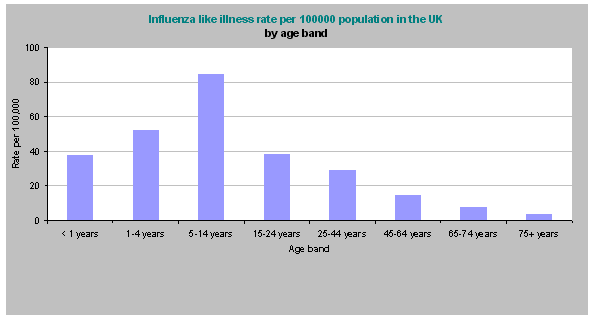
As you can see the normal bell curve distribution is strongly skewed to the younger end of the range, with 5 -14 year olds apparently worst affected.
There's still no clear explanation for why that might be. The latest research published in the journal Nature this week does show some striking similarities between swine flu and the virus responsible for the 1918 influenza pandemic.
That could explain why people born before 1920 have stronger immunity, but doesn't really account for the lower incidence of infection amongst those aged 45 and over. It could equally be that school classrooms and the playground simply offer a better environment for the transmission of infection.
One more point for the statisticians amongst you. The graph may inadvertently give a slightly false impression of the distribution by age because the bands are not all of the same duration. There were, for instance, 38 cases amongst children aged up to one year, but later columns cover longer periods.
If anything, the real bias towards the younger end of the spectrum is even more pronounced.
 I'm Tom Feilden and I'm the science correspondent on the Today programme. This is where we can talk about the scientific issues we're covering on the programme.

Comment number 1.
At 21:09 14th Jul 2009, largemacmac wrote:hi, what does underlying health problems mean?. over weight,smoker,drinker or is it what would be called more serious problems?.
Complain about this comment (Comment number 1)
Comment number 2.
At 17:14 15th Jul 2009, jitseniesen wrote:It's not clear to me what the graph means. Does the first column refer to 38 out of 100,000 children of aged less than 1 year, or to 38 cases out of 100,000 people (of which I guess that 1000-2000 are less than 1 year old)? The first explanation seems far more likely to me, but then I can't make any sense of the last remark "for the statisticians". I also don't understand why the graph is compared to a bell curve; if you expect the virus to be indifferent to age the result would be a flat line.
Complain about this comment (Comment number 2)
Comment number 3.
At 09:19 16th Jul 2009, paulaatrustymonkey wrote:It's a 'social' illness is the possible answer, as well as the fact that it's the first time we've really been able to look at it from many technological perspectives, also the fact that some groups are really isolated from contact with other groups: ie that we have a 'communcation disposition' to assume and expect much more now about and from information about the very young and the very old than we have done in previous generations.
The 'truth' about swine flu is probably that it is an epidemic but that we're not able to look at it from the grass roots, receive information from those grass roots about how people understand and deal with swine flu. I think that society is a whole, bigger than any sum of its parts: yet we don't get that real incisive look at a real range of contexts that we need to develop understanding and confidence.
We don't really look at the 'grass roots' of society as a place where we should listen rather than preach to or 'tell'. We're not 'geared up', if you like, to be able to have a balanced and detached perspective, that seriously includes all groups in society as having a valid contribution to make to medical research, planning and strategy.
Swine flu seems to become more enigmatic as time goes on!
We're 'revved up' to respond to everything in emergency planning terms, where professionals are given too much responsibility for these 'emergencies'.
Perhaps what we do need is to communicate clearly what this virus is and to recognise that the human condition is always an 'underlying one', that we imperfectly treat, care for and understand.
Complain about this comment (Comment number 3)
Comment number 4.
At 19:22 3rd Sep 2009, dennisjunior1 wrote:Tom:
I think that most of the information about, the Swine Flu and its issues are looking and aiming at young folks....But, I also, think that others will get it also...
=Dennis Junior=
Complain about this comment (Comment number 4)
Comment number 5.
At 17:24 10th Nov 2009, disco bunny wrote:"Is swine flu targeting the young?"
No. Viruses don't 'target' anybody.
Surely the heading should be something like 'Swine Flu; are the young more vulnerable"?
And I thought we already knew that they are.
Complain about this comment (Comment number 5)