

Celebrating 400 years of the telescope
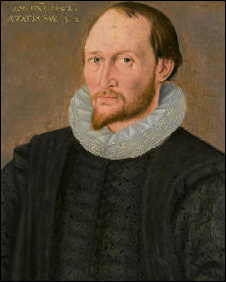
It's exactly 400 years since the Jacobean scientist and draftsman Thomas Harriot first turned his "Dutch Trunke" to the night sky to make a series of observations and drawings of the moon.
The telescope had been invented, probably in Holland, a few months earlier. But it had mainly been used as an amusing way of spying on one's neighbours, and by the navy to spot the colours of far off ships.
It was a profound moment in the history of science. The first time any sort of instrument had been used to augment one of the five senses.
Until then astronomy had been conducted with the naked eye. We saw the same starry sky as Aristotle and Plato, and although Copernicus had suggested that the planets orbited the sun rather than the earth, the geocentric Greek model of the universe still held sway.
But if Harriot was first, it was Galileo who cemented the telescope's place in history. His observations of the moons of Jupiter the following year proved that the earth was not the centre of the universe - and no end of trouble it caused him.
Since then of course the telescope, and the instruments mounted on it, have been refined and improved beyond Harriot's wildest expectations.
Today the biggest ground based telescopes, like those at the Keck Observatory on Mauna Kea in Hawaii, boast mirrors ten metres across. We can see further, and at greater resolution than ever before.
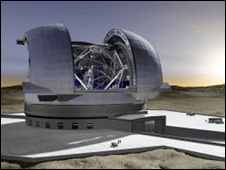
With a primary mirror some 42 metres across, and housed in a dome the size of Wembley stadium, the European Extremely Large Telescope, or ELT, will dwarf even the biggest existing instruments. At the moment it exists only in virtual space, but when it's finally built - probably by around 2018 - it will dramatically improve our understanding of the cosmos.
But telescopes enable us to do more than see far off objects in greater detail. Because light travels at a finite speed they're also time machines.
When Harriot pointed his telescope at the moon he was seeing it as it was a couple of seconds earlier. The light from the moons of Jupiter that Galileo observed the following year had taken a few minutes to reach him.
In order to see this content you need to have both Javascript enabled and Flash installed. Visit BBC Webwise for full instructions
By the same token the ELT will study the light emitted by some of the first galaxies to form more than 13 billion years ago.
According to Andy Martin, the author of Beware Invisible Cows, it means that nothing is ever really lost. If we want to know whether Lee Harvey Oswald acted alone, he says, all we need to do is get to a point some 46 light years from earth and train a powerful telescope on the grassy knoll.
It's somehow comforting to think that if there's an advanced civilisation out there inhabiting a planet some 400 light years from earth, and they happen to point their version of the Extremely Large Telescope this way on Sunday, they just might catch a glimpse of Thomas Harriot staring back at them through his Dutch Trunke.
 I'm Tom Feilden and I'm the science correspondent on the Today programme. This is where we can talk about the scientific issues we're covering on the programme.

Comment number 1.
At 22:10 26th Jul 2009, cmeador wrote:"Heliocentric" indicates a view being centred on the Sun. As used in "although Copernicus had suggested that the planets orbited the sun rather than the earth, the heliocentric Greek model of the universe still held sway" (par. 4), you are conflating heliocentrism with geocentrism. BBC, if I wanted to see rookie mistakes I'd be watching my local American news.
Complain about this comment (Comment number 1)
Comment number 2.
At 13:56 27th Jul 2009, dbreid wrote:There is strong evidence that the first telescope was made by Leonard and Thomas Digges in 1576, two Kentish gentlemen. Colin Ronan, the astronomer and historian, has done extensive research on this (see https://www.chocky.demon.co.uk/oas/diggeshistory.html%29. This means the telescope and the first astronomical observations of celestial objects (although no written observations have survived) were most likely made by two Englishmen long before Hans Lippershay's first instrument in 1607/8.
David Burrett Reid, EPSRC
[Personal details removed by Moderator]
Complain about this comment (Comment number 2)
Comment number 3.
At 22:01 4th Aug 2009, ghostofsichuan wrote:In over 400 years we still say that the "sun rises and sun sets." The sun does neither, we revolve and orbit. Slow learners, I guess.
Complain about this comment (Comment number 3)