

Scientists hampered by brain shortage
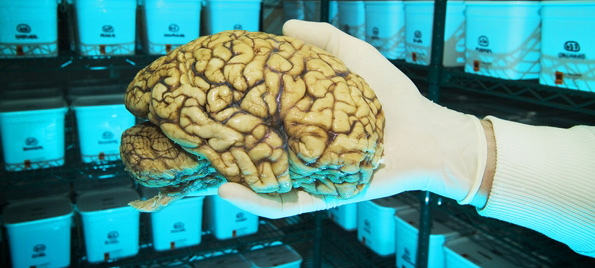 The decision to set up a UK network of brain banks will come as welcome news to researchers working on a wide range of neurological disorders including Alzheimer's disease, multiple sclerosis, and autism.
The simple fact is that not enough of us are donating our brains to medical research after we die.
As a result, scientists have been hampered by a shortage of human tissue to work on, and earlier this year some of the country's leading neuropathologists held a press conference highlighting the problem. They warned that vital research could grind to a halt.
Professor James Ironside - the man chosen to head the MRC's new brain bank network - was at that meeting. Now he'll co-ordinate the provision of brain tissue, and help tackle the shortage of donations.
Speaking after his appointment this morning he said: "The availability of high quality brain tissue is critical to the success of research into devastating clinical conditions such as motor neurone disease and schizophrenia. My job is to build on the fantastic work that is already being done by the individual brain banks. Co-ordination is essential to give researchers access to what they need, when they need it."
In order to see this content you need to have both Javascript enabled and Flash installed. Visit BBC Webwise for full instructions. If you're reading via RSS, you'll need to visit the blog to access this content.
Part of the problem is that, because it can't be transplanted, the brain is not included under the existing regulations governing organ donation - a separate consent process must be completed. That's meant the organ is often overlooked by people who plan to leave their bodies to medical science.
Another problem, highlighted by Professor Margaret Esiri at Oxford University, is that people may be reluctant to donate their brain because they see the organ as the basis of their identity.
It's a squeamishness she says must be overcome given the appalling social and financial costs associated with conditions like Alzheimer's and autism.
 I'm Tom Feilden and I'm the science correspondent on the Today programme. This is where we can talk about the scientific issues we're covering on the programme.

Comment number 1.
At 00:45 6th Jun 2009, Tom Bayes wrote:My apologies as I'll be frank and blunt. This issue is really important, but a simple appeal as in this report won't work. So, you've spent the last 13 years trying to keep someone alive, sacrificing everything, and I mean everything. They are the light of your life, they die, the last thing you want to hear is "can I have his brain?". Needs addressing far more deeply and well before that day comes. About 1/3 of my babies brain is already in a jar somewhere, I really hope that the learned fellows who took it are learning fast. The rest is still with me. Oh, BTW you missed epilepsy off the list. Sorry to be blunt, comes with the job.
Complain about this comment (Comment number 1)
Comment number 2.
At 15:06 6th Jun 2009, Forsdyke1 wrote:Yes, as related in my book - Tomorrow's Cures Today? (2001) - the cruel peer review process has hampered progress by eliminating some of the best brains from research in the biosciences!
Complain about this comment (Comment number 2)
Comment number 3.
At 05:28 22nd Jun 2009, krishnamurthi ramachandran wrote:First, i want to say that, i am either a doctor nor a researcher.
After reading of this article, i came to know that,due to great advancement in science,technology,increased knowledge from all best,available sources.,Professor James Ironside!s co-ordination of brain banks set up in U.K.are to be welcomed by all medical professionals,and from well wishers of more longevity.
We have to encourage many people to donate their organs after their death,and that will give many lives to affected persons.
Great article for great medical researchers,health interest groups,and formedical students and to public.
Complain about this comment (Comment number 3)