BBC BLOGS - Today: Tom Feilden

Archives for April 2009

Should we panic about swine flu?

Tom Feilden|09:54 UK time, Wednesday, 29 April 2009

So how worried should we be?

The death toll in Mexico has risen to 159. In the United States, California has declared a state of emergency and Dr Richard Besser, the acting head of the Centres for Disease Control, has warned there will almost certainly be fatalities.

Here, health officials are waiting for the results of tests on 23 people with symptoms of the disease, and in Europe, Germany is added to the list nations with confirmed cases.

It all reads very much like the start of a pandemic: one we were warned to expect, although the most likely vector was assumed to be poultry rather than pigs.

And yet it remains the case that no one outside Mexico has died of the disease.

That fact offers some hope. It could be that the strain circulating in Mexico is unusually virulent. Or it could be that the total number of cases in Mexico is very much higher. If 10,000 people have caught the flu there for instance, then 159 deaths - bad as that is - does not herald global armageddon.

Good health care, and the anti-viral drugs like Tamiflu and Relenza we've been stockpiling in recent years, should be enough to see us through.

In order to see this content you need to have both Javascript enabled and Flash installed. Visit BBC Webwise for full instructions


One troubling scenario remains however. This strain of swine flu does appear to be easily transmitted. If it gets to south-east Asia where the much more virulent H5N1 bird flu is widespread, then we might expect the strains to mix and mutate. That could throw up a highly virulent and easily transmissible virus.

If that happens one of the world's leading experts on the 1918 flu pandemic, Professor John Oxford from Barts and the Royal Hospital London argues, all bets are off.
Could a cooling sun save the planet?

Tom Feilden|10:36 UK time, Tuesday, 21 April 2009

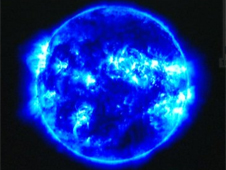
Quiet sunIt might not seem like it given the wonderful weather, but the Sun seems to be asleep on the job.

Images taken over the last year show virtually no sun-spot activity and very few solar flares. The observations, which will be presented at the UK National Astronomy Meeting later today, are baffling scientists.

The Sun normally undergoes an 11-year cycle of activity, spitting out flares and planet-sized globs of super-hot gas at its peak, before settling into a calmer period. According to the pattern of recent years the Sun's activity should have started to pick up again, but that simply hasn't happened.

Instead astronomers have been confronted with a 50-year low in solar winds, a 55-year low in radio emissions, and a 100-year low in sunspot activity.

A similar quiet spell in the middle of the 17th Century - known as the Maunder Minimum - lasted 70 years, and coincided with a "mini ice-age".

That's led some climate scientists to suggest that a cooling Sun could undo much of the damage wrought by global warming.

Climate sceptics have gone further arguing that the Sun - rather than man's activities - may be the main driver of climate change. The argument came to a head with the broadcast of Channel 4's The Great Global Warming Swindle in 2007, which focused on the cosmic ray theory.

But speaking on the programme this morning Mike Lockwood from the Rutherford Appleton Laboratory said the cycle of the Sun's activity didn't fit with the longer term trend towards global warming.

Solar activity began to tail off in the mid 1980's - a period of steadily rising temperatures. If the Sun was responsible for global warming we would have seen a much more marked decline by now.

Dr Lockwood believes the latest data settles the debate. The Sun has an impact on global temperatures, but it's not enough to account for climate change.

"If the Sun's dimming were to have a cooling effect, we'd have seen it by now," he says.

Salmon run

Tom Feilden|07:14 UK time, Thursday, 16 April 2009

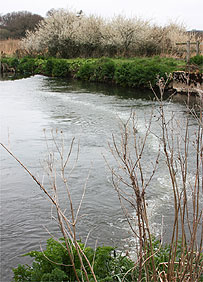
The spring salmon run gets going over the next few weeks: tens of thousands of young fish charging downstream and out to sea on the first leg of a journey that will take them as far as the coast of Greenland in the north Atlantic.

Salmon at East Stoke
It's one of nature's great migrations. But how many of those fish can we expect to see back as adults in years to come ready to spawn in Britain's rivers?

The Atlantic salmon has suffered a dramatic decline over the last 30 years. Numbers are estimated to have fallen by as much as 70% - a population crash that's been blamed on overfishing, pollution and disease in the marine environment.

But scientists working on the River Frome in Dorset are not so sure.

Biologists working at the East Stoke Fisheries Research Station have been studying salmon for more than 40 years. Now, in a project lead by the Game and Wildlife Conservation Trust, they've embarked on the biggest fish tagging and monitoring programme ever undertaken.

In all, 50,000 fish have already been tagged, and Dr Anton Ibbotson, who's leading the project, already has one possible culprit - climate change.

The warmer weather we've experienced in recent years has increased growth rates for juvenile salmon, and Dr Ibbotson has recorded a dramatic increase in the size of fish leaving for the sea.

But these "early developers" are still relatively young, and it may be that they are too immature to survive in the marine environment.

It's the algorithm, stupid

Tom Feilden|11:31 UK time, Wednesday, 15 April 2009

Could maths - or rather the lack of it - turn out to lie at the root of problems like the credit crunch, telecommunications bottlenecks, and even climate change?

That's the logic behind the launch of an £8m partnership that aims to solve the massive numerical problems posed by the latest advances in science, medicine and engineering.

The new centre - The Numerical Algorithms and Intelligent Software Centre, or NAIS - is the brainchild of scientists at Edinburgh, Strathclyde and Heriot-Watt Universities. It will develop the supercomputing skills and complex mathematical algorithms needed to make sense of the vast amounts of data produced in climate models or on financial markets.

In order to see this content you need to have both Javascript enabled and Flash installed. Visit BBC Webwise for full instructions. If you're reading via RSS, you'll need to visit the blog to access this content.

Better modelling of the risks they were running could have helped city traders avoid some of the worst pitfalls of the credit crunch, according to Professor Andrew Cairns at Heriot-Watt University.

Although he does concede the real problem was that bankers didn't fully understand the mathematical and computer models they were using on the trading floor.

Perhaps a more comprehensive grasp of the basics, a course in mathematics 101, would be a better bet for safeguarding the city's future.

April fooled?

Tom Feilden|17:21 UK time, Thursday, 2 April 2009

OK, be honest - did we get you?

Judging from the comments sent to the Today programme website it seems most of you spotted there was something 'fishy' about our claim that the taxonomic divisions between apes and humans were about to be scrapped.

If that's so you were right. The squirrel monkeys at London Zoo are not roaming free like some pack of stroppy adolescents. They haven't been stealing donuts from the kiosk beside the gorilla enclosure, and the dominant female gorilla, Zaire, has not been orchestrating their pilfering like some great criminal mastermind.

Although he does think apes are exceptionally intelligent animals, Dr Filippo Aureli (he really is the professor of animal behaviour at Liverpool John Moores University) doesn't think it's time to scrap the taxonomic distinctions between humans, chimpanzees and the other great apes. And nor is the Linnean Society convening an extraordinary meeting to vote on this vital issue later in the month.

For those of you who are interested the idea really did come from the story of Santino, the stone throwing Swedish chimpanzee. His antics, and the reporting of it last month, reminded me of Jarred Diamond's book The Third Chimpanzee. The rest is entirely my responsibility.

Many thanks to the Zoological Society of London, Prof Aureli at Liverpool, and Dr Sandy Knapp at the Linnean Society for having the breadth of character to poke fun at themselves.

BBC © 2014The BBC is not responsible for the content of external sites. Read more.

This page is best viewed in an up-to-date web browser with style sheets (CSS) enabled. While you will be able to view the content of this page in your current browser, you will not be able to get the full visual experience. Please consider upgrading your browser software or enabling style sheets (CSS) if you are able to do so.