

Life on Mars?
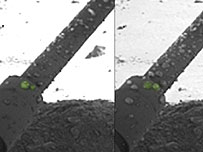 Take a good look at these pictures.
It could be you're looking at the first evidence that liquid water is present on the surface of Mars. If that's right then life - at least in bacterial form - could well be there too.
The images come from the Phoenix Lander, and appear to show liquid droplets scattered along one of its supporting struts. But what's got Dr Nilton Renno, who's a co-investigator on the Phoenix Mission and professor of Astronomy at the University of Michigan, so excited is the way the droplets seem to run in rivulets through the sequence of pictures.
He's convinced the liquid is forming a droplet, and that the reason it suddenly vanishes is because it has dropped back to the surface. It adds up to overwhelming evidence, Dr Renno believes, that water exists in liquid form in the surface layers of the Martian soil.
Others are not so sure. Dr Michael Hecht from NASA's Jet Propulsion Laboratory says there are other simpler explanations for the bumps and blobs on the Phoenix's struts. And he says Dr Renno's explanation for why the water hasn't frozen - that it's contaminated with perchlorates, or salts that are acting like antifreeze - is flat out wrong.
What raises this above the level of an arcane dispute between academics are the stakes. We've known for some time that ice may be present beneath the surface of Mars, meaning that life might have been possible in the dim and distant past. Liquid water raises the possibility that bacterial life could survive on the surface of the red planet today.
We still don't know if there is life on Mars, but liquid water means it is at least possible.
 I'm Tom Feilden and I'm the science correspondent on the Today programme. This is where we can talk about the scientific issues we're covering on the programme.

Comment number 1.
At 10:03 18th Mar 2009, adybee wrote:Sorry to be ignorrant but could someone tell me what the 'simpler explanations for the bumps and blob' are?
Complain about this comment (Comment number 1)
Comment number 2.
At 10:21 18th Mar 2009, WebServiceRich wrote:This is a wonderfully compelling story, and how I wish I could believe it.
Unfortunately, having looked at some higher resolution images on another site, I must say I'm just not convinced. Look at the 'droplets' on the underside of the leg - they just seem too jagged to be liquid which you'd expect to form rounder balls. And look at the two 'droplets' on the leg right above the one marked in green - they just look too close together in the final picture to have not merged. And even the one marked in green is a little odd - if it is flowing, then it appears to be flowing left to right, not downwards at all! Finally, note that the concentration and sheer number of 'droplets' on the photo make it unlikely that we'd only see one of them appear to merge through the complete sequence.
I wouldn't be suprised if one day we get proof of liquid water on Mars, and one day we'll get proof of life on Mars, but I'm just not at all convinced this is it I'm afraid. Good story though!
Complain about this comment (Comment number 2)
Comment number 3.
At 10:43 18th Mar 2009, mikeohare wrote:Webservicerich,
Mikeohare
You may be correct but you would first have to observe what happens to water droplets in gravity approx one-third of Earth's. There might well be a breeze blowing the droplets sideways and into different shapes because of a lower gravitational pull.
Complain about this comment (Comment number 3)
Comment number 4.
At 11:06 18th Mar 2009, MARTYNNGILBERT wrote:I'm more inclined to believe it is water. Droplets are rarely spherical under the influence of gravity and as has been pointed out, the wind, even with Mars's rarified atmosphere.
There is also the issue of surface contaminents. Those struts must be covered with the fine Martian dust. That would serve to distort the effects of the hydrogen bonds that give rise to surface tension. Look at how droplets form on any terrestrial dirty surface. The fact that they are observably not wetting the surface very well is suggestive of how droplets form on finely dusted surfaces.
I do agree the perchlorate suggestion sounds flawed because the evapourated water becomes distilled but the surface contaminents could serve to provide the necessary salts. As the atmospheric water condenses onto the struts, the contaminents disrupt the charge distribution of the hydrogen bonds normally associated with ice.
Complain about this comment (Comment number 4)
Comment number 5.
At 13:38 18th Mar 2009, NormanKirkby wrote:Do we know what the struts are coated or painted with? If they are droplets, the surface looks quite hydrophobic. If the surface is hydrophilic I think we can rule water out.
Complain about this comment (Comment number 5)
Comment number 6.
At 13:39 18th Mar 2009, AngusMiasma wrote:I'm intrigued by the photo if not totally convinced - but even if it isn't water I'm not too concerned.
Since the Mars rovers landed the evidence has shown - and science now pretty much agrees - that liquid water probably existed at the surface as recently as one million years ago.
In relation to the 4500 million year history of the solar system that is almost yesterday.
When one also considers recent pictoral evidence from the Mars orbiters, which imply outpourings of dirty water in gulleys in the brief time they've been in orbit, then it becomes more and more likely that water probably exists in liquid form - for at least some of the time - even today.
And when you combine that evidence with the findings of the polar lander - which showed that soil on Mars may not be anywhere near as acidic as had been feared - then the chances of bacterial life suddenly become much better than we thought they were just 10 years ago.
Complain about this comment (Comment number 6)
Comment number 7.
At 22:34 20th Mar 2009, nrenno wrote:The raw images show almost exactly the same thing as the interpolated images. I am posting them on my website (Nilton Renno) at the University of Michigan for any interested person to look at.
Complain about this comment (Comment number 7)
Comment number 8.
At 13:34 21st Mar 2009, mm wrote:Why do people have to link existence of life with water, air, temperature etc basically what is required on Earth for man to survive or for creation of life. What this people refer to as 'Goldilocks zone' around which it is possible that life can exist. Why is it not possible that alien life form don't require what we require on earth to survive. It's certainly not beyond the realms of possibilities and infact is the more possible scenario where alien life is present without the prerequisites of water, oxygen etc. This find is nothing to get too excited about as it won't be a conclusive proof of anything.
Complain about this comment (Comment number 8)
Comment number 9.
At 15:17 21st Mar 2009, eanassir wrote:I think there is an ample amount of sweet water and there is life on Mars, and this recent discovery is one of the successive steps towards this result.
If the temperature is so cold at the site of the Lander, and in spite of this, there have been some drops formed in this way, ((why wouldn’t such drops freeze quickly in such freezing circumstances?)) But on the contrary, the drops merged into larger drops. Is it so supersaturated salty solution!
Therefore, when these drops became larger by absorbing some humidity from the atmosphere, it could be possible that ((such drops were not formed by the splash)), but essentially from the humidity of the atmosphere itself (as is it the condiition here on Earth, when a cold metal will have some drops formed on it directly from the atmosphere humidity.)
Moreover, why is the ice restricted to the two poles (like that on Earth), and on the tops of some high mountains (like the situation of the Earth mountains)?
If it is very cold and freezing on Mars as a whole, then the entire planet should freeze, like some of the remote planets of our solar system.
universeandquran.t35.com/#The_planets_Are_Inhabited_
universeandquran.t35.com/new_page_2.htm#The_Journey_to_Mars_Is_Successful_
universeandquran.t35.com/new_page_2.htm#An_Anticipated_Meeting_
Complain about this comment (Comment number 9)
Comment number 10.
At 12:59 28th Mar 2009, Dusty_Matter wrote:What surprises me is how lopsided this article is. How about giving us the more reasonable explanations for what those droplets are? The other explanations have been presented, but you haven’t given the more reasonable side of the real scientists actual conclusions.
The polar ice caps on Mars are not made up of water but are composed of Co2. Liquid water cannot exist on Mars because of it’s thin atmosphere. It would boil away instantly.
The Phoenix probe landed in the northern latitudes of Mars to examine the icy regions of Mars. Remember the ice is not water ice, but Co2. The liquid droplets are therefore most likely droplets of Co2 which are condensing, but it isn’t quite cold enough for it to freeze.
You shouldn’t suppress and only present the unintelligent sensationalist side of the story.
Complain about this comment (Comment number 10)