

'The moment my legs begin to move, my thoughts begin to flow'
I'm making a piece for Newsnight about walking and seeing and feeling, then documenting and fictionalising. It's a way of making art or writing books that goes back at least as far as Chaucer and his Canterbury Tales.
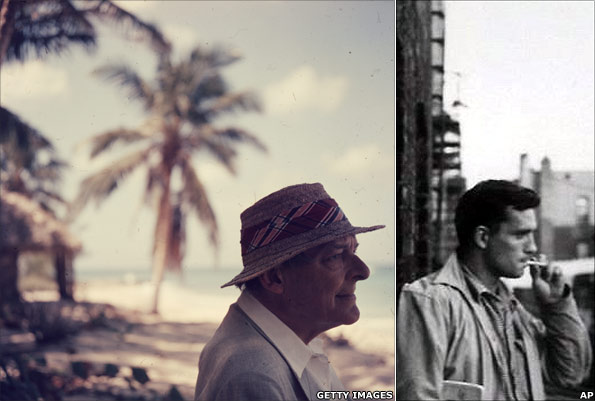
TS Eliot (1957); Jack Kerouac (1953)
William Blake, TS Eliot, the beat poets in America and the situationists in Paris all used the act of walking, responding and reporting as the basis for works, a tradition that is continued today by writers such as Will Self and Richard Mabey.
Iain Sinclair is another writer who primes his literary canvas using the environment: sometimes built-up; sometimes open countryside; most effectively, the unloved edge dividing the two. I asked him where documentation stops and fantasy starts and, given the inevitable ambiguity in blending the two, how the reader is to know which is which.
The sometime book dealer started his answer with another question: "And where in a bookshop do you position the book?" Under travel writing, memoir or fiction? He said it was his job to blend the two worlds, to work out how they can make a coherent whole where the fiction may end up more truthful then the facts.
He then pointed me to an article he wrote late last spring about a new edition of Richard Mabey's 1970s book The Unofficial Countryside, a classic of topological writing concerned with - among many other things - the bypass and the passed by.
It's published by Dovecot Press, where the primary concern seems to be writings about place.
 An arts journal by


Comment number 1.
At 09:44 26th Nov 2010, Arrrgh wrote:The walking space between city and countryside is explored in Iain Sinclair's Lonon Orbital. A book I walk love to walk one day. Just for the blandness of the cityscape.
Complain about this comment (Comment number 1)