

The market price of cutting airline emissions
Whenever I talk or write about how the outlook for growth in the UK, US and some other parts of the world is much worse than it was before the Crunch, there are some who always respond that they're delighted.
These tend to be individuals concerned about climate change, and fearful that the world's governments and big businesses will never reach agreement on stemming emissions sufficiently - because the benefits are always slightly further away than the immediate financial pain of producing less or investing in expensive green technology.
But if we could only muddle through in a world of low or zero growth, they say, we'd all be so much better off in the long term - because we would not be incurring tomorrow's climate-change costs for today's nebulous and transient (in their view) prosperity.
So will the voluntary agreement announced today by the airline industry to reduce net CO2 emissions by 50% by 2050 compared with 2005 levels reassure these doubters?
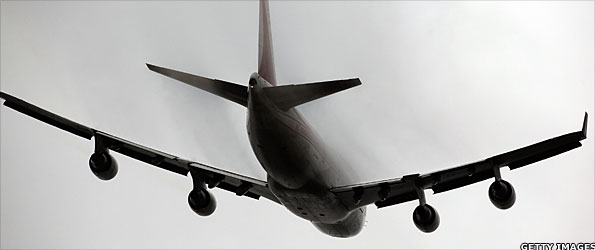
Unless they're peculiarly uncharitable, they'll say it's a useful journey in the right direction.
But they won't be uncorking any kind of carbon-neutral, celebratory beverage - because the industry does not expect to stabilise emissions until 2020. Which most psychologists would say is too far away to serve as much of a deadline.
And the associated commitment to improve so-called CO2 efficiency by 1.5% a year on average is vitiated (or so critics would say) by the inclusion of the words "on average" - it allows plenty of wriggle room for semi-worthless promises to do better if CO2 efficiency were not to improve.
So there'll be concerns about the enforceability of the commitments. And also worries that the promised cuts - large as they may seem - are not enough.
Aviation emissions currently account for just under 2% of global emissions, but have been growing fast, so the offer of cuts by the industry may be seen as too little in the context of gains in energy-efficiency made in other parts of the economy.
Far more effective in reducing carbon emissions, for the airline industry and more widely, has been the global recession. When all those factories shut down in China and other parts of East Asia, when airline travel slumped, the impact on emissions was significant.
According to the International Energy Agency, global CO2 emissions will fall more than 2% this year - with most of the decline the result of the weakness of the economy, rather than the fruits of deliberate government policies.
But to state the obvious, no government will be re-elected on a platform that recession is good for us and should be prolonged indefinitely, so world leaders are still on the hook to make difficult sacrifices at the climate-change summit in Copenhagen later this year.
And here's the striking thing. British Airways' share price is a bit higher this morning in a rising stock market.
Which doesn't imply that investors see BA as enduring serious pain for long term gain.
An emissions pact that is share-price neutral is probably not carbon neutral.
 I'm
I'm 






Page 1 of 2
Comment number 1.
At 09:36 22nd Sep 2009, saga mix wrote:economic growth is nothing to be scared of, it's natural and will continue ad infinitum - every generation reckons they're "special" ... think they must be reaching the Limit of this, that and the other ... and they are always wrong
Complain about this comment (Comment number 1)
Comment number 2.
At 09:38 22nd Sep 2009, Kudospeter wrote:To describe this as the best option for the earth is amazing. For targets to be effective there needs to be clear plans on how and when they will be achieved, monitoring of actual agains plan and penalties for not making each stage.
Surely limiting the number of flights and the number of air miles racked up by heavy users would have positive effects.
The web / conference calls provide suitable alternatives for travel to most business meetings however i doubt the airline business are going to promote this idea.
Clearly this is a proposal to get away with as little pain as possible.
Unfortunately not leaving our children a planet is a bigger worry than the level of debt they are inheriting
Complain about this comment (Comment number 2)
Comment number 3.
At 09:43 22nd Sep 2009, JavaMan wrote:A bit OT but, I like a rant!
Why are the G20 ‘calling for a more balanced economy?’ Who are the calling on, me?
https://news.bbc.co.uk/1/hi/business/8268009.stm
I mean, surely they are in charge and implement their idea’s findings, surely they don’t need to call on each other and pat each other on the back?
This is evidence (if it were required) that these dudes clearly have no inkling as to what’s going on, or how to fix the economy – They are too busy protecting their own interests and the interests of those really in charge!
I think we are now at the start of a depression for sure now…………
Complain about this comment (Comment number 3)
Comment number 4.
At 09:43 22nd Sep 2009, hughesz wrote:If Gordon Brown would have a airline fuel tax tomorrow, if he could get away with it.
The bottom line is airlines are going to be taxed more in the future in order to control aircraft emissions, its simply stupid spending billions on new greener power plants, cars etc and then blow it away on high co2 emitting cheap air flights.
Bio fuels could be an option but it will always be an expensive fuel, because of high demand, but may be cost efficient for the likes of the expensive carriers ie BA.
Complain about this comment (Comment number 4)
Comment number 5.
At 09:56 22nd Sep 2009, neverspeakbadly wrote:Economies are just the grouping together of what people do. People numbers are multiplying therefore economies will grow. No-one wants to or is able to regulate population. Therefore in the words of Dad's Army- We're all doomed.
Complain about this comment (Comment number 5)
Comment number 6.
At 09:59 22nd Sep 2009, CComment wrote:It's hardly surprising that some green eco-fascists would welcome an economic downturn, ostensibly as the cause of a reduction in CO2 emissions, but in reality because a failure - even temporary - in the present economic system suits their underlying anti-capitalist political agenda. They use concern for the climate as a cloak. Caledonian Comment
Complain about this comment (Comment number 6)
Comment number 7.
At 10:08 22nd Sep 2009, Straightalk wrote:Even an acknowledgement by the airline industry that they should be included in calculations regarding atmospherica pollutants is to be welcomed. The airlines have managed to evade this since Kyoto.
However, in the case of airline pollution, one should recognise that this should not simply be about CO2 emissions. Even modern aircraft jet engines belch out some very nasty toxins at their cruise altitudes whose chemical reactions are not fully understood; suffice to say, they are not considered benevolent. As certain aviation players have pointed out, a considerable amount of ground level pollution could be reduced simply by towing aircraft out with electric tugs to their 'holding points' before engine start-up and subsequent take-off. On a global scale this could help enormously with immediate effect.
The industry faces some real challenges in trying to meet reduction targets in pollution for a number of reasons. Firsty, the technology path to create very low polluting engines will not easily be achieved. Secondly, the rising levels of demand for air travel in Asia and South America look set to significantly increase global aircraft movements; at the same time, air traffic in Europe continues to grow as more point to point services are introduced for short and medium range routes. Such growth is of course a reflection of rising demand, which is driven by the insanely low air fares available. Whilst the carriers like Southwest Airlines in the US or Ryannair and EasyJet in Europe may have cost and pricing structures to sustain a viable business model, most of the traditional carriers do not: hence the ongoing waves of mergers, acquisitions and alliances in the industry.
The reality is that most governments (advised by their ever so impartial industrial economic advisors) see air travel as "good for the economy". The jobs created around airport hubs and their impact upon the surrounding local economies are seen to be worthy of more growth. At a purely local level this is probably true, except for the fact that the economic cost/benefit calculations take little account of the pollution effects (not only around the airport, but also on the flight path of departing and arriving flights). Economists call these factors 'externalities', which effectively neatly wraps them in a little black box marked 'unknown'. Furthermore, politicians rarely challenge the 'jobs card' and are usually too ignorant of the overall system to grasp what is happening in the bigger picture. For example, very few politicians, except those of the green parties or persuasions are going to come out and address the real underlying problem: that is how to reduce demand for air travel. All those millions of people demanding cheap travel to their holiday destinations are unlikely to vote favaurably for such draconian measures.
Thus the aviation industry, including the manufacturers such as Boeing and Airbus, the airports and the airlines can rest easy in the knowledge that they are unlikely to see any serious pollution controls in the near future. There will be more discussion and jaw-boning on the topic, but the industry knows that its ultimate consumers (ie the general public) are only going to respond to one thing: price. If air fares were signficantly increased to reflect their true costs to the environment and tax subsidies on aviation fuel were removed, then there would be a significant drop in demand. However, the chances of this happening are as remote as 'flying pigs'. Are they environmentally friendly? Probably not - too much methane exhaust!
Complain about this comment (Comment number 7)
Comment number 8.
At 10:12 22nd Sep 2009, Wee-Scamp wrote:There's a US company that's just been awarded a contract to supply the DoD with 40,000 gallons of biokerosene which has been produced by "refining" the lipids that algae reactors produce from consuming CO2.
The answer then is quite simple. Burn lots of coal in power stations, collect the CO2 and pass it through large scale algae reactors and solve the liquid fuel supply problem. This process also cuts the net amount of CO2 released by about 50%.
Naturally, the US has a lot of companies working on this technology and MobilExxon has recently put up close to £500m for an advanced R&D programme.
In the UK there's one very small four man company in Scotland doing this and they've recently installed a system at a well known distillery. As a byproduct it produces a protein for animal or fish feed.
Complain about this comment (Comment number 8)
Comment number 9.
At 10:14 22nd Sep 2009, Brian Wigmoore wrote:NO JOBS ON A DEAD PLANET!
I don't need to say anymore.
Complain about this comment (Comment number 9)
Comment number 10.
At 10:15 22nd Sep 2009, watriler wrote:Lifting a 100 tons of metal and flesh 7 miles in the air at 600 mph is never going to be very green and is a particularly bad deal over relatively short distances (less than 500 miles). Ultimately air travel will have to be limited and a carbon tax is as good a way as any. High speed rail networks is one answer for such journeys but in UK this will require big investment now. I agree any target that talks about something in 2050 is the ultimate spin. Unfortunately it is only when a major climate catastrophe affecting the West occurs will the actions need to limit climate change be organised.
Complain about this comment (Comment number 10)
Comment number 11.
At 10:21 22nd Sep 2009, TheLlaw wrote:I find it interesting that, for most, commentators on the environment, a need arises to link economic growth and negative environmental impacts. Growth doesn’t = bad news, in fact it’s only with growth that we find ourselves in a prosperous enough position to make valid choices on climate impacts. Food in the belly, nice house and a holiday come before cuts in Carbon emissions for all but the most ardent eco-champions. I’m not saying it’s right but it is the way it is.
In the context of aviation emissions, the voluntary targets allow the sector to work towards the commendable goal of emission reduction but, crucially, on their own terms. To my mind this is exactly the way forward, let the collective wisdom of the sector guide it. This will allow them to model their business in a competitive way while still working towards these significant reductions.
In the end, climate change is coming and is unavoidable, no matter what we do. Let’s roll up our sleeves and work out how we’ll adapt within our current economic systems, rather than squabble over how we put off the inevitable for a few months/years.
Complain about this comment (Comment number 11)
Comment number 12.
At 10:23 22nd Sep 2009, Les wrote:I note that BA are pinning some of their hopes on stabilizing carbon emissions on "Bio-fuels". This is ironic because (if you remember back to 2007/8) the use of agricultural land for these hiked food prices and caused a number of poor people to default on their sub-prime loans leading to ...
Complain about this comment (Comment number 12)
Comment number 13.
At 10:26 22nd Sep 2009, Slug wrote:It's inconceivable that the next generations will travel anything like as much as we have done. The price of oil and pressures on the environment will take travelling by jet plane out of reach of millions of ordinary people.
The government waffles on about improving Britain's economy by building bigger airports, but if millions of Britons (and we are about the most travelled people on earth) do not go abroad and spend their money elsewhere, they are going to spend it in the UK which will have far more benefit
Complain about this comment (Comment number 13)
Comment number 14.
At 10:27 22nd Sep 2009, Gibbo wrote:The real underlying problem is not so much that we have to reduce the current levels of CO2 output but that the current World population has reached an unsustainable level and is continuing to grow. The effects of this will lead to extensive poverty, water shortages and more frequent famine. But in democratic societies, which politicians would dare stand on a population reduction platform? China tried it with her one-child policy but this largely failed because of the desire by Chinese parents to have a male heir, with all sorts of accusations as to how this was achieved! Excessive CO2 is the symptom not the cause, until we tackle over population the problem will not be solved.
Complain about this comment (Comment number 14)
Comment number 15.
At 10:30 22nd Sep 2009, JackMaxDaniels wrote:It's funny to read how climate change is sooo important yet on the ground nothing really happens other than taxes and the idea of a carbon tax together with carbon trading (no doubtedly in London) is mooted, I wonder who will make a fortune out of this one eh ?
About 5 years ago Nitrate Vulnerable Zones (NVZs) were introduced to the UK via the EU, with the idea being banded around some years before that. If there REALLY IS a problem with water, then why isn't direct action being taken ? For example reed ponds could have been created on streams from farmers irrigation ditches getting rid of most if not all pollution, creating a diverse habitat for wildlife, creating a source of biofuels, creating a source of reeds for traditional crafts and a valuable nutrient source to be put back on farmers fields to grow more crops.
Why hasn't this simple, effective approach been taken ? Instead we have an Entry Level Stewardship (ELS) scheme being introduced to farmers some years ago, paid for taking productive land out to lie fallow to enable wildlife (birds) a chance to flourish. I have never seen any wildlife in ELS ground, perhaps there are a few beetles and insects that might benefit, but certainly little to no wild birds. ELS doesn't even pay funds to preserve existing habitats, in fact it pays a farmers to clear existing woods and spinnys, plant the area and THEN change it back to barren land and claim ELS funds. The "system" is quite frankly idiotic.
For years in Germany small power generation plants have been created in villages and towns - power being prodided from their own community waste and surrounding farms. Yet in the UK nothing has been done and if anything there has been a campaign against such schemes - just look at the UK press against rape seed fuel and biomass projects. Idiots staing the world is short of food yet the price of the raw material is lower now than it was 20 years ago.
And here I go back to your point about air traffic. I am under no illusions that what ever IS done will not be done to rectify any so called "problem" but will be done on the basis of ensuring those in power stay in power and the money continues rolling in the "right" direction.
In fact I would say it IS in the interest that the "problem" of climate change continues to exist purely and simpley so that people are kept under the control of fear and those in power are seen to be needed in order to "fix" these "problems". A solution would quite simply remove the need for those in power and highlight the fact of what they actually are doing and getting away with in the background - for example loaning 100's of billions of far eastern money into the housing market ??? Where were our investigative reporters and economists then eh ?
Sorry Robert this is a NONE story, a far better story would be WHY no action has been taken on a multitude of issues from drugs, crime, immigration, social housing, pensions, loss of manufacturing, power generation, transport, tax havens, tax domiciles, housing inflation, local government corruption (planning especially), benefits, loss of UK culture, care in the "community" of the dangerously mentally ill etc.
This is just another SCARE STORY that doesn't even highlight the delibrate lost opportunities, lost through incompitence or design (the later in my opinion). Rather than reporting on the problems which just keep being circulated (oo we haven't reported on this one lately) isn't it time the BBC started reporting on the FAILURE of anything to be DONE, action actually taken that any informed person could quite legitamately say can be done and who is responsible for failing to act ?
Complain about this comment (Comment number 15)
Comment number 16.
At 10:33 22nd Sep 2009, fairlyopenmind wrote:I think it's true to say that, with the exception of the Concorde oddity, airplane manufacturers - pushed by airlines - have always aimed for higher efficiency in the generations of arcraft. Because fuel is one of the most critical cost elements, per-passenger burn is always a big issue.
Just as per-passenger burn in a motor vehicle (whatever energy source) depends on the actual occupants, airlines hate flying with few people on board because all that structural weight still has to be shifted anyway.
Like it or not, aircraft sometimes have to fly half-empty - or even less - to be in place to move a full load on the following sector. (I've certainly been on Jumbos where each cabin crew member had only 4 or 5 passengers to look after!)
Maybe some carriers could use turbo-prop aircraft on shorter-haul routes but people have been brainwashed to think that whirly bits are old fashioned!
Fact is, some aspects of business demand a handshake and eyeballing of people, production areas and a working environment that just can't be replicated via electronic communication. (Not yet, at least.)
And we're decades away from a time when a virtual experience will substitute for physically being on holiday in Rome, Bali or anywhere - even Bognor! Even farther from injecting money into another economy while we virtually holiday there...
Engine, aerodynamic and fuel improvements will come. Air traffic control and management will be ever more important.
I'd be impressed if politicians conducted "virtual meetings" about environment matters rather than flying all over the place to talk about it. Especially if everybody could have on-line access to meetings as they occur, so we could see who's saying what.
Any chance of that? Nah. Too much fun to travel around (and maybe tack on a few days holiday in interesting places as a by-product).
I'd also be impressed if a few more politicians actually understood the science they claim to be proposing or defending. Can't see too many UK MPs with that sort of background.
In fact, even in areas where they should have some expertise, we've had a UK Minister for Europe who publicly stated she couldn't be bothered to read the Lisbon Treaty!
What chance that Miliband Minor has actually struggled through the IPCC documentation and grappled with some of the computer modelling techniques, which are fundamental to our projected doom? Maybe I'm wrong, but I'd guess he's read a few synopses - probably on board an aircraft to the next meeting to cut CO2 emissions...
Complain about this comment (Comment number 16)
Comment number 17.
At 10:37 22nd Sep 2009, Ozzie Stan wrote:Ultimately this will really about resources and their scarcity... The 'environment' will look after itself in the longer term.
What are the world's leaders doing to reduce the global population?
Complain about this comment (Comment number 17)
Comment number 18.
At 10:42 22nd Sep 2009, Star_Trekker wrote:The only way to achieve any significant reduction in greenhouse gas emissions without decreasing the size of the world economy would be a massive worldwide investment in everything and anything that reduces greenhouse gas emissions - lifestyle changes, public transit, higher density development, end-use energy efficiency improvements, carbon capture and storage, nuclear power, renewable energy, battery powered cars,industrial process improvements and a man to the moon type of effort on new technologies.
The capital requirements, the manpower training and recruitment requirements and the approvals lead time to achieve any significant reduction preclude achieving this in the timeframe suggested by what appears to be the majority of climatologists. That does not mean that we should not start, particularly given the fact that consumer spending has decreased as a result of the financial crisis and that we need to stimulate the economy in any event.
A commitment to a decreasing world economy simply will not happen. Consider that China emits greenhouse gas emissions equivalent to 3.9 tons of CO2 per person. The United States and Canada emit over 6 times this amount. And China is only one example of a developing nation. China has something like 300 million people who exist on less than two dollars per day.
And then consider that the world's population is expected to stabilize at about 9 billion people, compared to the 6 billion now. The prognosis is not hopeful, to say the least, if the climatologists are correct in their projections of the timeframe required to achieve those significant CO2 emission reductions.
Our research and development efforts should include a significant effort on ways to offset the effect of CO2 in the atmosphere, perhaps ice eating the upper atmosphere with sulfate crystals.
Complain about this comment (Comment number 18)
Comment number 19.
At 10:43 22nd Sep 2009, writingsonthewall wrote:"But if we could only muddle through in a world of low or zero growth, they say, we'd all be so much better off in the long term"
Robert - this can be done - it's called a Command Economy - you know the idea that we plan our Economic future rather than allow a dodgy collapsing system to take us where it wants.
Bring on the 'STALIN' comments and shouts about Gulags from the vehemently opposed (but loosely reasoned) bloggers....
Complain about this comment (Comment number 19)
Comment number 20.
At 10:51 22nd Sep 2009, sonbinor39 wrote:This is not really a market issue. Either airlines cut emissions or, when the climate crisis comes, as it will, face severe, very severe restrictions on flying, requiring them to shrink their businesses.
Complain about this comment (Comment number 20)
Comment number 21.
At 10:53 22nd Sep 2009, stevewo wrote:I wonder what percentage of the population don't believe in climate change, or if it is changing, has anything to do with human activities.
The climate changes naturally all the time, due to changes in solar emissions.
And I wonder what percentage of the population think that they are "being had" by slippery politicians, eager to find new taxes, and to justify their own importance.
Last winter was the most visciously cold for many years, with Europe and North America frozen solid for months.
Climate change? I still need much more evidence that it's caused by humans.
Surely by far the greatest source of CO2 is heating, so as temperatures rise, the biggest polluter falls.
Will the folks in 100 years time be laughing at our madness, or sweating it out in Iceland?
Everything seems to have an effect on share prices, so why should carbon dioxide be any different?
And will we still be getting on planes to go on holiday when the British summer average is 80 degrees, and Margate has the climate of Marbella?
Where's David Bellamy when you need him?
Complain about this comment (Comment number 21)
Comment number 22.
At 10:59 22nd Sep 2009, romeplebian wrote:what about a tax on the hot air coming out of Baroness Scotland's mouth ? and the rest of them for that matter, that is more polluting.
Complain about this comment (Comment number 22)
Comment number 23.
At 11:22 22nd Sep 2009, Always Blurting wrote:A lot of people book their flights online. If there was an indication of an airline's CO2 emmissions when you book your flight it may help consumers choose a more environmentally friendly flight.
This would have to be based on aircraft type and an average occupancy rate so an indication of CO2 emmissions per passenger would be given.
However, in the real world this figure may not be accurate (the flight may be below average occupancy) but it could drive airlines to buy greener planes.
Complain about this comment (Comment number 23)
Comment number 24.
At 11:26 22nd Sep 2009, Paul433 wrote:Why do the BBC NEVER draw a distinction between global HUMAN emissions and global NATURAL emissions of CO2. Considering that HUMAN emissions are less than 2% of ALL emissions, it is significant to note. The airline industry produce less than 2% of 2%. The eco's are actually romantics who like to wallow in a collective of community harmony with nature - just like most fascists
Complain about this comment (Comment number 24)
Comment number 25.
At 11:28 22nd Sep 2009, icewombat wrote:Off topic:-
But what exactly does a minister in this goverment have to do for G.Brown to think they should resign?
Failing to complie with a law you wrote and got thru parliment isn't one of then; fiddeling your expenses at worst you are allowed to keep your sea, stand down as an MP at the next general election and receive your golden good bye.
So my question is what law does a member of the goverment have to break for Gordan to require you to resign, and what illegal act is required before Gordan will sack you?
Whiter then White springs to mind Gordan!
Complain about this comment (Comment number 25)
Comment number 26.
At 11:28 22nd Sep 2009, ThorntonHeathen wrote:1. At 09:36am on 22 Sep 2009, sagamix wrote:
"economic growth is nothing to be scared of, it's natural and will continue ad infinitum"
Well, you really will need to be on another planet when this one is all used up. Mars maybe or maybe head straight for a biggie like Saturn, I'm sure the techies will have fixed things for us all to live there when this planet is toxic.
6. At 09:59am on 22 Sep 2009, CaledonianComment wrote:
"It's hardly surprising that some green eco-fascists would welcome an economic downturn, ostensibly as the cause of a reduction in CO2 emissions, but in reality because a failure - even temporary - in the present economic system suits their underlying anti-capitalist political agenda. They use concern for the climate as a cloak."
Yes, and I imagine most (rather than "some") green-thinking people see as valid their objections to the present economic system in which "growth" per se is seen to be a good thing. Maybe its a boy thing why all the graphs have to be pointing up all the time...
Also I do object to the term eco-fascist. Fascism is defined by its methods rather than a core belief of any type, except maybe for a belief in brute force as a method of oppression.
Complain about this comment (Comment number 26)
Comment number 27.
At 11:37 22nd Sep 2009, writingsonthewall wrote:The whole environmental argument shows up the nasty side of Capitalism for all to see.
In the thirst for profit and the need to compete with each other the Earths natural resources pay the price. No free market theory takes into account the environmental cost of production until it's too late (i.e. we actually start to run out of materials) - the system in fact despises intervention (like taxes) as it claims it prevents Economic growth (which we all realise is false in Western Economics by now).
We have reached a point in Capitalism where the only way to sustain it's life is to encourage more consumption (which is not needed) - which in turn encourages waste. Our Government is cutting interest rates and printing money in an effort to do this as we speak.
In the meantime even more CO2 will be produced with the hot air and excuses spouting from politicans and business leaders alike.
How arrogant of man to think we can continue to pillage this planet for resources without any consequence - and how stupid of man to insist on a system which is actually assisting in his extinction.
Complain about this comment (Comment number 27)
Comment number 28.
At 11:44 22nd Sep 2009, writingsonthewall wrote:14. At 10:27am on 22 Sep 2009, RedundantHippie
It's not over-population that's the problem, it's the consumption which is occuring for each person.
The Earth can fit as many people as there are square feet of land if we could grow crops more efficiently and stop wasting resources.
Too many people are using "the resources of 10" - which is the problem, not their existance.
Complain about this comment (Comment number 28)
Comment number 29.
At 11:49 22nd Sep 2009, mrsbloggs13c2 wrote:Perhaps we could have a target for reducing the increase in CO2 emissions caused by running PCS, server farms, mobile phone chargers and a load of other technology left on standby
Complain about this comment (Comment number 29)
Comment number 30.
At 11:51 22nd Sep 2009, writingsonthewall wrote:21. At 10:53am on 22 Sep 2009, stevewo
You don't need to believe the argument for or against climate change, but the fact that Earth is a finite planet means it has finite resources and that means one day it will run out.
The "I don't see the evidence for climate change" is simply an excuse people use to justify their own self-indulgence at the cost to the planet.
I agree that you cannot trust any politicans - especially one's telling us to fly less and then flying more themselves - but you can trust your own logical deduction about the future of earths resources.
It won't be the first time man has taken action before he 'has proof' - many scientific breakthroughs were 'deduced' long before they were actually proven.
Complain about this comment (Comment number 30)
Comment number 31.
At 11:51 22nd Sep 2009, stanilic wrote:I will beleive that politicians are committed to resolving global warming when jumbo jets are being fueled up at Heathrow at the GBP1.04 per litre I have to pay when I fill up my Fiesta Diesel.
As it is we are going to run out of clean water supplies and food long before the last ice-cap melts. The issue is over-population not climate change. As usual we deal with the symptom rather than the real problem. But then what do you expect; there are no radicals left. It is not just the oceans which are full of plastic.
Complain about this comment (Comment number 31)
Comment number 32.
At 12:00 22nd Sep 2009, writingsonthewall wrote:24. At 11:26am on 22 Sep 2009, Paul433 wrote:
"Why do the BBC NEVER draw a distinction between global HUMAN emissions and global NATURAL emissions of CO2. Considering that HUMAN emissions are less than 2% of ALL emissions, it is significant to note. The airline industry produce less than 2% of 2%. The eco's are actually romantics who like to wallow in a collective of community harmony with nature - just like most fascists"
A classic argument - well Paul433 have you considered in your wonderful grasp of mathematics and the environment that the optimum level of Co2 in the atmosphere might be 20% - and the contribution by humans is an extra 2% which upsets the balance of nature?
I also presume you know that airline use in on the increase which is going to increase both the contribution of CO2 from the airline industry and the to emmissions total?
I don't actually believe in climate change - but I am not so foolish to assume something isn't happening based on broken logic...
....which refers to the comments I made about the Earths resources above.
Complain about this comment (Comment number 32)
Comment number 33.
At 12:04 22nd Sep 2009, TheLlaw wrote:At 11:28am on 22 Sep 2009, ThorntonHeathen wrote:
"Yes, and I imagine most (rather than "some") green-thinking people see as valid their objections to the present economic system in which "growth" per se is seen to be a good thing."
I say again Growth is a good thing, you will never get sensible, committed activity on long term goals from poor/needy people, hierarchy of needs and all that. Choice is a is gift of the privileged.
Complain about this comment (Comment number 33)
Comment number 34.
At 12:06 22nd Sep 2009, hubert huzzah wrote:A Carbon (and other pollutant) licence per aircraft seat, payable per flight by the Aircraft Operator. That licence would be per seat, not per passenger. If an Operator chose to fly an empty aircraft the full levy would remain due. The Levy can be calculated by simply dividing the Carbon Dioxide emmission per mile by the number of seats on the Aircraft.
Customers would, ultimately, be obliged to pay the cost. But of more importance: profits would fall by the idiocy of not filling aircraft to capacity. The fundamental problem with aircraft is not that they emit but that they do so for reduced or no practical transport benefit.
Complain about this comment (Comment number 34)
Comment number 35.
At 12:14 22nd Sep 2009, writingsonthewall wrote:I don't think environmentalists despise all growth. There are 2 main categories;
1) those who dislike growth (of any sort) which doesn't account for the environmental impact of achieving that growth
2) Those who dislike the Capitalist system because as we can see clearly at the moment, the result of the 'boom and bust cycle' inherent to Capitalism, is a lot of wastage. Allowing the market to dictate recycling levels is absurd and doesn't achieve any of it's goals - mainly because the Capitalist interpret everything into 'the need to make money'
We're all racing to 'grow fastest' - but has anyone stopped to ask why?
Surely technological advances generally come from educational establishments and not really from the wider Economy. Mass production is about producing more for less - not about innovation. This is why some car manufacturers continued to produce petrol driven cars rather than produce electric driven ones (which have been possible for years). This was because they were making money selling petrol driven motors and therefore the push simply wasn't there.
Market Economics breaking down again I'm afraid, - just to remind you that all parties lining up for the election are promising cuts - and in education - for the sake of the private sectors survival.
....does that sound like a logical plan to you? Kill off the chances you have of reducing wastage through technological advances by moving investment into mass producing more of the inefficient and cheap products we already have too many of.
Complain about this comment (Comment number 35)
Comment number 36.
At 12:18 22nd Sep 2009, writingsonthewall wrote:....just a little story caught my eye....
look at the man laughing at us all as he commits yet more money from the Public sector to prop up the failed private one....
https://news.bbc.co.uk/1/hi/business/8267901.stm
....and what do the opposition propose......more of the same..
Complain about this comment (Comment number 36)
Comment number 37.
At 12:21 22nd Sep 2009, Paul433 wrote:I think the eco-movement taps in three compelling strands of history - that of apocolyptic doom; that of christian guilt for existing in the first place and that of romantic commune with nature. The end, self-defeating result will be more nuclear-power stations (zero carbon!). Oh, the arrogance and ignorance of these people is so tragic
Complain about this comment (Comment number 37)
Comment number 38.
At 12:34 22nd Sep 2009, Doctor Bob wrote:The overview is simple, the detail complicated: if we don't do something about the way we ravage this planet it will cease to support humanity. It's a finite resource. We now take far more from it than we can ever repay. As population increases - it won't be long before it's at 10 billion - the situation can only get worse.
The point about climate change, regardless of whether humanity has anything to do with it or not, is happening. It's going to take huge adaptation to continue living with it. One can't even predict where a decent crop of wheat will grow next year, never mind rising sea levels that will take a reasonable chunk off Britain's coasts, let alone those countries soon to be submerged.
The politicians and corporations are not interested. Better to profit now and worry about the disaster when it happens. Trouble is, by then it'll be too late. The price of trying to stop it gets steeper by the day. I doubt the aviation industry will bother to do anything until easily available fuel runs out - and the riots that attend biofuel will render that a difficult option. Not everyone will agree that land that could support food should be handed over to the airlines.
Complain about this comment (Comment number 38)
Comment number 39.
At 12:35 22nd Sep 2009, the_near_side wrote:Re no. 14.
You are right. The fundamental problem is over-population.
This exacerbated by other factors such as inequality and poverty.
Carbon reducing measures should be undertaken. Probably the biggest single thing we can all do as individuals is ...... to turn the thermostat down! Wear more clothes! Improve insulation.
Complain about this comment (Comment number 39)
Comment number 40.
At 12:35 22nd Sep 2009, spareusthelies wrote:When the airline industries are insisting the only way forward for them is growth, the only way this can be denied is convincing them that fewer people want to fly. The BA share price certainly implies this is not about to happen, in the immediate future. Although higher fuel costs will suppress demand.
The 2050 date is 2 generations away. On that basis I take what is being said today to mean, we can't be bothered to do anything about airline emissions at all, well not for 40 years! By then the scarcity of oil itself will enable the voluntary agreement, announced today, to become a self-fulfilling prophecy. The emmissions targets will be met, because oil will have run out!
The comment that, "no government will be re-elected on the platform that recession is good for us and should be pro-longed indefinitely," is testimony to the complete lack of political leadership and imagination in Britain. Politicians, once in office, view their reason for being as the need to raise more tax, difficult without growth! (I appreciate the current talk is all about "cuts" but none of them seem to believe this, hoping it will be short-term before growth resumes, and certainly have little appreciation of the implications.)
Economic growth is, amongst other things, about the way we live our lives. Changing the way we live our lives is what's at stake. For many, not having access to say a motor car, would seem like going backwards rather than changing their lives for the better. Leadership would be about making it possible for people to do this, i.e NOT needing fossil fuel driven engines for journeys to work etc. Instead the (irresponsible) political mentality is to use the issue as an excuse to raise taxes. Small wonder people are cynical about climate change! Also people rightly argue how no car use can possibly become reality with all those salesmen/women doing 60,000 miles a year?
The majority of people simply do not accept climate change as being credible. Until they choose to do so a responsible attitude towards it, by everyone, cannot be taken.
Complain about this comment (Comment number 40)
Comment number 41.
At 12:38 22nd Sep 2009, Sleenius wrote:One has to admire an industry that has only been around for 100 years that then declares that it will reduce its CO2 omissions in 50% more of its lifetime to date! And who will enforce this "golden future"!
It seems somewhat silly to me that instead of using this economic downturn to try and wrench ourselves away from a damaging and ultimately dying industry (Fossil Fuel use) we continue to bludgeon ahead with the “well that’s the way it’s always been” mentality.
Moving forward using alternative methods of fuel (both existing and “new” green sources) does not have to create an economic disaster – far from it, what happened to a maxim “you need to speculate to accumulate”? Instead of Governments Green taxing the hell out of us for no good reason – they should implement a real change that every industry that uses a significant amount of fossil fuel needs to spend at least 5% of its profit on looking at new ways to get the job done without a negative effect on the environment.
This will create news jobs and give the people who will be out of jobs when the oil, gas and coal stop flowing something to move onto. How is that a bad thing?
Complain about this comment (Comment number 41)
Comment number 42.
At 12:39 22nd Sep 2009, the_near_side wrote:No 29 wrote about switching off mobile phone chargers. As almost any person odff average intelligence knows, if it isn't warming or cooling or moving a great weight, then it isn't consuming much electrcity! Unplugging phone chargers will have as much effect as peeing in the proverbial! Get real - turn the heating down!!!!!
Complain about this comment (Comment number 42)
Comment number 43.
At 12:39 22nd Sep 2009, ruralwoman wrote:# 21 stevewo
Totally agree with you.
Global climate warming / cooling is part of Earths history and is being used by the powers that be to control and tax.
Yellowstone is overdue to blow, the human race has no idea what's happening a few miles under its feet, neither is it likely we will get any useful advance knowledge of a large meteor strike.
All we know for sure... Global warming and cooling has happened several times in the past and therefore we must presume it will again.
However I would prefer we didn't leave an utter mess behind when our time is up... if only crash and co felt the same.
Complain about this comment (Comment number 43)
Comment number 44.
At 12:41 22nd Sep 2009, Doctor Bob wrote:#27
"How arrogant of man to think we can continue to pillage this planet for resources without any consequence - and how stupid of man to insist on a system which is actually assisting in his extinction."
Absolutely.
Problem is, the politicians probably view it like the credit crunch - it'll just take a little suffering to restore us to our former glory. Well, no amount of summits will sort things out when it's too late, having wrecked the very system we were born into and nurtured us.
No problem about the planet being destroyed - it'll be here until the sun goes bang.... but I doubt humanity will be around to see it.
Complain about this comment (Comment number 44)
Comment number 45.
At 12:41 22nd Sep 2009, Jomar777 wrote:I do not think it is worthy to comment on the (favourable...) aspects of this compromise since as Mr. Robert Peston adds, the timeframe for this and the use of the "average" word in the statement, this is a very vague compromise.
There's a lot that they may be doing but no significant progress is made or compromised since there is no clear path or set of decisions.
The fact that the recessive market actually achieved for a very significant cut on the emissions rather than any other so advertised measures, simply states how far are we in being efficient and active in our "efforts" to cut the environment.
if anuthing, I take this compromise from the airlines with a pintch of salt: this is simply an excuse to increase fares without offer anything in exchange (apart from empty promises...) except another excuse for governments to increase airfare taxes, again with no significant investment on environment or trasnport alternatives.
Train was mentioned on these comments but, at least in UK, the rail is so unreliable and of poor quality in regards to timing and pricing that it is prohibitive. result: more cars in the road regardless of the charges that are levied.
Unfortunatelly...
Complain about this comment (Comment number 45)
Comment number 46.
At 12:42 22nd Sep 2009, MarcosEldente wrote:Oh, please. The more travel, the more tourism, the more development, the more everything just starts to look the same.
What with mass migrations and global warming, the only point of tourist travel will come down to the psychological need to be able to feel good about being a bore. As for business travel, most of it again comes down to psychology failings within humanity - mainly issues relating to trust and persuasion - along with a degree of self importance that it brings.
The environmental reality, irrespective of what anybody says about resource management, is that there are too many people on the planet. The idea that any degree of eco-friendliness can outweigh the effects of this over population is laughable and shows a complete lack of awareness of the history and psychology of humanity.
Complain about this comment (Comment number 46)
Comment number 47.
At 12:43 22nd Sep 2009, unusual_example wrote:If you care to scroll up the page a bit you can click a link to Tom Feilden’s blog elsewhere on the BBC site, which features a very interesting debate concerning the effects of CO2 on Climate Change.
The discussion centres around some recently published work that effectively disproves the theory that humans have any effect on climate change whatsoever, and in fact there are some very detailed and enlightening comments posted as well.
“Denial” is not a new thing of course; the US Senate has been publishing and updating for some years now a report on the increasing number of reputable scientists who disagree with the original IPCC report on climate change. Google “Senate Report AGW” for a link.
Despite my scepticism of the whole Man-Made Climate Change movement, I do appreciate that oil & gas are finite resources. There is more available than the disaster-mongers would have us believe, but it is a finite amount. Rather than howling at the dreadful environment impact of all the CO2 released by burning it all, we would be better advised to focus on managing the remaining resources; nuclear power should be at the heart of this, as should plastics recycling, and alternative fuel sources for transportation.
These things are being tackled anyway (albeit slowly), but they should be done in the name of resource management, not “carbon emissions”. I personally believe that a lot more headway would be made if such issues were tackled on the more genuine basis of being upfront about the need to protect, manage and optimise these resources, rather than extorting money from us under the spurious pretence of saving the planet from unspecified but definitely very nasty weather based disasters.
The trouble is you can measure and tax “Carbon” and it has a nice ring to it – Carbon Tax, Carbon Credits, Carbon Footprint…. In reality it is nothing more than a convenient political hook to hang environmental policy on. Which leads me to the question: “why are the airlines playing this game?” I would speculate that their motives are either political (more airports and runways, anyone?) or financial (watch the cost of your ticket spiral as they fund the new CO2-less aircraft developments). Just tell us you need to put the ticket price up because you are making new engines that use lots less fuel so it will last for longer!!!!
While I’m at it, I would also suggest a similar more pragmatic approach to other pressing issues such as water resource management (most important), food availability, and mitigating the impact of the results of the inevitable (naturally occurring) climate changes, such as coastal erosion, desertification, and sea level changes.
But then, I’m not a politician.
Complain about this comment (Comment number 47)
Comment number 48.
At 12:46 22nd Sep 2009, writingsonthewall wrote:33. At 12:04pm on 22 Sep 2009, TheLlaw wrote:
At 11:28am on 22 Sep 2009, ThorntonHeathen wrote:
"I say again Growth is a good thing, you will never get sensible, committed activity on long term goals from poor/needy people, hierarchy of needs and all that. Choice is a is gift of the privileged."
Apologies if I mis-understand you, but surely we have already had 'committed activity on long term goals from poor needy people' - it's called history and how we got here today.
Choice is indeed of the privileged - but it's no gift, a gift would imply there is no consequence to that choice - however it's clear that in a finite world one man's choice forces the lack of it for another.
The disassociation of seeing the consequences of that choice is what allows people to sleep at night - however the consequence goes on regardless. We can clearly see the consequences of choices made in the past all around us today - which are impacting us further into the future.
The lack of high speed rail in this country is down to the choice made by previous administrations (and the public opinion to be fair) not to invest in rail transportation and the consequence is that now we're forced to change our transport network we're going to find it much more difficult and expensive.
...and still some of us don't learn from our mistakes in the past as politicans continue to make the same mistakes today...
Complain about this comment (Comment number 48)
Comment number 49.
At 12:47 22nd Sep 2009, ThorntonHeathen wrote:33. At 12:04pm on 22 Sep 2009, TheLlaw wrote:
"I say again Growth is a good thing, you will never get sensible, committed activity on long term goals from poor/needy people, hierarchy of needs and all that. Choice is a is gift of the privileged"
Survival is the traditional aim of the poor, not growth. Trouble is, we're all consumers now........
Complain about this comment (Comment number 49)
Comment number 50.
At 12:54 22nd Sep 2009, DisgustedOfMitcham2 wrote:Totally meaningless. How many of today's airline CEOs are still going to be in their job by 2050?
They can promise whatever the heck they like, as they know that they're not going to have to deliver it.
Complain about this comment (Comment number 50)
Comment number 51.
At 12:55 22nd Sep 2009, IR35_SURVIVOR wrote:4 billion years ago GAIA was a baron rock then life appeared and the climate changed, often having violent turns from internal and external events like asteriods meteors etc. Plant rotation Sun spots etc etc. Even the life greatly effect this. This was shown in Daisy World in James Lovelockd Wonderful book The Ages of GAIA. The System managed to regulate inself over a long period of time not allways to the liking of some species. There are various T constants at work some acting together other actiing to cancel each other and others getting there own way until it settles again.
It maybe that that are just passengers and will have no effect whatever we do.
Most made made Co2 has been emitted since about 1945. although its been happening since about 50,000 years BC. But the cumulative totals since 1945 drawf those from 50,000 BC to 1945. Therefore the Time Constant from effect of extra Co2 might well be quit long say 250 years in which case the Change is already in motion or quite short 50 years in which case the effect are already in play and we could not do anything.
Therefore to slow or return to a level that supports human life might mean going back to a level not seem since 1750 to 1900 period. When the population was about 1/6 that of today.
Climate change people seem to refuse to discuss the level of population and standard or living that is desireable to save the planet ? that should be the starting point factor in what technology might be able to achieve
or take some more dramatic steps like build a very very large lake in the deserts to reduce the water level until the climate can be stabalised. We have the machines to do this right now ? Then filter the water by natural means and have fresh water to irrigate with or grow grops that can live in salt water etc
Complain about this comment (Comment number 51)
Comment number 52.
At 12:57 22nd Sep 2009, Tayloroftheyard wrote:I just cannot believe the statistics. When a Boeing 747 fills up it takes on 180,000 - 200,000 litres of fuel. This it can happily use up in a day. To do my 10,000 miles a year in my car I use 5 litres of fuel on average per day. So, setting aside the different fuels involved, the Boeing uses the same as 36,000 average cars. So if there are 1000 flights a day originating in the UK you can begin to see that aircraft use up a huge amount of fuel. I cannot see how the percentage for aircraft CO2 comes out much lower than that for cars.
I am also amazed that my home apparently emits 5.5 tonnes of CO2 per annum. I do not know what a tonne of CO2 represents, after all most gasses have negligable weight. It all confirms my view that the general public are perceived to be the easy option to clobber for climate change measures when in fact the great polluters are industry, power generation and commercial transport. Governments are frightened of tackling these guys.
Complain about this comment (Comment number 52)
Comment number 53.
At 12:58 22nd Sep 2009, Gerald Harniman wrote:Here's a thought - at present 300 odd souls are crammed in the back of the aircraft in spaces that even a veal calf would find restricting, while in the front are the very same money grabbing bastions of industry in the lap of spacious luxury, pampered with free this and that (oops included in the excessively high price - payed for by us the customer). I recollect once travelling with BA to Portugal, having to carry a packed lunch onto the plane, then reading in the in-flight magazine how the airline had made stingent cuts to enable 1st class to have an extra free glass of champagne and canapes.
Solution, make all passengers have the same accomodation, giving an extra 100 seats per flight, instantly cutting the number of flights by a quarter. Before long the bastions would realise that they do not need to travel, that the laptop they would be playing games on in-flight could just as easily be used back at base for video conferencing, and they would be able to spend the savings on an extra long lunch at their favourite restaurant. There everybody happy, less CO2, less aircraft noise and pollution, and still the bastions can feel pampered and maybe actually find out what the toy they have been lugging about in its Gucchi bag is actually for.
Complain about this comment (Comment number 53)
Comment number 54.
At 12:58 22nd Sep 2009, ExcellenceFirst wrote:"But to state the obvious, no government will be re-elected on a platform that recession is good for us and should be prolonged indefinitely"
Perhaps not, but I would like to be given the opportunity of voting for a group of politicians who made clear that the current recession is deeper than it might have been, the destruction and disruption unnecessarily severe, and that the reason for this is that a booming economy was encouraged to go further and further down the route of unsustainability by an asininely short-term economic policy. A policy which, in its arrogant dismissal of all warnings and advice, displayed the depth of the hubris that has become embedded in modern politics.
Am I likely to get this from politicians steeped in the tradition of "It's not my fault"? I don't think so.
Complain about this comment (Comment number 54)
Comment number 55.
At 12:58 22nd Sep 2009, writingsonthewall wrote:37. At 12:21pm on 22 Sep 2009, Paul433 wrote:
"The end, self-defeating result will be more nuclear-power stations (zero carbon!). Oh, the arrogance and ignorance of these people is so tragic."
Don't think the solution that the Government come up with is the only solution.
We don't need to build any nuclear power stations if people reduced their levels of waste. Most office buildings in London have their lights on all night - therefore the electricity used (for lighting) while the office is close is twice that when it is open.
If you stand at Bank station at night you can feel the warm air extraction from the air-conditioning (it's where the tramps sleeep) blown into the atmosphere - does that sound like efficiency to you?
Too many people throw their arms in the air and give up on this subject - often darting to extremes of "we should all live in a cave then" or "oh so we have to have wind farms in every street" etc. all of which are idiotic - simply to cover their own guilt of using more than their fair share of planetary resources - which they are aware is wrong.
The arrogance and ignorance is squarely with the people who simply reject the arguments out of hand but cannot state why - and refuse to entertain it's a possibility. I accept there is a possibility that climate change may not be driven by humans, or that it might not matter too much - but logic tells me that the planets resources are not infinite and it would be foolish to continue as if they are.
Complain about this comment (Comment number 55)
Comment number 56.
At 13:00 22nd Sep 2009, writingsonthewall wrote:38. At 12:34pm on 22 Sep 2009, atrisse wrote:
"The politicians and corporations are not interested. Better to profit now and worry about the disaster when it happens. Trouble is, by then it'll be too late."
....never a truer word spoken on Roberts blog.
Complain about this comment (Comment number 56)
Comment number 57.
At 13:08 22nd Sep 2009, Gerald Harniman wrote:Watriler #10 mentions:
"... major climate catastrophe affecting the West ..."
What bit of major forest fires; increased frequency of hurricanes; irregular weather patterns and extremne weather conditions; rising sea levels; melting polar ice, do the West not understand as effects of global warming. A world full of Bushite, god fearing idiots!
Complain about this comment (Comment number 57)
Comment number 58.
At 13:12 22nd Sep 2009, writingsonthewall wrote:45. At 12:41pm on 22 Sep 2009, Jomar777 wrote:
"I take this compromise from the airlines with a pintch of salt: this is simply an excuse to increase fares without offer anything in exchange"
This is very accurate of how it is at the moment, and of why Capitalism works against environmentalism and efficiency. Airlines are driven by shareholders, shareholders want profits - therefore any opportunity to make an excess profit is taken - regardless of the bigger picture.
Therefore to be an environmentalist you must reject Capitalism - the two cannot live in harmony and I think even the great supporters of Capitalism concur - hence the adjustment to market theory to include Government intervention where you have market failure.
Complain about this comment (Comment number 58)
Comment number 59.
At 13:16 22nd Sep 2009, TheLlaw wrote:writingsonthewall/ThorntonHeathen
I'm sorry if I'm not making myself clear here, I'm not a regular blogger - as you may have guessed. However, the point I'm trying to make is that we can only make a dent in climate impact if we are free to make the choice on what we do. People who need food in their belly or a roof over their head do not have a choice. Hence I support economic growth which will enable, eventualy, people to have the gift of choice. Once we've done that we might have had a chance at taking some action on the long term goals I mentioned. My realism pevents me from being overly optermistic as this will take to long to happen for us to make a change in the outcome anyway. This is why I said "In the end, climate change is coming and is unavoidable, no matter what we do. Let’s roll up our sleeves and work out how we’ll adapt within our current economic systems, rather than squabble over how we put off the inevitable for a few months/years"
Off Topic - quite enjoyable this! given that I'm being made redundant soon I hope to engage with people on this site a bit more
Complain about this comment (Comment number 59)
Comment number 60.
At 13:18 22nd Sep 2009, saga mix wrote:G @ 53 - oh god that's a nice point, I'm going to end up "following you" if you carry on like this
Complain about this comment (Comment number 60)
Comment number 61.
At 13:20 22nd Sep 2009, writingsonthewall wrote:When it comes to air travel some people forget why it's there.
We have been able to travel to India for hundreds of years - however what has changed is that everything needs to be done quicker. The driver of the Economy (Growth at all costs) means we're all working longer and harder.
We probably get a 2 week holiday per year and we would like to go somewhere nice - not much time so it's on a plane.
However as a friend of mine (who was lucky enough) took a year off work and travelled the world by bike and train. The same trip you and I would take but he didn't have the time pressure.
Once again, the driving force of Capitalism is producing a problem and the politicians are attacking the symptoms and not the cause (again)
Think about it this way:
If profit was not being extracted from the work day then we could work a third less of the time and produce the same amount of goods and services.
This extra time could be used to ensure we have additional holiday which alllows us to reduce the need to fly.
The lack of extracted profit would mean people could no longer live off the work of others and spend their lives destroying the planet by taking unnecesary trips - simply because they can afford to as someone else has bascially paid for it.
Instead we have a spiralling of reduced free time and increased need for getting everywhere fast so we can work longer to earn more and have less free time but be able to afford to get to places faster etc.
Complain about this comment (Comment number 61)
Comment number 62.
At 13:26 22nd Sep 2009, writingsonthewall wrote:53. At 12:58pm on 22 Sep 2009, honestgeraldinho
Excellent post - however I think you'll find the people who sit in first class would object to your proposal as it would 'impact their liberty to travel in luxury' - because they are so stupid they actually think that if they have more the rest still have more too!
Equality must be achieved before liberty can - the liberal lunatics have got confused but unfortunately they've escaped and their now running the country seeking their freedom above all else (including the planets)
Complain about this comment (Comment number 62)
Comment number 63.
At 13:35 22nd Sep 2009, writingsonthewall wrote:TheLlaw,
I think I understand where you're coming from, but growth isn't about feeding the poor, it's about moving more commodities into the hands of the rich.
We could already make sure that everyone in the world has food and shelter - however no if others are going to have more shelter and more food than they need.
If you take a walk down any western street and look at all the obese people and it becomes obvious why there are starving people in the world.
I believe that the first starting point should be this - make sure everyone has food and shelter, take from those who have excess and give to those who have none.
Why destroy 2 lives by inequality? (the obese heart problems and the poor's starvation)
Once we have tackled the basics then we can move on to other more complicated things...
It's a bit like 'From each according to his ability, to each according to his need'
Complain about this comment (Comment number 63)
Comment number 64.
At 13:55 22nd Sep 2009, EnglishRefugeeInThai wrote:Ok, so carbon dioxide accounts for about 3 percent of green house gases, (with water vapour accounting for over 95%)
Of that, about 3 percent of the carbon dioxide in the atmosphere is due to man made carbon dioxide emissions.
of that around 3% is due to aviation.
Let's look at the maths: 3%*3%*3% = 0.0027 percent.
Still, i guess every little helps.
Complain about this comment (Comment number 64)
Comment number 65.
At 13:56 22nd Sep 2009, Horned_Devil wrote:For all of those proposing the fact that there is more than sufficient land for everyone (and not disagreeing) - can someone please answer me the following:
1) How would resources be reallocated? In order for this to occur the whole world would need to be involved so who would be responsible for resource allocation? For example - a large amount of crops can be grown in say, the United States and there would be a large need for them in the sub-saharan areas of Africa. How could these be distributed? Or would it be better (and more environmentally friendly) to relocate the inhabitants to the US (following the older migration theory)
2) How would cultural differences be dealt with in terms of allocation? For example, if we have finite amounts of water and food to distribute at any given point of time (consider crop faliure, transport issues etc) how could we fairly allocate on a family basis to say, one family which has say, 10 children, compared to another which has only one or two (which could well be because of cultural attitudes towards the number of children in a family)
3) Have we considered the impact the internet has on the "global warming" issue. The large amount of server farms we have are supposed to have an impact on global warming/resources - isn't the move away from air travel to other forms of transport/use of the internet only delaying the issue with a growing population (eg more people will generally mean more travel/requirement to move resources) so isn't this just delaying the inevitable?
4) Why always the attack on the air industry when presumably cars are much more to blame (I'm guessing). Isn't it like complaining how much you have to spend to heat your house when fuel bills are going up whilst you leave the door open in winter? Shouldn't we tackle the bigger issues before attacking an easy target like airlines?
Complain about this comment (Comment number 65)
Comment number 66.
At 14:20 22nd Sep 2009, armagediontimes wrote:#63 writingsonthewall. It is not so simple as poor people starve because rich people deprive them of food by overeating and becoming obese.
Most starvation has its root causes as either natural disaster (e.g. flood or drought) or human conflict. Ordinary people are generally prepared to help out in such circumstances. Take for example the magnitude of public donations after the tsunami of a few years back and compare that to the government response.
Why would governments seek to alleviate starvation? It was they that funded the development of a computer program that sought to demonstrate that the life of 1 US marine was equivalent to the lives of 80,000 Rwandan civilians. Hence no intervention.
Small scale wars in far away countries are good for business, so they will always be encouraged.
...and so to the obese. Do you really think that some years ago the average man in the street suddenly decided that it would be a good idea to become seriously overweight? Or, is it possible that, for the most part, you are looking at 2 sides of the same coin.
Take a look at your neighborhood and see how many fast food shops there are. Do you think their product represents a balanced and healthy diet? What competitive advantage do they have? ...oh that´s right they are cheap. They are also fast - so if you have been working an 18 hour day trying to ramp some dodgy market then maybe its the best you can do.
Complain about this comment (Comment number 66)
Comment number 67.
At 14:30 22nd Sep 2009, armagediontimes wrote:#55 writingsonthewall. If you turn of lights at night, but don´t turn them off during the day, this will have zero effect on the number of new power plants needed.
The number of power plants needed are a function of peak demand, NOT average demand. Also turning power plants on and off tends to shorten their operational life.
Ah well I guess Marx can´t explain everything after all.
Complain about this comment (Comment number 67)
Comment number 68.
At 14:32 22nd Sep 2009, Paul433 wrote:The 'tipping point' metaphor serves a dramatic vision of apocolypse but there is no tipping points only pretty chaotic fluctuations over thousands of years - in carbon. We should be more worried by 'wobbles' in orbit which pretty much do cause catastrophic climate change. Also, the planet does not have 'finite resources' as what counts as a resource changes over time. Remember also this law of thermodynamics: 'energy cannot be created or destroyed' - that's why fertilisation works so well!!! Let's give ourselves a break - we're just another form of energy in an indifferent universe - time to move on from the apocolypse, the guilt, the utopianism
Complain about this comment (Comment number 68)
Comment number 69.
At 14:32 22nd Sep 2009, puzzling wrote:How about global emissions from military aircrafts?
How about emissions from private jets? Some of these private jet trips are probably make only to maintain ex-dom status of their owners.
Complain about this comment (Comment number 69)
Comment number 70.
At 14:43 22nd Sep 2009, fairlyopenmind wrote:53, honestgeraldinho wrote:
"Here's a thought - at present 300 odd souls are crammed in the back of the aircraft in spaces that even a veal calf would find restricting, while in the front are the very same money grabbing bastions of industry in the lap of spacious luxury, pampered with free this and that (oops included in the excessively high price - payed for by us the customer)."
Honest -
Most airlines struggle with the economics of managing different "travel classes". Ever bothered to check what the possible prices to travel in the back end are like, compared with the cost of a front-end seat?
Staggering. Of course, if you're smart, or a business man working through some agencies, or a Government Minister, you don't pay the face-value. But the gap is still enormous. Is it worth it? No idea. Probably not.
"... Solution, make all passengers have the same accomodation, giving an extra 100 seats per flight, instantly cutting the number of flights by a quarter. Before long the bastions would realise that they do not need to travel, that the laptop they would be playing games on in-flight could just as easily be used back at base for video conferencing, and they would be able to spend the savings on an extra long lunch at their favourite restaurant. There everybody happy, less CO2, less aircraft noise and pollution, and still the bastions can feel pampered and maybe actually find out what the toy they have been lugging about in its Gucchi bag is actually for."
Honest,
Rather silly really. The fact that there are more available seats doesn't mean there are more available passengers.
And "chopping flights by a quarter"? How does that work with many airlines who only have a single class anyway? The so called no-frills carriers? Whose fares are very often very similar to "old-fashioned" companies when you get to the basic offerings and factor in time of travel and time of booking?
But if the same logic applies, the raiway companies would have longer trains but only operate from time to time?
We could have a Eurostar that is so long it stretches between stations, so people can shuffle up and down
to find a seat and walk half a mile to disembark in Paris, Brussels, wherever..
Good economics there.
Great idea. No wonder Saga like it.
Complain about this comment (Comment number 70)
Comment number 71.
At 14:44 22nd Sep 2009, Optimist wrote:#53. honestgeraldinho wrote:
"I recollect once travelling with BA to Portugal, having to carry a packed lunch onto the plane, then reading in the in-flight magazine how the airline had made stingent cuts to enable 1st class to have an extra free glass of champagne and canapes."
Nonsense. Even if it were true (that BA cut economy-class meals to give extra champagne to first-class passengers) it is extremely unlikely that they would make such an admission in their inflight magazine.
And BA still serves light meals and snacks, plus unlimited drinks, on its short-haul routes. There is no need to carry a packed lunch for a two-hour flight.
Complain about this comment (Comment number 71)
Comment number 72.
At 14:47 22nd Sep 2009, Horned_Devil wrote:As a complete aside - I've just been informed that HMRC are switching their bank account (for VAT payments anyway) from the Bank of England to RBS and Citi bank
Anyone have any ideas why the change?
Complain about this comment (Comment number 72)
Comment number 73.
At 14:49 22nd Sep 2009, Optimist wrote:#62. writingsonthewall wrote:
"I think you'll find the people who sit in first class would object to your proposal as it would 'impact their liberty to travel in luxury' - because they are so stupid they actually think that if they have more the rest still have more too!"
I have never travelled in first class, unfortunately, but do generally choose to travel in business class because I am prepared to pay more for the the additional space and comfort provided. What is wrong with that? Why should I not choose to spend my money in that way?
As for your last, puzzling, assertion - I have no illusions whatsoever that the masses at the back have just as little space whether I travel in business class or not. Why would anyone think differently?
Complain about this comment (Comment number 73)
Comment number 74.
At 14:52 22nd Sep 2009, Gerald Harniman wrote:Writingsonthewall #62
Here's another thought, why not virtual luxury - headphones, eyeshades and motion sensor seat - the bastions would not know the difference. A quick relaxant in the free VIP champagne and they would think all was fine. Come to think of it you could probably fit them in the baggage hold, or maybe just the realisation that the free ride has gone will make them stay at home.
It seems ridiculus that certain American airlines are willing to fly empty planes just to keep their landing slots at certain airports. I am not sure that the cattle in the back give a hoot whether the bastions up front will miss their luxury - do you?
Complain about this comment (Comment number 74)
Comment number 75.
At 15:00 22nd Sep 2009, Optimist wrote:#52. loudunrepresented wrote:
"When a Boeing 747 fills up it takes on 180,000 - 200,000 litres of fuel... To do my 10,000 miles a year in my car I use 5 litres of fuel on average per day. So, setting aside the different fuels involved, the Boeing uses the same as 36,000 average cars... I cannot see how the percentage for aircraft CO2 comes out much lower than that for cars."
As you say, a 747 takes 200,000 litres of fuel. But it will carry 400 people 12,500km, thus making the fuel consumption something of the order of 0.04 litres per kilometre per person.
You drive 10,000 km per year and use 1800 litres of fuel - a consumption of about 0.2 litres per kilometre per person (assuming there's only you in the car).
So in fact, you use approximately five times as much fuel in your little car as a Boeing 747.
Statistics, eh? :-)
Complain about this comment (Comment number 75)
Comment number 76.
At 15:05 22nd Sep 2009, mrsbloggs13c2 wrote:#42
Heating is off
You scoff at the chargers but how many of them are there world wide these days?
How do you feel about disposable nappies?
Complain about this comment (Comment number 76)
Comment number 77.
At 15:13 22nd Sep 2009, Peter wrote:Straightalk wrote:
"As certain aviation players have pointed out, a considerable amount of ground level pollution could be reduced simply by towing aircraft out with electric tugs to their 'holding points' before engine start-up and subsequent take-off. On a global scale this could help enormously with immediate effect."
What about the engine and aircraft system running checks that are carried out during the time between start-up and take-off? You either do those between leaving the gate and arriving at the take-up hold, or you sit at the hold and do them, you cannot just leap away into take-off without running those checks first.
Complain about this comment (Comment number 77)
Comment number 78.
At 15:24 22nd Sep 2009, ghostofsichuan wrote:The reduction targets are the pretense of doing something. Most of the targets are readily gained with improved technology and upgrading existing equipment and enforcement of existing regulations. Governments will expand their welfare to the corporate world with tax credits and the such to insure that they can continue to reward investors. Target dates are in the distance and new technologies will come on line to further reduce emissions. The goal of the governments is to continue the use of fossil fuels and the accompaning tax revenue. The goal should be the development of alternative fuels that are not carbon based, but coal and oil interest influence the political leadership not to fund such activities to be conducted outside of their own labs. This is about the maintenance of power and wealth and Climate Change is simply the term being used to insure that concentrated wealth and investors are protected, any residual benefit to public health or the environment is coinsidential. The level of dishonesty rivals the banking mess and its causes.
Complain about this comment (Comment number 78)
Comment number 79.
At 15:29 22nd Sep 2009, JavaMan wrote:61, Writings.
Excellent post.
Complain about this comment (Comment number 79)
Comment number 80.
At 15:42 22nd Sep 2009, carbonsceptic wrote:Why do people assume that the air industry is not the answer - for example bilding a international rail network would consume so much more enegy in its creation - that steel needs to be manufactured somewhere. We need to focus on efficiency rather than new high embodied energy infrastructures which will become obsolete within 50 years.
How about this: If we half the world's population, we'll half the CO2 emmisions. 1 Child policy for all.
Complain about this comment (Comment number 80)
Comment number 81.
At 15:43 22nd Sep 2009, Spare_a_Copper_Guv wrote:Robert, just like your blog yesterday about the CBI and students, this is just more manana - read "We'll fix it by 2050" as "We're lumbering the next generation with the problem".
No one can map a path that leads civilisation from where it is now, to where it needs to be in 40 years if we want to control climate change, without a revolution in there somewhere. So it ain't going to happen. Might as well face up to it. All individuals can do is anticipate the problems and plan for them.
In 40 years time, food, water and fuel will be global problems and global motivators; there will be mass migrations for survival. Hmmm, not a very stable picture is it?
Complain about this comment (Comment number 81)
Comment number 82.
At 17:12 22nd Sep 2009, proman53 wrote:Your article was bound to be like a red rad to a bull, and its hard to remember seeing such a huge amount of long contributions.
My only point on this is if the government is alreasy raising a lot of money from the airlines and taxing us all the more for flying where is all this revenue going? my fear it is to pay for more non jobs that serve no one any purpose but give to those with them a security and pension no one in the private sector has a cat in hells chance of securing.
Only when Labour are finally and unceremoniously kicked out of power will we see some sense returning to the economy and dealing with eh environment in a meaningful way.
Complain about this comment (Comment number 82)
Comment number 83.
At 17:20 22nd Sep 2009, IR35_SURVIVOR wrote:have the mods stopped working at 2 till 17:19 as nothing is getting done ???????
Complain about this comment (Comment number 83)
Comment number 84.
At 17:42 22nd Sep 2009, Horned_Devil wrote:In terms of the airline flying "ghost" flights - or near empty ones between destinations...I assume that people here are a lot better at operating the logistics of having a multiple aircraft fleet (not to mention the staffing of this operation to ensure adequate flight staff available on all flights operating under union guidelines on hours). Of course, the airlines just do it to kill the environment as part of the big conspiracy to keep "certain people in power".
If you think these empty flights can be avoided I challenge you to drive to a station, get a train to another destination and then drive back - oh, hang on - your car is somewhere else!
One of the issues with the excess amount of gasses produced by the air industry is the amount of circling they have to do before landing - partly to do with overcrowded runways, partly to do with groundstaff issues and partly to do with air traffic control/private jets - to ir traffic control a "blip" is a "blip" on the radar - whether it is a 747 or a private jet. The increase in private jets has caused a large increase in delays in landing/take off because of this - cut this and the emissions would drop substantially!
Complain about this comment (Comment number 84)
Comment number 85.
At 17:54 22nd Sep 2009, fairlyopenmind wrote:#62, writingsonthewall wrote:
"53. At 12:58pm on 22 Sep 2009, honestgeraldinho
Excellent post - however I think you'll find the people who sit in first class would object to your proposal as it would 'impact their liberty to travel in luxury' - because they are so stupid they actually think that if they have more the rest still have more too!
Equality must be achieved before liberty can - the liberal lunatics have got confused but unfortunately they've escaped and their now running the country seeking their freedom above all else (including the planets)"
Wonderfully, nonsensible post.
When the European airlines decided to stop first-class offerings in favour of business/economy mixes, what do you think the oligarchs did? They chose to hire private planes.
So, instead of sharing a big cylinder with lots of others (even if screened behind curtains), they took individual aircraft to shift about. Economic and CO2 impact? Not what you'd have wanted, I guess!!!
As for that "equality must be achieved before liberty can" stuff - that's just complete rollocks. If you want to be, you can be free and a pauper. Quite a lot of people don't give a toss about comparing their own situation with that of others, just getting on with life.
I've never found anyone, anywhere, who can explain what "equality" is supposed to mean. It can't be genetic - otherwise we'd all be clones. It can't be financial - because there's no way you can stop some people just dribbling any income down the drain, while others think slightly longer term. It can't be housing - because some folk break up their own homes which may have been supported by others as they went from "equal" to "daft".
We are all born unequal. Find a way to standardise a human population somewhere. Then watch as it deteriorates because in-breeding doesn't help. People are different. All you do is try and put in place a structure that attempts to lift everybody. After that, choices deliver outcomes!
Complain about this comment (Comment number 85)
Comment number 86.
At 18:00 22nd Sep 2009, Luke Reilly wrote:I need some help here!
Climate Change activists are anti-capitalists and that is a bad thing - that seems to be the general tenor of most anti climate change responses.
The current economic crisis is fundamentally what?
Is it a correction of the exaggerated speculation similar to the 1920's?
Is it an inevitability that as capital ratchets up its demand for profit clever strategists devise ways to sell risk disguised as no risk?
Is it inevitable that as the shift in economic manfacturing power from the west to the east, forced the western ecomonies to move into property speculation and financial services the global economy found this was unsustainable?
On climate change...does anyone think that we can reduce carbon emissions...particularly if the oil companies switched totally their emphasis from carbon based fuels to other energy technologies - note I saw a speech by someone from Shell last week that said Energy demand was going to double by 2050 - that would require oil fields the size of 3 Saudi Arabias to be discovered....Shell were working on the premise of contributing 50% of the future energy from non carbon technologies...thereby continuing to produce the same amount of energy from carbon based fuels (even supposing they made this fuel less carbon toxic)...that's not gonna reduce emissions.
What do you think?...I don't think we are inevitably doomed...but I do think we need a catastrohphe to get everyone to see sense....and recognise that growth of economies, the growth of carbon energy requirements and the growth of populations are going to be hard to balance....
Complain about this comment (Comment number 86)
Comment number 87.
At 18:09 22nd Sep 2009, armagediontimes wrote:#75 rbs_temp. What rational basis do you have to assume that all 747´s travel with an average of 400 passengers and all cars travel with an average of zero passengers?
It seems reasonable to assume that cars mostly go where their divers and passengers want to go. Is that a reasonable assumption for airline passengers?
A few years ago if you wanted to travel from LAX to London it was always cheaper to go to Italy and then fly back to London. Today, if you travel within southern Europe it is often cheaper to go to the UK and then fly out again.
¿Assumptions eh?
Complain about this comment (Comment number 87)
Comment number 88.
At 18:29 22nd Sep 2009, John Coyle wrote:Will someone explain to me why the opening of the North West Passage proves that global warming is man made and yet the last time it was 'known to be open' was between 5000 and 7,000 years ago?
John C.
Complain about this comment (Comment number 88)
Comment number 89.
At 18:38 22nd Sep 2009, saga mix wrote:fairly @ 70
Great idea. No wonder Saga likes it
oi, it was a nice point! - didn't say I agreed with it (did I?) ... just that I liked it - anyway, it gets back (as most things do) to the inequality issue - you wanted clarification on that, didn't you? - first off to say I agree with a lot of your points - in particular kids should go to school to learn stuff, life will never be fair and, of course, if you give everyone equal money then (in very short order) some of them will get rich, and some will be poor - this last one is moot because it's NOT part of what I'm saying that everyone should be equal, as regards material wealth - no way - not possible for one thing and even if it was, would involve an amount of state interference in people's lives which would be nothing short of tyranny - so forget about that - no, it's Equality of Opportunity I'm mainly talking about - we don't have that, or anything even close, and it's a crime - education is the way to address the problem, hence what I keep saying about the need to move to a uniformly good standard of schooling for everyone ... will just repeat that ... a uniformly good standard of schooling for everyone ... and the only way to achieve that is via the state sector - gotta happen and far as I'm concerned, when it does happen that's it - c'est tout - nothing else required, as far as the state goes - which leaves the question of equality of outcome, doesn't it? - as I say, I don't think the state should be too involved in this, but I do think there are valid ways in which to mitigate life's natural inequalities - my position is that rich people will, on the whole, have a better life than poor people, and the state has a role in making sure that the difference, whilst always vast, does not get too nausea inducing - best way to tackle this is a progressive tax system - which we don't have, we have a mess - and Fairly, what I'm proposing is very mild - it speaks volumes about the people who always shout it down, that they can't even engage with the issue without chanting "politics of envy" and the like - don't you think? - look, let's just list out what people can spend their money on, under a Clear Thinking Progressive administation - it's illuminating
so ...
they CAN buy:
first class air travel
better 'owzes
bigger cars
nicer food
more holidays
an early retirement
a pony for their daughter
a sports car for their son
extra marital excitement
better health care for themselves and their family
clothes that really suit them
the very best in skin care and cosmetics
etc etc
but they CANNOT buy:
somebody's body
somebody's soul
a better education for their kids, than other people's kids
... now is that such a terrible proposition?
Complain about this comment (Comment number 89)
Comment number 90.
At 19:18 22nd Sep 2009, prudeboy wrote:This is really quite simple.
We are living in the oil age.
Oil is being used to enhance our standard of living and perhaps our very existence.
We do not know when oil is going to run out.
Tax is inevitable and pays for things the state does.
One way or another those taxes get collected.
Complain about this comment (Comment number 90)
Comment number 91.
At 19:20 22nd Sep 2009, IR35_SURVIVOR wrote:At least this blog has not been cut short like Nicks are ?
Complain about this comment (Comment number 91)
Comment number 92.
At 19:31 22nd Sep 2009, Gerald Harniman wrote:rbs_temp #71
The year was 1981; my wife and I were flying to Lisbon on a BA flight from Heathrow; we had to walk across the tarmac to the flight collecting a plastic boxed packed lunch; the in-flight magazine contained the very article as mentioned. We have nevcer flown with BA since, except for one occasion last year when our Quantas flight to was transfered to BA. We arrived at the famous Terminal 5 to be told we had to check-in at a terminal before handing our luggage and were subsequently given seats at different sections of the plane.
Believe me the bastions of BA cater for the tens of their ilk at the front rather than the hundreds of cattle at the back. Hence the disembarkment through the varying classifications of seating arrangement illustrating for those with deep vein throbosis what they would get if they were able to join the bastions. Please tell me you do not believe the smoking ban on aircraft was for the health of the passengers, and not to reduce fuel costs as recirculation of clean air could be reduced, ultimately causing increased agitation and ill health for travellers. Air rage (linked to air quality in aircraft) has led to the requirement to remain seated for longer periods (crowd control) which medical advise indicates is the prime cause of deep vein thrombosis.
Complain about this comment (Comment number 92)
Comment number 93.
At 19:45 22nd Sep 2009, Gerald Harniman wrote:rbs-temp #75
Do not know what car you are driving but your calculations would indicate consumption of 18L per 100K, the average family saloon would do nearer 8L per 100K. RBS; blogging in the middle of the day; travelling business class, near bastion as most of us can get, and before you blog anything I am retired, thank you.
Complain about this comment (Comment number 93)
Comment number 94.
At 19:54 22nd Sep 2009, the_near_side wrote:#76
Glad your heating is off. It doesn't matter much how many phone chargers are being used, they use very very little energy. Turning the thermostst down 2 degrees centigrade multiplied by the number of boilers in the world would be a really useful carbon saving. I guess 1 day's thermostat saving would be equivalent to about 100 years od moboile phone charger use. The point is that, sadly, some people will switch off their charger and think that they have done enough, when the have done next to nothing. We must address the real issues. I apologise if my earlier posting was abrupt.
Complain about this comment (Comment number 94)
Comment number 95.
At 20:01 22nd Sep 2009, C Turner wrote:Man is too puny to affect the Earths climate no matter what he does or does not do.
Still its a handy excuse to tax and fine the Common man into slavery.
As regards the tosh about "our childrens future" , each generation as it matures must face up to its own problems and seek
its own salvation.
One thing is for sure if these green fanatics and venal rapacious self-serving politicians are allowed to run riot you can be very sure they will be in their chauffeur driven limousines whole we are on bicycles- just like Pyongyang.
Fight it, do not pay tax, do not work, do not spend. The Government is at war with its own people and needs to be shown its limits by the People.
Complain about this comment (Comment number 95)
Comment number 96.
At 20:14 22nd Sep 2009, Straightalk wrote:Listerdiesel wrote:
"What about the engine and aircraft system running checks that are carried out during the time between start-up and take-off? You either do those between leaving the gate and arriving at the take-up hold, or you sit at the hold and do them, you cannot just leap away into take-off without running those checks first."
Agreed. However, back in the 1950s, Britain's V-bomber force were equipped with a high-speed start-up system that allowed them to become airborne within minutes (before an atom bomb hit their base). Surely, a similar system could be devised with modern systems that was sufficiently safe and reliable. For example, the APU (auxiliary power unit) could be driving key systems, until main engine start-up. This is simply a suggestion to "think outside the box" to try and reduce engine idle time. I am sure most of us have sat at busy airports with a line of 10-15 aircraft ahead. This can take 20 minutes or more to clear. Completely inefficient use of time and fuel.
If this is so fanciful, then somebody should tell Richard Branson who has suggested this kind of scheme. Presumably somebody from Flight Operations at Virgin would be wise to the feasibility of such ideas.
Complain about this comment (Comment number 96)
Comment number 97.
At 20:34 22nd Sep 2009, Gerald Harniman wrote:fairlyopenminded #85
"we are all born equal. ... People are different. All you do is try and put in place a structure that attempts to lift everybody. After that, choices deliver outcomes!"
I am sure the Royals would not agree that they were in anyway born equal - hence the furore whenever one attempts to marry a "commoner" (even if their family owns swathes of the countryside).
As for structure that attempts to lift everybody - try telling that to the applicant from Peckham with 3 or 4 A grades at A level failing to get a place at Oxbridge.
Choices deliver outcomes - let's see do I pay exorbitant heating bills as I have a meter because I have no bank account so cannot pay by Direct Debit - or do I spend my limited resources from my minimum wage on something else? Maybe I should have applied to some public school when I was younger (rather than being sent to the local tech.), oh, ofcourse no family contacts, no family history - letter in the bin. Choices are in the main for those lucky enough to have resources - for the rest there is getting by. A recent BBC TV series followed some celebrities roughing it for a period of time - they found that if not recognised their lot was "reality" - abuse; denegration, the experience of an increasing number of our society. Hegomony makes us believe our situtation is through our actions, and that of others is a result of theirs - not so - what I have is at the expense of somebodyelse (and usually more than just one). Lucky you and me for having choices. That's what EQUALITY means - not having somebody denying you even hope.
Complain about this comment (Comment number 97)
Comment number 98.
At 21:24 22nd Sep 2009, Gerald Harniman wrote:Gosh, fairlyopenminded #85 you have got me going.
The point about the oligarchs in the private jets - one assumes they pay the cost of that choice, in full up front, baught at the last air show, staff salaries paid. Or do you think the average cattle container passenger is subsidising their travel costs?
I think equality can be equated with not having to sit, or stand in a crowded railway carriage looking at an empty First Class seat. Tell me who pays for the luxury of keeping empty spaces in premium areas? I'm sure the railway operater has calculated the appropriate costing to ensure profitability, even with taxpayer subsidies and fare guarantees.
I suggest you take your fairlyopenmind to Peckham, the Walworth Road, checkout the choices of the local population in their high rises, then take a short stroll to Dulwich through Camberwell and East Dulwich. Just as William Cobbett in "Rural Rides" (1820) take in the multitude of choices and comparitive equality then explain what "attempts to lift everybody" and which "choices deliver outcomes!". On your journey you will be able to peruse the luxury house in its gated community given to Margaret Thatcher by Barretts the builders. Oh, you will also be able to check the flight pathes into Heathrow, City Airport and Gatwick; compare Dulwich Common with Rye Park maybe. There lies the problem with your choices, hegomony, you believe what you believe because it supports what you have and denies your part in the denial of others to what you have.
Complain about this comment (Comment number 98)
Comment number 99.
At 21:37 22nd Sep 2009, fairlyopenmind wrote:#97, honestgeraldinho wrote:
" fairlyopenminded #85
"we are all born equal. ... People are different. All you do is try and put in place a structure that attempts to lift everybody. After that, choices deliver outcomes!"
I am sure the Royals would not agree that they were in anyway born equal..."
Honest,
Are you trying to tell me that having a bit of money makes anyone immune to cancer, stupidity or genetic disorders?
Wow. That's somebody who actually believes in a tiered society. I haven't noticed that the "Royals" actually live more fulfilled lives than most of us. Have you? Maybe better off. But not better people. Though some try harder than others!
"As for structure that attempts to lift everybody - try telling that to the applicant from Peckham with 3 or 4 A grades at A level failing to get a place at Oxbridge."
Honest,
Do you recall Brown getting stroppy because a student (think she was a Laura) who didn't get accepted at Oxbridge, then it turned out that just a handfull of people were accepted - and some of them had a similar background to Laura's.
Oxbridge colleges want people to deliver. To preserve their own reputations as bastions of learning and encourage people to challenge existing ideas. Times have changed. Many more people are recognised as having intellectual capacity nowadays, regardless of their background. Good thing too.
"Choices deliver outcomes - let's see do I pay exorbitant heating bills as I have a meter because I have no bank account so cannot pay by Direct Debit - or do I spend my limited resources from my minimum wage on something else? Maybe I should have applied to some public school when I was younger (rather than being sent to the local tech.), oh, ofcourse no family contacts, no family history - letter in the bin. Choices are in the main for those lucky enough to have resources - for the rest there is getting by. A recent BBC TV series followed some celebrities roughing it for a period of time - they found that if not recognised their lot was "reality" - abuse; denegration, the experience of an increasing number of our society. Hegomony makes us believe our situtation is through our actions, and that of others is a result of theirs - not so - what I have is at the expense of somebodyelse (and usually more than just one). Lucky you and me for having choices. That's what EQUALITY means - not having somebody denying you even hope."
Honest,
Now that's just a rant.
I don't see any government (except in the old communist's states) denying people hope. Hope is something inside people.
Doing something about it can only come from inside.
The problem we have is because (at least until recently) society was a fairly undescribable element where people looked out for each other - and other people's children.
If you want a state-controlled parentage and upbringing scheme, under which the state will decide who should be doing what, you are living in the wrong geographical- and time-zone.
The USSR tried that sort of stuff. So the "ruling class" sent their children to "special reserved schools" where - surprise - they managed to emerge with good results.
Every time you make and sell something, it's because SOMEBODY ELSE makes a choice to buy it or swap something of roughly equal value. Been like that for millennia.
My point would be - go look at education in some of the old countries where the Brits "held sway". Check whether children go to school to learn things or just attend because they have to.
Hope isn't denied to any child in the UK. It can't be. There is no mechanism to make it happen, even under the most extreme government.
However, it can be stiffled by rediculous educational policies that fail to recognise that children need to learn real things - like reading, writing and basic arithmetic. The children can't determine how their education should be developed. But some of the kids we call "experts" deprive people of hope because they imagine that "child-centric, develop as you want, at your own pace" learning makes sense.
It's nonsense. You can't get a child to walk by explaining the bio-mechanics of personal perambulation, can you? Or get through potty-training via a shared dissertation on urinary functions?
I don't like priviledge too much. But rich people produce some poor examples of humanity. As do poor people.
Bright people emerge from all over. You an be bright from whatever background or school. Maybe some teachers can't handle that. If you want some sense of equality, get really good teachers. Cut all the garbage about SATS and get on with teaching young people to learn. That's the way forward.
So, there will always be competition for the places in the most highly rated universities. Quite right. And some will choose to enter banks, big companies, charitable organisations, whatever.
Do too few people own too much in the UK? Probably. Want an uprising? Maybe I'd join. If somebody could persuade me that we wouldn't just end up with a load of self-serving, bright but incompetent ministers running things.
Back to you.
Complain about this comment (Comment number 99)
Comment number 100.
At 22:14 22nd Sep 2009, Neil Postlethwaite wrote:In 2050, it will be academic.
Assuming global warming hasn't caused choas....
All travel apart from Sea and Air will be electric, as what litle oil is left will be prized as chemical feedstock for manufacturing. Other CO2 sources will be largely gone, apart from Coal power/heat generation.
Roll on the day when the penny drops with Greenpeace and Friends of the Earth, and they learn to love Nuclear Power as being the only viable means of producing reliable, sustinable bulk energy.
Complain about this comment (Comment number 100)
Page 1 of 2