

Nationwide to rescue Dunfermline
I have learned that Nationwide is likely to emerge as the buyer of Dunfermline's branches, good loans and deposits. And it will also take on Dunfermline's 530 staff.
The Treasury will take over £1bn of commercial property lending and acquired portfolios of self-cert and buy-to-let mortgages.
Announcement should be before branches open this morning.
Update 07:56: Nationwide is - in many ways - the natural buyer of the good parts of Dunfermline Building Society.
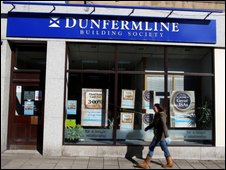 It is the biggest building society, by far.
And it has a strong track record of absorbing weaker societies.
What should reassure Dunfermline's members is that it also preserves the brand names of the societies it buys - so there are still Cheshire and Derbyshire branches, even though these two societies have recently been bought by Nationwide.
But Nationwide will not be taking on the bits of Dunfermline that are seriously loss-making.
These are commercial property loans and portfolios of buy-to-let and self-cert mortgages - with a gross value of £1bn.
These less attractive assets will be transferred to the public sector; they will become yet another banking burden on taxpayers.
And as the dust settles on a financial crisis that is relatively small but politically fraught, the big unanswered question is why Dunfermline took such risks that ultimately cost the society its independence.
 I'm
I'm 






Comment number 1.
At 08:13 30th Mar 2009, invisiblehandadvisor wrote:This comment was removed because the moderators found it broke the house rules. Explain.
Complain about this comment (Comment number 1)
Comment number 2.
At 08:15 30th Mar 2009, Dave_n_Derbyshire wrote:Buy to let, Celf Cert, commercial property... the finanical heroin. You could stop if you wanted to but in the end you couldn't and the results were a disaster. Don't blame the treasury for the mess you got in.
Complain about this comment (Comment number 2)
Comment number 3.
At 08:16 30th Mar 2009, chriss-w wrote:The answer to the "big unanswered question" is fairly obvious.
A Building Society, particularly a small provincial building society, is a relatively mundane business of collecting people's savings and giving mortgages. It is not clear what this has to do with commercial property loans, and buy-to-let except that this additional business boosts the balance sheet, creates the illusion of growth, and so justifies higher salaries and bonuses.
The fact that they were also running self-certified mortgages jusyt shows that lensding standards were being relaxed to much the same end.
The big unanswered question is, were people really saving enough with the Dunfermline to fund these loans - or were they, like most of our banks, caught in the spiral of higher house prices and low savings ratios: and borrowing in order to lend.
Complain about this comment (Comment number 3)
Comment number 4.
At 08:18 30th Mar 2009, Prof John Locke wrote:......."These less attractive assets will be transferred to the public sector, they will become yet another banking burden on taxpayers......"
Why? Just guarantee the deposits and let the company go.....the government has to stop taking on more debt........ when will it end?
Complain about this comment (Comment number 4)
Comment number 5.
At 08:21 30th Mar 2009, SocratesDundee wrote:How can the Nationwide "buy" a building society that is owned by its members? Who is doing the selling?
Complain about this comment (Comment number 5)
Comment number 6.
At 08:27 30th Mar 2009, agent_of_chaos wrote:DBS bought shed loads of sub-prime mortgage books years ago from the likes of GMAC and Lehmans. Coupled with a massive IT failure which ran into the tens of millions it's absolutely no surprise.
Never reported at the AGMs, but then it's audience were only interested in the free food and wine.....
Complain about this comment (Comment number 6)
Comment number 7.
At 08:28 30th Mar 2009, Leigh Caldwell wrote:The answer to Robert's question - why did they take such risks - is, for once, probably nothing to do with greed and bonuses.
Instead, it shows that risk-taking behaviour can arise from behavioural and social phenomena that are inherent in any social group:
https://www.knowingandmaking.com/2009/03/dunfermline-building-society-irrational.html
Complain about this comment (Comment number 7)
Comment number 8.
At 08:37 30th Mar 2009, DebtJuggler wrote:A sinister plot to protect the BoE's pension pot?
At the end of 2006, the Bank of England pension fund made a sudden and very extraordinary decision. It sold all the equities in its portfolio and invested them in index-linked gilts - even though it realised that such a move would increase the annual cost of the pension fund by some £45million.
Looking back, this was a brilliantly farsighted decision because shares have since fallen in value by almost 50 per cent. It seems clear that the Bank of England fund managers understood the nature of the looming economic crisis well before anyone else.
At the time, they said their decision was based on concerns about 'unsustainable' positions in credit markets and the consequences of a possible credit crunch.
The move from equities to gilts raises a very awkward question: did the Bank of England foresee what was coming as early as 2006 - yet did little about the impending crash, apart from protect its staff's own pension fund?
Complain about this comment (Comment number 8)
Comment number 9.
At 08:48 30th Mar 2009, naturaleconomist wrote:We are not yet at the bottom and unless the financial institutions come clean this type of event could happen again and again and again. Possibly on a different scale but more is definitely to come. Why can’t we change the rules and get them to set the records straight. What are the FSA doing? They look very stupid and ineffectual at present.
Complain about this comment (Comment number 9)
Comment number 10.
At 08:48 30th Mar 2009, excellentcatblogger wrote:Has another failure in the financial sector sppoked the markets this morning. It's not just the FTSE, it is also DAX and CAC and the big banks are taking a pasting.
PS Robert, are you time travelling, or are you still working on GMT?
Complain about this comment (Comment number 10)
Comment number 11.
At 08:51 30th Mar 2009, StrongholdBarricades wrote:Quick question Robert?
Any idea why Nick Robinson's blog has been "closed"?
Complain about this comment (Comment number 11)
Comment number 12.
At 08:53 30th Mar 2009, Eddie wrote:Was it not once the case that when a Building Society faced collapse, the other Societies would step in and rescue it.
Why, assuming the Nationwide is still strong, has the taxpayer taken the bad assets in this case? The annual profit of the Nationwide should easily allow it to absorb an additional £1 billion, and the potential bad loans.
Why has the Nationwide not taken over, lock stock and barrel?
Whilst there is a loss of confidence in the banking system, surely the old rules should not be torn up, unless not to do so would further weaken the banking system.
Where is the moral hazard now for Building Societies? They have no shareholders that can lose out, and the owners - the members who have savings and mortgages with the Societies cannot lose out either! Furthermore, the Building Societies themselves have no incentive in calling other reckless societies to account, as, if they fail, the other societies can mop up the good assets and pass the poor ones to the taxpayer.
This seems to be a deal done in haste, to remove the problem before the G20, and to save the Jobs of Gordon Browns constituents. Can the taxpayer be sure that they got the best deal possible, when it was negotiated over a single weekend, and the taxpayer takes all of the bad bits, while another Building Society takes all of the good parts?
Complain about this comment (Comment number 12)
Comment number 13.
At 08:53 30th Mar 2009, Slug wrote:No 4 Jolo13
Failing banks and financial companies reflect driectly on one Mr G Brown who has overseen the conditions under which they expanded so foolishly.
Whilst it's undoubtedly true that a managed collapse and forced sale is less disruptive in the short term, it obviously has a much bigger impact on us all over the long run - but then again in the history books 'Dunfermline Building Society, sold to Nationwide', looks rather better than 'Dunfermline Building Society, bankrupted by government intransigence and badly managed regulations'.
And if there is one thing that Blair has taught Brown, it's about the value of a 'legacy'...are we being saddled with debts to prop up Blair and Brown's place in the history books?
Complain about this comment (Comment number 13)
Comment number 14.
At 08:53 30th Mar 2009, StrongholdBarricades wrote:Certainly the head of DBS was a little angry yesterday.
Why is his part in the whole debacle not covered by your blog?
Are his comments correct?
It would be much easier to make an assessment if we were actually given a precis of all the information out there, IMHO
Complain about this comment (Comment number 14)
Comment number 15.
At 08:55 30th Mar 2009, mantis569 wrote:It seems as though the Governments (both US & England) are intentionally trying to 'crash' the currency. There is a definate alterior motive here, perhaps they are trying to unify the currencies by devaluing it to the point that it is worthless and will therefore ultimately need to be replaced! No one in their right mind would place the taxpayer under this much stress.
Although I am no supporter of the Tory's, I think that Daniel Hannan's dressing down of PM Brown was well put and fully justified. You can see the full extent of his comments here: https://www.freenation.org.uk/?p=483
Why the Government is taking on more bad debt cannot be explained in any rational way, other than to say that there must be an alterior motive!
Complain about this comment (Comment number 15)
Comment number 16.
At 08:58 30th Mar 2009, Nick Drew wrote:Convenient for G.Brown ahead of G.20 - but surely if his liquidity schemes were working properly to free up commercial lending, takeover wouldn't have been necessary ?
Complain about this comment (Comment number 16)
Comment number 17.
At 09:00 30th Mar 2009, Clive of India wrote:Whilst clearly the Dunfermline took far too many risks with things outside its natural compass, from the description of its dodgy book, I cannot see why it was an unmanageable problem. Even if EVERY mortgagee / Loanee defaulted on the £100M book, the selling price of the assets would be between 50% (at worst) and 75% meaning that the provision should be around £37M (ie 62% on average). The situation would be nowhere near this bad however as interest rates are very low and 100% defaulters would be highly improbable anyway. This looks like a case of the BOE/FSA raising the capital ratios required immediately and thus forcing Dunfermline out of business. Is the Govt trying to muddy the waters by letting a few small fry die to bolster its case that "every type of organisation is affected" and justify the huge bailouts elsewhere and the fact its taking "action". Increasing the capital ratios which is designed to increase an organisations ability to weather a storm only works if you don't kill the organisation by imposing the new capital ratios in a draconian manner in unseemly haste. Still take ssome of the headlines off Jackie Smith!
Complain about this comment (Comment number 17)
Comment number 18.
At 09:00 30th Mar 2009, Eddie wrote:#8 BankSlickerminustheR writes:
"The move from equities to gilts raises a very awkward question: did the Bank of England foresee what was coming as early as 2006 - yet did little about the impending crash, apart from protect its staff's own pension fund?"
I have long held the view that Gordon Brown was very much aware of the imminent bursting of his bubble.
That is why towards the end of 2006 there was talk of a challenge to Blair if he did not step aside immediately, for Brown to take on the role of PM.
The outcome of course was the agreement, announced by Blair, that he would step aside in May 2007.
Brown fully intended to go to the Country in the Autumn of 2007 - which is why, in his budget of 2007, he cut the basic rate of tax, and abolished the 10% band (which would take effect in April 2008 - after his intended election).
However events did not turn out as he had planned - he bottled the election.
Complain about this comment (Comment number 18)
Comment number 19.
At 09:04 30th Mar 2009, possumpam wrote:Nationwide should only be allowed to take on the bad along with the good. This idea of dumping the garbage on the rest of us while the buyer of the 'spring cleaned' company enjoys the profits from the 'good' bits is
illogical and utterly indefensible. Just watch Nationwise share prices rise .
Complain about this comment (Comment number 19)
Comment number 20.
At 09:06 30th Mar 2009, stanilic wrote:No surprises that the Grey Knight was the Nationwide.
However, there is a need for an authoritative statement as to why this has happened.
There was a very articulate and angry senior manager from the Dunfermline abusing the government in general and Alastair Darling in particular on the box last evening.
I for one would like some clarification as to what was the precise financial disorder the Building Society found itself in. It was losing money and had done some silly things but was it as bad as it was being painted? There seems to be a lot of rhetoric from either side.
So at the moment I don't believe anyone and I am one of the people underwriting this action.
Complain about this comment (Comment number 20)
Comment number 21.
At 09:07 30th Mar 2009, EdTuBrutus wrote:So we, as taxpayers, get $1bn of toxic asset.
Nationwide gets a highly profitable business, sans toxic debt, for nothing.
Scotland loses a load more jobs as Head Office functions get merged.
THe governments actions in the whole situation are criminal. If they are intent on hiving off the bad business then keep it as an independant entity. Its the same result.
Regards,
Eduin
Complain about this comment (Comment number 21)
Comment number 22.
At 09:09 30th Mar 2009, naffertonian wrote:might not be good for Labour election hopes in Scotland if a Scot allows DBS to fail? (all these Scottish banks and ministers...)
Complain about this comment (Comment number 22)
Comment number 23.
At 09:11 30th Mar 2009, naffertonian wrote:all this nonsense
"Where's my comment?All new members are pre-moderated initially,"
quite apart from not being a new member (am ancient member)
ALL posts are pre-moderated anyway
Complain about this comment (Comment number 23)
Comment number 24.
At 09:12 30th Mar 2009, naffertonian wrote:and how about getting the time right? it is now one day and 7 hours since the rest of us advanced into British Summer Time (though sadly not summer weather)
Complain about this comment (Comment number 24)
Comment number 25.
At 09:15 30th Mar 2009, auntysuncle wrote:Quote:
What should reassure Dunfermline's members is that it also preserves the brand names of the societies it buys - so there are still Cheshire and Derbyshire branches, even though these two societies have recently been bought by Nationwide.
Sorry, Robert, but it can be no re-assurance at all. I was a (borrowing) member of the Portman Building Society, and very happy to be so, and then by a majority vote, Portman decided to merge with the Nationwide. The -inevitable?- consequence: closure of Portman branches (and presumably job casualties) and loss of the Portman name. My mortgage statement now comes from Nationwide's own HQ and carries nationwide branding.
I hope you might adjust your wording on later re-workings of this story to read something like it USUALLY preserves the brand names- but don't count on it!
Complain about this comment (Comment number 25)
Comment number 26.
At 09:19 30th Mar 2009, U13868622 wrote:This comment was removed because the moderators found it broke the house rules. Explain.
Complain about this comment (Comment number 26)
Comment number 27.
At 09:22 30th Mar 2009, Stephen wrote:Why am I feeling pessimistic? I have a cold. Its raining again. Business is very slow. My financial backbone, business and private centres on the Dunfermline Building Society and the Royal Bank of Scotland! Confidence is at an all-time high. Good job RBS was too big. Good job the Dunfermline was too small. Barclays is just right.... Sounds like the three bears here. Neverthless, the Keystone cops mentality of economic policy management at the top is faintly amusing. (Remember how they arrive at the scene.) This time the cops have brushed the crime under the carpet quickly ahead of G20 and a society not beyond repair has been unduly discredited. Just remember. A run on the Dunfermline Building Society is not possible as anyone who has witnessed their Monday morning system creaking into life can tell you. If the run starts today it will be at least midweek before it gets serviced and moving in earnest.
Complain about this comment (Comment number 27)
Comment number 28.
At 09:25 30th Mar 2009, minuend wrote:This is a scandal, the whole affair stinks.
The Dunfermline Buiding Society was pursuing a £25 million LOAN not a bail-out. The whole business was sound and was on course to make a small profit. Contrary to what the FSA and Alistair Darling have said the Dunfermline Building Society had no toxic debts, no American debts, no sub-prime mortgages. All it had was a liquidity problem, which all the banks and building societies currently suffer from.
What we have here is a larger building society, being assisted by government ministers, preying on a smaller building society, and that is a scandal. The Dunfermline Building Society has been sold out by the Labour party.
Complain about this comment (Comment number 28)
Comment number 29.
At 09:28 30th Mar 2009, puzzling wrote:"big unanswered question is why Dunfermline took such risks that ultimately cost the society its independence"
It is all becoming very clear now. In politics,
Politicians put their self-interests above those of his/her networks.
The interests of networked associates, whether British or foreign, comes before that of the party. The interests of the country and society is sacrificed for the interest of the political party. And the interest of the country and/or race come before the survival of humanity.
In banking, there is all the money to gain and egos to inflate with ittle personal risks. Stuff the company, stuff the country, stuff the society if there are £££££$$$$$ to be gained personally. Yes, they are getting away with it again and again.
What examples :-(((
Complain about this comment (Comment number 29)
Comment number 30.
At 09:32 30th Mar 2009, Mike-CH wrote:Guarantee the the deposits and and let the rest go bust.
This is just another example to show financial institutes that they can do what they like. At the end of the day the Treasury will always step-in and save them.
Complain about this comment (Comment number 30)
Comment number 31.
At 09:35 30th Mar 2009, John_from_Hendon wrote:Robert wrote:
"..commercial property loans and portfolios of buy-to-let and self-cert mortgages - with a gross value of £1bn. These less attractive assets will be transferred to the public sector; they will become yet another banking burden on taxpayers."
Presumably these assets will be paid for pound for pound when quite obviously they are worth substantially less. This is the nub of the whole problem in the World's banking system and I am afraid that this process(as in the 'rescue of the Dunfermline) is no answer.
Un-tradable assets have not market value and should in any honest accounting system (even Basel2!) be considered worthless - that is they are bad and in normal times should be written off (or provided for as a potential loss.)
This process (of non-bankruptcy) for just one sector (of banks) is structurally injurious to the whole World's economy - first it puts banks in a special non-commercial position and more importantly the assets that are taken over by the state do not return to the market economy at a realistic price and therefore there is a gigantic overhang of 'worth-less' assets still to return to the economy.
This latter process is preventing a return to normal trade and will almost indefinitely prolong the recession and turn it into a depression and slump. The loss needs to be taken and the assets returned to the market at whatever value they have.
If this means repossessions then so be it for withholding huge numbers of overprices assets from the market, just because the market price is lower than the bookvalue, enormously increases the certainty of a very long depression (c.f the Long Depression of 1873-1896).
Complain about this comment (Comment number 31)
Comment number 32.
At 09:38 30th Mar 2009, John_from_Hendon wrote:PS BBC YOUR SYSTEM CLOCK HAS NOT BEEN UPDATED FOR BST....
Complain about this comment (Comment number 32)
Comment number 33.
At 09:38 30th Mar 2009, penshawdave wrote:Wait till you see the Mc Broon smallprint on this deal.
No doubt that the rest of the "sensible Building Societies" will have to pay a "levy" under a fancy name to help pay for the losses.
Result : the savers of these BS get hammered again re interest rates held down for years to come. A true Socialist principle take from those who have worked hard and hand out to those on freebies.
Complain about this comment (Comment number 33)
Comment number 34.
At 09:39 30th Mar 2009, geofffromleeds wrote:......what a dreadful week for Crash, humiliated by Hannon at the EU, told off in Brazil, housekeeping explained by the female leader in Chile, BOE smart move for its pension fund, lectured by King about the fact that he has no money left for a fiscal stimulus, his local building society goes bust and to top it all his home secretary's house husband (paid for by the tax-payer)is caught warming his hands whilst the old girl is round at her sisters where she lives in the cupboard under the stairs, her main residence so she says. You couldn't make it up.
Complain about this comment (Comment number 34)
Comment number 35.
At 09:41 30th Mar 2009, r0berto wrote:A couple of points :-
Firstly Nationwide does have a record of preserving brands. You can walk down any High Street and see the branches of Anglia, Portman & Staffs, can't you??
Who is to blame for this mess?? Look no further than the FSA. They allow any Society to originate upto 25% of their assets as Commercial Mortgages.
Who is next?? Well ther Ratings Agencies all comment of high exposure to Buy to Let or Commercial Mortgages at Chelsea, Principality, West Brom & Newcastle. If the same accounting methods are applied to their books, as was Dunfermline then it would be interesting.
Complain about this comment (Comment number 35)
Comment number 36.
At 09:44 30th Mar 2009, Stew wrote:Here we go again !!!
More toxic loans for the tax payers to carry...
The question is what were the FSA up to!! They must have known that the
Dunfermline building society was in trouble.
Only last week the FSA said that Barclays is safe....
Should we belive this????
Complain about this comment (Comment number 36)
Comment number 37.
At 09:49 30th Mar 2009, tao-das wrote:I agree with #18 egrid1 and #18 BankslickerminustheR
It was primarily the media that swollowed the line that GB was a great chancellor and then as now fail to pin him down or analyse what was really happening.
The failure of the Dunfermline seems to fit neatly into the governments narrative arc (spin) that the systemic failure of the banking system is a result not of government policy or regulation but the banks taking on buy to let and self cert mortgages plus now commercial property. Yet we have not been told what the exact nature of the failure and it seems that the chaiman of the Dunfermline appeared to disagree saying that the treasury were wrong.
Surely the story here is not that the Nationwide is taking over deposits and the loan book leaving £1 billion of suspect loans. But rather what is the exact nature of the failure and is it a direct result of the treasuries assessment of the quality of the loan book( this is at odds with what the Dunremline management are saying) other wise how do we get to a situation whereby £1billion of assets are to be taken into public ownership?
Surely Robert you should be in here digging for the truth?
Complain about this comment (Comment number 37)
Comment number 38.
At 09:52 30th Mar 2009, absolutetoss wrote:This comment was removed because the moderators found it broke the house rules. Explain.
Complain about this comment (Comment number 38)
Comment number 39.
At 09:58 30th Mar 2009, Wee-Scamp wrote:Good of Robert to repeat the Commissariat's line on this. Given what the Dunfermline's management have been saying there is more to this issue than meets the eye.
Remember that Brown, Darling and Spud Murphy have been peddling the lie that an independent Scotland could not have dealt with the problems that arose with HBOS and RBS without considering the obvious which is that in an independent Scotland HBOS and RBS would have been better regulated, considerably smaller and so and so forth.
There is therefore a lot of suspicion that the Dunfermline issue is as much political as it is financial. Few people would trust Westminster to tell the truth on this matter so it's of critical importance that we hold an independent inquiry here in Scotland to get to the bottom of what really happened.
Complain about this comment (Comment number 39)
Comment number 40.
At 10:13 30th Mar 2009, Adam_C_UK wrote:At this moment Britannia Building Society (Britain's second biggest building society) is requesting permission from its members to be taken over by the Co-op Bank. Britannia is very strong financially, having been conservatively run; this Dunfermline fiasco just shows even mutuals can get into difficulty by recklessness.
Whilst I don't want to throw stones at the Co-op, the fact remains that Britannia is an institution that has survived for more than 150 years on the mundane business of taking savings and lending to families to buy their homes. Whereas the Co-op Bank is...well...a BANK. I can't see ANY benefits for Britannia members in the takeover - except that they will get a free shareholding in the Co-op which would otherwise cost them a whole pound! And for that they have to sell out the independence of a mutual that has been handed down through generations, and is held in trust for future generations by the current members.
As a Britannia member, I'll be voting against the takeover - but Robert, as a leading financial journalist, shouldn't you be asking some questions about what the logic is for that Britannia takeover?
Complain about this comment (Comment number 40)
Comment number 41.
At 10:23 30th Mar 2009, Amused2Death wrote:And so the downward spiral of the UK's self-humiliation continues.
Who would want to be working in the Treasury these days ?
We, along with the US, need to say SORRY to the rest of the G20 next week. Now I wonder if Mr Brownhilde will manage that before he warms himself on Siegfried's Pyre.
Scotland should be granted immediate independence along with Bavaria. And then both new states share the same Monarchy. And let the new King be called Wotan...ther namesake of some god who much action eventually sits around and does nothing. (Candidates for King need to have practical experience in Regulating Banks and speak with an endearing regional accent.)
History repeats itself, itself, itself...and if this blog is initially enigmatic there are some who will understand it straightaway. Just ask around in HMT. Oh, alright then, just ask one or two employees in particular.
Complain about this comment (Comment number 41)
Comment number 42.
At 10:31 30th Mar 2009, Sasha Clarkson wrote:We seem to have a divergence of alleged fact here.
On the one hand
#6 "DBS bought shed loads of sub-prime mortgage books years ago from the likes of GMAC and Lehmans
On the other hand
#28 "Dunfermline Building Society had no toxic debts, no American debts, no sub-prime mortgages."
I won't believe either of these assertions without evidence. Nor will I believe what was said in the link provided by #7 "I haven't been able to find out whether management were incentivised with highly leveraged short-term bonuses, but given that this is a Scottish building society, the obvious assumption is that they were not."
This may be true of course, but to me it just smacks of hope and wishful thinking. Certainly, the execs at Yorkshire BS get paid handsomely ie circa 250 -350k. True, no bonuses in 2008, but the CEO got 308k salary plus 140k bonus in 2007. So I think there's certainly been some "trickle down" of the greed culture from banks to building societies, even if they haven't been fully infected.
Complain about this comment (Comment number 42)
Comment number 43.
At 10:37 30th Mar 2009, costaquenta wrote:Robert and the BBC 'business' correspondents
Whilst I do accept that the Banking Crisis has been a massive story that has required extensive coverage, I would now request that you turn your attentions to that of the 'real' economy as this recession now begins to bite. Why not have an in depth look at how SME's are coping and maybe make some assumptions about wether or not the Govt approach to tackling the downturn has actually achieved anything?
I am not a business correspondent, all I can tell you is that things are becoming very grim down here on the shop floor of the UK. The Credit Crunch has now filtered through into the real world. Most companies I deal with, including my own, have now closed off their Credit Terms offered. This means no more new Trade Accounts and all customers on stop after 30 days. I am afraid Fear has taken over. Companies, some who have been trading 30 years+ are failing, and this squeeze on credit from outside the financial world is just making things worse, as goods and services are witheld meaning orders cannot be fulfilled. It is also impossible for new start-ups to gain credit with suppliers, making it very tough for those brave souls who are 'having a go' in this economic climate. Once again, as so often happens in recessions, Cash is King and any business without substantial cash reserves is going to struggle to make it to the end of this year, despite the resumption of some lending from the financial institutions.
I hope im wrong but it does feel as though we are now at the beginning of the really nasty part of this recession. The Banking Crisis was the appetizer, now for the main course......
Complain about this comment (Comment number 43)
Comment number 44.
At 10:42 30th Mar 2009, NewsStudent wrote:Why did the Dunfermline do it? It is a Scottish institution, they could see what RBS and BOS were doing and wanted to play the same game and not be seen as stuffy and old fashioned. For a brief period of time, Edinburgh was where it was all happening and the flame of financial aggression burned ever more brightly. It has now fizzled out.
Are there any more skeletons in the cupboards north of the border?
Complain about this comment (Comment number 44)
Comment number 45.
At 10:48 30th Mar 2009, skint wrote:I agree with #37, surely you should be seeking the truth.
We have a well respected BS of which I have been a member for over 40years requesting a loan of £25m, a Scottish Government prepared to help out and a flat no from the UK Government.
It would appear to have been done with too much haste, was this purely a political move? Unionism v Nationalism? Murphy telling us it was all due to the sub prime market in America, Faulds telling us that is nonsense, KPMG said the DBS was viable, just what is going on?
We as tax payers haven’t benefitted one bit, thankfully the staff keep their jobs for the time being and depositors money is safe but start asking the pertinent questions Robert all we have is a lot of flannel at the moment and we have a right to know the real reasons behind this current crisis.
Complain about this comment (Comment number 45)
Comment number 46.
At 10:50 30th Mar 2009, Sasha Clarkson wrote:#39 Wee-Scamp "the lie that an independent Scotland could not have dealt with the problems that arose with HBOS and RBS without considering the obvious which is that in an independent Scotland HBOS and RBS would have been better regulated, considerably smaller and so and so forth."
How do you know? It's not obvious to me. Salmond is an ex-banker who worshipped at the altar of banking until this crisis broke. Did he, like Vince C, anticipate the housing bubble crash? No. Would he have intervened to stop RBS taking over NatWest, or the HBOS merger? Did he criticise either of these transactions at the time? Not that I'm aware of. I think he rather liked the idea of Scotland punching above its weight - which, lets face it, it did - until the house of cards came crashing down.
Scotland shares a cultural problem with the rest of Britain - obsession with money and house prices. This does not affect the arguments pro or anti independence. But the bloated banking sector is a shared poisonous legacy.
Complain about this comment (Comment number 46)
Comment number 47.
At 10:52 30th Mar 2009, Sasha Clarkson wrote:#39 Why call Mr Murphy "spud" - is it meant to be derogatory? Are you a Rangers supporter by any chance?
Complain about this comment (Comment number 47)
Comment number 48.
At 10:56 30th Mar 2009, Blanklook2 wrote:This comment was removed because the moderators found it broke the house rules. Explain.
Complain about this comment (Comment number 48)
Comment number 49.
At 11:18 30th Mar 2009, JavaMan wrote:22,
Methinks the election is already in tatters, independance is now a realistic proposal.
Tally Ho
Complain about this comment (Comment number 49)
Comment number 50.
At 11:31 30th Mar 2009, thinkb4 wrote:#4 jolo13
You can't just keep the good stuff and leave nothing for the creditors to pick through when something goes bust... it's illegal
Complain about this comment (Comment number 50)
Comment number 51.
At 11:37 30th Mar 2009, saintCromak wrote:There seems to be a common thread with these failures - apart from the "bankers" acting as tho' they were at the dog track. How many of them are qualified in banking? The latest Chairman, Jim Faulds, has a background in advertising - in what way does that qualify him to run a Building Society?
As far as I know, Goodwin at RBS had no formal banking qualifications either.
But why are we surprised? They gave a boy from Paisley the keys to the bank then were astonished that he filled his pockets on the way out! Presumably the Coatbridge-reared Faulds will also be lining his pockets before he leaves.
Complain about this comment (Comment number 51)
Comment number 52.
At 11:43 30th Mar 2009, JavaMan wrote:47, Sasha
There are many Rangers Fans on the RebuildBritain forum ;-)
Complain about this comment (Comment number 52)
Comment number 53.
At 11:43 30th Mar 2009, Toldyouitwould wrote:This comment was removed because the moderators found it broke the house rules. Explain.
Complain about this comment (Comment number 53)
Comment number 54.
At 11:48 30th Mar 2009, excellentcatblogger wrote:#44 newsstudent
A salient question. Why indeed did so many financial institutions follow the herd and like lemmings fall off the cliff. Up to a point I can understand the big boys competing with each other to become bigger and more profitable, entering riskier markets etc. However, for a smaller regional building society to do as well, the whole thing begins to stink. I lean towards some kind of scam going on, where a lot of banks in US and Europe have been taken for a ride. Add to the mix of the B of E moving their pension investment from shares to gilts, as per BANKSLICKER blog above in 2006 the finger of blame points to Whitehall. The Serious Fraud Office and the FBI need to set loose and launch a criminal investigation.
The role of the supine British financial press, also needs to be investigated. Part of their job is to hold the executive holders of government to account, not just regurgitate the latest press release from the spin doctors.
As to DBS, the information emanating from Scotland and Whitehall is so divergent, it is hard to believe that it relates to the same company. NuLabour are desperate to sweep this under the carpet before the G20 shindig aka "the hot air conference". If DBS are to be believed they were seeking a coimmercial loan and not a bail out, and have had no communication with the Treasury for months. So how the Treasury is able to quantify the scale of DBS's problems is a bit of a mystery. Also Darling completely misses the point of mutuality - he argues that their profit streams are too small. Doh!, mutuals exist to the benefit of their members not to fleece them!
A query: as DBS is a mutual, can the Treasury steamroll a takeover of DBS by Nationwide without consulting the members? It does not bode well for other cooperative socities and mutuals if this is the case.
Complain about this comment (Comment number 54)
Comment number 55.
At 11:54 30th Mar 2009, Lambo51 wrote:#19, possumpam wrote: "Just watch Nationwide share prices rise." - note that it is a mutual building society, owned by its members - there's not a share price in sight!.
Lots of other comments about preserving building society names when being taken over by the Nationwide. If the members read the merger documents when distributed, they'll know if their society is to retain its old name - sadly for the Anglian and Portman and others, there was no agreement to keep the name - in the case of the Cheshire, Derbyshire and now the Dunfermline - it looks as though there is specific agreement to retain the name, although I doubt if is an arrangement in perpetuity!
The world is in a sorry mess from corporate (and personal) greed, inept government and regulation. Let's all hope that we come out the other side with our lives and relative well being intact. I dread the day when I need to retire.... perhaps I should have been a politician and kept my snout in the gravy pot.
Complain about this comment (Comment number 55)
Comment number 56.
At 12:01 30th Mar 2009, somali_pirate_SP500 wrote:#34 geofffromleeds you left out Mr McNaughty staying 'round his parents house, though he's suffering a bit of memory loss about how many days and when.......
#42 sashaclarkson and many others; yes exactly! who are we to believe - the chief exec of Dunlendin' or Darling et al; someone is being very economical with the truth
or, more probably, both sides are spinning it hard to match their aims
and it's pretty clear how Peston is going to report it all, as unofficial govt spokesperson and apologist
Dunlendin' might have been small but this is a real PANDORA'S BOX of tricky questions and problems that has been opened
I find it hard to believe that it was all under control and being sorted out behind the scenes for months......... this looks like one of those total panic, over the weekend deals and shotgun marriages, where the risk is socialised etc etc; like last autumn with Lloyds HBOS and in the US with Merrill Lynch
despite throwing trillions at the banks (globally but mostly in US and UK) over the past 6 months, nothing fundamental has changed or gotten better at all yet; where are the stress tests? the estimated value of various toxic assets? etc etc; either not done at all or being kept secret to avoid causing mass panic; all anyone can claim is that there hasn't been a total collapse and ATMs still work......
Peston has now posted an update and the moderators are working hard; an industrious Monday indeed!
Complain about this comment (Comment number 56)
Comment number 57.
At 12:07 30th Mar 2009, remoteislander wrote:Robert,
Sure this is news, but the effect on the wider economy of events of this scale is limited. Ditto for the Newcastle, Chelsea etc etc. Can we please have real economy news. I have followed (and appreciated) your blogs since your appointment, but you are the Business Editor, not the Banking Editor. The funny money games are now effectively over and the effects on the real economy, particularly outside the south east are just beginning. Further extensive coverage of the Banking system merely continues to re-inforce the notion that this is the area that Government (I use the term loosely)needs to place all it's time and resources into. Like others who blog here (grimupnorth etc), I own a well established family run, manufacturing SME, a world leader in it's field, and our complete pre-occupation is survival. We do not belong in the "foolish virgins" camp, surprised by recent events (I have worked through the last two major recessions) and we began to cut staff in the Autumn of 2007. We have reduced our break-even point by a third, staff likewise. We are neither financially or economically illiterate. For example, I personally pulled out of buy to let in 2007, taking profit when we hit 100% returns. Basically we have played the game right, in fact been ahead of it most of the way. The business is profitable since its inception 8 years ago - but is now experiencing a drop in sales, national and international, that is both unprecedented, and in my view, of a relatively short duration. Indications are that we can expect business to return to an acceptable (say 70% of 2008)level next year. Any small manufacturing business that is volume related and requires to make annual capital investments equivalent to 10% or more of turnover will be both financially highly geared and very sensitive to volume reductions, even in the short term. We can therefore expect a thrashing over the next 6 to 9 months. A cash flow drain that may well exceed our current facilities (doubled and put in place in late summer 2008) and place the business's survival in the hands of an incoherent and totally risk adverse banking environment.
In common with most SME owners some working capital and fixed capital requirements are covered by various personal guarrentees. At worst they could cost me £250,000, which, notwithstanding the current state of the property market, the family home will cover. I am therefore an easy target for the Banks to pick off. Should they seek a no pain exit, my guarrentees will probably see them clear.
What would really help us to fight another day (assumming a terrible 9 months to come)is a moritorium on the £150,000 of annual HP repayments for 6 months. While I cannot yet demonstrate to our bankers that this would be necessary for survival (as opposed to sensible or precautionary), that is the route we are proposing to them. It will be interesting to see what the reaction is - panic probably, and that's the risk you take if you try to work with your bank early - particularly if you are operating within your facilities and those facilities are fully covered by adaquate collateral. If they agreed to help us in this way (for a suitable fee no doubt), cash would be conserved and the business supported until next year. The P&L would still take a pasting, but that's real business and that only effects my income, while enabling us to keep 23 skilled employees in place. What chance of the right result, do you fellow real business guys think?
Alternatively - and this is the way I would be playing it if I was a very large bank, if the Government would like to buy the equipment for a few shares and allow us to keep it (sound familiar?) that would be ideal. Of course the Government could simply guarrentee to the lenders, by means of an insurance deal, that after our 6 month "holiday" we would restart the remaining payments.
Robert - use your contacts to see if there is the slightest understanding in Government of either our (most UK SMEs) potential problems or any thought at all as to potential solutions.
Keep up the good work - but please cast your beady eyes towards the wider world.
St Helena (still on GMT)
Complain about this comment (Comment number 57)
Comment number 58.
At 12:08 30th Mar 2009, stevewo wrote:We need to find a way to protect the taxpayer from reckless financial institutions in future.
We wneed to be able to "do a Lehmans" with them, and let them go bust.
Otherwise, the ordinary British working man is going to become the guarantor of a large slice of the worlds financial industry, and to be blunt, he cannot afford it.
Treasury policy seems to be making John the plumber from Sidcup responsible for the gigantic losses floating around among the billionaire institutions.
British people should only be guaranteeing the High-Street operations, and British current and savings accounts.
All other operations, including business loans, international loans mortgages and investing SHOULD NOT FALL ON THE SHOULDERS OF THE BRITISH PUBLIC when they fail miserably.
Break the huge banks up, and "do a Lehmans" with the trillions of losses, or we will all become slaves, as will our children and grand-children.
Complain about this comment (Comment number 58)
Comment number 59.
At 12:36 30th Mar 2009, JavaMan wrote:Has anyone considered the impact that the tax credit system had on the housing bubble, and is having on the UK’s debt burdon?
Can we afford it?
Can we afford all the benefits being paid to EU economic migrants?
Complain about this comment (Comment number 59)
Comment number 60.
At 12:37 30th Mar 2009, absolutetoss wrote:Dear Moderator,
I thought it best to drop a line to assure you that no offence was intended by my use of the alternative (but legitimate) spelling of King Canute's name in reference to the esteemed author of this blog.
Warmest regards from the real world.
Complain about this comment (Comment number 60)
Comment number 61.
At 13:11 30th Mar 2009, BlackIsleJag wrote:Its to be expected that the Dunfirmline ended up in this mess, with the freedom allowe by the FSA and the climate of the early 2000 s. Its a shame that Fife and Scotland loses this financial institution. Yes I believe if the Goverment had the will it could have saved it, especially as Mr Darline and Brown are, as we now know, had the political will to take the toxic debt into public hands!!
But this did not happen overnight, nor over the weekend, but took months of planning. I personally think the Goverment were not financially panning - there are better ways of saving the money involved - but policital manouvering, There now very few financial instutions for an independent Scotland to call on if we were to become independent and more and more we depend on the ailing Westminster Banks!!
Complain about this comment (Comment number 61)
Comment number 62.
At 13:16 30th Mar 2009, newProtectorCromwell wrote:At the start of the banking crisis, and on frequent subsequent occasions, the PM and his Chancellor repeated ad nauseam that they were “prepared to do whatever is necessary to ensure the survival of the banks". Didn’t last long, did it? And if the Chairman of the Dunfermline is to be believed, over a period of six months his board could not so much as get an interview with the “faceless mandarins in London” to discuss a recovery strategy they had developed. But there was the Chancellor on the Andrew Marr show on Sunday simply ignoring all this and saying that he and the FSA had worked on the matter tirelessly for 6 months. So why didn’t they talk to the Board? Ah now this is where it becomes interesting. It was a political decision and not an economic one. If it were economic they would without a doubt have consulted the Dunfermline Board. Political decisions, on the other hands, are played verra close to the chest.
Now let us turn to Simon Johnson, a professor at MIT’s Sloan School of Management, who was the chief economist at the International Monetary Fund during 2007 and 2008. He writes a blog on the financial crisis at
www.baselinescenario.com
In the May 2009 journal, The Atlantic, he wrote an article entitled The Quiet Coup. It should be compulsory viewing for all commentators to Peston’s Picks. You can see it at
https://www.theatlantic.com/doc/200905/imf-advice
In the article he refers to some of the counties that needed help like Ukraine, Russia, Thailand, Indonesia, South Korea, and elsewhere, and says it is all depressingly familiar to IMF staff and that the economic solution is seldom very hard to work out. The real concern of IMF staff, and the biggest obstacle to recovery, is almost invariably the politics of the countries concerned. He says:
“Typically, these countries are in a desperate economic situation for one simple reason—the powerful elites within them overreached in good times and took too many risks. Emerging-market governments and their private-sector allies commonly form a tight-knit—and, most of the time, genteel—oligarchy, running the country rather like a profit-seeking company in which they are the controlling shareholders. When a country like Indonesia or South Korea or Russia grows, so do the ambitions of its captains of industry. As masters of their mini-universe, these people make some investments that clearly benefit the broader economy, but they also start making bigger and riskier bets. They reckon—correctly, in most cases—that their political connections will allow them to push onto the government any substantial problems that arise.”
He did not dare, of course, to refer to countries like the USA and UK – that would have been too close to home and a good job - but there is no reason to suppose that they are in any different a boat.
He goes on to say that oligarchs get carried away, waste money, and build massive empires on mountains of debt. Then he says what we know so well from the current crisis, that over-borrowing always ends in grief for an individual, a company, or a country. Of course, squeezing the oligarchs is seldom the strategy of choice. The oligarchs are usually the first to get help from the government, like “preferential access to foreign currency, or maybe a nice tax break, or—here’s a classic Kremlin bailout technique—the assumption of private debt obligations by the government.”
Stop! Pause! Consider! Is the man not describing precisely what has happened in this country? Is it not all because of a political shambles? And note that what is being used here more than anything else is the Kremlin option – take over of private debt by the public purse. Where do you think it can all end but in a form of socialism both we and the USA will come to rue. We are making the classic mistakes of tinpot countries. And if that is the company we keep, that is what we will become, because birds of a feather flock together.
Complain about this comment (Comment number 62)
Comment number 63.
At 13:26 30th Mar 2009, JadedJean wrote:'IT'S JUST BUSINESS'
Those who have encountered those wheeling and dealing in the commercial property market (and elsewhere) in recent times know that this fits.
The really worrying thing is that so many feel inadequate because they are not able to do this!
When you see these reprobates before Treasury Select Committee etc acting out how sorry they are, or in some cases, how outraged they are at the behaviour of others they were supposed to regulate/manage, just bear this in mind and that they are incorrigible.
Now you know why the USSR/PRC branded these types 'enemies of the people' and treated them so severely.
Complain about this comment (Comment number 63)
Comment number 64.
At 13:27 30th Mar 2009, Prof John Locke wrote:robert next time you are speaking the mr Darling can you ask him why it is better for the taxpayer to take on the "toxic" debt and in addition pay nationwide £1.5 billion rather than lend Dunfermline the £35 million of liquidity?.....
Complain about this comment (Comment number 64)
Comment number 65.
At 13:32 30th Mar 2009, TheFridayJoker wrote:#19 Possumpam wrote:
"Just watch Nationwide share prices rise"
Nationwide doesn't have a share price, or any shareholders. It is a mutual society owned by its depositors.
Complain about this comment (Comment number 65)
Comment number 66.
At 13:52 30th Mar 2009, JadedJean wrote:THEY'RE NOT DOING THEIR OWN JOBS
somali_pirate_SP500 (#56) "... and it's pretty clear how Peston is going to report it all, as unofficial govt spokesperson and apologist
These days reporters don't even do their own jobs, i.e report. Instead, they 'analyse' and 'interpret' i,e dramatically create fictions. What's worse, most of them (Paxman is a rare exception, and even he appears to be backing off/giving up, these days) don't demand that those they interview make truth-functional statements for which they can be held accountable. That is what the press in democracies is supposed to do. They just don't do it.
Instead, they pass around sophisticated 'gossip' because most of their audiences and and probably their producers/controllers?) can no longer tell the difference!
Complain about this comment (Comment number 66)
Comment number 67.
At 13:57 30th Mar 2009, Matthew wrote:What I don't understand is why, if all of the bad stuff is being hived off from DBS, what's left needs to be taken over. If DBS is left with a profitable business once the Treasury has taken out all of the rubbish, why can't it replace its management and stand by itself?
Or is the removal of the toxic debt not possible if DBS remains as a mutual entity?
Complain about this comment (Comment number 67)
Comment number 68.
At 14:45 30th Mar 2009, JavaMan wrote:We are skint and everyone knows it, that’s our nuclear stuff up for sale. Wonder if Osama will put a bid in?
Complain about this comment (Comment number 68)
Comment number 69.
At 16:03 30th Mar 2009, JadedJean wrote:jolo13 (#64) "... ask him why it is better for the taxpayer to take on the "toxic" debt and in addition pay nationwide 1.5 billion rather than lend Dunfermline the 35 million of liquidity?....."
Bonuses paid as hush money, ever so complex 'financial instruments' that only 'rocket sicntists' can allegedly understand (except that maths is extensional, and as computers can process these algorithms, it has nothing to do with being 'clever' (or even living) thank goodness!).
Osborne says the FSA report should be published - but we've already seen that the FSA was set up as a sinecure/poodle to further light-fingered regulation (anarcho-capitalism) along with other directives.
If one doesn't smell what's rotten now, I guess one never will?
Complain about this comment (Comment number 69)
Comment number 70.
At 16:33 30th Mar 2009, J Wilson wrote:As Nationwide takes over Dunfermline's savings business this is yet another instance of reduced choice for savers. We are told to spread around our savings and never put more than £50,000 in one bank or society. What happens now to folk who have more than a total of £50K invested between Nationwide and Dunfermline?????
Complain about this comment (Comment number 70)
Comment number 71.
At 16:55 30th Mar 2009, largeBenny_FitFraud wrote:I have come to the decision that now is the time to be investing in shares for long term gains, rather than low interest bank accounts. Can someone please tell me how to do this and what percentage commision I should be looking to pay? Also do you have to pay tax etc if you sell for a profit?
Just small time obviously, £100 - £200 a month
Thank you
ps I always find the comments far more interesting and enlightening than the actual articles
Complain about this comment (Comment number 71)
Comment number 72.
At 17:11 30th Mar 2009, Japanbytes wrote:#47 sashaclarkson
re #39 Wee-Scamp
Answer to your question 'Murphy' is another name for potato - and so is Spud!
Complain about this comment (Comment number 72)
Comment number 73.
At 18:01 30th Mar 2009, NewsStudent wrote:#57 Remoteislander
An interesting analysis. It is in many ways a relief to be an observer in this crisis rather than wondering what to do with the people in the factory, the raw materials on their way from the Far East and the finished goods in the warehouse as I was in previous difficult times.
Will we see another generation of Jim Slaters looking to strip assets on the cheap, making themselves very rich in the process and closing down more of our productive industries?
Complain about this comment (Comment number 73)
Comment number 74.
At 18:19 30th Mar 2009, stilllitterarty wrote:Thus far everything that came to the rescue of anything to do with AAA's holes ended up joining the wrecksqueues pile up of the stAAArship enterprise commandeered by the labour clingons .
Fog seems to be the permanent mental state for anyone involved in banking
Complain about this comment (Comment number 74)
Comment number 75.
At 19:03 30th Mar 2009, Nezimao wrote:newprotectorcromwell @62.
thanks for the link, interesting stuff.
Complain about this comment (Comment number 75)
Comment number 76.
At 19:49 30th Mar 2009, DebtJuggler wrote:This comment was removed because the moderators found it broke the house rules. Explain.
Complain about this comment (Comment number 76)
Comment number 77.
At 19:56 30th Mar 2009, JadedJean wrote:Newsstudent (#73) "Will we see another generation of Jim Slaters looking to strip assets on the cheap, making themselves very rich in the process and closing down more of our productive industries?"
What productive industry? We're something like 80% 'Service' industry, the boom allegedly being based on Financial Services and handgers on. Who wants to buy the services of that bunch of spin-doctors and crooks now? In the former USSR and PRC they'd have been locked up!
This government's Public Sector commitments seem to have been so dependent on PFI/PPP that they couldn't afford to let the crooks go to the wall..... and I bet the crooks knew that - that's probably why so much of what they say now sounds so surreal!
Complain about this comment (Comment number 77)
Comment number 78.
At 22:31 30th Mar 2009, auntysuncle wrote:In answer to your reply to my earlier comment this morning, RobertO
>Firstly Nationwide does have a record of preserving brands. You can walk down any High Street and see the branches of Anglia, Portman & Staffs, can't you??
Not in my High Street you can't! I can't remember when I last saw an Anglia BS- I thought they went years ago at the same time as the excellent "Nationwide Anglia" campaign was dropped on TV. I'm not sure whether this reply was ironic or not, but all experience so far shows that, unless checked otherwise, Nationwide absorb brands, not preserve them.
This may make economic sense where there have been branches of the two separate societies close by, but otherwise it only further serves to dilute the local roots of the building societies movement and lessen choice- though admittedly, to their credit, when Nationwide took over Portman, they also passed on their more favourable SVR on former Portman mortgages. I wonder if Dunfermline borrowers can expect the same treatment under the circumstsnces?
Complain about this comment (Comment number 78)
Comment number 79.
At 23:08 30th Mar 2009, DebtJuggler wrote:JadedJean
Paxo's been 'trousered'...as exemplified by tonight's Newsnight.
and...
I am not allowed to respond to your psycopath link (moderated out)...even with no reference to any particular person.
It's all getting a bit scary!
Complain about this comment (Comment number 79)
Comment number 80.
At 02:37 31st Mar 2009, OldSouth wrote:...'the big unanswered question is why Dunfermline took such risks that ultimately cost the society its independence.'
Greed and stupidity.
Stupidity and greed.
That question is not hard to answer.
This one is: How do we educate the next generation of young people to not repeat these follies?
Complain about this comment (Comment number 80)
Comment number 81.
At 09:36 31st Mar 2009, JadedJean wrote:OldSouth (#80) "This one is: How do we educate the next generation of young people to not repeat these follies?"
No off3ence, but you appear to naively assume that generations can be educated i.e. taught rather than just nurtured. In fact, generations are born. Their cognitive and other abilities are a) largely inherited and b) sadly subject to dysgenesis at the population level.
Give that some careful thought, and you'll see how what we see all about now has largely been brought about through naive (i.e. non evdience-based) assumptions about education (education, education).
A very Marxist idea.
Complain about this comment (Comment number 81)
Comment number 82.
At 12:24 31st Mar 2009, Toldyouitwould wrote:#72 Japanbytes:
"#47 sashaclarkson
re #39 Wee-Scamp
Answer to your question 'Murphy' is another name for potato - and so is Spud! "
___________________
I do not know how you got away with this.
I was 'Moderated' for putting the popular prefixes to people with surnames of Clark and White.
PC gone mad?
Complain about this comment (Comment number 82)
Comment number 83.
At 12:31 31st Mar 2009, Toldyouitwould wrote:#62 newProtectorCromwell
"In the May 2009 journal, The Atlantic, he wrote an "
___________________
In his time machine?
Complain about this comment (Comment number 83)
Comment number 84.
At 12:34 31st Mar 2009, Cazzkins wrote:I must admit that this part-takeover is very suspicious. Nationwide had made it clear that they wouldn't be looking to take over any other societies in the near future as they had been downgraded following the recent takeovers of Cheshire and Derbyshire. It looks to me that the £1.6bn that they are to receive is a government bribe as they have in fact only agreed to take the successful aspects of the Dunfermline. The tax-payer is left with the bad debts and problem loans AND loses a further £1.6bn to Nationwide! Is this just about GB saving face AGAIN?
Complain about this comment (Comment number 84)
Comment number 85.
At 17:46 31st Mar 2009, William_Read wrote:I recall that in the late 1960s the BBC News programme "Nationwide" fronted by Michael Barratt, reported major problems in the Co-operative Movement, including its building society. Shortly afterwards the building society was re-launched as "The Nationwide Anglia Building Society", and later dropped the Anglia reference. I believe that today the Nationwide has no connection with the Co-operative Movement. Can anyone confirm that the Nationwide began its life as part of the Co-operative Movement?
Complain about this comment (Comment number 85)
Comment number 86.
At 19:47 31st Mar 2009, DeniseCullum222 wrote:Banks are run by humans and do not have a life of their own and so the humans want to get ride of a bank or building society so hides the money and says its lost it and someone either buys it or part buys it or what ever and so we have less small banks but a few large banks whom the Govenment asks them to lend us our money that we gave them and they say no we have to have our bonuses for doing nothing really except loosing your money. it should be made into a board game for Christmas cash or no cash or war or no war or who really runs this country?
Complain about this comment (Comment number 86)
Comment number 87.
At 00:03 1st Apr 2009, billyblue1 wrote:As I understand it The Nationwide won't 'buy' The Dunfermline. It will be done by The Dunfermline 'transferring engagements' to The Nationwide. No purchase price will be paid.
Complain about this comment (Comment number 87)
Comment number 88.
At 07:41 1st Apr 2009, billyblue1 wrote:In answer to William_Read; yes the Nationwide used to be called The Co-operative Permanent Building Society.
Complain about this comment (Comment number 88)
Comment number 89.
At 04:09 3rd Apr 2009, dennisjunior1 wrote:Robert:
Nationwide to rescue Dunfermline That is very good news, that Dunfermline will be able to be operatable under a new company...Without the "bank" would not go out of business....
~Dennis Junior~
Complain about this comment (Comment number 89)