

Bull in a china shop
Companies burdened with debt and dependent on discretionary spending by consumers are currently as fragile as the finest crystal or bone china. So, sadly, there's no surprise that Waterford Wedgwood - which had net debt around £470m last spring - has called in the receiver in Ireland and has gone into administration under insolvency procedures in the UK.
Almost everything that Waterford Wedgwood manufactures is a nice-to-have rather than a must-have. And most of us are thinking twice about shelling out on nice-to-haves.
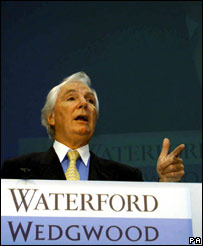 WW's collapse is a resonant event that speaks of a noxious global squeeze on consumer spending. But although it has more history than most of the FTSE-100 companies combined - Waterford, Royal Doulton and Wedgwood are great names from Britain and Ireland's industrial past - WW is not a huge company.
Global sales are £650m. In the UK, it employs 1,900. Of these, around 600 work in manufacturing at Barlaston.
There are 5,800 employees outside the UK. And (lest you've forgotten that we live in a globalised world where production gravitates to low-cost economies) the biggest manufacturing centre is Indonesia, where there are 1,500 staff.
The brands will surely survive under new owners. And my understanding is that there have already been expressions of interest from possible buyers of the brands.
However, what happens to its manufacturing plant - and that of many other companies like it - is what matters. Even if in WW's case there are just a few hundred British manufacturing jobs at stake, the UK can ill afford to see yet more precious exporting capacity relocated to more productive competitor economies.
That said, for biggish British companies this morning, there's some good news on this, the first proper business day of the new year.
What I mean by this is that there's no news of any significance from them - and that's good news.
If trading by retailers over Christmas had been even worse than investors had been led to expect, there would have been emergency announcements by those retailers (under Stock Exchange rules).
So in the coming few days we can expect the likes of Marks & Spencer, Next and Debenhams to say - in their scheduled trading updates - that turnover per square foot of selling space is falling pretty sharply and that profit margins have been squeezed by heavy discounting and promotions. But we knew that.
And we can be fairly confident that they remain on course to meet much reduced expectations for their profits this year (a bit over £600m in the case of Marks & Spencer, down from £1.1bn last year, or an eye-watering drop of around 45%).
More generally, the question to be asked is whether most of the bad stuff that could happen to companies is already discounted in stock market prices.
Analysts are forecasting that the earnings of European companies will fall fairly sharply this year and that those of US businesses will drop in the first half before recovering. The outlook is more mixed in Asia.
Against that ostensibly gloomy background, stock markets have been rising fairly generally over the past two or three weeks. The FTSE-100 is now more than 20% above its low point of last year. The S&P 500 is 26% off its 2008 bottom. Asian stocks have been rising solidly for the past eight days.
Shome mishtake, shurely?
Not at all.
Stock markets are looking at the prospects for 2010 and 2011. And however rotten 2009 will turn out to be, in the form of companies going kaput and unemployment rising sharply, investors are increasingly confident that armageddon has been avoided.
They look at the way that central banks have slashed interest rates and are - in effect - dropping money from helicopters. They look at Barack Obama's plan to pump something over $700bn into the US economy in the form of tax cuts and public spending. And they conclude that an economic turn for the better must surely come towards the end of 2009.
Here are a couple of almost needless words of caution.
Stock markets aren't always right (we've all learned that painful lesson in the past couple of years, haven't we?).
And, as and when we see the green shoots, they may be fragile, stunted and spotted with a disease called inflation.
 I'm
I'm 






Page 1 of 3
Comment number 1.
At 11:29 5th Jan 2009, Antonio59 wrote:"Bull in a china shop"
....and I thought this was going to be a full and frank article about Gordon Brown's hopeless attempt at being PM, while still being the real Chancellor, working his puppet Alistair !!
Well at least he's "saving the world including the USA (mustn't forget to mention the USA as many times as possible !!)
Complain about this comment (Comment number 1)
Comment number 2.
At 11:37 5th Jan 2009, steve_webprogrammer wrote:"It would work much better..."
said Gordon on the Andrew Marr Show
"..if all the G20 countries adopted the same policy of pumping cash into the economies rather than just GB in isolation."
Very true Mr. Brown.
Similarly, if I owe 100 quid to a bank and I get 20 of my friends to all put 5 quid into a financial stimulus fund, then we will all end up owing only 5 quid each.
Great Idea. You are a Genius.
Because if my friends don't do this, then I can blame them for my 100 quid debt.
Brilliant. Stunning. Visionary.
Complain about this comment (Comment number 2)
Comment number 3.
At 11:38 5th Jan 2009, sabes10 wrote:Did I spot a little bit of positivity? Most unusual.
Complain about this comment (Comment number 3)
Comment number 4.
At 11:38 5th Jan 2009, StrongholdBarricades wrote:Is someone calling the floor?
"Here are a couple of almost needless words of caution."
...is that optimism or are you saying another frost is due?
Complain about this comment (Comment number 4)
Comment number 5.
At 11:39 5th Jan 2009, watriler wrote:Wise words of caution because many have repeatedly underestimated the severity of the downturn. People seem to want to write economic history before it has happened.
The economy is very different to the 30's or even the eighties. There are substantial and variable time lags between events and policy changes and the resulting effects. There is much more to be played out.
Even people who are maxed out with credit will be in denial for months before they come to terms with living beyond their means and take action.
Government policy is in confusion and far from Cameron fantasy of Labour returning to intervention Brown is continuing the love affair with finance capital and free enterprise - perhaps more worship than love!
It is difficult to see how we can move on economically before doing cold turkey on personal and corporate debt and the government should be prioritising protecting the weak and poor.
Complain about this comment (Comment number 5)
Comment number 6.
At 11:46 5th Jan 2009, Dreaming_Ben wrote:The stock markets seem to reflect a consensus that nominal GDP should bottom out in 2009. That doesn't mean that the recession/depression will end - it might mean that, but it might just mean that inflation will have taken hold. Either way, investors will then want to be holding shares rather than cash.
Complain about this comment (Comment number 6)
Comment number 7.
At 11:49 5th Jan 2009, alexandercurzon wrote:Waterford/Royal Doulton/Wedgwood:
Sales circa 650 million sterling
DEBT AT 470 million sterling
Compared to my business 31/12/08
Sales at 713 million sterling
Cash at bank 491 million sterling
Trade creditors 17 million sterling
Sales ledger 147 million sterling
stock 102 million sterling
assets 79 million sterling
Complain about this comment (Comment number 7)
Comment number 8.
At 11:53 5th Jan 2009, bodgitt wrote:Why do companies such as WW and Woolworths, companies which were obviously in the latter stages of their corporate lives, borrow so much money instead of downsizing. Is it because the directors prefer to keep the company artificially large so they can justify large salaries? It appears that companies nowadays prefer to "rev the nuts off" their assets and risk blowing up rather than down size to a managable level. Perhaps if the shareholders were not mostly pension funds, managed by the same people that lent them money, this would not be such a common theme. Have you noticed how the private firms such as JCB can agree to pay cuts, whilst the PLCs prefer to make redunduncies? I put the greedy company directors of PLC firms in the same bag as the greedy bankers. They only look as far into the future as their own retirement dates.
Complain about this comment (Comment number 8)
Comment number 9.
At 11:54 5th Jan 2009, Emzdad wrote:Why did this happen?
As a small business, and by small I am a self employed shoe repairer and key cutter on the high street, a one man band, I am hearing a lot of independents like me are finding that the one big killer is Business rates.
Robert, this is one that I would like you to get your teeth into, because there are gross inequities if you are on the high street or an out of town super/hypermarket.
We should all pay the same rate per square foot/metre, doesnt matter where you are, otherwise they will just kill the high streets up and down the country.
Complain about this comment (Comment number 9)
Comment number 10.
At 11:57 5th Jan 2009, NewsSpotz wrote:This comment was removed because the moderators found it broke the house rules. Explain.
Complain about this comment (Comment number 10)
Comment number 11.
At 11:59 5th Jan 2009, Joseph Postin wrote:Inflation will be the worry.
All this new money has to go somewhere and affect the real economy.
All this money has to be repayed by those paying tax, or as surely as eggs are eggs the real value of money will devalue.
A recovery of 5% in economic activity offset by a 10% hike in prices, is still a 5% reduction in activity. Is this the sort of recovery we can expect in 2010/11 ?
Complain about this comment (Comment number 11)
Comment number 12.
At 12:03 5th Jan 2009, geofffromleeds wrote:...nice to see a bit of positive spin for a change Robert! Unfortunately, it looks like a 'dead cat bounce to me', but there we are. We will see when the actual numbers come out from the retailers over the next 2 weeks and decide then. By the way, am I alone in wondering how the stores will go about replacing the stock that they have just about given away when most of it is imported? I see what you mean about inflation!
Complain about this comment (Comment number 12)
Comment number 13.
At 12:04 5th Jan 2009, creditcrunchpoor wrote:Nice to see some positive news
A Curzon, who cares what your business has if you have to shout it out a comment that means nothing to anyone but your ego again!
Complain about this comment (Comment number 13)
Comment number 14.
At 12:11 5th Jan 2009, somali_pirate_SP500 wrote:Robert this seems a strangely muted and half-hearted attempt on your part to report some bad news but dress it up with a positive spin. Have your bosses given you new running orders for '09 to lay off the doom and gloom?
But what about us, your loyal readers. We need our daily fix, especially in these cold, grey, dark January days when we like to keep our SAD levels maxed out.
SO GIVE US A BREAK. Otherwise we'll just carry on posting to yesterday's blog about bank lending!
PS: we are still doomed to suffer through a severe downturn of unknown and unpredictable length; it can not be avoided and we (UK, US etc) had it coming to us
Complain about this comment (Comment number 14)
Comment number 15.
At 12:16 5th Jan 2009, doctor-gloom wrote:Robert:
'And they conclude that an economic turn for the better must surely come towards the end of 2009.'
We'll see. I think that any predictions will fall well short of how bad it's really going to get. Even this one.
Complain about this comment (Comment number 15)
Comment number 16.
At 12:16 5th Jan 2009, View from the North wrote:Perhaps it is time that the UK/Europe only accepted imports from companies that can PROVE they treat their workers in an acceptable manner? NO child labour; NO cheap labour; NO environmentally unacceptable practices; proper provision for the retired.
If the UK (reluctantly) and Europe (somewhat more enthusiastically) requires home-based companies to do these things, then surely it is only right that companies importing goods to Europe/the UK should be required to do the same.
Apart from helping to create a level playing field, it would do more to raise standards in poorer countries than any number of aid packages?
Complain about this comment (Comment number 16)
Comment number 17.
At 12:17 5th Jan 2009, alexandercurzon wrote:creditcrunchpoor post 13
I run a proper business which has paid
down debt holds reserves for a RAINY
day.I employ as many people as WW.
If i can do it why cant all these
OVERPAID CHIEF EXECUTIVES DO IT?
Sorry if my post offended YOU.
Complain about this comment (Comment number 17)
Comment number 18.
At 12:18 5th Jan 2009, Guy Croft wrote:A very generalised report written by a guy in an office, well (?) paid by a service sector media corporation..
Completely - as usual - ignoring the 'human' effect.
So long as the name survives (and the state, naturally), individuals don't matter, right?
AH said as much.
GC
Complain about this comment (Comment number 18)
Comment number 19.
At 12:22 5th Jan 2009, MadTom wrote:Its all well and good being optimistic but no amount of spending or borrowing is going to change the fact that the last 20 years economic growth was a piece of accounting fraud.
The economy was never that good.
Now we have to wait for the money that never was to trickle out of everyones accounts over the next two or three years before we get close to the bottom we may be able to rebuild from - but only if we dont keep trying the same stupid tricks.
Complain about this comment (Comment number 19)
Comment number 20.
At 12:23 5th Jan 2009, truths33k3r wrote:Governement should not be in the business of price fixing, whether that be through interest rates, bailouts, money supply etc etc. Markets find their own level and this is what we are seeing. Bad businesses should be allowed to fail and we should return to a sound money backed by gold.
We have spend too long living in a debt fuelled bubble and the things that the government are doing are just going to prolong the pain and make it worse.
I am writing from my depreciating home, where I, along wiith millions of others, were swept up in the fervour of GB's ponzi housing scheme that made us all feel rich, but hid the truth that we have de-industrialised and caannot live on a budget deficit perpetually. Foreign countires are wising up to the fact that they do all the graft and then lend us the money to but things that we cannot afford.
The age of western over-consumption is coming to an end and borrowing even more money to delay the inevitable is not the answer.
The future does not have to be disasterous but different. Are you prepared?
Complain about this comment (Comment number 20)
Comment number 21.
At 12:29 5th Jan 2009, BerkshireTerrier wrote:That stock turn is looking a bit dodgy Mr Curzon!
Complain about this comment (Comment number 21)
Comment number 22.
At 12:29 5th Jan 2009, creditcrunchpoor wrote:AC Post 18 - no offence taken but the numbers are irrelevant all you needed to say were those points made in your 2nd post, we are well past bragging rights.
Complain about this comment (Comment number 22)
Comment number 23.
At 12:31 5th Jan 2009, joeplumber wrote:Well thats alright then, the shops were giving stuff away over the past 2 weeks, which may have something to do with them being busy.
So all these blogs for nothing, it will all be over in 2010, in time for the new Dr Who to take over. My kids will be pleased as I will be able to afford the merchandise.
Back to work then, if my business goes down the pan, I can start again next year. Will that be January 2010 or a bit later in the year?
Well that is good news, shame you did not tell us before Christmas, I could have enjoyed it more. Never mind not long til next year.
Complain about this comment (Comment number 23)
Comment number 24.
At 12:34 5th Jan 2009, Jen wrote:Another casualty of the credit fueled lifestyle.
Business prudence is just a larger version of good housekeeping-is, not living beyond your means.
Not a difficult principle, surely?
GB take note-and leave 10 Downing street now!
Complain about this comment (Comment number 24)
Comment number 25.
At 12:36 5th Jan 2009, rahere wrote:Oddly enough, at the moment Marks is unlikely to be saying that: you can't get into some Marks stores for the foreign trippers benefitting from the cheap pound. The others have less presence and so may be more at risk.
Complain about this comment (Comment number 25)
Comment number 26.
At 12:38 5th Jan 2009, somali_pirate_SP500 wrote:This comment was removed because the moderators found it broke the house rules. Explain.
Complain about this comment (Comment number 26)
Comment number 27.
At 12:40 5th Jan 2009, hairyhouseoflords wrote:What the heck are they doing with debt of £470 million?
Who put them in that position? Did they walk off with the real value in the company when they swapped it for debt? Totally criminal.
Still, hopefully Gordon can get us all borrowing again as that's surely what's best for us all. Not.
Complain about this comment (Comment number 27)
Comment number 28.
At 12:40 5th Jan 2009, rahere wrote:Stock markets rising 26% on zero volume means nothing, just someone taking a punt in the hopes others will follow when they get back. Such statistics would be more credible if they were volume-weighted.
Complain about this comment (Comment number 28)
Comment number 29.
At 12:40 5th Jan 2009, Adam_C_UK wrote:"Barack Obama's plan to pump something over $700 billion into the US economy" is actually nothing of the kind. The money will be borrowed by selling gilts. So he will take the money back out again when he sells the gilts. The only way to truly "pump money into the economy" is by printing it (currently known as quantitative easing) - and that will just cause inflation and not affect output at all, as we know from past experience. Mr Obama's policies are the same as those of the discredited UK government and will fail just as spectacularly. We need CUTS in public spending not increases.
Complain about this comment (Comment number 29)
Comment number 30.
At 12:41 5th Jan 2009, windchrisleeds wrote:Robert. I have moaned and moaned about your constant negative approach over the last 6 months. Well at last I congratulate you on actually seeing a story from a positive point and not all about your own self importance. I really believe that every bit of positive news should be embraced and then maybe we may put some confidence back into the economy. Well done Robert on playing your part in stopping the constant flow of negative views.
Complain about this comment (Comment number 30)
Comment number 31.
At 12:43 5th Jan 2009, Pot_Kettle wrote:@25
When I visited Marks' in the sales you couldnt move for the market traders restocking thier stalls.
You cant tell me that one bloke needs one womens jumper 26 times in 10 different sizes
Complain about this comment (Comment number 31)
Comment number 32.
At 12:43 5th Jan 2009, alexandercurzon wrote:berkshireterrier
Our stock is always too high if you saw
the breakdown you would understand
why it looks too high.
Plus theres work in progress in the
figure.
Re WW
I still dont see why so many firms
carry so much debt particularly when
theres so little evidence of investment
in so many UK factories.
Complain about this comment (Comment number 32)
Comment number 33.
At 12:45 5th Jan 2009, alexandercurzon wrote:RE Gordy
Theres a petition on Downing Street
WEB site for his resignation!!!!!!!
Complain about this comment (Comment number 33)
Comment number 34.
At 12:49 5th Jan 2009, onward-ho wrote:Now when did you last buy anyone Waterford crystal or Wedgwood anything?
Even my mum doesn't buy these things anymore.
The only person I know who did buy these things is dead, but would be over 100 if she was alive .
In the meantime young and old people are forever buying chatzkies for their flats ....what has happened is a fundamental failure to appeal to new buyers and to enlist the best designers.
Who wants a crummy vase at £100 when a fiver buys something trendier at Ikea?
7
Alexander, you can obviously afford it, and with your import /export/design/financial acumen....I think you should buy WW!
Complain about this comment (Comment number 34)
Comment number 35.
At 12:49 5th Jan 2009, U9461192 wrote:FTSE-100 is now more than 20% above its low point of last year. The S&P 500 is 26% off its 2008 bottom. Asian stocks have been rising solidly for the past eight days.
I'd have thought it was obvious. With the yanks and Brown printing as much money as they can while paper is still cheap this stock market increase is just folk buying assets, any assets, before their cash becomes worthless.
Inflation is going to go ballistic at some point this year with 85bn of government squandering sloshing about the system. And certainly in 2009/2010 when we'll be looking at 150bn of government squandering just to meet the payroll.
I'm pencilling in summer/autumn for a return to the property market. The smarter money is buying stocks and shares while the pound is still worth the paper it's printed on but having lacked the courage to go all into Swiss Francs last year I reckon that I'm better off having my cash tied up in a devaluing house than in a devaluing currency.
I still think there's a fairly wide window of opportunity in the second half of 2009 to get a good deal on a house before it becomes apparent to Joe Public that rampant inflation will be wiping out folks debts from 2010 onwards and they'd be better off hanging onto the house and let 1970's style inflation work its magic.
Printing cash. Look to your history books. It's what Labour do.
Rampant inflation is nailed on. The only question is timing.
Complain about this comment (Comment number 35)
Comment number 36.
At 12:50 5th Jan 2009, GRIMUPNORTH77 wrote:Alexander Curzon - just looked you up as a director at Companies House - only two directors with your name - one is a director of a small company therefore can not have assets and turnover you describe, the other is director of a non trading company.
Therefore either you are just making your company performance up (perhaps you own a company on My Sims??) or Alexander Curzon is a pseudonym (bit of a strange one if it is?).
Look forward to reading your response!
PS If you are hoarding £490 million in cash perhaps you should be spending it all (sorry correction say 75% of it) now on assets and investment to stimulate the economy and give some of the rest of us who are still trying to build companies up a little break!
Complain about this comment (Comment number 36)
Comment number 37.
At 12:51 5th Jan 2009, Stuart wrote:FAO: Mr. Curzon
Can I have a job please?
Anyone wanting a return just now should play RBS shares - you'd be 10-15% up just now if you bought in at the low pre-Christmas.
Complain about this comment (Comment number 37)
Comment number 38.
At 12:51 5th Jan 2009, andy-blog1 wrote:A large part of our problems are caused by poor credit control and large companies continuing to delay payment to smaller businesses and owner managed ones. Many SME's will go under because of this and also because directors and family members take "too much money " out of their company in perks, motor expenses, entertaining, private expenses........being in the accountancy profession I've seen it done time and time again. As for listed companies, directors should forfeit or defer their bonuses ( and that includes banks ) during lean times and make sure the employee gets paid. We are in for a long hard slog despite what dear Gordon keeps telling us. Watch him change his tune in a few months time
Complain about this comment (Comment number 38)
Comment number 39.
At 12:51 5th Jan 2009, thinkb4 wrote:Can anyone explain to me why we've had a blanket reduction in interest rates?
I didn't think repaying mortgages at the old interest rates was an issue. Record borrowing for the past 10yrs!
And I though the issue with borrowing at the moment was the lack of funds, not the cost of repaying!
So why at the cost of Billions are the government so determined to push the cost of borrowing down even further....
At most leave it as it was and spend the money somewhere else please! There is no doubt, a need to help the economy, but this is the most random way of distributing it you could imagine!
........ and a thought, if you are trying to attract more funding from overseas (as we don't seem to be able to save enough domestically to fund the borrowing demand) wouldn't higher rates and a better return be what investors are looking for?
Complain about this comment (Comment number 39)
Comment number 40.
At 12:52 5th Jan 2009, Lasertrip wrote:@ Mr Curzon,
The reason you can do it and they can't is because they're playing a completely different game.
From my observation running a PLC seems to mean,
- borrowing money;
- making acquisitions to grow "headline results*";
- calling this expenditure goodwill,
- never taking this goodwill it to the income statement,
- telling the market you created a massive amount of value,
- patting yourself on the back
- cashing in your share options
- retiring somewhere warm with your winnings....
Generating cash is neither here nor there! :p
*actual results taking into account all the money you actually spent don't seem to be so important!
Complain about this comment (Comment number 40)
Comment number 41.
At 12:52 5th Jan 2009, Gary wrote:Robert, I've always considered you to be quite impartial, even when there were others condemning your Northern Rock scoops.
BUT today what I read sounds almost like a press release from the Chancellor, "better by the end of the year'!! -- no chance.
We'll have a quick burst of deflation, followed by a long run of inflation, which, if we are not careful, could tip over to Mugabe style Hyper inflation
This follows a "political Correspondent" selling GB's jobs package for him on the breakfast news sunday morning, he also sounded more like a Labour Party Spokesman rather than an impartial commentator
Complain about this comment (Comment number 41)
Comment number 42.
At 12:54 5th Jan 2009, EightiesConception wrote:Robert, you talk about stock markets regaining ground, anything to do with the war that has just kicked off in the Middle East? war = profit and all that.
Complain about this comment (Comment number 42)
Comment number 43.
At 12:55 5th Jan 2009, alexandercurzon wrote:post 36
I dont use limited company status
so theres no record at company house.
Complain about this comment (Comment number 43)
Comment number 44.
At 12:56 5th Jan 2009, brickfielder wrote:Another over leveraged company goes under.Let us be honest, this company was cripled by debt with some poor strategic decisions made in the past. Re structuring might be a positive result for this company.
You could blame government for allowing a credit and housing bubble to develop, the regulators for not tackling the issues earlier, banks, sterling etc. The reality is that management and owners failed.
Retailers will be basing their expectations for next year on the christmas period sales. Even though sales were down significantly I expect those seasonal sales to have been a last hurrah, before the real pull back occurs during January and February.
This new year peoples thoughts have not been with dieting or what positive steps they will take this year, but how they will hang on and what they can do without. We may be technically a long way from depression, but there are more than a few out there who are feeling depressed, especially since the government seems determined to stretch the downturn out as long as possible.
Complain about this comment (Comment number 44)
Comment number 45.
At 12:58 5th Jan 2009, Hippy god says Peace and Love likes RT wrote:Whilst pay rises lag behind Inflation (real Inflation) Consumer Demand will continue to shrink.
Britain needs manufacturing businesses that can create more of our own needs, and hopefully something worth exporting.
Nothing has actually changed from last January, except that unemployment has grown.
The fall in the value of sterling will help in forcing us all to buy fewer imports, and those we do buy will cost much much more.
And it seems strange how Bank Depositors are complaining all the time.
Had they invested their money in Bank Shares they would have lost every penny.
Funny how Bank Shareholders (Pension Funds mostly) are portrayed as Villains instead of the reality that they are just more victims of the confidence tricks played by certain traders in the Bond markets.
The failure of the Ratings agencies and the Accountancy profession in general has yet to be properly addressed.
I believe the current stock market trend is a victory of optimism over common sense.
No business relying solely on British consumers is likely to do very well for the forseeable future.
Perhaps in 2020 things will be different !
Complain about this comment (Comment number 45)
Comment number 46.
At 12:58 5th Jan 2009, Mark Savill wrote:Very interesting. Robert Peston posts a comment that effectively calls the bottom of the stock market - meaning the only way is up - and virtually nobody posts a comment.
Good news really is no news after all!
Not that the worst is over - the lagging indicators are housing and employment. I work as an estate agent in housing and am expecting another tough year. My business model is non high street though, so my cost base is minimal.
A lot of businesses will have models like mine before this recession is finished.
Happy new year to all you bloggers!
Complain about this comment (Comment number 46)
Comment number 47.
At 13:02 5th Jan 2009, gruad999 wrote:This crunch is hard to predict seeing as it unfolds in a manner that suggest some application of chaos theory will be introduced in hindsight.
Of course we will end up on the ground but what we hit on the way down to temporarily arrest the fall is not.
Complain about this comment (Comment number 47)
Comment number 48.
At 13:02 5th Jan 2009, Friendlycard wrote:41 gvheard55:
Very good point - it seems to me that the Labour spin-machine is going into overdrive - any bets on the date of the election? My money would be on early May. GB would like to get himself five more years before the economy turns even nastier. Heaven help us if he succeeds.
On this subject, the opinion polls are intriguing. At no point have Labour fallen seriously behind the Tories, and polls seem to show Labour support holding up remarkably well given the economic crisis. But are the polls to be believed? EVERYONE that I talk to, irrespective of age, occupation or income, views Brown and his crew with uttter contempt - so how come the polls are not reflecting this?
Complain about this comment (Comment number 48)
Comment number 49.
At 13:02 5th Jan 2009, ATNotts wrote:Your last line speak volumes - inflation will follow, I would expect in the second half of this year.
Why? Well take my employer as a case study. As subsidiary of a Eurozone company, we buy nearly 50% of all our product from them, and pretty well everything else we resell to UK manufacturers also comes from other Eurozone countries or the USA. Our costs have reisen over the last 12 months by 20 - 30%, purley due to the weakness of sterling. To maintain the business we have to raise our prices - not by these percentages, but by more than the UK inflation rate.
As between them, the Eurozone and US Dollar area accounts for the overwhelming majority of the UK's imports, the above is not unique to my employer. The higher cost will filter through to the UK consumer.
Without intentionally riling the anti-Euro lobby, had the UK been part of said currency, then in real terms our costs would hardly have increased at all on Euro purchases, and the effect of the dollar rate would have been less. Those facts are without question.
As the UK is a net importer, perhaps the political parties should have paid more attention to this down side, rather than pandering to the Daily Mail and Sun reader when we had the chance to join at a more sensible rate.
Complain about this comment (Comment number 49)
Comment number 50.
At 13:03 5th Jan 2009, Peter Johnston wrote:You seem to have rather missed the point here. The big retailers have done what they needed over Christmas to survive – chase cashflow, regardless of profit. The difference is this year they won’t be re-investing it in new stock, but in reducing debt to improve gearing.
Gearing is that wonderful word which meant that you weren’t a good executive unless you were borrowing up to the maximum debt to equity ratio – now with a much reduced asset base due to the property crash, the amount borrowed must fall dramatically, even if the banks were lending as they did before.
The banks are not the culprit here. Would you lend the same amount to a business when its asset base is 25% smaller? Would you lend at the same multiple of earnings when you know the profitability has been halved? Would you lend on the same terms when you know the chances of the business failing is twice what it was?
What this will lead to is a crisis in manufacturing as the orders won’t be coming in. At the same time most manufacturers source at least some components from abroad and massive price rises here for currency reasons will increase their costs – yet retailers will resist price rises and even enforce price cuts. Double whammy.
Clever retailers also know the best way to minimise stock is to close poorly performing stores, not renew leases etc. and spread their stock round the others. Job losses will rise dramatically as the chains become slimmer and fitter and clever ones will use this to reduce staff wages and benefits, get rid of restrictive practices etc.
We have not reached the end of the retail crisis – just the end of the beginning.
Complain about this comment (Comment number 50)
Comment number 51.
At 13:09 5th Jan 2009, stanilic wrote:The defining future for British manufacturing will be what happens to the WW production unit at Barlaston.
I would have thought we needed a domestic ceramic supplier as we can't eat off the floor.
So how about a strategic purchase, eh Gordon?
Come on man, put our money where you whinge from!
An efficiently UK production plant, free of debt and properly run, should be able to knock the socks off any imported crockery.
Complain about this comment (Comment number 51)
Comment number 52.
At 13:12 5th Jan 2009, Seer wrote:Robert - 2 days in a row with the positive slant. It looks as if my comment on your blog yesterday can hold more water. You are now de facto a spin doctor?
So look here Robert:-
https://www.contractjournal.com/Articles/2009/01/05/63348/uk-construction-shrinks-at-fastest-rate-on-record.html
Construction leads the economy - it always has by about 1.5 years - and the latest results are the worst ever and do not look like they will turn any time soon.
The FT100 is on a bounce, not a steady rise, it will soon remember what state the economy is in and continue on its downward path.
Complain about this comment (Comment number 52)
Comment number 53.
At 13:14 5th Jan 2009, alexandercurzon wrote:post 37 25 and no hope??
NO HOPE??
NO HOPE IS LIVING IN GAZA OR
SIMILAR!
So get up,get going,theres plenty to do
but your future is yours to create.
Complain about this comment (Comment number 53)
Comment number 54.
At 13:16 5th Jan 2009, GRIMUPNORTH77 wrote:Mr Curzon - okay so my curiosity roused I have googled you - having read your entry on linkedln I shall not be corresponding with you in any way in the future - one of the most objectionable self congratulatory pieces about yourself I have ever read.
I am an honest and dedicated individual who is not looking for a millionaire lifestyle and I am not looking to communicate with the likes of you.
You seem to be self obsessed and run your company by spending all day on Robert Peston blogs and possibly many others too.
GrimUpNorth77
Complain about this comment (Comment number 54)
Comment number 55.
At 13:17 5th Jan 2009, Graham Harris Graham wrote:The company has borrowed over 60,000 pounds per employee, to keep them in a job so the company can award its management team with bonuses and perks.
The total debt is greater than the revenues of the entire business but management blames the credit crunch for the liquidity crisis.
Amazing lack of accountability & responsibility from a bunch of titled business men who couldn't run a hot bath let alone a decent company. Shame on all of them. Pity the employees who will pay the price for management's short sightedness and greed and shame on the banks for allowing such wreckless lending.
Complain about this comment (Comment number 55)
Comment number 56.
At 13:21 5th Jan 2009, micromj wrote:The latest news from Construction industry purchasing is very bad, but not at all unexpected. Given the scale of proposed construction projects (Olympics et al), there must be concern over the shortage of skilled workers and for the many sub contractors who will be needing to order large quantities of materials. This industry has has never been understood by banks (eg NatWest manager who asked me in 1998 what industrial thermal insulation was) so is the government fully conversant with these problems?
Complain about this comment (Comment number 56)
Comment number 57.
At 13:24 5th Jan 2009, Jim1881 wrote:This comment was removed because the moderators found it broke the house rules. Explain.
Complain about this comment (Comment number 57)
Comment number 58.
At 13:26 5th Jan 2009, alexandercurzon wrote:post 54 grump up north
So sorry for offending you.
The ATTITUDE is intended as CHEEK.
As for spending time on here i am in
Moscow between meetings. . .
Complain about this comment (Comment number 58)
Comment number 59.
At 13:27 5th Jan 2009, hairyhouseoflords wrote:I run a company with £13 billion turnover.
I have £20 billion in the bank.
In between high-profile meetings and press conferences I thought I'd just pop in and post on Pesto's blog. Repeatedly. Whilst making even more millions.
:-)
Complain about this comment (Comment number 59)
Comment number 60.
At 13:29 5th Jan 2009, somali_pirate_SP500 wrote:#45 supercalmdown you are absolutely right about the blame that should be laid at the door of the ratings agencies and accountants; and let's not forget all the so-called regulators
the behaviour of Moody's and Standard and Poors in the US is nothing short of a disgrace but then they were effectively being paid to give those AAA ratings by the companies they gave them to! and the SEC? look at the Madoff scandal
Michael Lewis, author of Liar's Poker wrote a very interesting op ed piece in the NY Times on Jan 4th; posting a link doesn't work on here but you can Google it
PS: my earlier post, which the moderators removed for some reason, was simply saying that alexander curzon isn't boasting but making a valid point about greedy CEOs, such as the Detroit Big 3, whose behaviour Henry Ford would presumably find disgraceful
Complain about this comment (Comment number 60)
Comment number 61.
At 13:37 5th Jan 2009, zclex30 wrote:"we live in a globalised world where production gravitates to low-cost economies"
This is a massive overgeneralisation which assume the cost of labour is the biggest expenditure in a modern manufacturing.
For some manufacturing tasks, such as assembly or packaging, this could certainly be the case.
But what about the manufacture of advanced components and complication machinery? These are capital intensive activities - a factory owner in China might invest $1,000,000 per factory worked in captial investment.
Your assumption that manufacturing goes to low-wage countries as a matter of course is misguided - take Germany or Japan or Switzerland, which have economies with a large manufacturing base.
Complain about this comment (Comment number 61)
Comment number 62.
At 13:42 5th Jan 2009, hardworkinglondoner wrote:Stocket markets tradiationally rally a couple of % over the Xmas / New Year Period (particularly well documented for the US indices) so treat the market performance of the last couple of weeks with caution.
Low trading volumes and no new really bad news from the big (listed) companies. Lots of the bad news over the last 3 weeks has come from privately held firms not public ones. If your competitors are doing far worse or disappearing it could be regarded as positive news for you.
Complain about this comment (Comment number 62)
Comment number 63.
At 13:50 5th Jan 2009, Prof John Locke wrote:This comment was removed because the moderators found it broke the house rules. Explain.
Complain about this comment (Comment number 63)
Comment number 64.
At 13:53 5th Jan 2009, Jen wrote:what a shame some posters don't understand Alex C's sense of humour!
Very dry, sharp and direct!
There are many successful business people who have not relied on lines of credit in recent years.
Their success is knowing their market,spending wisely, keeping their operations slim and trim, and not taking monies out of their businesses for themselves at the risk of the business.
These folk are direct, outspoken, hard nosed, and a pleasure to meet!
These people know how to run a business-they are also great employers-firm but fair.
Our government could learn a great deal from them.
I would like to see Alex C as treasurer or PM
No woffle, no smoke and mirrors-straight forward, telling it like it is.
What a refreshing change that would make-a politician who tells the truth, and can answer a simple question simply!
I've signed the petition for GB to resign, so has Tony Blair apparently (I do suspect a caseof identity theft!) anyone else?
Complain about this comment (Comment number 64)
Comment number 65.
At 14:01 5th Jan 2009, moraymint wrote:Nope, I don't believe the markets are correct in indicating better or, dare I say, good times by 2010/2011.
If someone could tell me on what basis national economies will be functioning normally again by then, and global economic and financial systems doing the same, I'd like to hear from them.
Just a quick look at the ludicrous economic assumptions and forecasts made by our own government for the next 5 - 8 years tells me that as far as the UK is concerned, we're in a serious mess for a decade ... possibly longer.
Complain about this comment (Comment number 65)
Comment number 66.
At 14:04 5th Jan 2009, GRIMUPNORTH77 wrote:I've just looked up Hairy Houseoflords on Companies House - you don't really seem to be a director at all?? Or is that a pseudonym?
;-)
Complain about this comment (Comment number 66)
Comment number 67.
At 14:11 5th Jan 2009, Jonathan S wrote:This article seems pretty sound to me. WW sold luxury items to a dwindling customer base. They carried a load of debt. Companies like this are the ones that will go first in a recession.
If you are one of their employees and lost your job today, that won't sound very nice, but it's still true. Hopefully the upturn (whenever it is) will create a new breed of companies with stronger business models and a sensible approach to debt which will lead to the creation of decent, stable jobs.
As for the argument about trying to buoy up the economy via public spending vs letting things take their course, it seems like an argument drawn along political lines.
Tories have to be seen to be committed Adam Smith style economics i.e low tax, low public spending, small government, unfettered markets. This has brought prosperity and also slump (isn't that the nature of capitalism?)
Labour have been forced to abandon some of their "new labour" credentials and return to high public spending and borrowing in order to stimulate the economy and protect us from the worst of the recession. Which this succeed? I think only in a limited way, if at all.
Many of these ideas will lead to job creation heavily biased toward the South East. Browns mania for public private collaboration will lead to a new "gravy train" for every half-baked management consultant in the land, and plenty of associated wastage in "hospitality", "launch meetings" and "fact-finding trips".
If this was hadled correctly maybe it would make a difference but I don't have much confidence based on past performance.
Interesting times....
Complain about this comment (Comment number 67)
Comment number 68.
At 14:13 5th Jan 2009, Prof John Locke wrote:ok further posts negated my post #63 which was moderated for some reason.
what i wanted to say to robert was not to be fooled into thinking the stock exchange has anything to do with business...it is just a casino.
so WW had sales of £650m and debts of £471m who on earth lent them this kind of money on that turnover? this is exactly the lending that GB wants the banks to offer now.....how foolish!
Complain about this comment (Comment number 68)
Comment number 69.
At 14:13 5th Jan 2009, ben collins wrote:I have some read some great posts on here! At least not everyone is fooled.
Basically the WW directors have fraudently borrowed beyond the means of the company, whilst paying themselves lots for rotting WW into the dirt.
How come no one is in prison yet?
Complain about this comment (Comment number 69)
Comment number 70.
At 14:13 5th Jan 2009, Jen wrote:Robert, best take a look at the stock markets again...
Bank shares taking a tumble, FTSE, CAC and DAX in the red too.
Why's that I wonder?! Not something to do with a possible further bank bail out surely?
Maybe this Russian gas business, or perhaps the rapidly contracting economies in Asia?
Stand by folks! Another bumpy few days approaching!
Crikey! This is better than the Revolution ride at Blackpool!
Complain about this comment (Comment number 70)
Comment number 71.
At 14:24 5th Jan 2009, BerkshireTerrier wrote:Tigerjayj
Based on his own testimony (he doesn't put audited accounts into the public domain through Companies House) Mr Curzon is a very astute businessman but sense of humour? - I don't think so!
I find his posts to be somewhat preachy (so definitely PM material) and lacking the touch of merriment displayed by say Sasha Clarkson.
My earlier, tongue in cheek, comment about stock turn resulted in a justifying post - or have I missed a tongue in check rejoinder!
Complain about this comment (Comment number 71)
Comment number 72.
At 14:29 5th Jan 2009, steve_webprogrammer wrote:Interesting article on corporate debt..
https://www.telegraph.co.uk/finance/financetopics/recession/4123631/Corporate-Britain-faces-110bn-debt-time-bomb.html
Complain about this comment (Comment number 72)
Comment number 73.
At 14:29 5th Jan 2009, GRIMUPNORTH77 wrote:To comment on the original blog - I must agree with many others who view the debt/turnover ratio as a disgrace both for the directors and also the finance providers.
My expanding company has gone from a £5million turnover to a £20 million turnover in two years on an o/d facility of £400 thousand. Finance provision from our bankers has been a constant hindrance to our progression as a company and all this money being scattered to the winds by all the banks but not coming in our direction has been very frustrating.
By September 08 we had finally got ourselves on a more solid financial platform and had gained a great reputation with many major customers. However since then UK orders have nearly ceased (we provide high value services mainly); Europe where we are much more competitive now due to the Euro is also a sleeping market and only the Middle East is keeping us going.
In many ways I am delighted we do not have a high level of bank debt (currently none) however how many more companies like ours are suffering due to the neglect and profligacy of others.
I blame the government for not regulating where regulation was needed (everyone knew the debt bubble would burst but no one would put a lid on it); I blame the banks for bad lending and lending on the wrong criteria of security over property and nothing else (eg a sound business model with no assets never had a chance of funding even though it was often more financially sound than the property investment - but the bankers operated in a world where property was safe and did not need to invest in trading propositions they were required to understand); I blame directors and individuals for a requirement to have now and pay for later with an 'I want' rather than an 'I need' mentality.
Do I blame myself? I feel in some way I must be responsible but it is difficult to see where I could have influenced what has happened around me.
However I have already had to sit down and make three people redundant to protect the other forty seven and there may need to be others to follow in order for us to survive what i think is going to be a long and very painful process - making people redundant is a horrible thing to do and I wish the banking billions could somehow have been redirected through trading companies to generate investment and jobs rather than simply filling in the banking black hole of 5 years bonuses.
Complain about this comment (Comment number 73)
Comment number 74.
At 14:32 5th Jan 2009, organum wrote:Pity no 10 can't even spell
https://petitions.number10.gov.uk/Fianance/
First time I've looked at the no 10 site in a while and what a load of tosh about yer man from the manse.
Just off to communicate with Hughie Green down the porcelain telephone............
Complain about this comment (Comment number 74)
Comment number 75.
At 14:36 5th Jan 2009, alexandercurzon wrote:La la its just gone 5.30pm out here.
Tigerjjay thanks for the UPPER!!
Grumpupnorth77 has sent me to
Coventry cos i am a BAD person.
I feel very sorry for the WW employees
the bosses have emptied the
cupboards so as they say UP NORTH
"Theres NOWT left".
Complain about this comment (Comment number 75)
Comment number 76.
At 14:36 5th Jan 2009, virtualsilverlady wrote:I see the pound is holding up against the euro at the moment but still falling against other international currencies.
I suppose it could be something to do with Europeans buying pounds to take advantage of all this cheap shopping here.
Short lived though 'cos when the shops have converted their old stock into cash and have to import new stock as they will it will be far more expensive and no longer so attractive to oversees buyers.
One more short lived respite.
Unless of course sterling falls completely through the floor.
Complain about this comment (Comment number 76)
Comment number 77.
At 14:37 5th Jan 2009, Navvarr wrote:I read with interest what was written about Alexander Curzon and I'm impressed, at face value, he seems to have the right ideas as to how to run a business. -ie, not borrow borrow borrow, but to maximise profits and actually make money.
Reading some of the other comments about him, sounds like sour grapes and probably envy.
Lets face it, Britain is on its knees through idiot 'managers' and 'directors' unable to manage effectively, being in charge.
Its the 'lions led by donkeys' all over again.
Complain about this comment (Comment number 77)
Comment number 78.
At 14:38 5th Jan 2009, Wee-Scamp wrote:#51
Good grief Stanilic... The Treasury and the City have put a huge amount of effort into deindustrialising the UK by either ensuring what industry we have is not UK owned or just making sure it goes bust.
They've even just recently flogged their remaining share in the company that builds our nuclear bombs to the Americans so
you don't seriously think they'd actually use taxpayers pennies to buy WW do you?
Complain about this comment (Comment number 78)
Comment number 79.
At 14:42 5th Jan 2009, NewsSpotz wrote:We are all doomed, run for the HILLS!
Complain about this comment (Comment number 79)
Comment number 80.
At 14:44 5th Jan 2009, Guy Croft wrote:BBC Breaking News!!
Every company in Britain goes into administration!
Other TOP stories this Monday afternoon!!
Football unaffected by recession!
Israeli invasion diverts attention from recession!
Company closures - it's a guinea a minute says one liquidiator!
Sheffield mum's triplets bring joy during recession!
Another soldier killed (his family have been informed)
Repossessions, foreclosures, liquidations, court orders, seizures up - and nobody came..
GC
Complain about this comment (Comment number 80)
Comment number 81.
At 14:45 5th Jan 2009, alexandercurzon wrote:BerkshireTerrier post 71
Re sashaclarkson
Yes you are correct he is a brilliant poster who gets into the detail and
makes many valid points.
Re WW,as in Woolworths and the
others the debt levels are shocking.
Complain about this comment (Comment number 81)
Comment number 82.
At 14:46 5th Jan 2009, Woundedpride wrote:Of course there is no bad news yet from the big companies. But that hasn't stopped the media reporting the slide into administration of companies that would, in all probability, have ended up there without recession but with restricted credit as if it were a feature of the recession.
Woolies didn't fold because of recession but because of an incompetent business strategy. Whittards was a lost cause when credit got tight. And so on. These were companies that would have lost out in any event. It's the 'credit crunch' that got them, not the demand side contraction. In fact, they may even have been able to gain a stay of execution and ride out the latter if it hadn't been for the former.
Commentators need to separate REAL recessionary effects in which damped demand reduces margins and hence profits, leading to closure, on the one hand and the effects of restricted lending and debt finance availability on the other. It may even be GOOD news that companies that only kept the wolf from the door by borrowing, putting off creditors etc are folding since it is precisely that approach (financing your business on the back of delayed payments to other suppliers or passing of refinancing as a 'sound business strategy') that would exacerbate recessionary effects for small and medium sized supplier businesses and push them to the wall.
Oh, and for more good news have a look at what is happening to the better tech stocks on the NASDAQ, or even the performance of the companies in the FTSE Techmark 100 here. If a recession allows research intensive tech businesses like these to gain share value even as they proclaim the intention not to cut research and development spend, something must be going right.
This recession doesn't have to be a depression, Robert.
Complain about this comment (Comment number 82)
Comment number 83.
At 14:49 5th Jan 2009, akamrburns wrote:Inflation? A modest dose would mop up a bit of debt...it's quite an attractive option...if only inflation had brakes!
Complain about this comment (Comment number 83)
Comment number 84.
At 14:51 5th Jan 2009, TheNewPonzi wrote:Pesto has caught Zanu-Nulabour's 'Obama as Messiah' disease - even the Archbishop of Canterbury has rumbled that one!
DEBT - huge, persistent, intractable, open and hidden, that is the PROBLEM not the SOLUTION. This process has a long way to go yet.
Jonah, Ali and (it has to be said) Mervyn have cut rates to the point where investors are actually WITHDRAWING DEPOSITS with banks that now rely on the same as never before for their lending.
Jonah's 'do something' cry seems to be more akin to Corporal Jones' DONT PANIC. Running around opening the sea valves and water-tight compartments might count as 'action', but the result will be a true disaster zone.
Complain about this comment (Comment number 84)
Comment number 85.
At 15:03 5th Jan 2009, ZiggyArbuthnott wrote:Hello Robert, I've been watching your coverage of the unfolding credit crisis and UK's tumble into recession for some months now.
While your plain English explanations of how we have got into such a mess are welcome, I am baffled as to why you and other journalists are letting politicians, central bankers and other financial institutions get away with what I can only describe as muted, sometimes even deferential questioning.
The government is borrowing from the tax payer to stimulate.... more borrowing.... to get us out of a crisis caused by... excessive borrowing by people who could ill afford to repay their loans. We are creating a bigger house of cards to replace the house of cards that has just fallen down.
I watched Andrew Marr's interview with Gordon Brown on Sunday. Hardly tough questioning for a PM who is borrowing billions to bail out private companies without any mandate from the electorate. Borrowing that will raise taxes and strangle government spending on public services for years to come.
The ordinary punter is never going to get to interview Gordon Brown, Mervyn King, Adair Turner or the chairmen of any of the big banks. But you and other BBC journalists can, and do so regularly.
I would dearly like to see you and fellow journalists give the people responsible for this a real grilling for getting us in this mess. If their answer is - ah, we didn't know what was going on - that is simply unacceptable. If a home secretary has to resign because he or she is unaware of what is happening in their department, on their watch, surely some of these people deserve to fall on their swords - if not voluntarily, then at least as a result of intense media scrutiny and public criticism.
The public's anxiety about the future and bewilderment at the scale and speed of the collapse will, must, eventually lead to anger. Anger about the irresponsible lending and sharp fianancial practices banks have engaged in - on both sides of the Atlantic. Financial practices that have damaged both borrowers, savers and investors - shareholders, pension funds, and wannabe homeowners alike. Vince Cable and a minority of other economists were warning of irresponsible lending by the banks five years ago. I remember Evan Davis covering UK consumer borrowing (ex mortgages) hitting the £1trillion mark. If the warning signs had been spotted five years ago, why did we wait until the **** hit the fan before acting to stamp out clearly untenable, disreputable banking practices?
Is it not time for some tougher questions for the people in charge?
Over to you....
Complain about this comment (Comment number 85)
Comment number 86.
At 15:08 5th Jan 2009, rvpisneverinjureds wrote:who pays for the 2/3rd reduction relief for £200,000 and less mortgage payers? does brown know what hes doing?
Complain about this comment (Comment number 86)
Comment number 87.
At 15:14 5th Jan 2009, Seer wrote:#72
Excellent article
Complain about this comment (Comment number 87)
Comment number 88.
At 15:18 5th Jan 2009, Tatruth wrote:I enjoy your articles Peston but you're no Dow theorist are you? Frankly your opinion on stock markets should be filed in big time scoops small time brain. Should it go with your whisper it softly RBS might be a good buy at 65p post bailout? We all make mistakes but saying stocks are rising because people are picking winners for 2010? Sigh. People are fools and always want to pick next week's winners. Institutional investors are not taking their positions in the market, the big players are on holiday; daily market volume is well below average this time of year. No big movement means slow upward pressure in the market. Market psychology is made by precedent and followers.
This is a bear market rally and whereas in October last year many fund managers were split down the middle on whether equity prices would bounce or crash, I hazard a guess half those canvassed won't be in a job by March.
Always, always, always a crash in October is re-tested by March the next year. The bounce occurs then. Answer me this if a much smaller dot-com induced bust uncovered huge irregularities in Enron what will be uncovered in the finance desert we're now in? Regardless of retailers results, what happens when they come to re-negotiate debt in the new year? If shares are at fair value now what happens when people are pricing them up through government-inflationary pressure and irrational future profit?
With Bernanke's printing press they're storing up huge imbalances in the market. People are not cleverer than the market, if a big recession is avoided the next one just get's bigger. I don't think the so called shift in power to the East, will be shifting cash out West next time; probably because their growth is a laughable pack of cards in China and the Middle East.
We're in a bear rally.
Sure say when fund managers are unanimously glum and people like me saying it's this bad, then that's the time to invest. I say Peston why don't you start investing your money now and tell us online exactly what it's doing; do it only on investments that you'll refuse to comment on. Bit convenient that you say the market's recovering but you can't play in it. I'll be out till march I might miss the bounce but I won't be around for the re-test.
Complain about this comment (Comment number 88)
Comment number 89.
At 15:22 5th Jan 2009, truths33k3r wrote:Re 51 - Stanilic (or is is stalin-ic?) - Goverment to buy a ceramic company - surely you are joking? - we might as well declare ourselves the peoples' republic of Gordistan.
We need less Government not more. Get out of the way Gordo and let the markets sort this out.
Complain about this comment (Comment number 89)
Comment number 90.
At 15:24 5th Jan 2009, GRIMUPNORTH77 wrote:Mr Curzon - time for a Gordon Brown (in the good old days this used to be called a U turn) - I have read the emails of support from other bloggers and your 'Coventry' communication which is hard not to respond to - so here I am back for more!
Many bloggers have very strong views including yourself and it is easy to criticise what is and has been done because it is not working - but if GB did give you the call to come in and advise the Treasury as TigerJayj suggests what do you think should be being done at the moment?
The options seem to be
1) Sit on hands and watch the world collapse so we can rebuild it.
2) Current action - throw more and more money at the problem in a sh*t or bust (literally) approach that is so heavily criticised on all these blogs.
3) Throw the money at the problem in a different way.
4) Nationalise the banks.
5) Resign and let the Tories have a go - then re review first four options with a different political party.
Sorry for my comments earlier and I look forward to your well informed and knowledgeable response.
Complain about this comment (Comment number 90)
Comment number 91.
At 15:28 5th Jan 2009, torgoch wrote:Intrigued, I did a quick internet search for the businesses listed in the profile for Alexander Curzon, but can find no evidence any of them exist / have existed.
Can you substantiate something? It would lend some credibility to your assertions on here.
Complain about this comment (Comment number 91)
Comment number 92.
At 15:28 5th Jan 2009, willradnage wrote:Yes, they are forgetting me, and the thousands (millions?) like me. I have lost over 7.5 % of my income over the past two months alone due to falling interest rates, with further to fall (and this doesn't count the loss in the two preceeding months before I started counting). So Mr. Brown and FTSE participants, I have already taken a decision NOT to spend ANY money other than on essentials. Without us oldies to shore you up, oldies who saved all through the so called 'good' times, where will YOU all be? Grumpy old men have NOTHING on me!
Complain about this comment (Comment number 92)
Comment number 93.
At 15:31 5th Jan 2009, IanStafford wrote:Re WW - Just as important as the loss of yet another exporter, would be the loss of highly skilled staff, if the factory at Barlaston were to close.
However, what chance do those skills stand when when posters such as those at 34 liken the quality products that they create to those that can be purchased from IKEA.
[By the way, I am not over 100 and have consistently purchased, and used with pleasure, Wedgwood dining sets for the last 15 years]
I hope the local council will make every effort to ensure that the factory sites are not allowed to be turned into yet more warehouses, retail parks or housing.
Complain about this comment (Comment number 93)
Comment number 94.
At 15:31 5th Jan 2009, Tatruth wrote:ZiggyArbuthnott you've hit the nail onto the hand of the journo's pen . But as always the C in C is there for every momentously correct decision but anything that went wrong they were unaware of and it was delegated by another committee; the documentary The Fog of War on Robert McNamara is fascinating re this.
Robert Peston still bangs on about hedge funds after the fact; never once wrote an article on his worries whilst he was at the FT just a torrid peace on the louche money in Hedge Fund society. As if the hedge funds could ever possibly exist without financial legislation making a niche for them, or indeed the louche money available to them via retail/investment banking institutions.
To be fair to all the criticised politicians, Vince Cable would have been sacked if he'd have been Chancellor of the Exchequer. Policy that goes against the US economic phillosophy render's your party unelectable quicker than you can say Neil Kinnock. All these fools saying otherwise didn't have a clue that the credit crunch is just unpayable debt, probably like their credit cards.
Complain about this comment (Comment number 94)
Comment number 95.
At 15:43 5th Jan 2009, gordont10 wrote:Robert,
Isn't it the case that most items are "nice to have" not "must haves"? Does one need a new car/tele/I-Pod/etc? Generally, no.
We buy them because we can and it makes us feel good (and may make the Jones jealous). If we all bought only what we needed, the world economy would collapse.
I suspect that Waterford/Wedgewood's collapse is mainly because they have failed to cater for a modern market, rather than one with its face firmly in the past. like some other recent failures. After all, having exported most production jobs, it can't be U.K. costs, can it? I'm no spring chicken, but the sort of stuff Wedgewood produces belongs firmly in my grandmothers parlour.
As for the future, perhaps the relief over Christmas of not having endless political/media doom mongers banging on has given us all a little more optimism about it, hence the rise in the markets? After all, doesn't the whole thing rely on the confidence of we individuals?
Complain about this comment (Comment number 95)
Comment number 96.
At 15:56 5th Jan 2009, Seer wrote:Brown is going to pay interest on 200,000 pound mortgages.
Estimates for defaulting on mortgages next year stood at 500,000. Lets say they have an average loan of 100,000 pounds at say 4 percent. Wow - 2,000,000,000 - say 40million per week - where will all that money come form eh?
What if they will all be at the top limit?
What if the estimate of defaulters is low?
Complain about this comment (Comment number 96)
Comment number 97.
At 15:57 5th Jan 2009, political-interest wrote:Oooh, one of the most interesting blog days so far I think! Personally my business is small fry - tiny even - compared to Mr Curzon, but the gist is the same. Build a business up on a small amount of investment capital, and if you're successful in what you do and have the decent common sense to manage cash flow and take out REAL profits rather than imagined profits, that leaves you with cash reserves that allow expansion. It used to be termed 'organic growth'. Trouble is in more recent years this hasn't been an acceptable corporate policy, hence the massive over-leveraging of so many companies. There are plenty of normal business people out there who have their heads screwed on though. Of course, reserves can also be used to ride out the times when the order book goes dead. It's not rocket science. Somehow I can't quite believe that we're going to all wake up after the coming summer and everything's gonna be A-OK. But if you can tick over in the meantime and develop systems and practices to make you stronger come the eventual up-turn, then you're doing nicely thank you. It does amuse me that folk think that poor Robert is some how responsible for the twists and turns of the Casino known as the stock market...
Complain about this comment (Comment number 97)
Comment number 98.
At 16:04 5th Jan 2009, WestEndStokie wrote:Bodgitt - as an ex-employee of WW I can assure you that the workforce haven't milked the company. Quite the opposite. For the last 4 years I was there we didn't have annual rise and I know for a fact that there's been none since.
In addition to that many of us also contributed to the Sharesave scheme (SAYE) and as a result I have a few thousand shares worth precisely zip, zilch, nowt, nada.... My fault, that 's the shares game.
WW isn't just a casualty of the credit crunch. This particular patient has been in intensive care for more years than I can remember. The lack of an ability to produce product at a price the Consumer wants to pay is the reason behind it.
The sad thing is that in common with a million companies out there a lot of good people have and will lose their jobs.
I'm sure the Company will survive with the whole lot reloctaing to Indonesia twinned with Stoke-on-Trent.
Complain about this comment (Comment number 98)
Comment number 99.
At 16:07 5th Jan 2009, sosraboc wrote:Gordon Brownian solution to WW:
1 Everyone buy two dozen crystal vases.
2 Everyone smash their vases.
3 Everyone buy two dozen crystal vases.
4 Everyone smash their vases.
etc etc etc etc
Can anyone tell me what the difference is between this and what GB is presently proposing for the economy.
Complain about this comment (Comment number 99)
Comment number 100.
At 16:13 5th Jan 2009, TransitionPaul wrote:So 'investors are increasingly confident that armageddon has been avoided' ?
Not only does that forget the $500 TRILLION derivatives overhang (ten times larger than the GDP of the whole planet!), but it ignores
The little problem of Energy and Growth.
Next year the world production of crude oil, for the first time in history, is likely to decline for geological, not political or economic, reasons. Peak Gas will follow some 10 years later.
2008 is the end of the Era of Growth (as growth is predicated on the availability of cheap energy) and the start of the Era of Decline.
The total production from 2009 onwards will decline by perhaps 4% on average every year, thus our primary energy sources will halve every 20 years or so. This ‘peaking’ has already happened in 60 oil producing countries around the world, incl USA (1972) and UK(1999) and now, from 2009, global production will also begin to decline.
That will kill off any attempted recovery through sky high oil prices.
The 1930s depression was bad enough, but this decline will be on a massively larger scale. To start with, it will be at least 40 years long. 40 years will take us to about 25% of current energy usage, which is about the level of energy we can expect from all renewable sources combined. So at that stage, provided Governments have been wise enough to have invested massively in renewable energy, renewables may be able to take over from fossil fuels and perhaps stabilise the world economy.
However, pumping trillions of dollars into rescuing banks and car manufacturers and further trillions into ‘restarting the economy’ may impoverish governments to a point where no investment will be possible where it is really needed, such as renewables.
So, what should we do now? I suggest:
a) embrace the Green New Deal (Google it) incl. £50 billion per year invested in renewables in UK. This £50 billion investment will be easily repaid through lower import bills for fossil fuels in the years to come.
b) forget about tax cuts or increases in current spending, they won’t do any good anyway and just add more and more to national (mine and yours) debt
c) and go sustainable ( meaning: if you can't continue doing the same thing for 2 generations without damage, then its not sustainable)
Checkout www.transitionnc.org/?q=node/73 for a few more facts of life
Complain about this comment (Comment number 100)
Page 1 of 3