

Why hedge funds are crying
It may be a case of shutting the stable door after the thundering herd has bolted, but law and order is being brought to the wild wild west of global financial markets.
G Brown will, for example, in the coming days put on his Wyatt Earp costume, and will ask the financial gunslingers to hand over their weapons.
A huge and totemic encapsulation of the imminent arrival in town of a new breed of marshals and sheriffs is buried away in an article in today's Wall Street Journal.
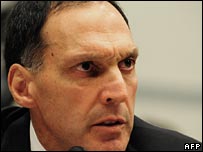 It's an excerpt from an e-mail sent on April 12 2008 by Richard Fuld, the somewhat tarnished former chairman of Lehman, the investment bank whose collapse last month brought the global financial system to the brink of meltdown (the e-mail was uncovered by Congressional investigators who've been examining Lehman's demise).
In an message to Lehman's General Counsel, Thomas Russo, Fuld summarised a conversation he had over dinner with the US Treasury Secretary Henry Paulson.
According to Fuld, Mr Paulson said he wanted to "kill the bad HFnds + heavily regulate the rest."
Crikey.
No wonder "HFnds," or hedge funds as most of us know them, are a teeny bit anxious at the moment.
After years of stellar performance, many of them (but not all) have suffered serious losses in the past few months of extraordinarily volatile markets.
Their increasingly risk-averse backers are asking for their money back.
And the likes of Paulson - who you might think would be on their side, as a former chairman of Goldman Sachs - apparently wants to slaughter the cowboys among their ilk and put the rest in shackles.
Of course, we only have Fuld's word for this.
But my own conversations with politicians and regulators are indicative that the tide has turned massively against this trillion dollar industry.
The authorities on both sides of the Atlantic have belatedly noticed that hedge funds' speculation in unregulated markets - such as the mind-boggingly huge credit-default-swaps market - has exacerbated the instability in regulated markets, notably stock markets.
They've belatedly noticed that hedge funds have vast amounts of power to decide the fate of banks and other financial institutions of central importance to the functioning of the global financial system - and yet there's almost no formal system for holding them to account for the use of that power.
And the authorities have abandoned their staggeringly naïve view that hedge funds are the girl guides of the financial community (I kid you not), because of the near-truism that when hedge funds fall over, they tend to hurt mainly their well-heeled backers in a direct sense, rather than millions of ordinary savers or taxpayers (I say near-truism, because the 1998 LTCM debacle notoriously precipitated a financial markets tsunami).
The point about hedge funds is not what happens when they make big booboos.
What matters is whether their activities make the financial system more or less adept at allocating capital in an efficient way, to the long-term benefit of our economies, and whether they enhance or undermine the robustness of the financial system.
As economic boom turns to bust, because of a systemic malfunctioning in the financial system, that's moot.
A few far-sighted hedge funds can argue that they were the good guys, that they shouted from the rooftops (through their profitable trading strategies) about what was going wrong before it went wrong (and more fool politicians and regulators for ignoring them).
But the industry as a whole hasn't even begun to address the central charges against it: namely, that it helped to stoke up the credit bubble by providing a market for toxic investments; and that it has brought disorder to the puncturing of that bubble, through the poisonous combination of deliberate strategies to destroy the credibility of weaker financial firms, and through massive automatic sales of assets in a falling market.
Proving that they've enhanced the general good, such that they protect themselves from being regulated into a dull and lifeless industry, may turn out to be somewhat more challenging than the trials of Hercules.
 I'm
I'm 





Page 1 of 2
Comment number 1.
At 08:42 15th Oct 2008, CarrotsneedaQUANGO2 wrote:We may have lost confidence in the bankers and the markets, but do we really trust politicians to perform better.
You just know this isnt going to go well.
Complain about this comment (Comment number 1)
Comment number 2.
At 08:45 15th Oct 2008, starquin10 wrote:Regulation, such as the CRA in the US and the Bassel II accord over here, caused the problem so more regulation will cure it?
Complain about this comment (Comment number 2)
Comment number 3.
At 08:47 15th Oct 2008, TGRWorzel wrote:The wisest comment I've seen during this crisis, was on an Andrew Neil special broadcast on News 24, the week before the vote in Congress.
Some bloke in Hong Kong, former chairman of Merrill Lynch, or one of the other US banks, looking a bit cheesed off as he was 5 hours ahead of us and he was stuck outside in the cold...
Anyway, he said that what the market needed in future were more contra-actions. Which I took to mean, if its a Bull market do things that are more consistent with a Bear market and vice-versa.
The idea being to keep the market stable.
As any student knows, complex systems need feedback mechanism and restrainers to keep them stable.
Clipping the wings of the hedge funds would therefore seem to be a good thing, as it'll stop one of the processes that drives the stock market in whichever feverish direction its headed, rather than restraining it and dragging it back to a more rational position...
Complain about this comment (Comment number 3)
Comment number 4.
At 08:48 15th Oct 2008, Jacques Cartier wrote:I think it's the toxic assets that are the main problem. I'm sure that Andy Hornby and Sir Fred Goodwin must now realise that, as assets become hugely abstract and immensely intertwined, they become impossible to value properly. And, as I'm sure they also now realise, the assumed value of a thing should go down (not up!) when it is impossible to get a good fix on its worth.
You don't need a "financial abyss" to learn these things - a bad experience with a used car dealer is enough for most people. The problem may not be hedge funds, but youthful energy and inexperience. To fix this, bring in some grey beards, and sack the yuppies, please. Pretty please?
Complain about this comment (Comment number 4)
Comment number 5.
At 08:50 15th Oct 2008, alphaGlen wrote:There is noting wrong with destroying hedge funds with regulations. If hedge funds have broken the law in the past they should be prosecuted, might be the right time to start investigating the funds.
Also this might be the time to tax excess remuneration. Its not fair to have supper rich not paying taxes and almost all the tax burden falling on middle class.
UK should move back to industries from banking as this type of banking will destroy this country.
Complain about this comment (Comment number 5)
Comment number 6.
At 08:51 15th Oct 2008, rvpisneverinjureds wrote:its ok everybody iceland and the government are working day and night to solve the banking crisis in iceland(the one that never existed 11 days ago) wow that really does fill me with so much confidence.!!!
Complain about this comment (Comment number 6)
Comment number 7.
At 08:57 15th Oct 2008, icespyder wrote:Robert , Bankers have abused their power by asset stripping cash in the way of bonus payments and leaving an essential industry collapsed .
Oil companies enjoy the protection of HMG and the infrastructure that goes with it to enjoy spectacular profits. They are abusing their position and destroying the financial stability of HMG by not passing on oil price reductions.Is it not time now to part nationalise them in a similar way to the Banks.
Complain about this comment (Comment number 7)
Comment number 8.
At 09:02 15th Oct 2008, MadTom wrote:Hedge fund didnt cause the problem - they were, like so many others, just parasitic on the market.
The problem was one of accounting fraud, or pyramid selling or fractional reserve banking or whatever you want to call it.
The massive growth of the financial system of late was a myth. A thousand people claiming ownership of the same £10 does not make £10,000. But thats what the markets thought it did.
The stock market in this country should be nearer 3,300 or so and will get there no matter how much money the government puts in.
I beleive there really is a case for criminal charges against accountants who reported liabilities in the profit column. They are ultimately responsible for this correction.
Complain about this comment (Comment number 8)
Comment number 9.
At 09:08 15th Oct 2008, rvpisneverinjureds wrote:yes #7 nationalize the oil cpmpanies and while your at it the railways as well,and then how about treating elderly people with some respect and scrap all their heating bills in the winter. the government soon found £100bn when it suited them.
Complain about this comment (Comment number 9)
Comment number 10.
At 09:08 15th Oct 2008, Mike wrote:It would be useful if we could be reminded what the terms of reference are for banks operating in the UK market and be reminded what each bank's original mission was when founded.
The current strategic objective has been to stabilise the banking system. Before we go regulating let's stand back and review the real purpose of our range of financial services.
We need places of safe cash deposit. We need sources of realistic funding. We need limits on the uses of cash deposits for profit making by bank so that their prime responsibility is honoured. We need a total separation of straight simple banking from investment gambling.
We need to reward companies building for the long term for the benefit of the UK and its people.
Before we go looking for whipping boys, we need to be clear about the specific objectives for the UK right now. We can sort out the bad boys and girls later.
Complain about this comment (Comment number 10)
Comment number 11.
At 09:09 15th Oct 2008, Wee-Scamp wrote:One topic which nobody has as yet mentioned is the future of venture capital.
Do fellow bloggers believe the availability of risk equity capital is going to get better or worse?
Please note I'm not referring here to private equity companies which in my humble opinion should be erased from the planet for having created absolutely nothing new.
Complain about this comment (Comment number 11)
Comment number 12.
At 09:10 15th Oct 2008, ishkandar wrote:This article sounds like so many other "kill them all and let God sort out the good ones" propaganda !! Hedge funds will not go away !! The better ones have and will operate in climes that are more friendly but properly regulated. The failure is not the hedge funds per se but in government regulations !!
So long as people have too much personal wealth to manage personally, whether they are too busy making more or whether they prefer a more knowledgeable person to do it for them (for a fee, of course), hedge funds will exist. Nowadays, there is an even more powerful form of hedge funds called Sovereign Wealth Funds, set up by rich governments, that operate in the same manner.
Unless Gormless Gordon intends to declare economic war with those rich nations and wipe out UK's economy at a stroke of the pen, he would do well to, not only seek out the advice of wiser and cooler heads, but actually *ACT* accordingly. However, knowing his track record, he will make a big show of seeking advice and then act totally contrary to the advice given !! He's done it time and again !!
On another subject, once upon a time, RBS was nearly as big and powerful as HSBC. Now RBS is extending its begging bowl in all directions while HSBC is sitting pretty. I said so last week and I still strongly suspect that HSBC has the ability to tap into lines of credit from the Far Eastern Funds that RBS, in its infinite wisdom and hubris, has failed to develop !!
While HSBC is rapidly and intensely developing its forays into the China market, RBS is suffering from massive indigestion and heart burn after swallowing a too large chunk of ABN AMRO !!
Whom the Gods wish to destroy, they first turn into over-proud bankers and politicians !!
Complain about this comment (Comment number 12)
Comment number 13.
At 09:10 15th Oct 2008, netsuper wrote:Another issue is regarding investor confidence, driving bank share prices down and so-called nationalise happened to NR and Bradford & Binley and even happening now by nationalising more banks will once for all completely utterly destroy the stock market and investor confidence in the heart of UK economic life. The hourable thing GB, AD and this government to do is coming out clean and say an apology to share holders and investors, after all these investors are the real rock of British economy, the investors are both tax payers and investors who day in and day out driving the UK ecomony moving forward. Rob their shares and nationalise banks without paying proper conpensation to share holders will totally destroy investor confidence. If the government come out tomorrow morning and announce that they will properly pay conpensation to Northern Rock and Braford Binley share holders, then I can say the market panic will disappear and confidence will return in no time.
Limit and regulate Executive pay and boardroom bonuses a resounding 'YES', penalise investors and ordinary share holders a resounding 'NO'. The government must be act pretty quickly to address this issue and lift the ban on all the banks concerned, otherwise the UK economy will totally collapse in the next couple of weeks.
Complain about this comment (Comment number 13)
Comment number 14.
At 09:11 15th Oct 2008, questidium wrote:I read in the FTfm a very good article that said that Hedge Funds had an enormous quantity of share they had to sell and that was why the equity markets were falling, then there was an enormous rally!
So whats happening? And if they are still being forced to sell, won't the markets continue to fall further?
Complain about this comment (Comment number 14)
Comment number 15.
At 09:18 15th Oct 2008, apollo_mcqueen wrote:The two hedge funds that piled unto Northern Rock towards the end of share trading are certainly crying now.
... and good! Vultures!
Complain about this comment (Comment number 15)
Comment number 16.
At 09:18 15th Oct 2008, s1mongraham wrote:The one certainty in all these events is that hindsight will always be 20/20
And this applies to all walks of life!
Complain about this comment (Comment number 16)
Comment number 17.
At 09:19 15th Oct 2008, bena gyerek wrote:a lot of hedge funds were truly irresponsible.
a very typical attitude was, when asked what assets they held, to respond that they didn't have a clue, but that didn't matter so long as they generated a good return.
a typical investment by one of these funds was to enter derivatives that generated fast short-term profits but exposed them to a "small" risk of serious loss. so for example they were big writers of credit default swap protection and of put options. exactly the kind of contracts that are now deeply underwater, meaning the hedge funds are having to liquidate assets to meet bigger and bigger cash margin calls.
most hedge funds do not disclose to their investors any details of their investments. they marketed themselves to investors on the basis of (a) they have a great track record (fuelled by the credit bubble), (b) they are super whizz kids, and (c) their fee structure (where they take 20% of upside return) incentivises them to outperform (and to take stupid risks).
unfortunately more and more of their investors were "real money" managers like pension funds, mutual funds, insurance cos and unsophisticated banks. given the usage of leverage by most funds (at least 2x leveraged), there is a real risk of another ltcm - i.e. hedge funds going bust and wiping out not only their own investors but also the banks that have lent them money.
this is a slow-burner issue. most hedge funds allow investors to withdraw money weekly or monthly (or sometimes even quarterly). but withdraw their money they will, and every $1 of equity withdrawn means $2+ of leveraged assets to liquidate and $1+ of borrowing to repay. all of which means there will be continued downward pressure on liquid assets (like the stock markets). it also means it may be a few more weeks before we see our first big hedge fund blowup.
fun times..
Complain about this comment (Comment number 17)
Comment number 18.
At 09:27 15th Oct 2008, ishkandar wrote:#10 Excellent summary and advice. Too bad, that the unwashed masses are baying for anyone's blood to salve their own shortcomings.
If those same unwashed masses had refused to borrow 125% mortgages, these funds will have nothing to trade with. If the then heroes of the unwashed masses, the barely educated barrow-boys who masquerade as "investment bankers", had their wings clipped by wiser heads instead of being allowed to re-package toxic assets as good ones, these funds will also not have anything to trade with.
These same people also to fail to realise that Share ISAs are also similar funds !! Are they going to ban Share ISAs from now on ?? Pension funds are yet more of their ilk !! Are they to be banned too ?? Yet both these funds have also contributed towards the market turmoil !!
Complain about this comment (Comment number 18)
Comment number 19.
At 09:27 15th Oct 2008, Ableblog wrote:Love your mixed metaphors, Robert: especially Gordon Brown as Wyatt Earp, and hedge funds as Girl Guides!
A little ray of sunshine amongst the general gloom.
Complain about this comment (Comment number 19)
Comment number 20.
At 09:28 15th Oct 2008, riverside wrote:I'm sure G Brown will wear the appropriate costume. Err is it trick or treat soon.
Complain about this comment (Comment number 20)
Comment number 21.
At 09:37 15th Oct 2008, questidium wrote:MadTom1999 #8
I assume you will have seen this video entitled "Money as Debt":
https://video.google.com/videoplay?docid=-9050474362583451279
It is a real eye opener!
It contains the following quote:
""Permit me to issue and control the money of a nation, and I care not who makes its laws"
Mayer Anselm Rothschild, Banker"
Reassuring isn't it;-)
Complain about this comment (Comment number 21)
Comment number 22.
At 09:38 15th Oct 2008, m_wils wrote:could somebody please help me. At first I was under the impression that the sub prime lending was the cause of the problem, but "The credit losses associated with sub-prime have come to light and they are fairly significant...Some estimates are in the order of between $50bn and $100bn of losses" (Ben Bernanke, Chairman US Federal Reserve, speaking on 20 July 2007) does not come anywhere near the amounts of money now required for bail-outs etc.
Is there a good article explaining clearly how this relatively small initial amount of money led to the huge amounts now needed to save the financial system.
It seems to me too easy to blame the sub prime problem, when apparently (according to recent articles like this one) the real problems are debt trading, hedge funds etc etc. However, I would very much like to read an informed article explaining in detail how the present financial crisis has evolved (I have seen the 'cartoon' bbc timeline but would like more meat on the bones to get a full picture).
Many thanks for any links
Complain about this comment (Comment number 22)
Comment number 23.
At 09:43 15th Oct 2008, ishkandar wrote:#17 Quite a few hedge funds are leveraged far higher than the 200% !! If the hedge funds are liquidating massively and the prices are still rising, then it could only mean that the Sovereign Wealth Funds are stepping in to grab assets at fire-sale prices !!
I think that in the coming years, the knowledge of Mandarin, Arabic and Russian may be very profitable to its owners !! The value of Turkic-derived languages may also be profitable as Kazakhstan, Turkmenistan and other central Asian nations discover the need to manage their oil and gas wealth !! Iceland will probably have Russian as a subject in their schools, just as English (or the strange Trans-Atlantic dialect, thereof) was a subject there.
Complain about this comment (Comment number 23)
Comment number 24.
At 09:44 15th Oct 2008, nbyslog wrote:Robert, if you believe that,you'll believe anything.
There are only two things wrong with Hedge Funds.
One, they are Masonic in their secrecy- and all capitalisation of politics, government, business and institutions must be completely transparent.
Two, they represent 50% of FTSE trades on behalf of 0.2% of investors - all of whom self-define as already monumentally wealthy.
The idea of Bourse capitalism was NEVER to produce a tiny risk-averse minority of unregulated plutocrats sitting inside gated communities.
Broader vision needed, here - as with most things today. www.notbornyesterday.org
Complain about this comment (Comment number 24)
Comment number 25.
At 09:46 15th Oct 2008, JohnConstable wrote:In the world of the Web, people are familar with the hackers Distributed Denial of Service attacks, which can effectively stop a web site from functioning.
It is often accompanied by a blackmail attempt.
It did occur to me that it might be possible for hedge funds to operate in a similar manner, that is, collude to simultaneously attack a stock, driving down its price until all sorts of unpleasant thresholds were triggered and thus make an (unhealthy) profit.
If this has been happening, then maybe it is time for the 'hedgies' to be reined in.
Complain about this comment (Comment number 25)
Comment number 26.
At 09:47 15th Oct 2008, Tatruth wrote:When Myron Scholes and Robert C Merton were winning their Nobel prize in 1997, everyone with serious money wanted to be in Hedge Funds Highly leveraged vehicles in high risk markets which just can not cope when the market converges and points down.
So what's different this time? What regulation was brought to the Hedge funds post the Asian crash of 98? Asia is a constant property bust waiting to happen. As for transparency in Chinese markets, well give me a break. I agree Mr Peston regulate the hedge Funds but you didn't make a great case previously. All I can remember is a 'what a scoop' these guy's are earning article, by you. In it there was some wishy washy worries on avoided taxes by Hedge Funds and the brain drain into them. Can you think of such a dominant industry in Britain's modern history that will leave no great mark on the landscape? Seems that all you thought about was 'charidy' largesse. No real analysis.
What areas do you need to regulate? I would argue shorting should be allowed and unfettered in the markets. Sure maybe there should be a mechanism whereby banks are protected during a prolonged compression of price. But if we didn't have it we'd still blindly have all this toxic debt on the balance books and Hedge Funds could go again just like after LTCM.
For such an excellent business journalist you keep waffling on about Hedge Funds undermining financial institutions. I'm sure underhand techniques have been used buit how does shorting collapse HBOS' shareprice when only 3-6% of shares are shorted? It doesn't does it in the case of a massive bank, there is only catastrohpic downward pressure because of the bank's suicidal business model.
Mr Peston I enjoy your journalism but a little less scoop/hyperbole and a little more considered responsibility towards the markets and us. Then hopefully when the next bust in Chinese property comes to the fore our financial instituitons won't be in it up to their necks. Will you be questioning them over the next ten years if we have the good times again?
Complain about this comment (Comment number 26)
Comment number 27.
At 09:49 15th Oct 2008, ishkandar wrote:#22 I suspect that he(or she) who writes just such a knowledgeable article will sell it as a study paper for lots and lots of money !! Such is Capitalism !! Knowledge is money and money is power !!
As our Trans-Atlantic comrade are fond of saying - There ain't no such thing as a free lunch !!
Complain about this comment (Comment number 27)
Comment number 28.
At 09:53 15th Oct 2008, NH wrote:The 'dead cat bounce' has been and is now petering away.
The indexes will now go down even further - failed CDS's and derivatives are going to be the killer blow that no amount of gvt money can stop.
The charts have a horrible similarity to 1929 into the 30's - let's hope we can avoid the 1939 scenario.
The smile will be permanently removed from GBs face by the end of the week.
Although Fri 10th was the CDS deadline for Lehmans 400 billion of debt - I think about 350bn is leading to CDS/insurance claims - there is a 2 week deadline for the debts to be paid! By Fri 24th the CDS pyramid will come crashing down and the indexes will hit new lows, with some be shut for years!!
It's going to be horrible!
Complain about this comment (Comment number 28)
Comment number 29.
At 09:54 15th Oct 2008, Tim Coldwell wrote:The Bank of International Settlements has recently reported that global outstanding derivatives have reached 1.14 quadrillion dollars: $548 Trillion in listed credit derivatives plus $596 trillion in notional/OTC derivatives.
These July '08 numbers seem to be a lot higher than often reported upon.
Complain about this comment (Comment number 29)
Comment number 30.
At 09:57 15th Oct 2008, afcone wrote:The issues is not hedge funds per se, but in the use of derivatives to get around normal capital requirements. The trouble with derivatives is that they are unregulated and have an ability to 'blow up', inflicting massive losses on entities that are then insolvent and unable to meet their obligations. The effect of this is that their counterparties - other hedge funds or banks - are no longer hedged, and incur similar massive losses; this goes on and on until large numbers of institutions become insolvent and the market freezes because nobody knows which insitutions this will be. No wonder Warren Buffet called derivaties 'weapons of mass destruction'.
The target should not be only hedge funds - it should be on the unregulated and dangerous derivatives industry in which entities 'pick up pennies in front of steamrollers' knowing full well that they can't pay out should their bet go wrong.
Complain about this comment (Comment number 30)
Comment number 31.
At 09:58 15th Oct 2008, Sasha Clarkson wrote:#13 "The hourable thing GB, AD and this government to do is coming out clean and say an apology to share holders......"
The Police may have been inadequate in the face of the amount of crime being committed, but it was the bad banks, hedgefunds, and speculators who were the criminals, not the government.
....."Rob their shares and nationalise banks without paying proper conpensation"???????
When B&B was nationalized it's market value was nil, because the value of its assets no longer covered its liabilities. NR slightly more complex but basically similar. The NR crisis was not caused by unjustified rumour and panic, but because it was going to run out of money. For both "banks" borrowing medium term to lend long term turned out to be a disastrous business strategy.
If the failure of these companies would not have had so many catastrophic knock -on effects, they would have gone into receivership, rather than being nationalized. But in either case, shareholders are at the bottom of the queue get little or nothing. That's capitalism - if you don't understand or like it, put your money in National Savings!!
Complain about this comment (Comment number 31)
Comment number 32.
At 10:01 15th Oct 2008, Simon wrote:alphaGlen (5)
tax excess remuneration.
Who will decide what constitutes 'excess'?
And what will stop these people taking their squillions of pounds/euros/dollars and dumping them into an account in the Cayman islands or Liechtenstein, where the writ of Revenue & Customs doesn't run and tax can't be collected?
I know that it's an old argument, it goes hand in glove with the non-dom question, but it's a valid one. Without currency controls you cannot prevent this happening. Impose currency controls and kiss goodbye to the City and all the money it gives up as taxes to Government to build schools/ hospitals/ prisons, etc.
It's a dilemma very well explained by none other than the owner of this Blog, Mr. Peston, in his recent book about 'Who Runs Britain'. (I have no connection to Mr. Peston)
Indeed I personally take some exception to his conclusions. Most public sector capital projects since 1997 have been funded under the expensive delusion that is PFI, not by capital expenditure from the Exchequer. So the Treasury weren't spending tax money on capital builds. (Begs the question as to where all that extra money DID go, doesn't it?).
And he contends that if we try to tax these financial big guns (who pay little or no tax)they will take their ball and play somewhere else, which would be detrimental to the economy. But if they pay no tax what is the Exchequer actually losing if they depart? They can go and not-pay-tax elsewhere.
There is a major contradiction here. Either they DO pay billions in tax, so the Govt. is grateful and doesn't want to make them flounce off elsewhere. Or alternatively they hardly pay any tax at all, in which case the Govt. can TRY to tax them, which will result in their relocation (supposedly) and the Govt. won't get the tax revenues anyhow.
Either way the nation is no better off.
WR.
Complain about this comment (Comment number 32)
Comment number 33.
At 10:01 15th Oct 2008, Simon wrote:alphaGlen at 5
tax excess remuneration.
Who will decide what constitutes excess?
And what will stop these people taking their squillions of pounds/euros/dollars and dumping them into an account in the Cayman islands or Liechtenstein, where the writ of Revenue & Customs doesn't run and tax can't be collected?
I know that it's an old argument, it goes hand in glove with the non-dom question, but it's a valid one. Without currency controls you cannot prevent this happening. Impose currency controls and kiss goodbye to the City and all the money it gives up as taxes to Government to build schools/ hospitals/ prisons, etc.
It's a dilemma very well explained by none other than the owner of this Blog, Mr. Peston, in his recent book about Who Runs Britain. (I have no connection to Mr. Peston)
Indeed I personally take some exception to his conclusions. Most public sector capital projects since 1997 have been funded under the expensive delusion that is PFI, not by capital expenditure from the Exchequer. So the Treasury weren't spending tax money on capital builds. (Begs the question as to where all that extra money DID go, doesn't it?).
And he contends that if we try to tax these financial big guns (who pay little or no tax)they will take their ball and play somewhere else, which would be detrimental to the economy. But if they pay no tax what is the Exchequer actually losing if they depart? They can go and not-pay-tax elsewhere.
There is a major contradiction here. Either they DO pay billions in tax, so the Govt. is grateful and doesn't want to make them flounce off elsewhere. Or alternatively they hardly pay any tax at all, in which case the Govt. can TRY to tax them, which will result in their relocation (supposedly) and the Govt. won't get the tax revenues anyhow.
Either way the nation is no better off.
WR.
Complain about this comment (Comment number 33)
Comment number 34.
At 10:02 15th Oct 2008, Wildbill48 wrote:After being told there was no link between the oil prices and the speculators it is I suppose only coincidental that as the speculators have had to cut and run the price of oil has dropped sharply
Complain about this comment (Comment number 34)
Comment number 35.
At 10:02 15th Oct 2008, joker42 wrote:Robert, you normally write intelligent stuff but the penulitimate paragraph of this piece is off the mark.
The investment banks created most if not all of the "toxic" assets (even if some funds were buyers of these), and perhaps you should use the word "forced" rather than "automatic" to describe asset sales in a falling market. Many funds will be forced to sell more assets over the next few months due to redemptions.
Complain about this comment (Comment number 35)
Comment number 36.
At 10:04 15th Oct 2008, Simon wrote:This comment was removed because the moderators found it broke the house rules. Explain.
Complain about this comment (Comment number 36)
Comment number 37.
At 10:05 15th Oct 2008, Simon wrote:Regarding oil excess profits;
Let's suppose that a company pumps oil from the ground and sells it on an open market. The dealers and speculators on that market inflate the price that they are willing to pay to the kind of extravagant levels seen this year. So that company now has massively inflated revenues and huge profits.
The cry of tax their excess profits goes up from many quarters. But they weren't involved in bumping up the price, they were just the happy beneficiaries from someone else's wheeler-dealings. Why should that have to pay some elevated taxation because of that? It's like taxing Apple because they make iPhones that sell for high prices. Or taxing Government because the heads of Quangoes are paid way too much.
And the question can be asked again; Who decides what constitutes excess?
WR
Complain about this comment (Comment number 37)
Comment number 38.
At 10:10 15th Oct 2008, TV Licence fee payer against BBC censorship wrote:#28
"The smile will be permanently removed from GBs face by the end of the week."
Oh no it won't, if we really do go in to a 1929 plunge and 1930s like depresion then he will have all the tools and popular support he needs to wipe the smirks of the faces of the bankers, speculators and hedge fund managers as well as the Tories by postponing the next election by forming a 'National (Emergency) Goverment".
Free market capitalism will have consumed it's self in it's own acidic bile, not just in one country but world wide - the future will be capitalism but not as we have known it for at least 30 years, back to the future we shall go...
Complain about this comment (Comment number 38)
Comment number 39.
At 10:11 15th Oct 2008, david F wrote:Whilst i agree with Roberts overall analysis, i fail to see just where or how any British government could possible find the sort of figures for bank bail - outs being bandied about without printing money - lots of it. This is in itself inflationary and will cause the £ to fall further sucking in more and more expensive imports. We need to start rebuilding our finances from new manufacturing and stop relying on the City of London and insurance in particular. Any world downturn with our markets in the state they are in will surely make Britains recession longer, deeper and more unpleasant than say Germany or USA.
For this the New Labour project and the miracle of the end of no boom or bust is as Shallow as the Cabinet led by one Mr G Brown.
Complain about this comment (Comment number 39)
Comment number 40.
At 10:11 15th Oct 2008, Simon wrote:Where is the erudite individual who will explain that it was our own venal and corrupting greed in borrowing on credit cards, loans and mortgages on massively over-valued houses which caused the bubble in the first place?
One can contend as to whether it was our demand that created a mania amongst the lendings institutions for doling out huge sums whilst ignoring any risk.
Or whether they created that market by encouraging us to borrow the money which they were willing to lend out cheaply.
In truth its probably a mixture of both. But we love to scapegoat someone else, don't we? If these bankers, hedge fund managers and private equity owners are making colossal sums for themselves then we can blame them for the storm, ignoring our own part in fueling the boom.
After all, none of us likes to take the blame ourselves. Do we?
WR.
Complain about this comment (Comment number 40)
Comment number 41.
At 10:20 15th Oct 2008, Dreaming_Ben wrote:No market of any sort can work without "arbitrageurs" (in the broadest sense) - i.e. people who buy whenever goods are being priced too cheaply and sell when they are priced too high. And in the finance industry it will never be possible to really distinguish between "arbitrage" and "speculation" - all we can do is lump the two activities together and call them "proprietry trading".
So the only choice is whether we want "propriety trading" to be the preserve of banks (in which case, if they get it wrong, then we lose our savings, liquidity, and the whole financial infrastucture that sustains our economy) or of hedge funds.
Much better if banking is left to banks and if trading is left to hedge funds.
Complain about this comment (Comment number 41)
Comment number 42.
At 10:21 15th Oct 2008, tuairimiocht wrote:Governments might not get there in time to regulate hedge funds. It might happen that their demise will be self-inflicted. One of the main principles of hedge funds is their ability to generate "absolute returns" - a positive return on an investment in rising or falling markets, through leverage if need be. This claim has been rubbished by the events of the past year.
Complain about this comment (Comment number 42)
Comment number 43.
At 10:22 15th Oct 2008, TV Licence fee payer against BBC censorship wrote:#40
I assume you were asking that of politicians and commentators etc and not this blog, many comments have been posted over the last few weeks that have pointed out just that thing.
Complain about this comment (Comment number 43)
Comment number 44.
At 10:24 15th Oct 2008, Anthony_Samuelson wrote:I think that Hedge Funds turned to high yielding toxic debt, interest rate swaps and other exotic instruments when nice easy vanilla trading on inside information became too hot for them. If I am right, they will wither on the vine.
Complain about this comment (Comment number 44)
Comment number 45.
At 10:24 15th Oct 2008, Eddie-george wrote:"But the industry as a whole hasn't even begun to address the central charges against it: namely, that it helped to stoke up the credit bubble by providing a market for toxic investments; and that it has brought disorder to the puncturing of that bubble, through the poisonous combination of deliberate strategies to destroy the credibility of weaker financial firms, and through massive automatic sales of assets in a falling market."
Let me take this statement apart.
The vast majority of hedge funds are equity specialists. How did they inflate a mortgage lending bubble? Beats me, they sure as heck weren't demanding MBS in any significant volumes. Yes, there are some specialist fixed income funds who were engaged in this market.
But they were a tiny minority of the hedge fund industry. And some funds, like John Paulson's, were way ahead of the game in foreseeing the collapse of the MBS sector.
Deliberate strategy of destroying weaker firms? I dare anyone to suggest no hedge fund manager spread a malicious rumour about, eg, Bear or Lehman. But hey, Soros lost millions investing in Lehman, RAB lost millions investing in Northern Rock. So the impression that hedge funds engaged in a co-ordinated and frenzied attack on vulnerable firms is nonsense - what many did recognise was a bear market on steroids, and bet on a rush for the exit. But not all, not even Soros.
If the idea is that hedge funds accelerated this stampede and are therefore to blame for the crisis, we might as well ditch the market system as a whole. Were there hedge funds back in 1929? During the South Sea Bubble? During Dutch Tulip mania?
Basically, you do not need hedge funds to create severely dislocated markets. If anything, hedge funds help correct dislocations more rapidly than would otherwise be the case.
And the massive automatic asset sales? Okay, how does this come about. As I mentioned, hedge funds generally are equity focused. The other thing about them is they are typically highly leveraged. Investment banks provide this leverage. The dumping of assets comes in one of two ways - firstly, it's a bear market, and that's what traders do. Sell. Sad reality, that. A catalyst for the pace of the decline is that investment banks, themselves having to deleverage, pull funding previously offered to hedge funds. So hedge funds have to sell even if they didn't want to.
Remind me, who's putting fuel on the fire?
I am not about to say that hedge funds are wholly blameless, but the thought they are prime culprits, the so-called "spivs and speculators" who brought the financial system to the brink is crazy. Some hedge funds won, some lost, like all the rest of us.
They are one section of a thundering herd of financiers, the herd as a whole perhaps needs to be corralled, not just the section that no-one else understands.
That said, the hedge funds need to pull of a PR miracle. A few months back they were supposedly to blame for the oil spike, now they are to blame for the cratering of the entire financial system. There is seemingly no "outrage" for which they are not to blame these days, and as they (unlike banks and insurers) weren't able to jump into bed with politicians, I guess they will end up getting blamed for the whole shebang.
Complain about this comment (Comment number 45)
Comment number 46.
At 10:34 15th Oct 2008, Guy Croft wrote:copy that, # 40
"Where is the erudite individual who will explain that it was our own venal and corrupting greed in borrowing on credit cards, loans and mortgages on massively over-valued houses which caused the bubble in the first place?"
If indeed you're right it was simply the housing market (and the USA housing marker really, so I understand; there was no housing problem in the UK big enough to trigger the credit crunch as far as I know).
Maybe I just have more social conscience than some but I think the greed in that context (in THAT context, note) was the eagerness to repossess houses rather than work out deals that folk could afford, thereby keeping a roof over their heads and assuring some level of expectation that the house would not fall into ruin and be taken over by rodents.
There is little to distinguish the UK bank/building society approach to that issue and unfortunately it's going to kick off in its usual ghastly way just like the 90's - with lenders (and courts) wagging their fingers at the poor stricken householders and saying 'you over-borrowed'.
You may say there are many who over-borrowed. Well, if that is so then both parties are equally culpable and equally at risk and this is no time for getting cocky about it.
I do wish someone in government would get off their backside and look into this.
GC
Complain about this comment (Comment number 46)
Comment number 47.
At 10:34 15th Oct 2008, neologic wrote:As LTCM, in 1998 leveraged it's capital of c. $2.5 Billion by a reported 40 times I am sure blog 17 is likely to be wrong when it states a leverage of only 2 for the current Hedge Funds (HF).
Regardless of the actual gearing/leverage it is certain that HF's have borrowed lot's of money and it is at risk.
How much resides within the soon to be nationalised Banks is what I would like to know?
And if the government does not yet know an exact picture of the liabilities of the UK Banks, why oh why has Prudence Brown
committed our future to these institutions?
I note last week it was going to be only £25 Billion in direct preference shares, we all know this week it is already a mere £37 Billion and rising.
Last week the Bank directors would not get bouses, then it was not to get cash bonuses.
Yesterday one Banker was quoted in either the Guardian or Times as saying that they would get bonuses but as share options, as though that was not getting a bonus, his gall is truly scary for the taxpayer!
I am sure they will also stuff their pensions and other invisible benefits (to you and me) to our detriment.
Remember share options when exercised dilute existing shareholders.
Already there is a groundswell of lobbying for the Banks to be allowed to pay dividends making the taxpayer even more at risk.
Finally the site of Prudence Brown taking 'the glory' for his 'innovative and fresh look' solution to the banking crisis, which he insisted should be copiedby the rest of the world, well his wish has come to pass and thus leaves the UK again near the bottom of the same pile as an attractive place to invest for the rich but excluded countries who did not participate at the G8.
(Because of the Uk's enormous government and personal debt burden).
P.S. Was I the only one who thought the sight of the G8 leaders trying to portray themselves as in control when they are the by far the most indebted indusrial nations was truly risible. Don't they know it is the person with the gold that makes the rules not the beggar?
Complain about this comment (Comment number 47)
Comment number 48.
At 10:35 15th Oct 2008, RC Robjohn wrote:I sympathise with you Robert. 'Why?' you ask. Because you have to report on the facts as you see them but in a manner that will not cause undue panic. The empire is on the verge of complete collapse but you need to keep smiling on through. Bottom line: the UK and the Western World is broke and is fidgeting like a freshly shot corpse. Apologies for the tasteless analogy. The only way through this mess is to go through it and speak constantly with family and friends - the politicians are now redundant, as they have been for a while. Economic doctrine counts for nothing - survival is all that matters now. Sorry to be so gloomy but quite a few of us are stocking up ready for the long freeze. 21st Century life will not be about celebrity or materialism, it will be about basic values and simplicity. Maybe it will be good for society? I hope so.
Complain about this comment (Comment number 48)
Comment number 49.
At 10:39 15th Oct 2008, Tatruth wrote:It's interesting this dead cat bounce analogy. Don't most cat's survive if they're dropped from enough height? All these doom mongers might be right but you'll be a little dissapointed if your metaphor means the cat lives.
Doom. Doom. Doom. Doom. Doom. Doom.
Complain about this comment (Comment number 49)
Comment number 50.
At 10:45 15th Oct 2008, TheresOnly1Soupey wrote:I think the quote to beat them all was one from George Osbourne - and yes, this is the same shadow chancellor George Osbourne.
"Laissez-Faire economics is dead"
Talk about the world on it's head.
This is after David Davies defended the right to trial before detention (48 days)
Meanwhile Labour have defended and supported the banks and effectively propped up the system.
I am confused - have I been in a coma?
Is this the reversal of polarity that Nostradamus talked of?
Complain about this comment (Comment number 50)
Comment number 51.
At 10:57 15th Oct 2008, Wee-Scamp wrote:The oil price?
It's down because demand is down by about 1m bbl/day and growing.. That's a consequence of having a recession, near recession or whatever you want to call it...
Watch now for cuts in new oil/gas projects as oil companies try to force the oil price back up...
We've nationalised the banks (almost) now we need to nationalise the oil and gas companies..
Complain about this comment (Comment number 51)
Comment number 52.
At 11:07 15th Oct 2008, starofthesouth wrote:No legal banking and brokering without transparency on all levels. That is a general conclusion, no need to focus on hedge funds alone.
And the most important level of transparency to achieve is the ultimate ending of tax havens.
No regulation from whomever and wherever will work, as long as there is any possibility to make your dirty business on a tropical or a channel island.
So, in my opinion, there is much bigottery in the statements of the politicians, espacially in the USA. If you take in perspective, that you must be wealthy or need to have very wealthy friend to fund a campaign in the USA, you come to the conclusion, that many of the top politicians in the USA have money and companies themselves on some island.
And I'm sure, that many of your british Lords and members of parliament have their money on a channel island, many french politicians in Monte and many germans in Liechtenstein.
The only, but significant difference: in Europe you must not be rich, to have political success. That means, the chances are higher, that it's not the majority.
Complain about this comment (Comment number 52)
Comment number 53.
At 11:08 15th Oct 2008, OrthosDoxa wrote:Nothing wrong with Hedge Funds per se; what I do have a fundamental problem with is the concept of shorting ... or selling something that you don't have in a falling market so that you can make money on the difference. What's the problem here? It exacerbates an already bad situation for the market ... and if you get enough shorters, you create a self fulfilling prophecy. "But how else can we make money when the markets are falling" comes the cry. Well tough. You sell what you've got, and do your research to work out where the real value in the market is ... not destroy what inherent value remains in the market. The markets are not there for speculators to make money ... they are there for investors and industry to make money. If Hedge Funds want to make cash in falling markets, got to Ascot or Aintree. They'll do less damage there.
Complain about this comment (Comment number 53)
Comment number 54.
At 11:12 15th Oct 2008, Ian Westbrook wrote:If governments want to take care of Hfunds they should ban short-selling with immediate effect and in relation to all markets. The immediate effect would be to see some Hfunds - and the banks over-exposed to them - go bust, but then you would see stability return to stockmarkets around the world. It is the ability of Hfunds and others to sell stocks they don't own - and never have owned - which is causing so much market instability.
Complain about this comment (Comment number 54)
Comment number 55.
At 11:13 15th Oct 2008, Jen wrote:Oh well, another naughty section of the financial sector bubbles up-and bank shares are going down again!
Is this a smoke screen to divert attention from the banks and the missing balance sheets and off book debt?
Bit like one sensational headline is supplanted by another then we all forget the first bit! Are we all being manipulated here?
Complain about this comment (Comment number 55)
Comment number 56.
At 11:14 15th Oct 2008, Red Lenin wrote:46 - Do you not think in that case that it would have been better right at the start of the mortgage process for the lenders to sit down and discuss whatt he borrowers could afford to pay?
I know, here's a really bizare idea, how about by an industry-wide formula enforced by legislation?
The lenders have got to take responsibility for this sub-prime mortgage mess. Most people who have them are a bit dim and naive when it comes to finance. That is why they go to see 'specialists' and 'experts' (known as morgage brokers). If these specialsts and experts tell them they can afford it, then they believe they can.
Perhaps we should stop referring to mortgage brokers as specialists & experts and refer to them as obvioulsy what they are.
Perhaps they should have a disclaimer on all their adverts and paperwork such as-
"Warning - May state deliberately misleading garbage in an effort to get you to buy what you can't afford. Offering a mortgage is no indication of your actual ability to pay."
Complain about this comment (Comment number 56)
Comment number 57.
At 11:16 15th Oct 2008, JackTraven wrote:~22 m_wils
I am not a banker or economist, but here is my understanding of it:
First of all, $50-100bn was an underestimated amount. At the time, nobody knew how many subprime loans had been issued in total. Rel sum is approx $500bn. Things were more complicated as companies had broken down the loans and repackaged them with prime ones, then sold them on as colladerised debt obligations (CDOs). Other companies had such liabilities hidden from the bottom line, and we are only now finding out about them.
The result of the repackaging was that, when a subprime loan was defaulted, the whole CDO went bad and had to be written down. So the initial toxic subprime exposure bled into other assets.
Also, what the clever (sic) investment banks had done was take out insurance against the loans going bad, called credit default swaps (CDSs). But when all was going well, they saw another opportunity: CDSs had a margin built in. As long as the loan was good, they could also sell that product / trade it in the market and make more profit. When the loans went bad, this multi billion dollar market also got wiped out, hence more losses. And down goes AIG, the issuer of many CDSs.
Furthermore, as banks had more open debts to cover after all the writing off of assets, their balance sheets started to hurt. Credit agencies (that had been so kind to them for years) now downgraded them. Which meant thet they needed more collateral against their debt. Which obviously they could not produce, as they were over-levereged at 30 or 40 times their actual market capitalisation. So they started going bankrupt.
And don't forget that banks lend to you and me on a long term basis, e.g. a 5-year car loan or a 20-year mortgage. But in the money markets, they borrow money from the bigger banks and funds every 3 months or so. When it was time to refinace their debt this year, many found that the interest rate was higher, or more collateral was needed than before, which again they did not have.
A perfect storm.
And people think it's over? It has not even begun. Some wrongly assume that China will keep the world economy going. Nah! Without western consumers buying its products, China is next to collapse. Mining companies are already saying that demand for metals has falled dramatically there. No more growth from there.
With the west in recession and China not producing, demand for oil drops and its price goes from $147 to £78, maybe less. And with middle eastern countries counting on $100+ oil to keep growing and pay for their budgets, they are next to hurt.
Please others correct me if I'm wrong.
Complain about this comment (Comment number 57)
Comment number 58.
At 11:19 15th Oct 2008, doctor-gloom wrote:Hey Robert, love to see it happen. Does this mean that the authorities are going to 'trim' the hedges???
Complain about this comment (Comment number 58)
Comment number 59.
At 11:23 15th Oct 2008, Pot_Kettle wrote:To join the Nick Robinson I told you so brigade.
Regular readers will note that I sadi that this was a dead cat bounce two days ago.
Smug Look
Complain about this comment (Comment number 59)
Comment number 60.
At 11:29 15th Oct 2008, Saillard wrote:What truly shocking comments! Little wonder US Treasury Sec Paulson would like Hfunds killed off, but isn't it a case of killing the messenger if you don't like the message?
Hfunds simply offer a more flexible investment approach in their ability to leverage themselves and benefit in falling markets - without them the asset price bubble may have been even larger!
The real cause to all this mess was - and still is - the availability of cheap & unlimited credit, a result of government policy seeking perpetual economic growth. From the bursting of the Japanese asset bubble in the 1980s when the BoJ printed unprecedented amounts of money which, via the 'carry trade', found itself overseas seeking higher returns in US securities markets, the reaction by most countries facing asset bubbles has been to expand credit further.
Excessive debt and its encouragement are to blame for the current financial problem and for as long as governments choose to penalise the savings versus borrowings, the situation will persist.
Complain about this comment (Comment number 60)
Comment number 61.
At 11:37 15th Oct 2008, har_money wrote:Transparency will be one of the results of the current crisis and hedge funds, private equity and off balance sheet traders will no longer be able to hide behind a cloak of secrecy.
It is a nonsense to claim that disclosure of positions will reveal trading strategies and thereby hurt performance!
Complain about this comment (Comment number 61)
Comment number 62.
At 11:39 15th Oct 2008, NH wrote:#38 - good point!
I meant his smile will be temporarily wiped. I read an article in The Times afew days ago that suggested GB was lining up for a war style coalition cabinet/government to try and save his sorry bottom!
If that is to happen he will have to resign first and have no part of said coalition, as suggested by the author (i forget who it was now).
Oh dear.....it's still going to be horrible!
Complain about this comment (Comment number 62)
Comment number 63.
At 11:44 15th Oct 2008, warwick wrote:"Laissez-Faire economics is dead"
I don't think we ever had them, if we did, every bad bank would have been allowed to fail without government intervention. The Austrian School make some good points on this.
What we have now, is what we had all along, Socialism for the rich, Capitalism for the poor.
The power stays where it did all along, as far away from the people as the elite can keep it.
Complain about this comment (Comment number 63)
Comment number 64.
At 11:47 15th Oct 2008, TV Licence fee payer against BBC censorship wrote:#51
I don't even think Attlee could have nationalised OPEC!
Complain about this comment (Comment number 64)
Comment number 65.
At 11:49 15th Oct 2008, NH wrote:#49 Slight confusion over the timing of the death!
The cat dies first THEN falls off a very high roof, thus it bounces when it hits bottom, but it IS STILL DEAD, it can only come down from the small bounce and it will STILL BE DEAD!
It will be resurrected over many years, but it will be a very different beast!
Complain about this comment (Comment number 65)
Comment number 66.
At 11:49 15th Oct 2008, TV Licence fee payer against BBC censorship wrote:#45
Are you thee "Eddie George" (ex of the BoE) or another Mr E George?
Complain about this comment (Comment number 66)
Comment number 67.
At 11:56 15th Oct 2008, sem wrote:didn't RAB invest tons in Northern Rock just before it got nationalised.
Complain about this comment (Comment number 67)
Comment number 68.
At 12:04 15th Oct 2008, Prof John Locke wrote:Oh Robert, you should know better ...the biggest fall in the markets came when the hedge funds were banned from shorting.
Blaming hedge funds for the current problem is like blaming maggots on a corpse for the death - they are just taking advantage of a situation. As i have said on many previous blogs Gordon Brown is great at taking credit and bad at taking blame, saying the hedge funds are the reason for this market situation is just laughable, it is the past ten years of misrule by the governments that basked in the glory of ever rising house prices and ever rising debt. Now is the time to pay and pouring money into banks will not solve the problem, repeating the mistakes of the past is no way to solve the problem.
Complain about this comment (Comment number 68)
Comment number 69.
At 12:07 15th Oct 2008, Novinsky wrote:This is an unfair snipe at the Hedge Fund industry (and know I don't work in the sector).
To condemn an industry (or to imply that others are condeming the industry) based on an excerpt from an email about a dinner conversation is an easy swipe.
If the 'central charges' against the hedge fund industry are that it helped to stoke up the credit bubble, then they are minor charges.
The hedge funds did (and do) what is allowed, help pay people's pensions and by investing money in their businesses they take a hit if they make a mistake.
Perhaps you should focus more on the 'central charges' against the public who should have said 'no' to borrowing cheap without understanding the risks.
Complain about this comment (Comment number 69)
Comment number 70.
At 12:07 15th Oct 2008, molieres wrote:Credit is printing money by other means?
Governments embraced monetarism in the 1970's and (more or less) have stuck with its central ideas, but wrongly thought their monetary control was working - when in fact it was the BRIC economies that were controlling our inflation?
In other words monetary policy was, in general, much looser than it would have been without the 'BRIC' effect?
If I am right then, without this loose money, the last 15 years or so in the developed world would have seen massive deflation (as in the late 19th century) rather than the steady but low inflation (with the odd bubble in real estate prices in some countries) that we in fact enjoyed.
Will the end of the hedge funds as an active force to promote credit creation now mean that deleveraging (and so negative monetary 'growth') will gather pace, so that asset (and consumer) prices rejoin their long-run trend line?
And, if so, what does this imply for formal monetary and fiscal policy needs?
Complain about this comment (Comment number 70)
Comment number 71.
At 12:09 15th Oct 2008, stilllitterarty wrote:Gordon Brown [mesmerelerado]over taking banks, is like Foinavon winning the grand national from behind in 1967,with the other stall ion type banks toppling eachother and their riderrs at the biggest beechers brook hedgefunds
To GB's credit, he always tried to concider the Nations future ,soon after becoming chancellor he forced the oil industry to collect gas instead of burning it off in, their rapacous desire to get at oil profits more quickly .
Complain about this comment (Comment number 71)
Comment number 72.
At 12:13 15th Oct 2008, StroszekBassist wrote:Could it be that Gordon Brown's economic policy of the previous decade was actually to give all the banks, hedge funds etc enough rope to hang themselves, so that no one would complain about starting a period of nationalisation, starting with the banks, and then moving onto utilities, transport and energy, until everything is back under state control?
If it has been, then he is a genius and I will throw all my support behind him (except in Scottish Parliament elections). 21st century communism - I like it!
Unfortunately, I have a feeling he really was just seduced by big businesses.
Complain about this comment (Comment number 72)
Comment number 73.
At 12:17 15th Oct 2008, godfreybrown wrote:Your brief but accurate summation outlining the way that hedge funds can and do deliberately unsettle the money markets, because of their size and manner in which they operate, goes someway towards explaining what is wrong with certain aspects of the money markets and why these funds need to be more tightly regulated and better controlled.
These funds appear to be managed by unscrupulous and unprincipled people who know their way around the financial markets and can use huge sums of other people's money in an underhanded way to disrupt the (money) markets.
These people have no long-term statergy or business plan other than to make as much money as possible, by short changing as many businesses as they possibly can, for as long as they can.
Complain about this comment (Comment number 73)
Comment number 74.
At 12:20 15th Oct 2008, FearandLoathing wrote:What would have happened to the shareholder’s stock in NR and B&B if the normal processes had been applied and these companies had been left to go into administration?
Would the sale of assets(mortgage securities) been enough to pay off all the creditors (savers deposits)?
Would there have been any money left to pay to the shareholders?
Why as the lender of last resort did the BOE not have the 'balance sheet' to provide the required liquidity to NR but can now find more than that amount to provide £200Bn of extra liquidity?
As these companies have not yet become insolvent or gone into administration, do the shareholders have any long term claims to be compensated in the future?
Thus far shareholders have been the only victims of this crisis. The bankers have kept their bonuses, the government has obtained company assets at fire sale values under circumstances it created, some cynics might say manipulated.
I think we have underestimated Mr Brown’s cunning in this episode, he will have realised that at some point banks would need to seek government intervention, moreover created the circumstances (along with BOE) that forced the banks to seek intervention i.e. not providing sufficient liquidity, not doing enough with fiscal policy to re-invigorate the housing market and thus return confidence to the wholesale money markets, deferral of responsibility on monetary policy within a framework that doesn't allow consideration of economic growth and then imposing capital ratio requirements at a time when achieving these ratios was impossible.
M Brown has either been completely incompetent in allowing the financial system to reach the brink of complete meltdown or he has been the ultimate opportunist in obtaining assets at bargain prices through the power the government holds with respect to the financial system.
It is for us to decide when we get the opportunity.
If the government nationalised in entirety the banking system, we would, in effect, be living in a communist state. Is this the ultimate objective of our leader, maybe the suggestions of Stalinism are not that fantastical.
Complain about this comment (Comment number 74)
Comment number 75.
At 12:26 15th Oct 2008, FutureFinancier wrote:#50
Socialists have always tended to be in favour of mega-businesses since they can use them to control the economy. Hence Socialists will tend to ramp up pointless regulation that only big businesses can readily afford to implement whilst simultaneously reducing the direct economic regulation of them. They will seek to control these mega businesses by patronage and favour (peerages etc.).
There is no doubt that smaller businesses that have been struggling with the costs of the regulatory burdens imposed by this Government will have to be the salvation of the UK economy - and for them to be able to do this we need to lift the burden of "social regulation". At the same time we need to tighten economic regulation - and this will hit the mega businesses.
So George Osbourne's statement is not so incongruous - he will impose economic regulation on the mega businesses that need to be regulated - but hopefully he will combine this with reduced social regulation.
And as for David Davies - well it was hardly difficult to be less authoritarian than the current Government!
Complain about this comment (Comment number 75)
Comment number 76.
At 12:30 15th Oct 2008, voltaire23 wrote:What the government should stand accused of lying about the necessity to everyone. According to them it was acceptable for the companies of the 4000 BANKERS EARNING OVER A 1000000+ to have advantageous corporate taxes because of what was brought to the economy.What was stated is that if they are not given what they want 'ALL THIS TALENT WILL GO ELSEWHERE'...What has been proven with flying colours is that these people have no talent...just egos and remorsless regards at gambling other people's money. If 90% of that cream crop of bankers is not out of employment within the coming year, absolutely no lessons will have been learned.
Complain about this comment (Comment number 76)
Comment number 77.
At 12:32 15th Oct 2008, stilllitterarty wrote:re post 71 Gordon Brown was 16 years old when foinavon[named after a scottish mountain ] won the grand national ,due to all the other front runners becoming spooked, slowing down and toppling their riders as they came into the fence now named the foinavon fence .
Gorden got over the psychological barrier of central banks not running pirate banks,thus turning them from profiteers to privateers
A giant leep for Gordon, a step back for bankind
Complain about this comment (Comment number 77)
Comment number 78.
At 12:33 15th Oct 2008, boosmith wrote:One question which I have not seen answered in the last few days is this:
Where did the money come from that the government is using to bail out the banks and get credit moving again?
It must have either:
1) come from reserves. Does UK PLC keep that much money in reserves?
2) been borrowed.
If was borrowed, as seems most likely, then borrowed from whom? Not from the Western banks that's for sure. So who does that leave? China and the Far East.
Complain about this comment (Comment number 78)
Comment number 79.
At 12:36 15th Oct 2008, TV Licence fee payer against BBC censorship wrote:#62
"If that is to happen he will have to resign first and have no part of said coalition, as suggested by the author (i forget who it was now)."
No he (GB) would not need to resign on the formation of such a coalition government, Chamberlain was only replaced because he had lost the support of Parliament, not because he or Parliament had decided on the formation of a coalition.
Complain about this comment (Comment number 79)
Comment number 80.
At 12:37 15th Oct 2008, stanilic wrote:One might as well blame the silicon chip as without the calculating power of computers it is unlikely that the hedge funds could have been able to function at all: too many calcualtions required in a very short space of time.
This can only be a marginal activity and it is a wonder that it was allowed to become so big when it did. The cutting, slicing and dicing of perceived assets in order to make a profit must have been incredible. It is amazing that nobody asked sensible questions as to whether this was a useful way to spend one's time.
To my mind the hedge-funds are the living proof of the failure of regulation. After the LTCM fiasco the regulators should have moved in wholesale as disaster was only avoided then by liquidifying the market with cheap money. We all know how that finished up, don't we!
There is only one way to earn an honest living and that is to provide something -either a product or service - which is useful to the individual and of value to society at large. I can appreciate that boring banking falls into that category but institutionalised risk-taking has no role in a civilised society.
If people like taking risks then they can join the SAS and be useful to the rest of us who like something more routine.
Complain about this comment (Comment number 80)
Comment number 81.
At 12:40 15th Oct 2008, FearandLoathing wrote:On the question of whether or not the government, BOE and FSA are culpable in this mess, you need to answer the following questions:
If the actions taken with the provision of liquidity and the underwriting of interbank loans had been carried out a lot earlier would we have reached this crisis point of potential systemic failure?
If capital ratio requirements had been imposed during the boom period would we have seen the unsustainable boom in credit?
Should macro economic policy have addressed the problems with the balance of payments which has in effect meant that we have imported all this debt from sterling surplus?
Does the tri-partite system for financial regulation and macro economic policy work and deliver the objectives of financial and economic stability and steady economic growth?
If you arrive at the same objective conclusions that I do it is clear that those authorities are more than responsible, and ultimately as the chief architect of all these policies, systems and structures Mr G Brown should be made accountable.
Complain about this comment (Comment number 81)
Comment number 82.
At 12:41 15th Oct 2008, Pot_Kettle wrote:The government has defended its investment advice to councils who deposited £858.3m in Icelandic banks which later failed.
Communities secretary Hazel Blears said the guidance had been "prudent and sensible" and that none of those affected would "struggle" to pay staff.
If thats prudent then I'm the Queen of Sheba.
Still it does Explain Gordon browns record if he agrees with this version of prudent
Complain about this comment (Comment number 82)
Comment number 83.
At 12:41 15th Oct 2008, TheresOnly1Soupey wrote:#59 - pot_kettle
...sorry, you'll have to do better than that...
I saw a post last week (I can't remember who it was) that said....
Government announces bailout Monday, shares rise - and then fall again Tuesday..
A day early for the fall - but pretty accurate.
Do you think Gordon Brown is finding time to post on here?
Complain about this comment (Comment number 83)
Comment number 84.
At 12:44 15th Oct 2008, traducer wrote:Drug Dealers. Eliminate one and two more pop up in their place selling cheaper and differently packaged products.
Money is THE drug to have.
So no Mr Peston. I think regulation (heavy-handed forcing transparency) is a no-no.
Trim the hedges, cut the branches and new (off)shoots will grow outside the borders. The additional light from trimming will stimulate the growth of new variageted weeds.
Honestly Mr Peston, we all need UK Plc to be No.1 for finance (we have no manufacturing or innovative base left). So, hands OFF regulation....
To. Pot_Kettle, Bit early for smug looks.
To. DocGloom, ha ha, & I expand your analogy.
This is not over yet, there are many debts to be paid and unwindings to come. Game of Domino's anyone?
Complain about this comment (Comment number 84)
Comment number 85.
At 12:45 15th Oct 2008, questidium wrote:White_Rat #32, You said:
"And what will stop these people taking their squillions of pounds/euros/dollars and dumping them into an account in the Cayman islands or Liechtenstein, where the writ of Revenue & Customs doesn't run and tax can't be collected?"
I expect sometime, in the not to distant future, governments will have to re-introduce (suddenly of course) capital controls and stop money moving international!!!
Complain about this comment (Comment number 85)
Comment number 86.
At 12:45 15th Oct 2008, The_Eye_Of_Sauron wrote:I worked for 5 years as a credit risk manager at Lehman, and I can assure you the writing was on the wall years before a hedge fund ever went short.
It was Dick's own acceptance of the massive proprietary risks that ultimately caused the fall.
The shorts merely pushed down the share price to its correct value. Zero.
Complain about this comment (Comment number 86)
Comment number 87.
At 12:49 15th Oct 2008, GiusCoUK wrote:I still think the main problem is leverage. Ordinary Joes with their £15k savings (when not in exotic heavens such as Iceland) are the only owners of real money: so reduce the allowed leverage factor to 2 or 3 and you solve most of the problems.
Guarantee the fundamental services first: NHS, pensions, education, sustainable growth. Is this socialism or communism? No, it is not... it's simply common sense, it's the world of real economy. Can real economy become finance? Maybe... have a look at the Ethical Banking system.
Complain about this comment (Comment number 87)
Comment number 88.
At 12:51 15th Oct 2008, stilllitterarty wrote:re post 69 Yes indeed hedge funds did fill pensionerds pots with their Strategicaly Hyped Investment Tranches [seemingly preferable to a straight flush at the time]
Complain about this comment (Comment number 88)
Comment number 89.
At 12:52 15th Oct 2008, David Richerby wrote:This "G Brown" guy sounds like some sort of rap star. What's wrong with "Gordon Brown", "Mr Brown" or "the Prime Minister"?
Complain about this comment (Comment number 89)
Comment number 90.
At 12:53 15th Oct 2008, comp77 wrote:two hedge funds walk into a bar..........
Complain about this comment (Comment number 90)
Comment number 91.
At 12:58 15th Oct 2008, rahere wrote:Any ressemblance between Richard Fuld and Elmer Fudd is entirely circumstantial. What's up, Doc? is therefore the cry of Buggs Darling...
Complain about this comment (Comment number 91)
Comment number 92.
At 13:03 15th Oct 2008, rahere wrote:I would remind tose of a classical bent that the labours of Hercules included cleaning the Augean stables, a phrase which has oft come to mind of late.The task was achieved by rerouting the rivers Alpheus and Peneus through them: the financial equivalent will be founding a clearing centre for all derivatives.
Complain about this comment (Comment number 92)
Comment number 93.
At 13:16 15th Oct 2008, IHaveaDream wrote:Hi Rob,
Fuld needs a scapegoat to provide an excuse for his complete incompetence doesn't he?
For the record, the reason why Lehman fell is because of exceptionally bad risk management and the inability of their useless managment team to take a hard look at their balance sheet and make the appropriate writedowns.
Lehmans opened their books to scrutiny - in the hope of finding a buyer and what did buyers find? CDO's which were still being valued at 80% book value when companies like Merrills had taken 80% writedowns.
No wonder Lehmans failed. As for the continued arrogance of the man, (Fuld) it beggars belief!
Complain about this comment (Comment number 93)
Comment number 94.
At 13:17 15th Oct 2008, whosgotthecash wrote:We hear of 37 Billion pounds being allocated to certain banks. Can someone out there kindly explain how much 37 Billion actually is. In other words, how many zero's follow 37?
Complain about this comment (Comment number 94)
Comment number 95.
At 13:22 15th Oct 2008, senseadeleg wrote:No one seems to have mentioned the prime-broker/hedge fund dichotomy...Most HFunds are populated at a senior level by ex senior banking execs using their old chums and their old banks for competitive advantage...Look at the John Paulson Story in the States...coincidentally, his fund's made as much money in a year as Bear's write-downs. Yes folks, Bear was his Prime-Broker (and he was an ex Bear employee who also had Greenspan as an advisor. Nice). There are countless other examples that could be looked at in terms of hedge funds getting away with murder and having less or sometimes more than transparent relationships with their prime-broker.
Essentially, hedge funds have gained significantly from a lack of standardization in the pricing and valuation of instruments. They have benefited from the lack of reconciliation on the valuations of assets between the various interacting entities involved in the trades. Instrument valuations have never been compared to those of prime brokers, of administrators, of custodians and of hedge fund managers. This has produced differences in the true value of the traded products. Additionally, there has been no agreement as to how much error fund managers are able to justify when pricing their hard to value instruments. This liberty has enabled them to tweak asset valuations by 1% to 2%, sometimes more than 5% per month cumulatively, to reach extreme returns of between 350% - 500% from fund inception up to the present day.
That's the crux of what needs to be looked at (and remedied) from a regulatory point of view.
Complain about this comment (Comment number 95)
Comment number 96.
At 13:25 15th Oct 2008, Rowan_P wrote:A lot of the coverage and comment on this issue shows an almost "lynching" mentality and largely shows a complete ignorance of what hedge funds actually do. However given that these are rich, secretive sorts they seem a popular target.
In the large part hedge funds are not involved in "gambling" in the popular sense. Most of the strategies are mind-numbingly tedious statistical methods designed to give results over the long term rather than short term punts. Problems arise when working in illiquid markets and one strategy or funds actions begin to impact the market price. (Leverage further exacerbates this issue)
The near meltdown due to LTCM was caused by LTCM becoming the dominant player in the market for emerging markets debt. Meaning that when they closed positions (because their banks required more collateral) this reduced the market price and reduced the value of all of their other positions - requiring them to liquidate more positions. it became a negative loop.
The answer is of course to regulate hedge funds, this could be using simple methods:
1) Reducing the amount of leverage they can use.
2) Limiting how much of the market that they manage. For example: A HF with 35% of the market in a particular instrument will impact the market price with its actions (government should take note with the LTSB/HBOS merger = 30-35% of the mortgage market)
3) Increase the skills base of the FSA enabling them to work with an regulate individual strategies.
The most popular regulation seems to be that we should ban bonuses and performance related pay. This is of course complete non-sense, if anything we should introduce performance related pay into all aspects of the economy particularly in the public sector. What is required is actually performance related pay. For example footballers get paid whether they play or not, a HF manager is paid if they perform.
As a final note; The cause of this crisis sits with one group of people who have done their best to avoid all blame and even turn out as martyrs and that is quite simply ALL OF US! We didn't have to take out 125% mortgages, no-one forced us to spend billions of pounds on credit cards, we decided that a house was a great investment and pushed prices up, we invested in Icelandic banks that we knew nothing about on the basis of on advert in the Telegraph.
Complain about this comment (Comment number 96)
Comment number 97.
At 13:30 15th Oct 2008, TheNewPonzi wrote:The main phase of the 'credit-crunch' began about three weeks ago and the indications are that things will get much worse.
Recent pledges made to banks by various western governments are, in reality, open-ended. This is now almost a war situation.
Banks and 'the enemy' (debt fuelled toxic off balance sheet sewerage & its originators), are inseperable. Next, to meet immense, almost 'black-hole-like' liabilities, more and more reasons will soon emerge to inject more and more public money to cover these liabilities.
The CDS situation is ready to explode when payments are called in and the actual bills arrive with insurers.
Months more of this turmoil is still ready to unwind. Don't drop your guard yet!
Complain about this comment (Comment number 97)
Comment number 98.
At 13:33 15th Oct 2008, CycleMike wrote:#49.
"It's interesting this dead cat bounce analogy. Don't most cat's survive if they're dropped from enough height? "
Not if they're already deceased, like Polly.
Even a dead parrot, when it hits the bottom of the cage causes a seedy-guano bounce event. Moreso if the fine feathered stiff loses it's grip from those higher perches.
Complain about this comment (Comment number 98)
Comment number 99.
At 13:41 15th Oct 2008, conflictinterest wrote:How can Alan Greenspan be allowed to advise Gordon Brown and the America Hedge fund Paulson who has made billions out of shorting the British banks. Haven't we got a conflict of interest here?
Complain about this comment (Comment number 99)
Comment number 100.
At 13:43 15th Oct 2008, TV Licence fee payer against BBC censorship wrote:#81
The designer of the fiscal system is the guilt person, so if anyone is responsible it is either Friedman or Thatcher, depending how strictly she followed the teachings of Friedman.
Complain about this comment (Comment number 100)
Page 1 of 2