

Debt and inflation
The legitimacy of the Bank of England's Monetary Policy Committee was never going to be properly established until it was tested by serious economic difficulties - of the kind we're experiencing now.
 Which is why I was intrigued by your response to Peter Two-Point-Two's whinge.
Many of the comments sympathised with P 2-P-2. But here's what should cheer up the governor, Mervyn King.
Few of you directed your ire about our economic slowdown at the Bank of England or said that the Monetary Policy Committee should slash interest rates and to hell with the inflationary consequences.
I'll admit to being slightly surprised, because many of those saddled with the biggest debts are also too young to have lived in a Britain racked by endemic inflation. These young Micawbers ought to be able to grasp that inflation bails out those who have borrowed too much, while not having had first hand experience of the damage that would be wreaked to the wider economy.
It's also slightly surprising that neither the government nor the governor have recently felt the need to re-state the case against inflation in a populist way, now that the evil is upon us again - even though there is a vast younger generation that only know of it from folklore and story books.
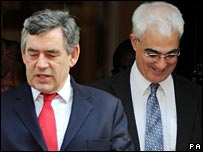 Instead the Chancellor, Alistair Darling, and the Prime Minister, Gordon Brown are trying to slay the dragon, by "leading" a putative global initiative to curb price rises in oil and food - though many analysts see them as using a toy plastic sword against an indomitable force of nature.
By the way, I can't commend too highly Nick Robinson's note on Brown's intervention in the oil market. Some would say that the mismatch between the prime minister's ambition to squeeze out the oil speculators and his modus operandi may be Pooteresque.
Better, perhaps, for Brown and King to be out there explaining in detail why we dare not risk a spiral of inflationary wage increases, which would undermine the ability of both businesses and households to plan and invest in a rational way.
It is, however, a tough sell.
When Darling in his letter to the governor of yesterday was demonstrating the government's anti-inflation intent by swaggering about multi-year pay deals covering 1.5 million public sector employees, he was on dangerous territory: he was, in effect, boasting that many of them had taken a real pay cut, because these deals were agreed before the great oil and food surge.
Darling did go on to say that "inflationary pay settlements would undermine rather than raise people's living standards with a damaging circle (sic) of wage increases eroded by steadily rising prices".
However, if you've borrowed too much, what you want is the value of money to decline - serious inflation is your best hope of avoiding the full and proper consequences of your imprudence.
Inflation is - of course - profoundly unfair to the thrifty, to those who have saved through thick and thin, because their nest eggs are smashed.
So here's what should worry King and Brown, and even David Cameron and George Osborne. The indebtedness of the United Kingdom - the record borrowings of companies and households - means that the political establishment must not take for granted that they have won the argument against inflation once and forever.
One measure will suffice for now: on figures that are now six months out of date and therefore probably understate the problem, companies and individuals are close to paying out record proportions of income to service their debts: the ratio of interest payments to profits for non-financial companies was almost 30% at the end of last year, perilously near to a peak; and households were paying out more of their income in interest and mortgage repayments than they had been doing since 1991, even before the sharp increase in the cost of fixed-rate mortgage deals caused by the credit crunch.
I shall return to the question of where the burden of borrowing is sharpest soonish, because our economic trajectory will probably depend more on the distribution of debt than on the aggregated weight.
But even these crude statistics capture a serious threat. As growing numbers of households and businesses have difficulties meeting their financial obligations, the pressures from them for an allegedly painless and quick inflationary fix will probably intensify.
There could come a moment when there would be widespread popular unrest at the sort of disclosure we had today from the Bank of England, that only one member of the Monetary Policy Committee at the last meeting voted for a cut in interest rates.
The over-borrowed are a sizeable minority of the electorate, so politicians will find it difficult to ignore their agony - though for all our long term prosperity, politicians will probably need to find a way of feeling their pain without actually doing anything very much about it.
 I'm
I'm 






Comment number 1.
At 11:10 18th Jun 2008, john westwood wrote:You make an interesting point regarding a dose of inflation to settle over-indebtedness,which would be a fair point if you had also pointed out that one of the serious sources of inflation is HM Gov,the number of increases in government charges is awesome, even if we ignore the spiral effect of fuel taxes. The BoE should be addressing the Government on this issue and reducing interest rates in an attempt to avoid a serious recession, the private sector is not the source of inflation, those in the private sector are not and will not make excessive wage demands, they will simply want to keep their jobs, The public sector is where the problem lies and given the state of this Government and the trully incompetent Prime Minister,plus The Labour Parties vested interest in the unions I expect the worst ,the bill for which,as always will fall on hard working small business people.
Complain about this comment (Comment number 1)
Comment number 2.
At 11:20 18th Jun 2008, Chris B wrote:"However, if you've borrowed too much, what you want is the value of money to decline - serious inflation is your best hope of avoiding the full and proper consequences of your imprudence."
Robert, lenders have a tendency to anticipate inflation, and charge a premium on top of the real interest rate to cover the expected decline in the value of the money. Unless you have fixed your interest rate for a lengthy period, higher inflation might well lead to higher monthly payments, not exactly what you want at the moment. The high inflation / high nominal interest environment of the past only "worked" because it kept a lid on mortgage affordability and house prices. It doesn't work for super-size mortgages taken out under the current mass-illusion that low inflation (and inflation premiums) means cheap loans.
Complain about this comment (Comment number 2)
Comment number 3.
At 11:22 18th Jun 2008, SGrindle wrote:Can we really expect those that greedily binged on credit to get off the hook at the expense of more sensible savers? I would bet that there are more pensioners that would lose out than over-leveraged home buyers, so it might still be politically unwise for the government to deliberately allow a surge in inflation.
On the other hand, perhaps it's already happening. Indeed, if one is a fuel tanker driver with a large home loan, for example, one's mortgage has just become a lot easier to pay off! This is at the expense of anyone putting petrol in their car, since the drivers' wages are ultimately paid out of the price at the pump.
Complain about this comment (Comment number 3)
Comment number 4.
At 11:46 18th Jun 2008, Hippy god says Peace and Love likes RT wrote:A question must be :
Which is worse, Inflation or widespread Defaults amongst Debtors ?
Clearly, if interest rates rise or rise by too much Defaults and Bankruptcies will rise greatly amongst Individuals and Businesses.
Tolerating a higher level of Inflation for a few years (including in Wages) may be sufficient to give the Economy the breather it needs to avoid Mass debt defaults and Recession.
Of course holding down Public Sector pay may sound good.
But many of these People are on low Incomes (less than 15000 a year) and indeed work part time or are disabled.
And of course holding down pay does not help a Consumer based economy.
After all who is going to buy the goods and services of the existing businesses ?
An increase in Manufacturing would help if exports were able to rise, but that does seem an unlikely prospect at the moment.
Restricting pay rises whilst the price of goods rise faster will of course end up in lower Sales for businesses relying on Consumers.
A self fulfilling downward spiral.
Complain about this comment (Comment number 4)
Comment number 5.
At 11:59 18th Jun 2008, doctor-gloom wrote:Robert:
On the Today Programme, this morning, Mr Darling was trying to sell the broader notion that we all have to think about how large wage increases will adversely affect inflation. The trouble was, he refused to admit that we 'should' all, or will all, have to accept a lower standard of living over the next year or so to get inflation under control: that wage increases should be, or will have to be, significantly lower than inflation. So he was sending out mixed messages. What was worrying was his inability, or unwillingness, to clarify this point. I think he knows that selling this message is going to be hard. The electorate are pretty unforgiving to any party that is in charge of a rapidly slowing economy. He knows this. This is why he kept insisting on the 'external' factors influencing inflation (US sub-prime etc.) He knows he, and his party, will be blamed (and, I think, is being blamed) for the mess we're in. Blaming US sub-prime etc. is a diversionary tactic to try to focus our attention away from the fact that New Labour have been in charge of our economy for over ten years, and like it or not, many of the problems we are now facing can be laid firmly at their door.
Complain about this comment (Comment number 5)
Comment number 6.
At 12:10 18th Jun 2008, Blogpolice wrote:Robert, the failure of this Labour Government has been spectacular. It has failed to regulate the economy by saving in the good years to pay out in the bad. The tool cupboard is bear and what tools are left are likely to make things worse. Not only has the Government failed to regulate the economy, it has wasted its funds. Over £1 million wasted on a scheme to measure rubbish and to get people to pay for it. Am I really being told that our Government did not think about communal bins, fly tipping etc. Am I in a mad house?
Complain about this comment (Comment number 6)
Comment number 7.
At 12:26 18th Jun 2008, charles62 wrote:Yes inflation is here and savers and pensioners all want to keep it low. Yes high interest rates hurt mortgage holders and businesses. So what about our profligate Government who brag about wage restraint, cutting Taxes. How? Get rid of half the £100 billion of useless Quangos they have set up in the last ten years. It may take 5 years to do, but at 10 billion a year that is a lot of tax rebates. Unless someone can tell us the quangos are useful? Tax cuts would stimulate the economy and we would all be happy.
Complain about this comment (Comment number 7)
Comment number 8.
At 12:29 18th Jun 2008, foundalive wrote:Robert
It is unemployment that it going to catch us out here. Several weeks ago I posted a comment suggesting the housing situation was not resovable due to the extra lead time buyers would need for larger deposite, and we see housing builders laying off tradesmen all over the place.
The impact of the credit crunch on personal debt will cause a simple rebalance....stop shopping. I expect unemployment to be slow and then suddenly explode as companies realise they can not ride out the storm.
Inflation levels on those not working is, of course, a different ball game and far less of a factor in bad debt,etc.
In short, low inflation will not make a blind bit of difference to the rebalance. Debt reduction involves taking money out of the system. There is no way around it.
Complain about this comment (Comment number 8)
Comment number 9.
At 12:43 18th Jun 2008, unemployedbanker wrote:And how is the government going to finance itself and issue debt if inflation starts getting out of hand? What kind of coupon are the government prepared to pay on their borrowings. Who would want to lend to UK plc when it has run away inflation?
The nest eggs of the prudent savers needn't be smashed, there are commodity funds available, which are rocketing up in value relative to equities, bonds and Sterling. A little sense means putting a little aside into something like that, rather than over-committing to the housing market.
I think one problem we have is poor financial education, preventing us from saving for the future effectively, buying things at inopportune valuations (houses), selling things at inopportune times (gold at "Brown's bottom", when Buffet was buying up the silver market).
Complain about this comment (Comment number 9)
Comment number 10.
At 12:52 18th Jun 2008, Deepak Chawla wrote:Yes inflation wipes out the value of your external debt. But that only holds true if you have the money to pay for it.
i.e. when inflation is rampant, economy is generally down at the time, you do not collect enough taxes to repay your loans.
So when you complete that theory with reality at the time you always for your external debt.
I also disagree that it wipes out your internal debt. i.e. Individual debt. When the inflation is high you pay higher interest. So you just got to pay more for the same amount of debt.
Also for savers. CPI is 3.3%. Have a look at the best buy charts you can get 7% + on savings. Minus the tax 20% you are still quids in.
Its all about how you manage your money.
Complain about this comment (Comment number 10)
Comment number 11.
At 13:18 18th Jun 2008, CaptnSlackbladder wrote:Hold on a second here.....
If inflation is seen as a allowable evil to rid us of debt, (and so damage those with savings). theres an additional huge issue, which is surely pensions....
If pension funds are invested in bonds, shares etc, etc, then inflation will eat away at the value of these as well (unless of course one is expecting the value of these investments to also jump in line with the increase inflation).
So ultimately we could be looking a a fundamentally reduced payout..
Of course, one might also expect contributions to therefore increase, but in times of economic woe, sticking more in a pension pot when your struggling to pay for your petrol is low on your list of priorities...
Complain about this comment (Comment number 11)
Comment number 12.
At 13:35 18th Jun 2008, TheresOnly1Soupey wrote:Sorry #1 - you have got it very wrong. The reason we have such high inflation is due to the years of wage inflation in the private sector. The city bonus's were all spent somewhere - hence the rapid rise in the RPI.
It's unbelievable that the government is coming down hard on public sector wage rises (Police, Nurses, Ambulance staff etc) whilst we in the private sector continue to make hay while the sun still shines.
I don't believe private sector wage inflation is curtailed until people start to loose their jobs and are offered lower pay deals in order to keep them.
I have worked in the city for the last 5 years now, and I have seen ridiculous levels of wage inflation off the back of booming markets, funded by a booming credit market. Now the good times are over it's funny how the poorest workers are being hammered by GB's 'keep it low' policy.
It's also strange how the Government never stops it's friends in the city earning a fortune - maybe that's related to party funding.
It's a sick country we live in that allows this to happen. Sure GB will be gone next election as will the Labour party, but the replacements will have the same attitude.
The solution? Well it's a tricky one, I immediately reach for the 'punitive taxation stick' on higher wages (over 100k say) - however knowing the system now, there is no point in that as the most highly paid people in the city pay less tax than a toilet cleaner on Embankment. Higher taxation leads to increased avoidance.
I would spend more time and think of a good solution, however I am not in Government and I'm afraid I don't have the time. However it does make you wonder what government are doing if they aren't solving this fundamental economic problem.
Complain about this comment (Comment number 12)
Comment number 13.
At 13:54 18th Jun 2008, JohnConstable wrote:The Torygraph's Real Cost of Living Index is currently 9.6%.
Public 'perception' of inflation is 4.9% (nearly half the actual rate).
Pay rises are (if you're lucky) 3% per annum.
Not a happy set of numbers.
There will be trouble now, fundamentally, in my opinion, because of long-standing Government dishonesty about the true cost-of-living for the 'hard-working' people of England.
Honesty really is the best policy, even for Governments.
Complain about this comment (Comment number 13)
Comment number 14.
At 14:12 18th Jun 2008, Mai_juli wrote:It's a mistake to think that inflation will painlessly wipe out the debts of those who have overstretched themselves, either businesses or consumers. It's a mistake that I woud expect an average man-in-the-street to make but not the BBC's business editor.
Inflation is a tax on the poor as the price of everything rises and wages rarely keep up fully with the pace of inflation, as we're already seeing in practice now. Anyone who is heavily indebted will be painfully hit by the rise in their cost of living long before they get the pleasure of seeing their jumbo mortgage evaporate. And that's assuming they can even keep their job in an environment where inflation is being imported not created by domestic growth. With rising input and wage costs and uncertainty over pricing, indebted businesses will also go bankrupt long before they get a chance to see their debts wiped out. Longer term, interest rates would also have to rise to protect the currency so, again, those reliant on debt will lose out (if they haven't already gone bankrupt).
So a wave of inflation might seem to be a nice solution to the end of a unprecedented debt bubble but it won't solve anything for anyone in reality. The MPC needs to raise rates sooner rather than later - some sharp short pain now is better than long, drawn-out and deep pain later.
Complain about this comment (Comment number 14)
Comment number 15.
At 14:12 18th Jun 2008, extremesense wrote:Re: #12, yes, I agree, #1 sounds as though he/she is repeating the CBI 'party line'.
Unfortunately, GB and AD have a vested interest in keeping the CBI and the private sector happy (Stephen Byers told the House of Commons in March 1999 that he was 'putting the interests of business first' and subsequent secretaries of state have continued with similar rhetoric).
New Labour long ago also declared they didn't want to rely on union money (something to do with a perceived conflict of inerest) - remember, they recruited a guy called Lord Levy to do their fundraising.
Now, if my memory serves me correctly, they're £23 million down and needing a large chunk of that debt by December - sounds like they're going to have a busy time attracting wealthy individuals, like say, Bernie Ecclestone, Lord Sainsbury, Nigel Doughty, Sir Ronald Cohen (both private equity), John Aisbitt (Goldman Sachs and Man Group, the hedge fund), etc.
I also agree that when I was in the City, a 3 percent pay raise would have been interpreted as constructive dismissal even with a significant bonus.
Complain about this comment (Comment number 15)
Comment number 16.
At 14:13 18th Jun 2008, John_from_Hendon wrote:lies damn lies, and statistics - to reinforce the point made in #13.
Leave things out put things in and you fiddle the index. Now, instruct the BoE to manage one other these fiddled numbers by adjusting interest rates (something that has only a vague connection with the index) and that is what we have.
It is a nonsense, but so long as we all believe in it it may work. Many individuals 'hammered' at the door of the BoE about the problems they were creating with excessively low interest rates in the last decade - but all you sanctimonious' commentators did was to poo poo us.
As I raised in the last topic - isn't t time that some better way of managing the statistics is found as it should be obvious that our civil servants are not producing statistics that reflect reality. Like many parts of our permanent government the people responsible are never held to account.
Complain about this comment (Comment number 16)
Comment number 17.
At 14:27 18th Jun 2008, stanilic wrote:The simple reality is that our economy has been a bubble for a number of years. I am not sure for how long but my guess is that it has been about seven years, with the biggest expansion of the bubble in the last three.
All such bubbles burst: the trouble is the longer it takes for the bubble to burst the more damage it does when it does finally collapse. I will own up to expecting this one to blow since 2005.
The problem with this latest bubble is that Big Government claimed the credit for it whilst Big Business was allowed to wreck the economy. Once again the argument that when Big Business and Big Government conspire together the little folk had better head for the hills has been proven accurate.
For the moment the blame game is pointless: we are where we are and we have to get through this somehow with as little damage as possible.
The tragedy is that by the time this is over a lot of people, most of them innocents, will have suffered and suffered badly. This is life changing stuff!
This is what will be laid at the door of government, the financial industry and the political parties in due course. The political fallout will be dramatic. Carefull cultivated reputations will be destroyed.
Complain about this comment (Comment number 17)
Comment number 18.
At 14:35 18th Jun 2008, Chris B wrote:#11 nail on then head - Robert's "solution" assumes that we are an economy of only borrowers - but where there are borrowers there are lenders. And the lenders are not "fat cats", but mainly our pension funds. In order for the lenders to maintain the value of their capital, they need to charge for the erosion that inflation leads to. Which means higher interest rates - which means bigger monthly loan payments.. etc, etc. Inflation is not the solution to anything.
Complain about this comment (Comment number 18)
Comment number 19.
At 14:36 18th Jun 2008, TheresOnly1Soupey wrote:I'd like to settle something once and for all regarding the 'increase in petrol prices'. Whilst other inflationary good are unavoidable (e.g. food) - petrol is certainly NOT (despite what motorists have you believe).
Lets get the facts:
If I own a Fiat Punto (80.7 mpg) and have done since 2004 (when petrol prices were a staggering low 84p a litre ) and I do the average daily UK commute 8.5 miles - that means today I am paying an extra:
80p a week
£3.53 a month
£45.23 a year
Now I'm all for keeping the budget low, but that's not really an amount that would 'kill me' as many people are claiming.
It's true, if I own a Land Rover discovery (22.3 MPG) it's not as good:
£2.90 a week
£12.77 a month
£163.70 a year
However, if I can afford a 30k-40k motor, then surely I can afford this price rise.
So the question is - who is really being affected by increased fuel prices?
a) Are you driving over 8.5miles commute a day? If so then you live too far from work - either move house / job, or stop moaning.
b) Are you driving a huge car? Well then I think you should sell it, buy a punto and don't buy a car in future based on 'trends' or 'fashion'. You were a fool to buy it, now stop blaming everyone else and get down the local car dealer and trade it in for something more practical before the value crashes through the floor.
c) Are you just moaning because everyone else is?
I think most people fall into the last category - like a bunch of mindless sheep.
The only people really affected are those who's business or industry relies on motor transport (hauliers, delivery etc.). However if these business haven't worked out yet that they need to drastically stop their reliance on petrol - then they are doomed anyway - because any sharp competitors will have, and will be doing something about it.
People in this category seriously need to invest in alternatives NOW (lpg for example) - the longer you leave it, the bigger the rush will be and the more expensive it will be.
It all comes down to good planning, any haulier / delivery company that starts up today that has no reliance on petrol or diesel will have a massive competitive advantage.
Stop reading the Sun, stop watching the news and start doing some maths and you might actually see what really does matter in our economy.
I have an average sized car and ride to work on my bike - I have been virtually unnaffected by the price increases and what increase there has been is very good value for money considering the social cost of driving.
Complain about this comment (Comment number 19)
Comment number 20.
At 14:45 18th Jun 2008, MOG wrote:It’s a cruel world!
Two major commodities in the world have increased in price – food and oil.
These commodities feed into everything we buy.
Simple answer: we consume less or we earn more.
Earning more does not mean awarding ourselves more money as that will just drop the value of the pound. We must export more goods and services.
Earning more in the short term is nigh on impossible; therefore in the short term we consume less.
We could have got round this problem it we weren’t in debt up to the hilt.
We will now go on to make this problem ten times worse by trying to consume as much as we are at the moment. The government will compound it further by claiming to be able to solve the problem.
Those who manage to make the high wage claims (the bully boys such as the tanker drivers) will take money that would otherwise pay the salaries of the meek. The meek will lose their jobs and the products that they would have otherwise produced will not be exported and our real earnings will fall.
This all leads to the spiral of increasing inflation, increasing unemployment and continuing recession.
It only stops when we are all so afraid that we will lose our jobs that we dare not claim a wage rise.
Complain about this comment (Comment number 20)
Comment number 21.
At 14:45 18th Jun 2008, TheresOnly1Soupey wrote:#15 - you made me laugh - I too have met many people in the city who would leave the job if their bonus wasn't at least 5 figures - and that's at the low end of the spectrum, the grunts like myself.
Fund managers would walk if the bonus wasn't over 6 figures. This is where the true inflation has been coming from.
I believe you increase the chance of inflation rising the fewer people that are given the extra cash.
If you spread 300 milion across 500,000 nurses as a pay rise the inflationary increase would be much reduced as each only receives a small amount and is more careful with it. However spread the same across 300 city idiots and the impact on inflation is much increased.
It's all down to 'easy come - easy go'. Money that has been earnt properly is far less inflationary than money 'won' or 'given' as in some cases.
Ah - but you can't tell the Government that, for the reasons you elloquently pointed out. Party funding is the key to this and although there has been 'talk' there has been very little 'walk'.
Complain about this comment (Comment number 21)
Comment number 22.
At 14:52 18th Jun 2008, James Rigby wrote:Playing devil's advocate somewhat (although not entirely), it was the profligate spenders that partially created the boom which enabled many to save in the first place. So now it's time to help out those in debt by allowing inflation to creep up.
I'm not convinced that pay rises are any longer the major driver of inflation. It's oil prices, global food prices, raw materials, and factory gate prices of consumer goods (in China, Taiwan, etc). A percentage point either way on UK wages will be negligible compared to these factors.
Complain about this comment (Comment number 22)
Comment number 23.
At 14:58 18th Jun 2008, wykhamist wrote:Perhaps we should step back from mr P2P for a moment and look at Mr Britain.
Mr Britain inherited great wealth and prestige as a young man. He soon set about spending this on all manner of things.
When his overseas properties were lost, luckily he still had an oil well in his back garden, and he could borrow all he liked while his credit was good.
He used this money mostly on servants, fighting wars and his health. He managed to earn some too by convincing everyone that he was 'rather good at finance'.
While some of his acquaintances were building up 'Soverign Wealth Funds' Mr Britain just kept issuing IOUs.
Mr Britain was a bon viveur and everyone wanted to come to his parties, although things could get a bit violent and he got a name for being a bit of a 'binge drinker'.
Sadly, things went against him when his oil well ran dry and suddenly nobody thought his marvellous schemes and possessions were worth much after all. In fact he had already sold all his good stuff already.
Mr Britain protested wildly about the 'global economy' and the fact that he could no longer pay his restaurant or petrol bills. Nobody wanted his financial expertise either.
Suddenly he didn't know what to do - god forbid that he would have to become a servant himself or something like that. By this time he had become very confused about his values and beliefs and didn't feel well at all. Changing his clothes made no difference.
In the end Mr Britain became a sad tortured soul, alcoholic and penniless until he died.
Complain about this comment (Comment number 23)
Comment number 24.
At 15:14 18th Jun 2008, Brownloather wrote:As ever, the prudent, intelligent and hard working members of society who have accrued savings and paid off their mortgages during the last ten yeats will have to pick up the tab for the feckless, greedy idiots who over-borrwed and over-spent to satisfy their own 'hyper-inflated' senses of entitlement.
Yes banks have acted with great irresponsibility by failing to take substantial deposits and lending too much money to people who simply could not afford to service their debt. But surely, even in this Nu-Labour age where everything is the fault of somebody else, there has to be a measure of personal responsibility and these irresponsible borrowers will have to pay the price of their own imprudence.
I grew up and started work during the 1970s and inflation along with a feeble government brought this country to its knees. Control inflation and all will eventually improve and if that means raising interest rates and the irresponsible lose their homes then so be it.
Complain about this comment (Comment number 24)
Comment number 25.
At 15:28 18th Jun 2008, Londonhillbilly wrote:People are not criticising the MPC for the toughness of its anti-inflationary policy for the simple reason that it isn't very tough.
The Governor predicts in his letter that inflation will hit double its target due to higher global food and energy prices. He says interest rates shouldn't rise unless there's evidence of higher inflationary expectations in the form of higher wage rises. But waiting until expectations of higher inflation have developed and start showing in actual behaviour before acting undermines the credibility of the Governor's anti-inflationary stance. After all, if inflationary expectations do increase significantly, more painful restrictions would be required, not only to restrain actual inflation but also to re-adjust people's expectations. And if there isn't the will to act now, would there be the will to act then when it would it cause more pain?
The first real test of the MPC arrangements is exposing the (deliberate) ambiguity in the Bank's remit to maintain price stability and "subject to that" to support the Government's economic policy, and brings into question how independent the Bank really is.
Complain about this comment (Comment number 25)
Comment number 26.
At 15:36 18th Jun 2008, Jan wrote:The people I feel sorriest for are those who are working their socks off already just to keep their heads above water and have little leeway to take on even more financial pressure. This is mostly people trying to raise children and desperately trying to keep a roof above their heads -- people like my children in their 30s.
We bought our first house in the mid 70s and the accepted wisdom of the time was to borrow as much as you possibly could knowing that in a few years' time the amount of the monthly mortgage payment would seem much smaller because of the high rate of inflation and because salaries were also rising. The first house was admittedly a slum and we did not allow sufficient to do it up so it wasn't much fun living in it but I seem to recall the mortgage was less than £100 per month (can't remember the salary). With the next house it was just about possible to service the mortgage and bills with one salary so it was possible to start a family. Now my own children need 2 salaries minimum just to live.
Luckily I managed to downsize 2 years ago as I foresaw trouble ahead and couldn't understand why people couldn't see that remortgaging was not the way forward as many of my agegroup were doing. Value on paper is one thing but until you realise the asset it's meaningless as many are now finding out.
Of my parents generation (pensioners) I agree there are many who are very badly off and will suffer a lot but equally there are a considerable number who are extremely well off and have been sitting on houses which are too big for their needs with substantial savings as well so it's certainly not doom and gloom for all the elderly. In fact many are better off than anyone else.
I don't know what the answers are either but inflation doesn't help anyone now. There needs to be some better mechanism than the present system of taxation for redistributing wealth. In some families the better off help the next generation and actually this has inadvertently helped fuel the housing bubble but a lot of people are left to struggle on without help from family or anyone else and often take on debt as the easy way out. As we are now discovering this is not the solution.
Complain about this comment (Comment number 26)
Comment number 27.
At 15:39 18th Jun 2008, Garleek wrote:As a professional economist I feel I should point out that Mr Preston has misunderstood the impact of inflation on debt. Debtors care about the real rate of interest, not the nominal rate of inflation, as it is the real rate of interest they need to pay back each year to keep their debt constant in real terms. Only if higher nominal inflation reduces real interest rates can debtors be better off. Furthermore, debtors can be worse off even if real interest rates fall as higher nominal rates of interest may increase their risk of bankruptcy.
I think Mr Preston has got confused by the fact that if the debtor’s contract implies that she has to pay the nominal interest rate each year, she will pay off her debt more quickly with higher inflation for a given real rate of interest. But this is only because the higher nominal rate of interest is forcing bigger capital repayments as a proportion of the outstanding debt each year, making the debt more expensive to service early on and less expensive later. There is no overall gain though.
Complain about this comment (Comment number 27)
Comment number 28.
At 15:42 18th Jun 2008, Red Lenin wrote:The government really are missing the point over inflation. It's their pathetic adherence to '3.3%' that's causing the most damage.
Every normal person in this country knows that inflation is at least 5% and because of the disproportionate impact on different products and services, is higher than that the lower paid you are. (the poor getting poorer).
Because the government continues with what is a blatant lie, no-one believes them about anything else - in short, they themselves are quite merrily destroying their own credibility.
If they could just tell the truth over this, then they might well find that people would be more prepared to accept other things they say.
But I thinks it's too late for that now, they've committed Hari-Kiri and will now slowly bleed to death.
Complain about this comment (Comment number 28)
Comment number 29.
At 16:04 18th Jun 2008, extremesense wrote:Ok, so it's all a bit of mess.... The Bank of England are powerless and Gordon Brown can't fix his legacy. Therefore, it's obviously time to contract out the Treasury and the Bank of England to perhaps, hmmmmm, I don't know, Virgin???? At least let them bid.
They're going to have a go at the NHS so why not the economy?
Complain about this comment (Comment number 29)
Comment number 30.
At 16:05 18th Jun 2008, stuart255 wrote:Robert.
For the UK to inflate away our debts. We need to increase the supply of money, which we have been merrily doing at a clip of around 14% for the past five or so years.
The reason we don't see 14% inflation is because the velocity of sterling has been slowing. It is used as reserves in asian banks for example.
However, here in the UK we increase our monetary base via the expansion of debt. Our central bank the BoE buys and sells government debt in order to fix the short rate.
If the UK were to inflate our money supply just how much money would we need to create? How much more government debt would we create in the process?
Yes it may be ok for those who have existing large debts, but by inflating our monetary base we will also increase the government debt burden by a proportional amount this also has the very real implication of raising our tax burden.
Hardly sensible policy for a nation trying to exist on the brink.
I have a very serious question that I would like somebody in the media to tackle...
What happens when your total debt expands faster than your gross earnings?
Lets take an example where a country has $1trillion outstanding debt and $1trillion GDP. Lets image that the debt is growing at 8-10%pa and GDP grows at 2.5%pa.
Pick whatever interest rate you feel is relevant.
Is this sustainable? How many years can this nation continue like this? Can this nation really use inflation to aid it's debt problem in any way?
Or is buying government debt to increase the monetary base throwing more fuel on the fire?
The only way it can go from here (according to mathematics) is a deflationary bust, which will occur some point between now and our national default.
Complain about this comment (Comment number 30)
Comment number 31.
At 16:11 18th Jun 2008, JohnConstable wrote:#28
It is 9.6%, according to the Torygraphs Real Cost of Living Index.
(sooner or later somebody was bound to do this - create a realistic index for the hard-working people of this country - well done award winning financial journalist Ian Cowie and team at the Torygraph - we are not related!).
I think that the Government lies about this because it is a long-standing lie - going way, way back to the last Tory administration.
So they were kind of stuck with it.
If you as a Government, start to admit that it really is over 9% then lots of bad things will immediately start happening.
For example, those pesky unions will complain that their members are being stiffed (they are right now) and will demand inflation busting pay rises.
So there really isn't much choice but to continue the pretence of 3.3% or whatever.
Complain about this comment (Comment number 31)
Comment number 32.
At 16:14 18th Jun 2008, TheresOnly1Soupey wrote:#28 - Very true Red Lenin, however when was the last 'credible government'.
There hasn't been one in the 38 years I have been alive, and according to older people, there wasn't on before that either!
No government will ever get it right until they incorporate ALL prices in their inflation calculation. They can weight it depending on how essential it is, or by the volumes purchased nationwide.
The governments figure is really telling us that the inflation rate of LCD TV's is keeping down the Inflation rate of food. The fact you cannot eat an LCD TV is quite relevant in this case I think. However you try telling the dum dum's down at the government that.
One of the reasons the housing market keeps bubbling is because they don't include house prices in the inflation figures - if they did, they would have been introducing fiscal policy (raising rates) much earlier and would have softened the blow and the market would have been steadier.
...before everyone gets on their high horse, I realise not everyone is a homeowner, however as you will see over the next few months, rental prices are linked to house prices - so the only people who wouldn't count house price inflation are those lucky soles who own outright - or the people living on the streets. Either way an accurate weighting could ensure these two types of people are accounted for.
Complain about this comment (Comment number 32)
Comment number 33.
At 16:15 18th Jun 2008, Onesicritus wrote:Surely, the market will adjust.
i.e. if workers make excessive demands then their companies can't afford them and will be forced to make them redundant. If the company puts up its prices then the company will go out of business. Then inflation or not, the greedy and indebted are stuffed.
An example being, if the oil companies whacked on a fuel price increase because of the tanker drivers settlement that would be honest and would at a stroke remove public support from the tanker drivers (but it suits the oil companies to muddy thus with fuel duty, so they won't).
Calling for restraint in wage demands is a bit weird (I mean has no-one been listening to The Ragged Trousered Philanthropists on Radio 4 this week).
After all, who wouldn't, if they thought they would get it, ask for a 10% wage rise. Self restraint never stopped the MPs for example.
It is really only the unionised industries (including the public sector) which has to be a concern of the chancellor. To be honest bleating about wage restraint on the telly does not help. It's a sure fire way to make people think they should ask for more and is likely to be taken as a sign of weakness.
Complain about this comment (Comment number 33)
Comment number 34.
At 16:15 18th Jun 2008, Duncan wrote:#27 is spot on. However although there is no overall gain it does change people's behaviour. People are less likely to take on debt in a high inflation environment because the initial repayments appear higher. The average person is not capable of doing the discount calculation to work out how things pan out of the course of the loan. So the savings ratio should improve. In fact it has done historically:
https://www.hbosplc.com/media/pressreleases/articles/halifax/2003-07-05-00.asp
Complain about this comment (Comment number 34)
Comment number 35.
At 16:30 18th Jun 2008, Hippy god says Peace and Love likes RT wrote:Its interesting how Economic problems are always blamed on Government.
Yes Government creates economic policy,
But
It is Private businesses, Big and Small that make the decisions that actually keep the economy going.
If Private Buisness makes a hash of things why blame the Government ?
Unfortunately the Private Business rush to export manufacturing jobs and industry abroad has and continues to have a serious impact on our economy.
Until Britain is able to pull together (including Big business) to create a balanced economy (ie a bit more manufacturing of a suitable type) that can export to meet its import needs, we are all going to be in trouble.
Finding suitable types of manufacturing could well be very difficult and I certainly cannot claim any knowledge of what they could be.
Of course no one likes the Value of money to fall.
But it is a case of making choices.
Very valuable money, but great social suffering and unrest, or a softer money with less suffering etc.
Money is only any good if you can safely walk down your street to an open shop and find goods to purchase within it.
If you have low inflation, business closures, Gated communities, high crime, etc is it worth it?
I personally think a balance needs to be found whilst the economy adjusts.
Complain about this comment (Comment number 35)
Comment number 36.
At 16:56 18th Jun 2008, Hippy god says Peace and Love likes RT wrote:Wage Inflation isn't necessarily bad.
Happy motivated Staff perform far better, have fewer Sickness absences, and are more likely to go that extra mile for their Employer.
Despondent, demotivated Staff, suffering from ailments brought on by struggling with endless difficulties at home etc, generally do not do their Company much good.
Employees should feel entitled to earn a living, (enough to keep themselves and their families).
It is absurd to believe that no account of rising food, rent or heating costs should be taken when figuring wage settlements.
Just before the first World War there was very serious under paying of Employees with great suffering throughout Europe.
People in full time employment unable to feed their own families etc.
We are not near that situation yet, but in the 21st century we should be aiming to have certain standards for all.
Not aiming to create new underclasses of Working Poor.
Complain about this comment (Comment number 36)
Comment number 37.
At 17:20 18th Jun 2008, TheresOnly1Soupey wrote:Here's one to float.....
How about Inflation is the efficiency driver of an economy.
Over these last few years of boom the UK has become incredibly innefficient - too much money flaoting about.
Now we need to look at the efficiency of the economy and bring it back into line.
How about the Government start by making sure the 'billions and billions' of investment into our public services they keep harping on about - actually gets distributed efficiently!
If anyone saw Jeffery Robinson on the NHS it was clear that although much money was poured in the top - a lot was lost through poor distribution and bad management.
...now someone tell me that wasn't inflationary. That's why sub-contractors who take up NHS contracts have been paid handsomly (although not neccessarily their staff) - and this is true across all public spending areas.
Complain about this comment (Comment number 37)
Comment number 38.
At 17:25 18th Jun 2008, fingerbob69 wrote:inflation arises in a situation where there is increased money supply chasing limited goods or services. The question first should be asked where is the supply of money increasing or has recently been increased?
Well, why not start with a £50billion loan by the BoE to the high street banks!
Where have those banks been salting that extra wonga? Well it wasn't used to reduce morgage rates! It's gone into commodity speculation...oil for example ...a commodity of 'limited' supply ...as a means of repairing bank balance sheets.
Oil rises, factory producer prices rise, consumer prices rise ...hello inflation.
Next up ....CREDIT DEFAULT SWAPS! ...Credit crisis part 3!
Complain about this comment (Comment number 38)
Comment number 39.
At 17:39 18th Jun 2008, Hippy god says Peace and Love likes RT wrote:Bad management is clearly a problem in both Private and Public sectors.
Reminds me of the Peter Principle !
(Ie a Person good at one job gets promoted until he/or she is no longer good enough to be promoted)
There seems to be an over reliance on Academic qualifications in Management rather than hands on training.
A Degree says someone can learn, but it does not say they can Manage.
Complain about this comment (Comment number 39)
Comment number 40.
At 17:42 18th Jun 2008, John_from_Hendon wrote:to #38
Would just like to add the synthetic money 'created' by the synthetic financial instruments that, if not caused, then compounded the credit crunch.
50 billion is chicken feed - my guess is that several trillion or perhaps tens of trillion of extra money was created by the, now known to be defective, ratings of the credit ratings agencies.
All this cash is still sloshing around and looking fro new commodities to devastate - oil, food, minerals etc. Somehow this extra money supply needs collecting and withdrawing - trouble is that the only known method is inflation!
Complain about this comment (Comment number 40)
Comment number 41.
At 18:20 18th Jun 2008, Chris B wrote:#34 it's not only that there is no overall gain, there is a large overall cost - with high and unstable inflation, the real value of any future payments are much more uncertain, and this risk is a cost to all of us, whichever side you look at it from.
I do agree that people are not capable of doing the discount calculation and simply borrow as much as they can afford in terms of monthly payments - in my opinion the main reason for the current credit bubble. But not only is introducing inflation a very costly way of trying to restrict borrowing - it doesn't work when people have already borrowed alot. This because the initial repayments don't just appear much larger - they *are* much higher, in real terms.
Lending needs to be regulated so that an understanding of the real cost of a loan is put across by the lender, not just monthly outgoings.
Complain about this comment (Comment number 41)
Comment number 42.
At 18:31 18th Jun 2008, therealhotairmail wrote:The fundamental problem is actually the lending at interest. Before you ask, no I'm not a Muslim.
It's just that 97% of all money comes into existence as credit. So, all that money is bearing interest this year, next year and the year after.
That means the total liabilities in the system exceeds the amount of money.
The money supply has to grow exponentially or the liabilities catch up.
You either have inflation or you must have default in order to wipe the slate clean of all those liabilities -it's the only way to get rid of them.
Unfortunately we have had years of inflation of the money supply - only it didn't show up in the price inflation measures as they lurked in assets.
Now as asset prices are adjusting downwards as they inevitably must, we have default rising....and the past inflation of the money supply washing around wreaking havoc even as we experience deflation. Heaven it ain't.
Complain about this comment (Comment number 42)
Comment number 43.
At 18:36 18th Jun 2008, therealhotairmail wrote:I should also add that wage inflation is actaully the only good sort of inflation in my book.
It's just that to get it we must improve real productivity or we'll impoverish ourselves again with price inflation.
Now, deflation would actually make everyone richer without having to go to our task masters and ask for a wage rise. But unfortunately, deflation is associated with a collapse in demand and economic stagnation.
Complain about this comment (Comment number 43)
Comment number 44.
At 18:54 18th Jun 2008, Timmytour wrote:What credibilty can you give to a government that denies it has any responsibility for the inflation rate of today and tomorrow when it has always been at great pains to claim credit for the low inflation of the past ten years?
When have you ever heard a member of the Labour government suggest that it was "external factors" that were keeping inflation at low levels in the preceeding years?
Complain about this comment (Comment number 44)
Comment number 45.
At 18:59 18th Jun 2008, stuart255 wrote:No. 42
That is a common myth.
Once you have repaid your lender in full, your lender is then free to spend that money as they wish.
i.e. The debt is cleared and the money still exists.
They could buy goods from a supplier and that supplier can then repay their debts. A single five pound note if changed hands enough times could repay all the debt in the world.
It is a false assumption that the only conduit for money to leave a bank is via an interest bearing loan.
Complain about this comment (Comment number 45)
Comment number 46.
At 19:51 18th Jun 2008, markus_uk wrote:To call for low interest rates and high inflation is as irresponsible as calling for petrol in a fire. I hope the BOE will stand firm and will not let themselves be bullied into a lax policy. Their decisions are about the future, not about easing todays hangovers of yesterdays debt-junkies.
Complain about this comment (Comment number 46)
Comment number 47.
At 20:25 18th Jun 2008, random_thought wrote:"Inflation is - of course - profoundly unfair to the thrifty, to those who have saved through thick and thin, because their nest eggs are smashed."
This is true only if interest rates on savings fall below the rate of inflation. As #27 says it's the real rate of inflation that matters. If inflation is 8% and interest rates are 10%, savers are in exactly the same position as if inflation is 2% and interest rates are 4%.
It's the long-term borrower that is clobbered. Why? Because lenders insist on calculating repayment schedules in equal nominal sums over the lifetime of the loan. So if I take out a 25 year mortgage the repayments are the same in year 1 as in year 25. Fine if inflation is low, but if inflation gets higher then my repayments get heavily scewed to the beginning of the repayment period.
There is just no reason for this. The banks could just as easily calculate repayments in equal real terms (net of inflation) - they could do this one year at a time so there's no need to predict future inflation levels in advance. This would mean that for a given real interest rate, my repayments this year would be exactly the same whatever the level of inflation.
A simple change like this to all installment based financial constructs (you can include pensions and long term loans to industry in that) would potentially render moderate levels of inflation virtually harmless.
The only problem is to provide a measure of inflation that everyone can believe in....
Complain about this comment (Comment number 47)
Comment number 48.
At 20:54 18th Jun 2008, therealhotairmail wrote:No. 45
On an individual loan, what you is say is not incorrect.
However, to repay that loan the borrower has had to repay more money than they initially borrowed.
If all the people had to pay back their loans at the same time, you would find that there wasn't enough money to go round.
This in effect is what happens invisibly over time. As that 97% of money in issue continues to rack up liabilities to the banks, an increasing shortage of money in circulation would take place in the absence of inflation of the money supply.
This phenomenon was more apparent in ancient city states with relatively closed economic systems - which is presumably why it was universally banned.
Complain about this comment (Comment number 48)
Comment number 49.
At 22:25 18th Jun 2008, eloquentSillyperson wrote:Does anyone hear who disagrees with the concept that 'inflation needs to be kept low' remember or looked at what happened in Japan just over a decade ago .. and whats happened there since then ?
If you fail to learn from history.....
Complain about this comment (Comment number 49)
Comment number 50.
At 23:04 18th Jun 2008, fingerbob69 wrote:#40 ... ofcourse, it's just that was a well known, recent, easy to remember example of something that has been intensely persued by the Fed inparticular but also by the ECB to the tune of $ trillions.
It is a whisper increasing in volume that many of the worlds banks, both high street and investment are to all intents and purposes bankrupt. If just a small porportion of their credit default swaps CDSs were called in (an unregulated but none the less real market estimated in value of $62trillion) as personal and corporate defaults rise, it is amust happen senario, then just what proportion of $62trillion does, for example, Leheman Bros 'own' and have no hope of honouring when called on?
Both here and in the USA, offical inflation bears only a passing resembalance to real inflation. Here in the UK we water it down by judging it's course against an unrealistic basket of ''everyday'' goods but not property costs. In the USA, gasoline isn't part of it's ''core' valuation.
The morgage bond market is nomore.
RBS expects a real, in-your-face, no holds barred, bend me over spank-me! spank-me! stock market crash by September this year... the Nasdaq down to about 1050pts. Their chief economist guy was, apparantently, spot on with predicting the CDOsubprime crisis of August '07 in Spring 07 so his stock carries some weight.
Intrest rates need to rise. Fed has hinted such but to raise rates goes against Big Ben's core instinct. When the Fed doesn't raise rates in August/September the game will be up... the dollar and therefore commodities (except precious metals) will crash. CDS will be called and not met.... the World will fall.
Complain about this comment (Comment number 50)
Comment number 51.
At 00:08 19th Jun 2008, U9461192 wrote:it's also slightly surprising that neither the government nor the governor have recently felt the need to re-state the case against inflation in a populist way, now that the evil is upon us again
Well the reason for that is obvious. Inflation is not a problem. It's a piddling 3.3%. Look, the ONS says so and the government certainly wouldn't be able to fix that. And interest rates are low. Only 5%. And not likely to rise. So that's all okay.
No way the government would be able to influence the independent MPC. No precedent for that at all. The last governor of the bank certainly gave no indication that rates had been cut during his tenure in, say, 2005 to keep housing artificially inflated. Nope. That never happened.
SO now we've established that inflation is low and interest rates won't be going up we can set to work on the causes of the recent increase in the incredibly low inflation rate. Again, not a problem. King Cnut himself has had a quick chat with OPEC and instructed them to produce more oil. So that's that problem solved. Not that it's a problem. Because inflation is low.
SO really there's nothing to see here. No story. Move along.
Okay. Here's what's really happening. The cost of oil is out of control. This is feeding through to our essential spending on transport and food. The government has no way of controlling this but since they took credit when it didn't need controlling they can suck it up when it could use some controlling. Fact is they were powerless either way.
Remember all those budgets of Brown grandstanding about 'no more boom and bust' anybody? The arrogant, incompetent, disingenuous Brown liked them so much that he invented a mini-budget every six months so he could claim credit twice in a year for benign conditions outside his control. And use them to camouflage further tax rises and more borrowing. Look over there, inflation is low. Don't look over here at me increasing taxes and trashing the national debt.
The RPI is rigged. And will be further rigged now that house prices are dropping so as to include house prices as a justification for lowering interest rates. This won't save the housing market because the banks aren't going to be lending any money any day soon because they know that millions of people are shortly going to be unemployed and have no way of paying back a loan unless it's at 0%. And they're not going to give 0% loans because they'll make no money.
SO the housing market is doomed and cutting rates won't help.
This Labour government will do what every Labour government in history has done. Print money. Man, we are going to have the smell of freshly printed thousand pound notes coming out of our ears before this is over. For investment you understand. In infrastructure. Like the investment in infrastructure we've had over the last 10 years. Invisible to the naked eye but it must be there because Gordon told us so. Twice a year in parliament and every weekend on the Andrew Marr propaganda slot.
We will have inflation. One way or another. Either through low interest rates or massive government printing of money. It's the only thing Labour understands. It's what they 'do'.
The only question is can they rig the GDP figures for long enough to avoid two successive quarters. And I think they can. Watch for many successive quarters of massive negative growth followed by a quarter of slight positive growth. No two successive quarters. No recession. It's in the bag.
Plus pouring over a hundred billion of borrowed money into the economy over the next two years will rather improve the chances of avoiding one quarter's GDP being less than the previous one. Just like it's done for the last 10 years.
Complain about this comment (Comment number 51)
Comment number 52.
At 08:45 19th Jun 2008, stevewo wrote:What has been the philosophy of the Blair-Brown era?
Clearly not..."do a decent job for a decent salary".
They have created a huge super-rich elite and at the same time caused serious hardship for about a third of the population.
The philosophy is very clearly..."take the money and run".
Complain about this comment (Comment number 52)
Comment number 53.
At 09:10 19th Jun 2008, Hippy god says Peace and Love likes RT wrote:With Consumer Demand at an all time low, and ordinary working people struggling to pay their rising utility and food bills (not to mention mortgages), who in their right mind would raise Interest Rates ?
Raising Interest rates would just hit the poorest half of society.
The very people who already are spending the least they ever did in the Shops.
The only way to manage (ie reduce demand) now is to target the People who have money.
The People who do not pay Interest.
So if reducing demand is the way to go (and I do not think it is), then the only way to do it is to raise Taxes on the Rich.
The trickle down effect does not seem to have happened in this country, so I doubt raising the higher Tax rate and extending National Insurance would have much effect on the lower orders (thats us).
It must be remembered that our Inflation is imported, in Commodities we cannot control with interest rates.
There is no guarantee that higher Interest rates will improve our exchange rate either.
Overseas investors will wish to invest in a growing economy not one that is on the Rocks.(Northern or otherwise).
So, how does the Governemnt propose to create the confidence in overseas Investors in order to pull their Money in?
Just raising Interest Rates and bankrupting the Peasants will not do it in my opinion!
Complain about this comment (Comment number 53)
Comment number 54.
At 09:44 19th Jun 2008, Hippy god says Peace and Love likes RT wrote:Lets all vote Liberal at the next election, that would wind up the Powers that Be, who have clearly decided its the Conservatives turn to Run the country next.............
Complain about this comment (Comment number 54)
Comment number 55.
At 10:38 19th Jun 2008, businessangelblog wrote:Good to read such a wide variety of opinions!
I actually wrote an article a couple of weeks ago In defence of Infation - lets just say I felt like I was a lone defender.
My argument was that given the problems with debt - inflation may be a good way for us to erode the debt mountain.
I accept that if interests rates go up (with inflation) the problem becomes servicing debt - but the nominal value of the debt will decrease
Complain about this comment (Comment number 55)
Comment number 56.
At 11:02 19th Jun 2008, robertagain wrote:Another excellent article.
I struggle to see how raising interest rates is going to slow the relentless rise in food, fuel and energy prices-not to mention mortgage rates. If inflation is travelling to 4% anyway (and it's probably more anyway!) holding or raising rates will not halt that in the next six months.
To me interest rates set each month have been like traffic lights, a cut is green so spend and borrow, amber is no change, so just carry on and an increase is red-panic!
The consumer is confused, interest rates are high, prices are rising on basic needs, the banks do not seem very well and also their home is falling in value.
So rather than the Chancellor saying the economy is 'well placed' to deal with the predicament and a few learned folk pondering in a room once a month 'shall we shant we make that 0.25% change' while traffic stops and pedestrians stand awaiting the momentous decision-is there a way to get confidence and some optimism back? I do not know how, but every day we watch the news and read the papers and everyday it is just more bad news.
Keep up the good work!
Complain about this comment (Comment number 56)
Comment number 57.
At 11:07 19th Jun 2008, fingerbob69 wrote:#51 i believe the correct spelling of that particular king's name is with an e on the end ...c n u t E.
Complain about this comment (Comment number 57)
Comment number 58.
At 12:42 19th Jun 2008, U9461192 wrote:This comment was removed because the moderators found it broke the house rules. Explain.
Complain about this comment (Comment number 58)
Comment number 59.
At 13:43 19th Jun 2008, TheresOnly1Soupey wrote:In response to #42 - I agree with your suggestion (and I am not a Muslim either).
I am forming the opinion that money lending is the evil of this world, does anyone think it's a co-incidence that some religions (like Islam) believe to make money from lending money is Immoral? Maybe it's more than that, maybe it makes part of the fundamental downfall of society.
Earning money from lending only benefits those who have money. As society allows the inherited wealth to continue through the family line, much of this money is being made from money stolen during colonial times.
The US in Iraq is a modern day form of colonialism.
I am also starting to believe that the 'money changers' story in the bible has been re-written to suit the west. I believe Jesus threw over the tables of money lenders, and that this had nothing to do with them being in the temple, but more to do with the fact they were lending money - which is immoral in gods eyes.
In christian countries who rely heavily on lending money for their income, this would be a bad contradiction to have to deal with.
Complain about this comment (Comment number 59)
Comment number 60.
At 15:02 19th Jun 2008, thatmcgrath wrote:For all those people who fancy a dose of inflation I would suggest emigration to Zimbabwe. Think of it: an instant zillionaire, but nothing to spend your vast paper wealth on.
I know governments have a prediliction for some inflation of around 3 % but it does tend to get out of hand for political reasons from time to time. Just pray that it doesn't do so this time round.
I'd like to see a debate or enquiry into removing the US dollar as the reserve currency to be replaced by some new unit controlled by consenus of states. I say this because I believe this financial crisis was born and bred in the US.
Complain about this comment (Comment number 60)
Comment number 61.
At 15:59 19th Jun 2008, Cassandretta wrote:I'm very glad to see these points finally being put, whether or not people agree with them. We need some discussion and reassessment now.
But what I'm still trying to figure out is whether (or to what extent) Mervyn and Alexander appreciate or agree that:-
(A) Today's chosen weapon against inflation, interest rate, is powerless against external commodity price rises as we have seen and looks fairly ineffective against the consequences of these;
(B) The government's suggestions that we all repudiate wage rises and accept a significant fall in our living standards without complaint looks unlikely to win any popular acclaim;
(C) Any chance that this might have worked has surely been dashed to bits by the tanker driver's success in obtaining a 14% rise, which has surely set a new 'going rate'.
(D) That (given the above) the current economic control regime can no longer work effectively, and must be replaced (soon) by something else.
(E) That with different commodity and energy prices diverging rapidly, the effective inflation rate felt by individuals varies enormously with their circumstances, and that because those on low incomes and with low net disposable income feel the government neither understands nor appreciates their problems, this is a political issue as well as an economic one.
Complain about this comment (Comment number 61)
Comment number 62.
At 18:46 19th Jun 2008, geoffrbrown wrote:When reading through the various replys to (RP) articles I find it difficult to understand why many people are so vehement in blaming the present government and the BOE for the problems in the housing market and the recent surge in inflation caused by the increase in commodity prices that we import from around the rest of the world.
The problems in the housing market was caused by the way the city banks conduct their business and the way in which the financial markets were allowed to operate, without proper or adequate controls being put in place. From time to time these things unfortunately do happen because we live in a free and democratic society where people and businesses do not wish to be too tightly regulated by government intervention. Whilst there is now much angst over falling house prices and the effect this is having on the housing markets that is not this governments fault. The current problem has been steadily escalating and building up since the city was deregulated (the so called city big bang) to much aclaim under the Thatcher government. Since then and once they were given the opportunity to work in a largely unregulated environment the "city charlatans" managed by deception, to conceal the level of indiscipline and corrupt dealings going on there from successive Prime Ministers and governments as well as the regulatory bodies that were supposed to oversee their handywork.
Likewise the steep increases that we are now seeing in the cost of oil, gas, food and every other commodity we frequently use or need is beyond the control of this or any other democratically elected government. The problem now facing this country and all other western countries is down to the fact that economic power and wealth is now shifting away from the western countries towards the eastern countries. Simply put that means we are now competing with a bigger audience for commodities where the supply cannot keep up with demand and so we have to pay the going rate, whatever that might be.
The only way that I can see matters improving in this country is if the two leading political parties can come to some closer agreement when drawing up a proper economic plan that is suitable for UK Plc in the forseeable future and regardless of who happens to be in power. We must stop lurching from lift to right and back again as and when the different parties are voted into or out of power.
Complain about this comment (Comment number 62)
Comment number 63.
At 14:24 20th Jun 2008, Timmytour wrote:geoffrbrown
So you think the steep increases that we are seeing now are beyond the control of this government?
Well perhaps you are right...but I doubt that will wash with those who have heard the current Prime Minister continually claim the credit for the low inflation of the preceding years. Can you cite a single instance of where he referred to this period of low inflation being lrgely down to external factors?
The real crime of this goverment is that it has borrowed its way into a corner. It had a duty to ensure that during the good times, we were well prepared for future indifferent times. It has failed miserably.
Instead it borrowed, and squandered money as if it came from an endless pot. In doing so it ended up achieving very little, save for completely wiping out the healthy surplus it came into power presiding over.
And now it has nothing left to help us with, but instead will have to extract more from us in a time of pain just to keep things ticking along. Its forecasts of economic growth, and therefore the tax revenue earned, will prove to be way over-optimistic. In the meantime the pound will start a gradual and prolonged slide against the dollar, which will not only prevent UK motorists from benefitting from a small decline in oil prices, but further reduce the income received from the government.
The government's to blame because it has nothing to offer us except pain.
Complain about this comment (Comment number 63)
Comment number 64.
At 07:10 21st Jun 2008, saintmarkymarky wrote:the following points need to be considered.
1. the self righteous comments of being prudent bear no resemblance to reality, the young need to borrow to buy a home for their family. older people have benefited most from the huge rise in house prices and years of low inflation.
2. the gap between the 'haves' and the 'have nots' is widening, low income jobs abound .
3.the consequence , many people are well off and can continue spending freely. those
who have large mortgages,families , tight budgets are going to really struggle if interest rates go up along with the other fueld, food etc.
4. the answer. ? a painful correction is happening and raising interest rates will only make matters worse.
Complain about this comment (Comment number 64)
Comment number 65.
At 21:34 21st Jun 2008, Mad_Mad_Max wrote:Power at any cost - what say Gordon?
Complain about this comment (Comment number 65)
Comment number 66.
At 23:00 21st Jun 2008, scargillwasright wrote:#19.
My Punto only does 45 m.pg.
Sometimes you move to be close to sork (less than 2 miles) then they up-sticks and move 20 miles away.
I don't complain but I wish I was close enough to cycle as I used to.
Otherwise what you say makes perfect sense.
Will we forget all the pain if pertol prices fall again ? We always seemed to in the past
Complain about this comment (Comment number 66)
Comment number 67.
At 23:19 21st Jun 2008, scargillwasright wrote:Wouldn't letting inflation rip be a short term fix to fix the last short term fix.
There are some fundamental problems in the world.
The supply of oil is finite (even if you find more the day of reconing is only delayed).
The supply of food is finite (increasing productivity may give us a breathing space to solve our population problems but will only delay the day of reconing unless we change).
Climate change, even if not man made a change in our climate would be terrible for agriculture.
Emerging diseases and a drop in effectiveness of drugs.
Pensions, even if the rest don't get us
Pension problems, even if the rest don't get us most of us will starve to death when we stop working.
We have to fix the underlying problem insted of dodging it as we have since I remember.
Complain about this comment (Comment number 67)
Comment number 68.
At 13:32 22nd Jun 2008, SportBillyGoat wrote:#1 @westpurwood
The public sector is a popular whipping boy of all that is wrong with the british economy, particularly amongst private sector workers and yes it's imperfect, however you comments are unbelievably partisan, have you not been paying attention,
The economy is largely stuffed because of the credit crunch and rampant inflation. But even a cursory examination of the root causes should tell you:
It was not public sector employees or government who decided it would be a good idea to lend 125% mortgages at massive multiples of salary at the extreme of a property bubble, to high risk borrowers.
It wasn't a public sector organisation that thought it a good idea to grow it's mortgage book 55% in the first half of 2007 with the above lending strategy or be so clueless that they launched a discounted tracker mortgage for buy-to-let investors in August 2007 (The subprime collapse in the US had been underway for months by then) only to go cap in hand to the BoE in a few weeks later with a "Oops, sorry were bankrupt, bail us out to the tune of £30bn+ please"
Likewise it is not public sector employees who feel £36000 pa basic is insufficient to drive a lorry and held the country to ransom for a whopping 14% pay rise. Nor do they receive lottery win sized bonuses every year for gambling with other peoples money.
If I was in the private sector at the moment I would hang my head in shame, I certainly wouldn't whinge about the increased cost of business and try and pin the blame on a group of low paid public sector workers (cf the salary of a Shell tanker driver with an ambulance driver) and expect them to take the hit for the financial mess created by the greedy, greedy private sector.
Complain about this comment (Comment number 68)
Comment number 69.
At 08:17 23rd Jun 2008, geoffrbrown wrote:Reply to Timmytour 63
I agree with you (and I'm sure so would Gordon Brown) that the low inflation figures that he and the Labour party kept harping on about were helped, to certain extent, by world wide low interest rates and benign trading conditions ove r the past decade. None the less Gordon Brown deserves some credit for setting such a low target figure and even if (as the BOE expects it to) this figure peaks out at 5% over the coming months then given the recent increases in the price of gas and oil etc that will be some achievement.
You are also quite right to say that it is a crime that this government failed to stash away enough more money in the good times to cover to cover the downturn in the economy that we are experiencing. That however is down to the policies of his predecessor Tony Blair who, in my opinion, was very much a populist prime minister (as David Cameron would be if he is given the chance) and wanted to be seen as a leader who responded favourably to the public's and the media's mood swings.
In his earlier years Gordon Brown was sensible and prudent with the Treasury's purse strings. In fact during those years he was often accused by many people, including those from within his own party, of being too tight fisted and the media frequently accused him of building up a war chest to fight future general elections.
In later years Gordon Brown relaxed his grip on the Treasury purse strings because (I strongly suspect) his then boss (Tony Blair) told him to do so or he (GB) would risk being being kicked out of office. That was when the government started to throw money at the NHS and other public services in order to create a good feel factor and to show that the government was listening to what the electorate had to say about failing public services etc. Then there was the little matter of the war's in Afghanistan and Iraq. Had the credit crunch and then the dramatic price increases in commodities not come about so soon after he became prime minister then I believe this government would again have become sensible and prudent with the Treasury purse strings.
Finally I must make it clear that I am not in any way affiliated to the Labour party. I am sixty seven years old in reasonably good health and I still need to work full time to enjoy living and for that I am grateful.
Complain about this comment (Comment number 69)
Comment number 70.
At 11:19 23rd Jun 2008, Timmytour wrote:geoffrbrown
I respect your opinions and views, but in my opionion your comments about Gordon Brown being prudent in the earlier years and "relaxing the grip" in the latter years because of the influence of Tony Blair, are misguided.
First of all, a man who likes to be referred to as "the Iron Chancellor" is not a man who would bow to the opinions of someone like Tony Blair, even disregarding the animosity that existed between the two. Gordon Brown was a man who made his own decisions, and it is often said that not even Tony Blair knew what the content of his budgets were before they were announced.
The real reasons for change in gear in spending are more to be found in the decision to abide by Kenneth Clarke's spending plans for the first few years they were in office. Thus Gordon Brown inherited a surplus and a prudent spending plan. Spending started going up when he was no longer restrained by his commitment to the previous Chancellor's spending plans...it had little to do with Tony Blair.
Then, more than ever, the external factors came into play...the ones for which he blames the current inflation rate but ignores in assessing "his" success in keeping inflation low and the economy growing. Then, basking in his own success, he enters the world of delusion. The days of "boom and bust" are over? By this he makes an assumption that whatever he spends can be earned by an economy which will continue to grow. He makes "rules" by which he abides, which continully bends and extends to prolong the delusion that he has the country living within its means. In the meantime his prodigious use of PFIs ensures that he can keep billions of government spending off the balance sheet and builds us a land where the country no longer own the schools and hospitals in which its young are taught and its sick are treated, but instead is beholden to big business for them.
Brown's legacy will be the turning of a prosperous Britain where all business flourished, into a Britain which is at much at the mercy of Big Business as it was at the mercy of Unions 30 years ago.
For Gordon Brown....read Jim Callaghan. Different strips, same results.
Complain about this comment (Comment number 70)
Comment number 71.
At 13:23 25th Jun 2008, TheresOnly1Soupey wrote:#66
I took the MPG's from a website showing the most fuel efficient cars (The Punto being top).
I understand that there are situations where using the car is inevitable, and I appreciate your point about business moving.
I suspect though you are less concerned by rising fuel prices than rising food prices (because we all have to eat).
There are 2 things to consider here:
1) Where is the retribution on all those oil companies who were buying up electric car companies in the 80's and shelving them.
2) Fuel sits at the bottom of our economy as we rely so heavily on road transport because no government has ever invested in public transport (because most PT plans are 10yrs +, most government terms are 5 yrs). This is making a huge contribution to inflation as all our goods, food and most services are all delivered by road.
We (or rather government) is now reaping what it was sowing.
Years of under investment in Public transport will bring this country down. Read up on Iceland, one of the most expensive countries in Europe. Why? - because their biggest and main import are oil based products. High inflation, and high interest rates to counter. This is where we are heading in the UK unless we change our transportation system.
Complain about this comment (Comment number 71)
Comment number 72.
At 00:23 1st Jul 2008, T A Griffin (TAG) wrote:There is a very simple solution to inflation which involves no pain. Where the price of a good keeps rising to the extent that its future availability will result in inflation then don't sell that particular product.
If it disapears off the shelves then it cannot cause inflation. We will not have a choice but then who cares.
There is one problem. If you continue to supply the product but in smaller volumes then the price will rise even higher, supply and demand. So, those that can afford the product will still have it but the majority won't.
Now, the solution is for the individual, who wants to buy the product, but can't afford it, to demand a wage rise so that he can then compete for the product with those that can afford it.
Sad thing is that the person who demands a wage rise is nothing other than a commodity so he too can be bought and sold, unfortunately he has priced himself out of the market so, loses his job, and can buy nothing.
The Great Depression II is just around the corner only few can see it coming.
Complain about this comment (Comment number 72)
Comment number 73.
At 13:32 1st Jul 2008, Iain wrote:So, please excuse my ignorance - 20 years ago I took an Ecomomics A-Level, and my academic learning stopped there. But now I'm confused, as what I learnt doesn't seem to fit with what I see.
Can someone solve this confusion for me?
I learnt that interest rates were a tool to effectively take money away from people to reduce the amount of money available for consumers to spend, thereby reducing demand, and therefore stopping prices shooting up.
I get that in an economy which is insulated from the rest of the world.
However, prices of oil and food are increasing in a global market, not a purely domestic market.
Every month, I now have less to spend already because of these two increases (and the rise of products derived from oil) and because the cost of new mortgages has gone through the roof. Therefore, I have less demand for other products, therefore the price of those things which can be impacted will be - not by interest rates being raised, but by the raise in prices of globally priced products.
My reduction in available cash each month is not affecting the oil price or food prices globally, so why consider raising interest rates? I already have less cash (and therefore less demand for other products) because of global issues.
Surely using domestic interest rates to counter inflation which is primarily driven by global factors is pointless, ineffective, and unfair to those who are being hit hardest?
Complain about this comment (Comment number 73)
Comment number 74.
At 13:45 2nd Jul 2008, T A Griffin (TAG) wrote:There is a problem. If a bank has money to lend, it does, and charges a rate of interest.
However, the borrower makes substantial profits by investing the money the bank lent. Therefore, the bank is terribly inefficient.
It has lent money to somebody but has only benefited to the extent that it has earnt interest. Accordingly, the bank has to take action to recover some of the money it has not made.
In respect of the government owned Northern Rock it is no longer lending money, to new borrowers or existing ones. Therefore, the other banks have to take up the slack. That is why they are not lending to new borrowers, they have to keep the money to lend to existing customers of Northern Rock.
Look into the history of an Austrian Bank in the late twenties to see what happens. The bank, Credit Anstalt! The Great Depression will be repeated.
Complain about this comment (Comment number 74)
Comment number 75.
At 11:17 12th Jul 2008, cj8652 wrote:Mortgage Strike
We've all heard of the credit crunch. What does that really mean.
It means that all the banks and building societies have been borrowing money of each other for the last few years that does not actually exist. When we got our mortgages we naively thought we were actually borrowing money for a mortgage or credit card that the bank actually had in a vault somewhere.
This of course we discover was not the case. Our lender borrowed the money from someone else, who borrowed that from someone else and so on and so on, in a money supply chain which became distorted and corrupted. In essence these companies have all been gambling on our houses relying on us working hard and dutifully paying our loans to keep them in their Aston Martins.
But what happens if those mortgages and credit card payments stop being paid?
All of them, at once for several months.
Lets consider what would happen if we were all to stop paying our mortgages for say 4 or 5 months.
Would all the banks and lenders reposes our homes? NO. What would be the point. There would simply be too many of them. Also they would have no money to lend anyone else to sell them to! and the legal cost of doing so would be crippling in itself.
Would the world fall apart and society end? no we would all still be paying our normal bills and buying food and fuel to keep the real economy going.
Would the banks crash and all the fat cats loose their £500,000 salaries and Aston Martins, probably.
remember these are also the guys who are also keeping oil prices artificially high through there commodity investment companies.
Would I loose all my savings. Difficult one. but if we knew what was about to happen we could all withdraw our cash from the banks before hand. (this in itself would cripple most banks)
There is no doubt that if everyone stopped paying there mortgage there would be general financial chaos. But a couple of months chaos may be a good price to pay. It may bankrupt many of the unscrupulous lenders who have been ripping us all off. it would teach the banks a lesson, and just maybe they would start treating us as customers and not like cattle we might even be able to force the banks to settle our mortgages for much less than we owe them.
its worth thinking about !
Complain about this comment (Comment number 75)
Comment number 76.
At 19:16 15th Jul 2008, steveimpecunious wrote:If fuel and food are the largest components in inflation and are skewing real inflation why cant the government intervene with fiscal actions.
For example why not reduce tax on petrol as the conservatives said. If petrol goes up 2p and the tax comes down 2p no inflation. If wheat goes up 2p do somethng similar, I dont know what but you get the idea.
This way there would be no need to bugger about with interest rates all the time.
Or are the government so broke that they cant act.
If so then its their fault and they shouldnt be allowed to govern.
Complain about this comment (Comment number 76)