

Rock or crock?
- 14 Sep 07, 12:41 AM
The good news is that the Chancellor, the Financial Services Authority and the Bank of England don't believe Northern Rock is an unviable business.
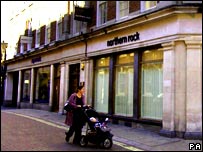 If they thought the Rock – or Northern Crock as it’s been dubbed in the markets – was an intrinisically bad bank, they would not have agreed to rescue it by providing emergency funding.
Such the was unambiguous implication of the Bank Governor’s statement to the Treasury Select Committee on Wednesday on the circumstances in which the Bank is prepared to act as lender of last resort to a troubled institution.
But that’s the end of the good news.
What Mervyn King also said is that the Bank will only provide funds to a troubled institution in this way if the risk of a collapse could lead to “serious economic damage”.
Certainly Northern Rock – with £24bn of retail depositors’ funds and £113bn of loans and other assets on its books – is big enough to wreak a fair amount of havoc, were it to fall over.
Anyway, none of us – not even Northern Rock’s depositors – probably need to panic that the Bank has had to step in.
But does that mean that Northern’s customers and shareholders have no reason to feel aggrieved at Northern’s management?
Is it anyone’s fault that Northern fears it cannot raise sufficient funds from its traditional commercial sources right now?
Well, Northern is the victim of exceptional market conditions.
Few could have predicted that problems thousands of miles away in the US housing market – notably the losses on loans to American homebuyers with dodgy credit histories – would have made investors and financial institutions wary about financing Northern Rock’s very different and very British homeloans business.
But actually that doesn’t let Northern’s management off the hook.
Banks have to expect the unexpected in the way they manage their balance sheets.
To use the ghastly City jargon, they are supposed to “stress test” their businesses all the time to ensure they can survive the market’s equivalent of a nuclear strike.
Northern’s stress tests were not stressful enough.
But perhaps the biggest criticism to be made of this bank is it massively increased its mortgage lending at the beginning of this year, when most economists were forecasting a slowdown in the housing market and when interest rates were already rising in a way that squeezed its profit margins.
In the first six months of 2007, its net lending rose 47 per cent to just under £11bn. And at June 30, it had a further £6.2bn pipeline of loans that had been agreed with customers but not yet delivered.
So it is unsurprising that other financial institutions might feel that these mortgages were provided too late in the housing-market cycle to be quite as rock solid as loans made a few years ago.
What’s perhaps even more embarrassing for Northern is that in its interim statement made earlier this summer, it was explicit that it continued to lend even as the interest rate environment turned against it.
So Northern Rock may not be going bust.
But its reputation has been badly damaged.
Which normally means that there will be a clear out of top management and also that the business may well be sold.
The BBC is not responsible for the content of external internet sites
I'm Robert Peston, the BBC's business editor. This blog is my regular take on the business stories and issues that matter.
Click here for all the business news
The New Capitalism: Download a PDF [37Kb] with my thoughts on how the global crisis occurred and what the re-made economy will look like


Archives
« September 2007 »
| Sun | Mon | Tue | Wed | Thu | Fri | Sat |
|---|---|---|---|---|---|---|
| 1 | ||||||
| 2 | 3 | 4 | 5 | 6 | 7 | 8 |
| 9 | 10 | 11 | 12 | 13 | 14 | 15 |
| 16 | 17 | 18 | 19 | 20 | 21 | 22 |
| 23 | 24 | 25 | 26 | 27 | 28 | 29 |
| 30 |
Being Discussed Now
- Will Thiam survive at Pru?(50)
- BP's financial pain is America's pain(407)
- Government cuts private pensions(137)
- Peston Picks is moving(46)
- HSBC banks on UK(61)
- What price a Greek haircut?(91)
- The big PPI lesson for banks(85)
- RBS opposes internal firewalls(97)
- Lloyds to settle PPI claims(136)
- Lloyds: back in the red?(27)
Websites linking here
- "Robert Peston at the BBC [gets blogging's] deepest utility: an essential intellectual tool as well as a means for distributing stories"
Website: Slugger O'Toole - "Peston, Murdoch and Marr sounds like a firm of dodgy solicitors, but they are, of course, the names of important prognosticators of our media future"
Website: Nick Baines - "Politicians really should be stepping up to make these arguments, but in their absence BBC reporter Robert Peston does a pretty good job of summing up"
Website: SqueezeBox - "I outline how blogging went from being an activity by a handful of journalists to being adopted by some of the BBC's biggest names, such as Business Editor Robert Peston, despite at times vehement opposition from within the corporation"
Website: Reportr
Robert's TV/Radio reports
- Rock criticised over risk taking
Broadcast: 20 March 2009 - Row over Sir Fred pension advance
Broadcast: 17 March 2009 - Testing times for China's economy
Broadcast: 12 March 2009 - Chinalco president on Rio Tinto deal
Broadcast: 06 March 2009 - China's factories 'in trouble'
Broadcast: 06 March 2009

Latest from BBC News blogs
Nick Robinson: |  |
Douglas Fraser: |  |
Brian Taylor: |  |
 |
Richard Black: |  |
Jonathan Amos: |  |
- News Editors
- Sport Editors
- Journalism Labs
- BBC Internet Blog
- Radio 4 Blog
- Peston's Picks
- Nick Robinson's Newslog
- Stephanomics
- Mark Easton's UK
- Mark Mardell's America
- Nick Bryant's Australia
- Andrew Harding on Africa
- Gavin Hewitt's Europe
- Soutik Biswas' India
- dot.Rory
- Science: Jonathan Amos
- Richard Black on environment
- Today: Tom Feilden
- Fergus Walsh's medical files
- Newsnight: Paul Mason
- Newsnight: Mark Urban
- Torin Douglas
- Will Gompertz's arts
- Phil Coomes on photojournalism
- Magazine Monitor
- Mark D'Arcy in Westminster
- NI: Mark Devenport
- Scotland: Brian Taylor
- Scotland: Douglas Fraser
- Wales: Betsan Powys
- Martin Rosenbaum on FOI
- 5 Live Breakfast
- Newsnight
- PM programme (iPM)
- World Tonight: Robin Lustig
