

Picking out pirates
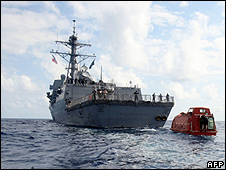 The confrontation between some of the world's biggest navies and the Somali pirates reminds me of one of those "Walking with Dinosaurs"-type reconstructions of web-footed little mammals darting and diving between the ponderous bulk of leviathans. Still, it doesn't make sense to me.
What the pirates must be bemoaning is the lack of any bureaucratic structure to guide their activities. And some initials. After all, they face the might of the US, Nato and of course our own EU. These are only the first initials. The EU force is called EU NAVFOR, Nato's operation is called Standing Nato Maritime Group 2 (SNMG2) and America's is CTF 151, which is also a multi-national force which, as far as I can discover, means there are some Canadian ships involved.
Ever since the EU developed its own military operations there have been worries about duplication with Nato. The US no longer seems to share these concerns and most military types are sanguine, so most of the objections come from those who are opposed to the EU. Fair enough, but how does having three task forces with their own chain of command contribute to such an operation? But that is not what puzzles me.
Most explanations of the difficulties faced by the world's navies focus on finding what the US defence secretary has called "untrained teenagers with heavy weapons" in such a huge area. But in the admittedly smaller border region of Pakistan there seems no problem at all picking out individual suspects and sending a missile their way. Presumably a combination of space satellites and spotter drones are used. Any idea why this is not possible off the African coast?
 I’m Mark Mardell, the BBC's North America editor. These are my reflections on American politics, some thoughts on being a Brit living in the USA, and who knows what else? My


Comments
Sign in or register to comment.