

A battle with Eurobabble
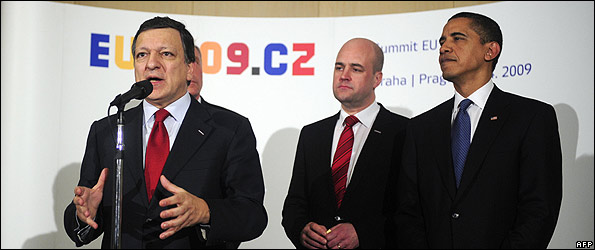 Meeting the Europeans has left President Obama with rambling on his mind. The new administration's first contact with the European Union has left some a little bit bemused, thinking that there must be a better way of doing business. While President Obama wants to listen, you can have too much of a good thing.
Someone who only wants to be identified as a senior American official was talking about the EU-US summit in the Czech Republic which, had it happened centuries ago, would have been called something like "the Discursion of Prague".
The summit was neatly divided into three subject areas. The economy. Climate change. Foreign policy.
At the beginning of each short session the US president gave a short address. Then the EU responded. Five, or sometimes six, European presidents or prime ministers spoke for two-and-a-half minutes each.
The official told me drily that there were "problems with the format". It was "repetitive, with a great deal of repetition and generalities". He observed that the European leaders did not seem to have taken the opportunity to coordinate their remarks in advance, so that they did not make the most of their chance to speak, as a group, to the president of the United States for 15 minutes on each subject.
This is perhaps reassuring to those who fear a United States of Europe. On one side of the table a politician representing half a continent, speaking for Americans in all 50 states, at least in theory. On the other side, 27 people playing an extended version of "just a minute", where hesitation, deviation and repetition are almost obligatory.
The official said he felt the Kissinger "one phone number for Europe" was a cliche, and the US did know who to talk to on key subjects. It was talking back that was the problem, and he then made what I felt was a slightly different point: "Formality at all levels inhibits the flow of ideas and people (in Prague) were constrained to their formal positions".
Being open must be much easier in the leader-to-leader talks - bilaterals in the jargon - which also took place: with Brown in London, Merkel and Sarkozy in Strasbourg, the president of Poland and prime minister of Spain in Prague. So why bother with the EU format at all, I asked?
"The fact is, a lot of authority and competence is ceded to the EU and they have a lot of technical expertise. But we've got to ask how best can we communicate with each other."
To put the other side of the argument, I asked if he was in favour of the solution of the Lisbon Treaty, which appoints a new President of the Council, who might speak for all countries. He wasn't convinced, pointing to the compromises the person would have to make to get the job, and would have to honour every time they opened their mouth. Lowest common denominator again.
The official had in a way put his finger on a central problem of the EU. Naturally enough everyone wants their national voice to be heard and what emerges from the cacophony can be uninspiring and bland. That leads EU enthusiasts to demand a single voice in place of the chaotic choir, ignoring the political reality - that even the current attempt at harmony is way beyond the desire and ambition of a good many in the audience.
Perhaps he felt he had been too critical, and went on to stress the benefits of the president or prime minister of a small state having, as a right, the ability to address the president of the United States directly. But the frustration remains: "We've got to find a better way of communicating".
 I’m Mark Mardell, the BBC's North America editor. These are my reflections on American politics, some thoughts on being a Brit living in the USA, and who knows what else? My


Comments
Sign in or register to comment.