

Big neighbour
- 22 Oct 07, 01:39 AM
This is the first of three pieces I'm writing in the run-up to this week's EU-Russia summit, as I explain here.
When east meets west you get one of the longest traffic jams in the world.
On and off for about 30 miles, lorries line the road, queuing to take their goods from Europe to Russia, occasional knots of drivers standing by their trucks, chatting.
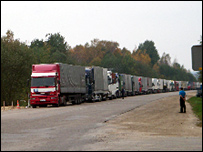 Through the windows of the high cabs, you can catch a glimpse of less animated types snoozing, or watching TV.
The area near the border between Russia and Latvia is a pretty enough place. The leaves of the silver birch are turning from green to gold, and in forest clearings there are small farmsteads, usually just a couple of rather ramshackle wooden buildings
But now portable loos and huge rubbish skips are plonked in front of the farms and the local council has declared a state of emergency. An estimated 1,500 lorries queue along this part of the border on an average day.
It’s 16 years since Latvia became an independent country, rather than a republic within the Soviet Union, but the line of the border with Russia has only just been agreed. Along a six-mile stretch it will have to be moved back about 100 feet, giving more territory to Russia. Latvian politicians say the real reason for the disagreement was that the Russians were trying to put obstacles in the way of Latvia joining the European Union.
Slow going
It has been part of the club for two years now, and while trade with the giant neighbour has increased, so have the tensions. Not that the lorry drivers think there is anything political in their little break from driving. Nikolai, an ethnic Russian Latvian, says he’s been here three days. How does he manage?
“We can cook. There’s gas cooker in our cabin and we’ve got spoons and everything, our whole lives are in our ‘cabs’. Our wives still love us so we’ve got good borshch, with meat.”
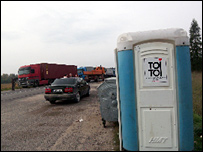 Not everyone is as stoical. Jevenijs Slisans, the executive director of Ludza District Council, says people here have had enough.
“They’re fed up with it. They’re littering all over the road, with all kinds of waste. Local people understandably aren’t happy. We’ve organised a collection but it’s really difficult to be collecting, collecting, collecting. It takes up a lot of money which we don’t always have. It seems on the Latvian side we could increase capacity, we could process more, but the Russian Federation has introduced more thorough checks at the moment, and it’s really slow going through their control points. It’s not clear why the question of organising more border crossing points hasn’t been resolved.”
The lucky driver right at the front of the queues has had time to make himself cosy. In a thick jumper, track-suit bottoms and woolly socks with open-toed sandals, surrounded by cigarette smoke, he’s turned his cab into a nest. He’s been here for five days and says that despite his TV, CB radio and videos, this is the bad part of the journey. When he gets through the nine checks on the borders he’s got another 6,000km to drive. But he’ll be over the worst bit. This wait.
He too doesn’t think the Russian’s are making a point. They just love paperwork. The more paper the better. The European Union is frequently accused of pointless bureaucracy, but for these men it’s a breeze getting through European borders. Russia is more like a breeze block.
History’s captives
It may not help the truckers much, but Latvia’s foreign minister until a few days ago, Artis Pabriks, is pleased the border line is about to be settled.
“It has a historic importance, because for a long time Russia didn’t want to sign the border treaty, because there was hope within some political circles in Russia that not signing the border treaty would hinder our entrance to the EU and Nato. After we succeeded in 2004 in becoming members in these two organisations, we also received an invitation from Putin to sign the border treaty, and now we are at the last stage to complete this task.
“My philosophy, and the philosophy of this government, is that we have to remember history, and we have to learn from history, but we should not become hostages to history.”
It’s hard in this region not to be held captive by history. Latvia won independence from Russia in 1920. After Hitler and Stalin carved up the region, it was invaded by the Soviet Union in 1940. More than 34,000 people were executed or deported. The Germans marched in a year later. The Soviets took it back in 1945.
It is why Russians who arrived after the war are seen as invaders and are required to take a citizenship test. It is one reason why Russia feels that it has vital interests in the region. But one man who was a communist in the dying days of the Soviet Union, indeed represented the party in Latvia’s last Supreme Soviet doesn’t look back towards his old homeland. Yevgeni Drobot told me, “We wouldn’t want to have to rely on the help of Moscow, we think we need to build our life in this state, and not depend on whether Moscow thumps its fist or not. We need to have rights and opportunities here in order to lead a good life here.”
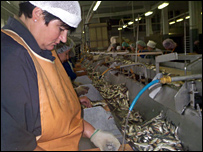 It’s clear that some Latvian still feel they are treated like small fry by their neighbour. Brivais Vilnis is a very fishy place. The smell of sprats and smoke is strong. The little fish are gutted and beheaded by an assembly line of women standing in rows.
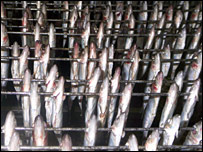
They are then transferred to the other side of the factory where they are regularly and expertly strung along long needles. These are then placed on a rack which trundles through a large metal construction. This smoker gives them their unique flavour. After a long drive, and four hours past lunchtime, sitting down in the boardroom to sample of some of their finest smoked sprats, I can see why they are considered such a delicacy and essential party food in Russia. Especially with rye bread.
'Unreliable' partner
But these sprats are banned by Moscow on health grounds. There’s little doubt that smoked food can contain cancer-causing chemicals but there are big question marks about the ways of testing and the levels. These sprats have passed EU regulations, which are often attacked for being too stringent, but failed Moscow’s tests.
The executive director of Brivais Vilnis, Maris Trankalis, has no doubt this is a ploy to allow Russian companies to develop the same skills.
“I think they try to protect their market and therefore they stopped our exports to Russia. And it’s not fair,” he says.
What about Russia generally? He smiles and hesitates, as people in the Baltics do when you ask them that question.
“It’s a big neighbour, and we cannot know what the big neighbour will do tomorrow. But it is not a very reliable business partner.”
He tells me later that he is trying to make up for the lost market by expanding into Western Europe and building up trade with other Baltic countries. He says it’s just not worth doing business with the Russians - it is just too uncertain. It’s such a huge market that few companies will take this line as a matter of policy, but it’s not uncommon to hear people say that Russia is just not worth the hassle and potential loss of trade that can follow a political whim.
The foreign minister, Artis Pabriks, wants the European Union to heed the experience of the Baltic states and particular to stand with them when they have such problems, rather than go chasing after individual advantage with Russian business or government.
 He told me: “In my view, Russians are led only by one interest, by national interest. While in the EU we frequently have the philosophy of a value-based policy and that sometimes makes it difficult to take a decision, especially because we don’t have a united foreign policy.
“So, looking from the Latvian point of view it is very important that the EU tries to stick to one foreign policy. We joined the EU in order to see this organisation as a strong one, not a weaker one. And if we are not united it’s just like Benjamin Franklin said, either we hang together or we hang separately.”
Tomorrow, I will write about Poland’s involvement in US plans for missile defence.
Russia and the EU
- 22 Oct 07, 12:15 AM
Tensions between Russia and Europe have been on the rise this year. Riots over a war memorial in Estonia. Trade disputes between Russia and Poland. Russian bombers back in the air. And these problems are reflected in increasingly fractious summits between the EU and Russia. It may just be a coincidence that these tensions have got worse since the former communist countries which border Russia joined the European Union.
Is it something to do with their experience of their giant neighbour or the reaction of some Russians to what they may see as defection to the other side?
And it is not over yet. While the Soviet Union once extended its power deep into Central Europe, now the EU is toying with allowing membership to countries that have long been considered within Russia’s sphere of influence.
I decided it would be a good idea to have a look at countries along this age-old fault-line.
After all, Russia has been critical to Europe’s history, and not necessarily a force for ill. What would Europe be like if Russia had not crushed Napoleon and Hitler?
It was hard to decide where to go, and I could quite happily have spent the rest of the year travelling this long border. It seems a miss not to go to the Ukraine. Georgia is fascinating. I had a visa ready for Kaliningrad, that little Russian island, landlocked within the European Union. But time and money are limited so this is a limited snapshot. I went to Latvia, Poland and Lithuania. The Russians, in the form of the ambassador to the EU, get their say in the third article.
The BBC is not responsible for the content of external internet sites
Description
Archive
« October 2007 »
| Sun | Mon | Tue | Wed | Thu | Fri | Sat |
|---|---|---|---|---|---|---|
| 1 | 2 | 3 | 4 | 5 | 6 | |
| 7 | 8 | 9 | 10 | 11 | 12 | 13 |
| 14 | 15 | 16 | 17 | 18 | 19 | 20 |
| 21 | 22 | 23 | 24 | 25 | 26 | 27 |
| 28 | 29 | 30 | 31 |
Being Discussed Now

Latest from BBC News blogs
Nick Robinson: |  |
Douglas Fraser: |  |
Brian Taylor: |  |
 |
Richard Black: |  |
Jonathan Amos: |  |
- News Editors
- Sport Editors
- Journalism Labs
- BBC Internet Blog
- Radio 4 Blog
- Peston's Picks
- Nick Robinson's Newslog
- Stephanomics
- Mark Easton's UK
- Mark Mardell's America
- Nick Bryant's Australia
- Andrew Harding on Africa
- Gavin Hewitt's Europe
- Soutik Biswas' India
- dot.Rory
- Science: Jonathan Amos
- Richard Black on environment
- Today: Tom Feilden
- Fergus Walsh's medical files
- Newsnight: Paul Mason
- Newsnight: Mark Urban
- Torin Douglas
- Will Gompertz's arts
- Phil Coomes on photojournalism
- Magazine Monitor
- Mark D'Arcy in Westminster
- NI: Mark Devenport
- Scotland: Brian Taylor
- Scotland: Douglas Fraser
- Wales: Betsan Powys
- Martin Rosenbaum on FOI
- 5 Live Breakfast
- Newsnight
- PM programme (iPM)
- World Tonight: Robin Lustig
