Olympic viewing
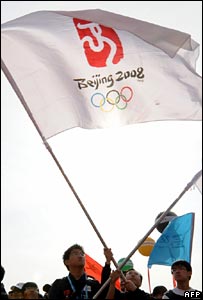
Why did the BBC decide to drop BBC Parliament from Freeview for three weeks in August, in favour of Olympics coverage? The Guardian's website reckons it's designed to bump up ratings to BBC Parliament on the back of all the Games viewers. Not so. It would be madness for us to claim soaring ratings one summer only to see them vanish again, the next.
 Ratings to BBC Parliament have come along very nicely without any such tricks. The channel has been averaging a monthly reach of 1.3 million so far this year. It was only last year that we reached an average of one million for the first time.
By taking BBC Parliament off air on Freeview for three weeks the BBC will be able deliver a sports service on Freeview that is much closer to the service being offered on the other platforms. It makes complete sense from the viewer's point of view to bring the service on Freeview, where bandwidth is most scarce, up to strength and to have as many interactive streams, showing as many different sports, as possible.
Freeview viewers will get BBC Parliament back in time for the Democratic National Convention in Denver, starting 25 August, when we'll be showing C-SPAN's gavel to gavel coverage of the conventions through the night, with daytime repeats. The conventions roll on into the TUC and the party conference season.
 BBC Parliament has a tiered approach to the schedules when Westminster is in recess. Some recess weeks allow us to show live the Scottish Parliament and the Welsh and Northern Ireland Assemblies. At Easter, we had all three.
In Whit Week we will have two specials: Permissive Night on 26 May with Joan Bakewell marking the big social and legal changes sweeping through Britain 40 years ago, and on 30 May a broadcast of the 1983 general election night programme coming up to its 25th anniversary. Look out for changes in accents and manners, even over that time span.
In the long recesses we show a loop of highlights from the term just gone, mixed in with documentaries and landmark speeches. It is not realistic to expect big audiences to BBC Parliament in August and it would be a bit odd to pour resources into this part of the schedule. If Parliament were recalled in the event of a national crisis, of course the channel would be back on air on Freeview, straight away. The loop will continue to run on all other platforms (Sky, Freesat, cable, Tiscali, online) throughout the summer.
Strange to tell, the idea for the sharing of the bandwidth for the Olympics actually came from BBC Parliament, when we started thinking about the prospects for the London Olympics. The BBC is trying to get away from thinking in terms of departments (what used to be described as output 'baronies') and to start working as one organisation. The idea is simply to do the best we can by the licence payer.
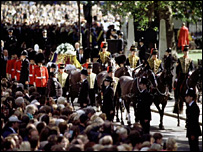 We did think long and hard about whether such a deeply personal event as a young mother’s funeral could be treated as part of our shared television history, and broadcast again in this way. Given the other public events on this tenth anniversary, including the commemorative concert for Diana and the Service of Thanksgiving in the Guard’s Chapel (BBC One, 1100, Friday 31 August) we took the view that the re-broadcast could be part of that sequence of programming.
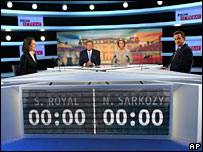 From abroad, we broadcast the whole of the election debate between Sarkozy and Royal (Friday evening with translation – all two hours 40 minutes of it). From the election night itself, the channel took coverage from TF1 and France 2, in French, for those who wanted to experience the event direct and as an alternative to the high-powered special presented by Jon Sopel on BBC News 24, (who, rather conventionally, stuck to broadcasting in English). Earlier in the day, we heard from C-SPAN, with Angela Merkel on the transatlantic partnership.
 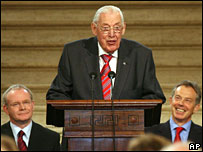 This morning, that extraordinary opening session of the Northern Ireland Assembly. Back to the Commons, this afternoon, and normal business.
 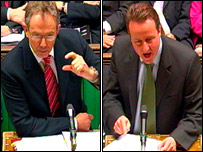 But an experiment that started in the Lords has changed all that. This week the Speaker of the Commons, Michael Martin, has agreed to change the rules to allow the cameras to follow the normal flow of the action, and to show reactions from around the chamber. It’s not the same thing as being there yourself, but for the first time the outside world is getting a real sense of the place – of the intimacy of the Westminster chambers and the closeness of the protagonists, standing feet away from each other across the debating chamber.
 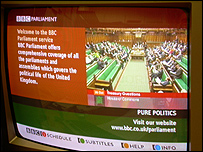 Thanks to some brilliant work by the BBC's distribution department, the bandwidth issues finally got sorted and the channel on Freeview will look just like a proper one, as it already has done for years on cable and satellite. Sitting next to BBC News 24 on the EPG at channel 81, it makes that transition from the first part of a major statement or debate - which both channels are likely to carry - to the handover to BBC Parliament, both natural and easy.