
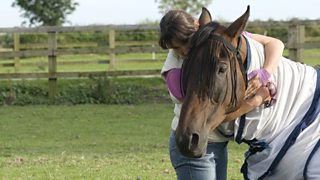
A horse which Shula has in livery has developed a disease with an unusual name: strangles. Vet and equine specialist Anne Gibbs explains the implications of this serious condition.
Strangles is a highly contagious disease. It gains its name from the fact that affected horses can develop enlarged lymph nodes around the throat, which restrict passage of food and in severe cases restrict breathing.
Horses were emotively described as being ‘strangled’ by the disease in early veterinary books and the term has been adopted worldwide.
Easily spread
The disease is caused by a bacterium, Strep equi, and can be easily spread. Nose to nose contact between horses is an obvious source, but people, tack and equipment also have the ability to transmit infection. Water troughs can harbour infection for up to a month if contaminated with nasal discharge. Paddocks too, should be considered ‘dirty’ for a month after being used by affected animals. This is because both faeces and discharges can harbour bacteria.
Aerosol spread will transmit infection where horses share the same confined air space, for example in an enclosed waiting arena or on a lorry. Riding past infected premises should not pose a risk, as long as horses are at least 25 metres away.
The incubation period following exposure is approximately 14 days, although this can be up to three weeks in some individuals. Once infected, horses can remain infectious to others for up to six weeks in most cases. This period can be extended by months if the animal is not screened clear of disease and becomes a carrier.
Clinical signs include high temperature, dullness, sore throat and neck, enlarged lymph nodes around the jaw and throat and profuse nasal discharge. Some abscesses may rupture. Not all these symptoms will appear at once or in every case.
Action
The suspect case should be isolated. Pain relief is always necessary. Antibiotic use will depend on each individual case.
If the disease is confirmed, the following actions should be taken:
- Isolate the affected horse/s and set up strict bio security.
- Stop movements on or off yard and be honest – tell neighbours.
- Separate horses into three groups under veterinary supervision – infected group, suspicious group and unaffected group.
- Allocate individual people to one of the three groups only, so there is no risk of a person spreading the bacteria. Affected animals must remain within that group until proven to be clear of infection. If affected animals are not screened, they run the risk of becoming carriers and being responsible for future outbreaks.
Prevention
- Monitor horses closely and take daily temperatures. Above 39C warrants discussion.
- If attending events of any sort in the future, avoid nose to nose contact with any other horses.
- Always take own equipment when staying away from home at an event – never share buckets!
- New horses coming to a yard should be isolated for three weeks – preferably in a paddock and 25 metres from others.
- A blood sample taken on arrival and again at the end of the isolation period will determine whether or not there has been exposure to infection.
Vaccination
[Added 30 June] Vaccination against
Strangles is available and may be useful in the control of an outbreak within a
local area.
Anne Gibbs is a partner in MacArthur, Barstow & Gibbs, a
veterinary practice in Worcestershire.
More about strangles from the British Horse Society and Wikipedia
Learn more about Shula, and the actor who plays her, in our Who’s Who
