
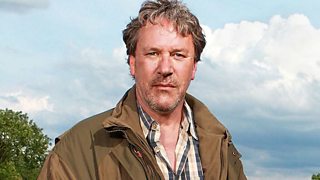
David Archer (Timothy Bentinck)
There hasn’t been a suitable moment for David Archer to tell the Ambridge locals that he and Ruth aren’t deserting them after all. Well, until now...
We caught up with actor Tim Bentinck, who plays David. Tim shared a few thoughts about the storylines that have gripped and divided the nation over the past year.
How much did you know in advance about the ‘Archers leaving Brookfield’ storyline?
Unlike normally with the Archers where you don’t know at all what’s coming up, Sean O'Connor had alerted me to this big story, which would see David and Ruth potentially moving North.
Sean told me confidentially that the Archers would be staying put. So I had to keep this knowledge secret for months. Unusually I knew where the story was going and was of course hugely relieved!
What does this particular storyline mean to you?
For me, after 33 years in the programme this is certainly the most important storyline I’ve been involved in, and the most heart-warming.
I think the listener was thinking it was a wonderful tease. As Sean has said, the reason to stay in Ambridge and not accept Justin Elliot’s silver had to be character driven and not a reaction to events, out of David and Ruth’s control. That would have left David and Ruth morally bankrupt.
David’s decision was hugely influenced by seeing his Grandfather’s old farm journals. He became acutely aware of the difficulties that he and his predecessors have been through - seeing what his father had fought for, and then hearing Phil’s voice say “I trust you” – he had to stay.
The Brookfield story has a certain resonance for me. Two years ago we nearly sold our house in London. It’s not one great thing that happens that makes you make the big decisions like that - it’s a culmination of a series of smaller events. In David’s case, the epiphany was hearing his father’s voice in his head. And with me it was literally sitting bolt upright in bed and saying to my wife Judy that we’re not going. For us, it wasn’t a bolt out of the blue like it was for Ruth. Judy knew it - one of us was going to say it - and it turned out to be me. So I could empathise very much with it.
What did you make of the flood story?
The writing was so clever. A friend wrote to say he’d picked up on these subtle things like water levels not being right and cars getting trapped in ditches that they otherwise wouldn’t have done. The way that this detail was drip-fed in, and the flood coming just after David’s epiphany, I thought was very well done. It was four months in the telling. When it came, people said they knew David and Ruth weren’t going to leave. The question was why? And I think the answer’s fairly clear.
I listened to the flood week Omnibus on the Sunday night with a roaring fire and a glass of wine. We’ve never really sat and listened to an omnibus like that – I tend to catch episodes in the car or on catch up.
It played out as a radio play, with a beginning middle and end. It was an entire story in itself. I can see that it might have been difficult to listen to episodes in isolation, but I think it was worth it to be able to listen to the omnibus.
In its totality, it was a fantastic storyline. It was technically brilliant. They spent two hours in post-production just on the scene with Eddie being lowered down the drain. The perspective of the scene is so clear. At its best, radio drama is about three-dimensionality.
What are your memories of recording ‘flood week’?
Trevor (Harrison, who plays Eddie) had a bad back and was sitting on a chair. He had to bend double and put his head next to two breeze blocks to give him the reverb he needed. Being a wonderful actor he used the pain of his bad back to make all those pained noises. (No acting going on there at all!)
Generally, we used this large garden trug and got very wet. It’s fairly unusual to be in wellies, jacket and hat and being sprayed with water. You can’t play these scenes without getting your face wet, though. Every detail was attended to.
I’ve got these pictures of me and ‘Eddie’ standing in our respective buckets in our wellington boots. It was a wonderful week, an adventure for everybody. We all had the most wonderful fun because it was very, very different.
From the writers to studio managers, actors, producers - everybody - this was a great team effort to produce fantastic radio drama. I’m very proud to have been a part of that.
What’s the significance of David’s heartfelt speech at the flood meeting?
I was just getting in the car the other day and turned the ignition on. Out of the speaker came the sound “Oh David, I want to kiss you!” Judy said to me “what’s going on? You and Lynda?”
David tells people his reasons for staying. He talks about his responsibility not only to his family but also to his neighbours. He knows that as a community we’re not owners but custodians of the land. This isn’t my farm I’m just looking after it for the next generation. If Justin Elliot turns it into something else then all of you around me will be affected. I don’t want to do that to you, I feel responsibility to you the village. People might have a go at David. He is a practical man. Underneath he’s got a strong opinion, a strong heart and a lot of love.
Why didn’t David consult Ruth over his decision to stay? Did he make a mistake?
Clearly at that time, he was very distracted. If it had been Ruth in the room when he came rushing in saying “is the jumble sale still going?!”, it would have been Ruth that went with him instead of his mother. Jill knows exactly what she’s doing. Jill’s the power broker behind the whole thing.
I think David was approaching a slight nervous breakdown. Thinking about his dad - that was a real crisis point - and he was absolutely knackered from lambing, so he wasn’t thinking straight. It was only when David realised that he hadn’t told Ruth and that he’d gone so far in his decision making that any discussion wouldn’t make the slightest difference.
Here, you divide the nation. Some will say David was right to make that decision. Some think Ruth’s not a real Archer and doesn’t get it as she wasn’t born in to it. Some might ask ”well what about Sam?” (a reference to Ruth’s affair) When David says “I’m sorry I let you down, Ruth”, I wrote the word ‘Sam!’ in my script, because she let David down there and he hasn’t forgotten that. Perhaps things have balanced out. Despite her regrets, I think Ruth gets it. Pip has regrets about not going north too and articulates this.
What did the return of Phil (Norman Painting) mean to you?
I was in tears when I read the script. I wondered how we were going to make it sound right. We’ve never done it before, and there was a danger that it was going to be like David seeing a ghost. But the result was very moving.
I listened to the track with Norman’s voice and recorded my lines. I knew it was going to be emotional. I thought about my own late father, who I worked on a farm with a lot when I was a child and then later in my twenties. This got the tears going. Because I do a lot of voice dubbing, I suggested that I try a take lip-synching to Norman. In the end result, you can hear this hardly articulated sound which matched Phil’s voice and it worked really well.
How do you stay so engaged with farming issues?
I was brought up in Hertfordshire and worked on farms as a child. My father gave up being an advertising producer in the 1970s and started a 10-acre organic smallholding in Devon. I helped him for a year to turn it into a farm. The economics of running a farm, however, is completely alien to me. If I don’t quite understand something in my script, I’ll look it up online. Like letting the cows out. It’s very important to have in your mind the image of what’s happening. Last year, Flick (Felicity Finch) and I went with a BBC reporter to see a sheep farmer whose fields had been flooded. So we knew first-hand what those fields look like. When you’re there in a studio and you’re imagining in your head the reality, if you can’t see it then the audience can’t see it. If you’re just pretending, it doesn’t work.
Why do so many people love The Archers?
The Archers was created after the Second World War to get the country back on its feet, and to help farmers into better ways in agriculture. It’s about community, not necessarily Englishness but community. The whole point about the village is it’s full of archetypes. The community that is Ambridge can happen anywhere in the world. It’s a gathering of people who are all different and all give something different to that community. In this particular instance it’s an English village. It represents what was fought for in the war - a certain quintessential Englishness. I think that over the years this hadn’t got lost but needed to be restated.
It’s about longevity, the land, family and community. It’s about trust, neighbourliness and about not letting people down. All those wonderful reasons that come under the umbrella term ‘community’ . That’s why, through the flood and the ongoing saga, I’m so to be a very small part of what I thought was a stonkingly good bit of radio drama.
What do you think the future has in store for the Brookfield Archers?
I don’t know what’s going to happen now, but presumably the story is going to be really interesting - which is true for farmers at the moment.
I’m very much involved in the idea that the programme, as it should do, represents the lives of real farmers. The Archers is concerned to get that right. How can British dairy farmers survive? That is a huge question, that will go on for a long time.
The storylines will be about our children, our relationships and about the sustainability of farming in Britain today. It’s fascinating.
Andrew Smith is an Archers Assistant Producer.
Learn more about the Brookfield Archers in our Who’s Who
