

Michiru School - my full report
 |09:49 UK time, Friday, 23 July 2010
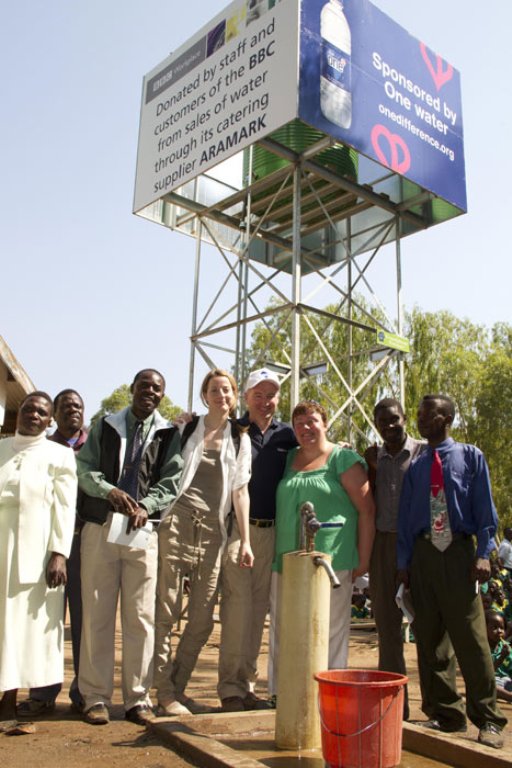
Thanks to thousands of sales of One Water in BBC catering outlets I had the opportunity to see for myself the end result last week. I am still amazed that the simple idea of using some proceeds from selling bottled water can deliver such enormous benefits.
This was reinforced by the trip and helped me build on the insights gained from last year's visit to Lesotho. Our 17 person party descended on Michiru Lea school last Monday morning. I was joined by Kate Smith and Hilary Friel plus representatives from Salford University and Aramark. The School is located in the south of Malawi not far from Ballantyne. We left the tarmac road just outside the town for the three mile off-road journey - I was struck by the size of the craters and boulders as we bumped our way up to the school.
There the staff and children greeted us enthusiastically, the smiles of these African faces are disarming and the excitement among the hundreds of children was clear.
I met Dyton Malazini, the Headmaster, who took me on a tour of the school buildings. In many ways they reminded me of derelict factory buildings in the UK, abandoned as a consequence of recession. The school comprised nine classrooms, six latrines and four teachers' school houses, one of which was completely inhabitable. In fact, to me all of them should be condemned.
The Headmaster showed me his nursery garden which was started a few months ago as a result of having the new pump. He hopes that the radishes, lettuces and other vegetables can be the start of a proper school garden. Then he can sell the produce to help buy desperately needed school books and equipment. I was amazed that the annual government grant for this school is equivalent to £25.
Walking around the school I was struck by the pride taken in bringing learning to the children. Although 1,500 pupils are registered, absenteeism is rife and only 600 to 700 were present for our visit. This is due to a variety of factors - many parents don't see the need for education, girls on reaching puberty have to stay away one week in the month, also as they get older girls are required to help with family chores such as fetching water. In many parents' eyes, it's more important to heard goats than go to school.
A key part of the visit was when the school assembled for a song and speeches. Along with the local chief, the Headmaster, his staff, and a fair proportion of his 1,500 'learners' came together in the schoolyard to thank us for the 'wonderful gift' of a clean water supply. Speaking in faultless English, we heard how the playpump is making such a big difference. Installed a few months ago, big strides are already being made in terms of teaching the children about personal hygiene. Given the huge amount of diseases rampaging across the country, the simple act of washing hands can be very beneficial. Measles, for example, is part of growing up here in the UK - in Malawi, it can prove fatal. HIV is the major problem and it was heartbreaking to realise that up to half of the young faces I saw in the schoolyard that morning may not see their 40th birthday. The best way of summing up the visit is repeating the words of the Headmaster: 'water is life'.
The facilities provided are a joke by Western standard. The school bell is actually the carcass of an old fire extinguisher. The number of classrooms is inadequate and many are just empty rooms, with any blackboards well and truly worn out. Most pupils have to sit on bare concrete floors. This image of concrete floors made shiny by many thousands of schoolchildren sitting on them will stay with me for a long time.
To round off the morning's visit, we presented the school with some footballs, Frisbees, skipping ropes and pencils. As they only had two footballs the arrival of ten brand new ones caused a mini riot of excitement.
The children challenged us to a game of football for the lads and netball for the girls. Hilary Friel, Aramark Catering Manager, decided to opt out of netball and show off her prowess at ball handling skills. She was not to be outdone however, as JCI's Kate Smith recalled her school day netball skills to great effect in the ladies game.
I was struck once again by the excitement and gratitude expressed by the simple act of bringing some gifts. These children delighted in showing off how they can use the skipping ropes, and playing with a Frisbee was a complete novelty to them! Once the initial euphoria died down the teachers carefully gathered up the balls and Frisbees. The latter will be used as plates, while the footballs will be carefully guarded for future use.
The three of us representing Aramark, Johnson Controls and the BBC, felt proud and privileged to make this visit. We saw for ourselves how the pump is truly part of school life and how much the children enjoying playing on it.
We saw the enormous deprivation and the huge hunger for learning. We saw when we returned unannounced later in the week that things were pretty much as we found them on our first visit. Even at 7.30 in the morning there were a few pupils happily playing on the playpump, while the pump pushed much needed clean water into the storage tank. We returned because we were able to provide a further helping hand by buying the school some gardening equipment - they were overjoyed.
I struggle to adequately summarise our experiences, but let me round of by once again quoting the Headmaster: 'water truly is life'.


Comment number 1.
At 16:47 5th Aug 2010, Fenny wrote:The One business model, where 100% of the profits from everyday products go to fund Playpumps and health and sanitation projects is excellent. Bottled water is a £billion industry in the UK. If only more of the proceeds could be funnelled into such schemes, life in Africa and other third world areas would be infinitely improved. We take water for granted and don't see how precious a commodity it is.
For those who don't approve of bottled water, not only is One Water sourced in the UK (or locally in other countries) and uses low impact bottles, but they also sell reusable drinks bottles and have partnered with companies to sell filter jugs to cut out the need for bottled water.
Complain about this comment (Comment number 1)
Comment number 2.
At 01:25 15th Aug 2010, NMcCracken wrote:Chris Kane's blog about his Malawi visit brought back memories. Americans on the internet aren't often on BBC Africa, but I check the site occasionally. I have been twice with church mission teams to Malawi in 1995 and 2001, totaling nearly a month, and worked among the folks in Embangweni at a hospital and Chitimba constructing the foundation for a visitor center. I made friends with the families with whom I stayed in Chitimba,continuing to the present time to supply crop seed to subsistence farmers and OTC reading glasses for people with no access to eye care.
Mr Kane may not be aware of over 2,000 wells built by Marion Medical Mission from Marion, Ill. in Malawi, Tanzania and Zambia.There are other American mission groups also involved in providing safe, clean water.
Complain about this comment (Comment number 2)