
Editor's Note: This episode of Bookclub is available to listen online or for download.
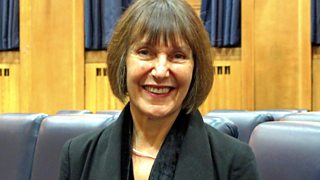
Happy New Year to all Bookclub listeners and readers. I hope those of you who heard Marina Lewycka talking about A Short History of Tractors in Ukrainian on Sunday enjoyed the discussion. A couple of things struck me about the programme. First, that it described how a writer found her voice. It’s the essential starting point, and it often takes some time. And second, that we were talking about a book dealing with a question that’s embedded in our contemporary national debate - migration. We’re going to have another chance to look at it, from a different angle, in next month’s programme, because Judith Kerr, as sprightly a nonagenarian as I’ve met for many a long day, will be talking about her childhood recollection of a Jewish family fleeing Germany - the marvellous When Hitler Stole Pink Rabbit. They have this in common - they’re both set against a background of tragedy and violence, but they’re both very funny. Not a coincidence, I think.
Marina’s story began as a memoir of her mother, and it was when she found it difficult to piece the story together in awkward conversations on a dictaphone that she decided that it might best be told as a novel, with the central character Nadezhda (Nadia) a representation of herself - born in a refugee camp in Germany to a Ukrainian family who travelled across Europe and finally settled in Yorkshire in the year after the end of the Second World War. When she found the right voice in which to tell the story it turned out to be funny (hence the title, with its reference to one of her father’s mild obsessions), but also penetrating. She discovered, for example, that in describing the difficulties of the arrival in the family of Valentina, the blowsy, forceful woman with whom her widowed father had fallen in love, she was dealing with one of the most common and fascinating relationships for novelists - that between older men and younger women. She was also talking, of course, about her own sister and their mother, and she acknowledged that it had sometimes been difficult. Although, like so many authors, she admitted that she finally lost her grip on them - ‘they told me what to do.’
In dealing with Nikolai, her father, she had some experience. ‘I worked for Age Concern and wrote books for carers and I spent a lot of time in people’s homes, and elderly people’s sons and daughters would be tearing their hair out saying “Mum – it’s so inappropriate, she comes down stairs in her nightie, and flirts with the milkman, and dad’s fallen in love with his carer,” and then the elderly people would say – “I’m sick of them, I’ve looked after them all my life and I’ve not got many years left and I want a bit of freedom.” I saw all these very intense family dramas acted out.’
The skill of the story is to weave that intensity through the humour. The worse things get, the funnier people can be. We were lucky enough to have quite a few Ukrainians in our reading group this month - having lived here for varying amounts of time - and all of them recognised something in their collective experience that rang true. I think the success of Marina’s book - more than a million sales in this country alone since publication in 1994 - is a consequence of that authenticity. The voice that she found when she began to turn a family memoir into a novel.
So she’s a good beginning to another year on Bookclub, now nearly seventeen years old. I can promise you in the coming months another fine mix of fiction, full of literary treasures that I and Bookclub’s wonderful and indefatigable producer Dymphna Flynn will reveal to you as the months go by.
Happy reading!
Jim
Jim Naughtie presents Bookclub on BBC Radio 4
