
Editor's note: This week Melvyn Bragg and his guests discussed the Continental-Analytic split in Western philosophy. As always the programme is available to listen to online or to download and keep - PM.
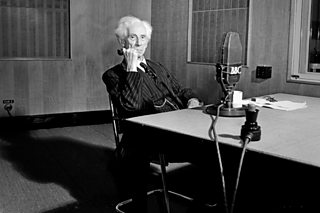
Bertrand Russell in 1953
During today's programme I had a distinct feeling that a quart was trying to get into a thimble.
This is not uncommon, but usually the thimble seems to expand as the programme goes on and, by and large, all's reasonably well that ends reasonably well.
Of course, as by now you know, after every programme the cry goes up "Why didn't we talk about X, or Y, or Z, or A, or B, or C...?" Well, it's because we have forty-two minutes and not three hours is the best answer.
But this programme did seem to be particularly crowded.
Stephen Mulhall, whose opening remarks on Analytic philosophy were stunningly good, I thought, did feel that putting Analytic against Continental philosophy was a mistake.
A better analogue would have been existentialism, say, or phenomenology. Or one or two other such subjects and not the whole Continental drift. On the other hand, that's what we set out to do, and we could and we would have changed it if pressed by those who know the subject better than we do.
It was a pleasure to meet Hans-Johann Glock - he had never been on the programme before, unlike the other two - and afterwards he launched into much more plain speaking about the divide between Analytic and Continental, having been as deeply thicketed as the others about it beforehand!
He also developed the idea of three sorts of arguments in philosophy: the mathematically tested, the legally tested and the poetic method.
Beatrice Han-Pile quoted Foucault: "You can't change a culture without changing its institutions", which I liked, but I can't quite remember what it was attached to, in the rather rushed few minutes while we have a cup of tea and are apprehensive of the arrival of the cavalry of Desert Island Discs.
A new programme possibility did come out of it, though: the notion of "ordinary language philosophy", especially Ryle, Austin and Strawson in Oxford in the middle of the last century, as it were, "supervised" by Wittgenstein. Tom Morris and I have chalked that one down and when we recover from this we will move on.
This is not special pleading, but among the e-mails I've already had (it's just after midday) is one saying that not much was understood, but what an enormous pleasure to hear such brilliant people talking in such a calm, collected way, when everything around seems to be falling to bits.
It made her proud to be in this country! And another saying it was one of the toughest he'd heard, so thank goodness he could hear it again and again.
Perhaps I'm overcompensating, but when Alice Feinstein (whose last In Our Time, in terms of being the editor of the morning series it was - farewell, Alice, you are going two doors down the corridor!) and Natalia Fernandez, who produced this programme, when we spoke we seemed to think that it had delivered what we wanted to deliver which is thoughtful conversation, often in areas that people find very difficult to follow but want to be led.
Instead of drifting down to St James's Park afterwards and looking at the ducks (I did that the last two days - they're all in good form, every single duck of them), I went up the hill to Belsize Park to get my teeth rattled. They're still there. They were jabbed and the gums were criticised, and then the whine of a descaler buzzed around like a hornet in the mouth.
On from there to the Royal Free Hospital to get a blood test, but the queue was so long I would have missed my train (literally - to Southwold for the literary festival). So, another day, another visit.
Off for some sea air now to what must be a contender for the prettiest seaside town in Britain.
Melvyn Bragg presents In Our Time
- Listen to this episode of In Our Time: The Continental-Analytic Split online and find out more about the programme including suggested further reading
- Download this episode to keep from the In Our Time podcast page
- More about the In Our Time archive of podcasts to download and keep
- Sign up to receive the newsletter by email
