
Editor's note: You can listen to this epsiode of Thinking Allowed now on the website. The Thinking Allowed team are also making a series of specials on the present and the future of our home life and are looking for your help. Details towards the end of the post - PM.
Nowadays I haven't any parents around to ask, but I think it must have been a bout of childhood illness which meant that I had to repeat my first year at junior school.
That wasn't too much of an imposition. I could readily recite the mathematical tables which at the time were such a core part of the syllabus, and had a good working knowledge of the principal rivers of Britain.
But what was really tedious was having to re-write the standard English essays. Our form teacher Mrs Machin, was a kindly soul who could boast of having created the first nature table in the whole junior school. She did, however, lack a degree of literary imagination.
Year after year she doled out the exact same list of essay topics: "Where I went on my holiday", "What I found in my pocket" and "My favourite thing".
I'd done all three topics on my first time round in the form and learned one of the first rules of literary composition: the need to fabricate. If I'd stuck to the reality of my actual holiday - another dreary two weeks in a boarding house miles from the beach in Torquay - then I'd certainly never have earned any gold stars for composition.
Neither was there any point in trying to make the actual contents of my pocket stretch to three hundred words.
It would hardly take more than a couple of sentences to document my possession of a handful of loose change, a rubber and a dirty handkerchief. So when I came to re-write my holiday essay, I gave full rein to my imagination, happily transporting myself and my parents and my little sisters to an exotic location somewhere in South America where we were attacked by bandits and only managed to escape over the border to safety with the guidance of a friendly sheepdog.
Mrs Machin seemed reasonably impressed by my literary excursion. She awarded me two gold stars and wrote "Very imaginative" in the margin of my last paragraph (the one in which my family made their final dash to safety across a raging torrent).
I followed much the same course with my pocket essay. Instead of discovering a used handkerchief and a shilling and sixpence and a used bubblegum wrapper I came up with a Havana cigar, a sliver lighter and a loaded revolver. My explanation of how these came into my possession relied even more on imagination than my family holiday. It featured a plot against my family, the murder of two next door neighbours and a last minute shoot-out in Alexandra Park between myself and the moustachioed villain.
It was too much altogether for there was only one gold star. And one reproof. "Don't let your imagination get the better of you" Mrs Machin wrote on the last page. It was, no doubt, to curb any flights of fancy that she took the unusual step of telling me that my next essay on "My favourite Things" must eschew exotic trips to South America and shout-outs with villains in the local park and concentrate on more ordinary matters.
"I know", she said, "write about your handkerchief".
I didn't even attempt the task. On the day the essay was due to be submitted I persuaded my mother to write a note saying that I'd been suffering from severe stomach trouble and been unable to sit still for long enough to write my homework.
How wonderful then to open a new book called Paraphernalia and find that the author Steven Connor had devoted an entire chapter - nine whole pages - to the subject of the - handkerchief.
And, what's more, it's fascinating reading. As indeed are the chapters devoted to such other examples of paraphernalia: buttons, combs, glasses, keys, pins, rubber bands and wires.
To learn why I've already handed out three gold stars to Professor Connor, join him and me, together with Michael Bywater for this week's Thinking Allowed, now available on the Radio 4 website or on our downloadable podcast.
Also in this episode: Are most sociologists secret utopians? Discuss.
Oh, one more thing. On the programme, I'm asking how you would feel about me coming to visit you in your own home. And not just me. Oh no. Me plus two other sociologists. That's right three sociologists in your house, your living room, your kitchen - for a few hours. It's simple really - for our special summer series this year we're concentrating on the present and the future of our home life. And it seemed a good idea to make these programme in three very different types of homes.
In the first place we're looking for a single person household - a house or more likely an apartment - occupied by someone living alone and often uses home as a workplace, with all the necessary technology to make it a veritable leisure centre.
And then for contrast, we're anxious to find a multi-generational home - one which perhaps contains grandparents and parents and children or even other relatives.
And finally - what shall we call this? - A classic nuclear mum-dad-children family, an Ask the Family type of home.
If you'd like to take part do contact us with details of your own home and family.
We'll bring our own coffee and biscuits - and contrary to popular belief most sociologists are relatively well house-trained. Mark your letters and e-mails - Home - and send them to:
Thinking Allowed
BBC Radio 4
Broadcasting House
London
W1A 1AA
Or by email to thinkingallowed@bbc.co.uk
Laurie Taylor presents Thinking Allowed
- You can listen to this episode of Thinking Allowed on the Radio 4 website, download the podcast or listen on the radio - it's repeated this Sunday night, 19th June 2011.
- Sign up for Laurie's Thinking Allowed newsletter.
- You can find out more about the programme's new partnership with The Open University and related features by going to their website.
- Names used in this article may have been changed.
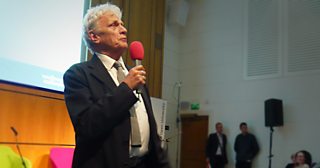
- The picture of Laurie was taken at the recording of last week's episode at the Wellcome Collection.
