
Frankly Speaking was considered 'risky' and 'unkempt' when it originally aired in the 1950s. Now, as Radio 4 Extra rebroadcasts a selection of high profile interviews from the series, Caroline Raphael sheds light on an archive jewel …
Frankly Speaking, which starts on Tuesday 17th March at 6.30pm.
The interview as a genre courses through modern broadcasting. Morning punch ups to late night hectoring, professional interviewers who are household names, interviewees trained to give the answer they want to give not the one we want to hear, evasive and slippery or prepared to share their deepest sorrows. People talking to each other on the radio hoping someone is listening.
It wasn’t ever thus. On Radio 4 Extra we are repeating Frankly Speaking, which to modern ears may sound frankly old fashioned. But, in 1952, when it was launched on the BBC Home Service it was a completely novel and ground breaking series; novel because instead of the traditional pairing of interviewee and interviewer there were three interviewers. And ground breaking because it was both unrehearsed and unscripted. It wasn’t however, a new idea. Frankly Speaking was based on a French programme, Qui etes-vous? What were then considered unusual and unconventional questions were designed to discover the private person behind the public veneer, to determine through cross-examination, what traits made them successful.
Maurice Chevalier is featured in the first episode, you can listen to a preview clip here
The first issue was this. Would the format work for a British listener? The BBC producer was Joe Weltman and he was very conscious of possible differences between French and British sensibilities. Would his guests feel comfortable with this sort of cross-examination? Would British listeners find it simply rude and discourteous? In the end Weltman took a slightly softer approach, what he described as a “looser, more discursive style which contrasts sharply with the tidy, analytical manner of the French programme…an atmosphere not quite so athletic or tense”. Despite this he still thought in terms of “judgements” and “victims”.
Guests came from far and wide to be interviewed but early reviews of the programme found it a disquieting listen, as Weltman had feared they might. Critics described it as ‘unkempt’, ‘an inquisition’, called interviewers ‘Torquemada’; they wrote of the guest as prey being cornered, quarry being pursued, and called for the end of the unscripted interview.
The Listener magazine described it as “a very risky form. Like violin-playing, unless it is very well done it stirs horribly uncomfortable feelings in the listener.”
The producer of Qui etes-vous? on hearing the English version declared that his questions would have been much more indiscreet.
Conscious of a continuing disquiet Joe Weltman wrote in the Radio Times in 1957: ‘What kind of a person have you got to be – to achieve fame and success? Is it any one kind of person?....Are we sometimes too inquisitive, too personal? Even tactless? Perhaps our ‘victims’ can answer that one. Not one of the many distinguished men and women who have appeared in the programme during nearly five years has ever made such a complaint. Instead, they usually tell us how much they have enjoyed this process of self-revelation’.
Whether it was before or after he wrote this that L.S. Lowry is said to have walked out of his interview after just a few questions saying ‘Oh let’s call it off, shall we?” as he rose to catch the train home, it is difficult to know!
In today’s over-sharing culture where we tell all to everyone all the time without even being asked, Frankly Speaking sounds very much of its time. But the deft speed at which forthright questions are often asked can catch you unaware. In this collection of episodes on Radio 4 Extra, listen to Flora Robson being asked about her looks and consider her honest response. A later episode features Gracie Fields - she is asked several times to consider how she betrayed her fans when she left for America during the Second World War.
If the aborted Lowry is one programme we shall never hear because it was never completed, there are the many others that cannot be heard because as far as we can tell copies have been lost. These include guests such as Coco the Clown, Dr Benjamin Spock, James Thurber, Rebecca West, Walt Disney, Ronald Searle, George Simenon, Joyce Grenfell and perhaps most frustratingly of all, the arch interrogator himself John Freeman. However, he can be heard as one of the interviewers on some of the surviving editions. Radio Times previews of these missing programmes hint at what was spoken of but nothing can quite compare with hearing the cadence of the voice itself, the breath taken, the elongated pause, the laugh, the interruption.
If the format was ground breaking so too was the BBC’s decision to hire often unknown or very inexperienced broadcasters as the interviewers. The first set of three were Stephen Black, a journalist and film writer, Jack Davies, secretary of Cambridge University and Charles Wilmot of the British Council. They all passed their initial test well and went onto present many other programmes in the series. Other notable interviewers, all at early stages of their broadcasting career included John Betjeman, Harold Hobson, Elizabeth Beresford (who wrote The Wombles) and Katherine Whitehorn. Anthony Wedgewood-Benn, as he was billed, took part just once. As that audio is lost we cannot know why he was never asked back or declined further bookings. As the years went on the number of interviewers sometimes went down to two and in one or two instances, for example the Brian Epstein interview, to just one.
The questions are direct and to the point, very straightforward. The inquisitors or interrogators, as they were sometimes described in those not always favourable early critiques of the programme, may have gone onto become personalities in their own right but here it is all about the guest, not them. And in the end the series won over its detractors.
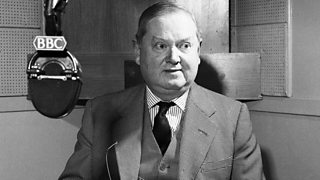
Evelyn Waugh discusses his career in the second episode
The series has been rather neglected but there is one famous edition that is often referred to. It was the interview with Evelyn Waugh, which will be broadcast in full as part of this initial run on Radio 4 Extra. It was considered to be one of the most ill-natured interviews ever put out on air. Waugh later turned the experience into a scene in his novel The Ordeal of Gilbert Pinfold with one of his interviewers, Stephen Black, becoming the character Angel who haunts Pinfold in his hallucinations. According to Waugh’s grandson, Alexander Waugh, the writer had been under a lot of pressure at the time, drinking cocktails of bromide and crème de menthe to help him sleep. Evelyn Waugh, who had contempt for many things, particularly loathed the BBC, calling interviewers and journalists ‘electricians with their apparatus’. His grandson recalls that the interview plus the sleeping draught sent him 'rather mad'.
Frankly Speaking starts on BBC Radio 4 Extra on Tuesday 17th March at 6.30pm.
The series will feature the following people:
• Maurice Chevalier (interviewed in 1963 by Penelope Mortimer, Colin Macinnes & Carl Wildman)
• Evelyn Waugh (interviewed in 1953 by Charles Wilmo, Stephen Black & Jack Davies)
• Tennessee Williams (interviewed in 1959 by John Bowen, Peter Duval Smith & John Freeman)
• Dr Jacob Bronowski (interviewed in 1964 by Mary Stocks & John Maddox)
• Bette Davis (interviewed in 1963 by Peter Duval Smith & George Coulouris)
• Dr Mary Stocks (interviewed in 1964 by Audrey Russell & Leslie Smith)
• Brian Epstein (interviewed in 1964 by Bill Grundy)
• Harold Lloyd (interviewed in 1962 by Liam O'Leary & Peter Duval Smith)
• William Walton (interviewed in 1962 by Dilys Powell & Antony Hopkins)
• Flora Robson (interviewed in 1960 by John Freeman & Philip Hope-Wallace)
• Danny Blanchflower (interviewed in 1961 by Roger Bannister & Brian Glanville)
• Gracie Fields (interviewed in 1960 by John Freeman, Harold Hobson & Patricia Brent)
