Editor's note: this week Radio 4's Archive Hour featured A History of the N-Word. Here, producer Colin Grant reviews the origins and legacy of this controversial and hateful word. Listen to the programme here.
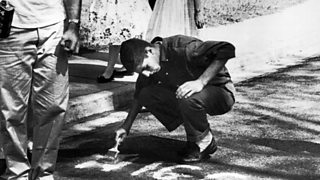
A student of the Senior Service and Key Clubs erases a sign painted on the driveway in front of the R.J. Reynolds High School September 1957. AFP/Getty Images
Historically, the N-word – one of the most hated and hateful in the English language – has been associated with the USA. In the Civil Rights era the word underscored the toxic relations between black and white people in America. Among the boxer, Muhammad Ali’s pacifist objections to the draft in the Vietnam War was the fact that no Vietcong had ever called him by that name.
For all of the difficulties in 1960s Britain, race relations had never been soured by the common use of the N-word, so the narrative went. But fifty years ago the character of the British discourse on race was changed dramatically by one slogan: “If You Want a Nigger for a Neighbour, Vote Labour”. The voters of Smethwick in the West Midlands seemed to have been persuaded. In the general election of 1964, the safe Labour seat was captured for the Conservatives by Peter Griffiths; and although he had not uttered the words of the slogan, he defended the notion that it defined a malaise at the heart of British society; and illuminated the antipathy that the electorate (in Smethwick at least) felt towards their black neighbours.
Ever since the spectre of the N-word was raised in the 1960s, British people have struggled to put it back in its box. Prior to Smethwick if people had heard the N word then it might have been in reference to a shiny, black Labrador (as witnessed in the WW2 film, ‘The Dambusters’), or on the cover of an Agatha Christie story whose title was later updated with the word changed so that it read: Ten Little Indians.
At the end of the 19th century the word was used by at least one spouse as an expression of endearment and "matrimonial" ownership. The popularity of the minstrel shows in Victorian England perhaps accounts for the nicknames that Charles and Emma Darwin gave to each other. In correspondence she was “Dear Mammy” and he was her “darling nigger”.
On the other side of the Atlantic, the N-word was rarely used affectionately: it was a term of abuse. Ever since the 17th century, from the inception of the Atlantic Slave Trade, it had been spoken and written in hatred, directed at the enslaved and their emancipated descendants as a demeaned and degraded people.
Such prejudice was lampooned by Mark Twain in Huckleberry Finn – a critique of American society where privilege was predicated on colour. The enslaved Jim is saintly, wise and kind, and in the novel everyone calls him “nigger”.
Notwithstanding attempts by rap and hip hop artists to re-appropriate the N-word, it is still offensive to modern eyes and ears. Diane Roberts of Florida State University who teaches the book to her students says that they will not say out loud the word that occurs two hundred times in Huckleberry Finn. Perhaps this explains why the novel has often topped the list of banned books.
Despite our enlightened age the N-word continues to leak out (even if only mumbled) giving lie to the suggestion that it had ever gone away. A rerun of classic comedy series such as Till Death Us Do Part shows us how far we’ve come but also gives us pause for thought. Distance has not diminished the offence. What should we do with all of that troublesome archive? Should the word be deleted as some have suggested?
“What, what nigger” were among the last words heard by Stephen Lawrence before he was murdered by knife-wielding racists in 1993. To attempt to wipe the word fromour memory banks is to risk future generations mistakenly believing that it had never existed.
Colin Grant is the producer of BBC Radio 4's Archive on 4: A History of the N-Word, and author Negro with a Hat: the Rise and Fall of Marcus Garvey.
