
Editor's note: Sir David Cannadine, presenter of Churchill’s Other Lives remembers Churchill’s funeral 50 years ago. You can hear the programme on Monday 19th January.
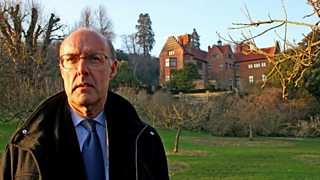
David Cannadine at Chartwell
Winston Churchill has always been a figure of extraordinary fascination to me. When I was growing up in the late 1950s and early 1960s, these were the years of Churchillian apotheosis, and he was the most famous man alive. On his ninetieth birthday, greeting cards were sent, addressed to ‘The Greatest Man in the World, London’, and they were all delivered to Churchill’s home address.
As Lord Moran’s diaries would later make plain, Churchill’s last decade was in many ways a sad one: he was old and infirm, which meant he was no longer able to keep the ‘Black Dog’ of depression at bay; and as his own strength ebbed and failed, he also came to feel that his life’s work, to preserve and safeguard Britain as a great empire and a great power, had been in vain. ‘We passed all the tests, but it was useless’, he is alleged to have said, as the British Empire disappeared and Britannia ceased to rule the waves. ‘I have achieved so much’, he observed on another occasion, in what must surely rank as among the saddest words ever uttered by a great man in extremis, ‘to have achieved in the end NOTHING.’ Of course, he did himself less than justice: it had been an utterly extraordinary life, and the more it recedes into the distance, the more extraordinary it seems, not less.
As Roy Jenkins observed, having written the life of Britain’s greatest nineteenth-century prime minister (Gladstone), and its greatest twentieth-century premier (Churchill), and thus being uniquely placed to compare them: Churchill was the most remarkable human being ever to occupy 10 Downing Street, and whatever the verdict of the electorate this coming May, it seems inconceivable that it will be such as to cause anyone to modify, let alone overturn, that judgment.
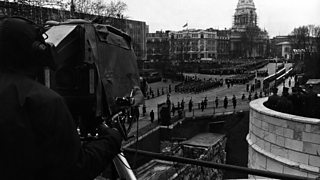
The State Funeral of Sir Winston Churchill as the procession approaches Tower Pier in London.
Since Churchill’s death exactly fifty years ago, a great deal of material has come to light which makes possible a much more rounded and nuanced appreciation of his remarkable, controversial, versatile and lengthy life than anyone could have managed half a century ago. But on his death, as I well vividly remember, there were two sentiments uppermost, both of which were very powerful, but which were also in their way contradictory.
On the one hand, his magnificent state funeral was a final gesture of homage to a man widely regarded (in Isaiah Berlin’s unforgettable phrase) as ’the saviour of his country’. But there was also a very different sense that his obsequies were not only the last rites of the great man himself, but also the requiem of Britain as a great power – a sense that would later be vividly be caught by Bernard Levin in his book on the 1960s, ‘The Pendulum Years’; by Jonathan Dimbleby in his biography of his father Richard, who delivered his last great commentary on Churchill’s funeral; and by Jan Morris, who ended the final volume of his trilogy on the British Empire, ‘Farewell the Trumpets’, with an account of Churchill’s sad but spectacular send-off as the last great imperial pageant.
That he could be at once the saviour of his country, but also a figure who had failed to halt his nation’s decline was a paradox and a contradiction that few then wished to explore in detail. But as Churchill passes from memory into history, it is one of the many ways in which his life is becoming more remarkable and extraordinary, not less.”
Churchill’s Other Lives is written and presented by Professor Sir David Cannadine. It starts on 19 Jan at 13:45 and runs every day for two weeks.
