In search of the Home Front

Radio 4
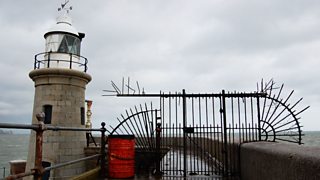
The End of Folkestone Harbour
Earlier this year, Radio 4 announced the commission of a landmark new drama series, Home Front, which will begin in 2014, marking the centenary of the First World War and telling the stories of British civilians over the course of four eventful years.
In the months since this announcement, a small team has been assembled to work on the project, led by Editor Jessica Dromgoole. For the first series, Dublin-based radio and television writer Sean Moffatt is joined by Katie Hims (The Martin Beck Killings), Sarah Daniels (The Cazalets), Shaun McKenna (The Complete Smiley) and Sebastian Baczkiewicz (Pilgrim). Last month the team made a trip to the seaside town of Folkestone, Kent, to begin developing the characters and storylines of Home Front.
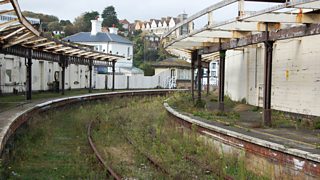
The abandoned railway station at Folkestone Harbour
Folkestone will be the first of several settings for Home Front. A hundred years ago it was a tremendously popular resort town; a playground of the rich and the up-and-coming middle classes, who flocked by train to enjoy sun and channel sea breezes. However, with the coming of war, it became one of the major embarkation points for the Armed Forces, a place where hundreds of thousands of soldiers took their last steps on British soil. More than simply a gateway to the battlefield though, it was also a haven for tens of thousands of Belgian refugees, who sought shelter in the town and were generously welcomed by its inhabitants. With its luxurious hotels turned into hospitals for wounded Tommies, shelters for refugees, billets for troops as well as training places for secret agents and the mechanics and drivers of the Women’s Army Auxiliary Corps, Folkestone is an incredibly rich source of stories that the team sought to uncover.
Beginning at The Grand Hotel, a turn of the century establishment that was briefly a refuge for the Belgian Royal family, the team met Michael and Christine George, authors of Dover and Folkestone During the Great War and members of the local First World War history group, Step Short. The Georges spent a day with the team, leading them on a tour of the town – taking in the Leas, the winding cliffside street where many of these hotels still stand, as well as the Harbour, with its ghostly, long-abandoned railway station, where troops disembarked before boarding the ships to France and Tontine Street, scene of a catastrophic 1917 air raid. Michael and Christine also showed the team some of the items from their archive – postcards, letters, and photograph books from the time, perfectly preserved glimpses into the real lives of wartime civilians.
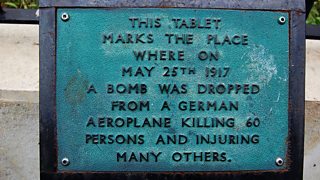
A memorial plaque at Tontine Street, scene of the 1917 air raid.
The following day, the team met a number of historians who delivered a fascinating series of seminars on the history of the Home Front. Professor Ian Beckett from the University of Kent spoke about recruitment and the nation at war, while the University of Worcester’s Professor Maggie Andrews told the stories of the women who began to fill the industrial workforce, and Tony Kushner from the University of Southampton spoke about a case study into the experiences of the Belgian refugees who found shelter in towns like Folkestone.
The channel
After a trip to the town library to examine the contents of its archive and to read local newspapers reports from the time, the team intensively developed ideas. By the end of the weekend, characters and stories had begun to emerge; fictional creations who will inhabit a real place in history, with inspiration drawn from the true events that the historians recounted and that the yellowed papers of the archive revealed.
Though there is a great deal of work still to go on Home Front before the first episode is broadcast next year on the 4th of August, the series is beginning to take shape, and it is hoped that it will do justice to the remarkable stories of those who kept the home fires burning a hundred years before.
Find out more about how the BBC will mark the World War One Centenary
