Guided by sound: Recording the Bearded Tit for Tweet of the Day

Chris Watson
Editor's Note: Listen to Tweet of the Day every day on Radio 4. Chris Watson is a Sound Recordist who presents Tweet of the Day in October.

Picking your way through a mature reed bed can be a disorienting experience, particularly when you know there may be open water just a few paces in any direction.
In August I was at RSPB Blacktoft Sands on the Humber Estuary and surrounded by tall amber reed stems with soft feathery crests, most of which were well above my height. I was being guided by sound - a series of short, percussive ‘pings’ that would erupt for a few seconds then trail off and fade. These were the calls of bearded tits and my target species for Tweet of the Day.
Pete Short the warden had advised me that at this time of year family parties of bearded tits patrol the margins of reed fringed pools and encourage the younger birds to seek out soft bodied insects that occupy the flowering reed heads.
The ground softened and I squelched and wobbled through thick black mud to the edge of an open patch of water. It was with some difficulty I fixed a stereo mic at reed head height, camouflaged the windshield with green cotton mesh, then retreated with a cable sixty meters back to a much drier position.
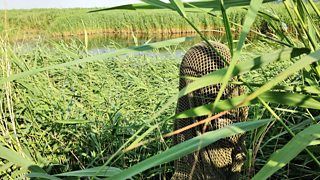
Chris Watson at Blacktoft Sands
The best moments of my work as a Wildlife Sound Recordist are putting on a pair of headphones and entering into that secret world of animals we can never get that close to. Listening intently, the clattering hiss and rattle of reed stems became much sharper, I heard the distant squeal of a water rail and the sharp warning notes of coot on the water. I could hear all of this yet see very little from my position. Eventually, and without much audible warning, they came by. Bearded tits would approach and pass by dancing around the microphone for just a few moments, calling frequently to keep in contact, and then melting away into the forest of reed stems.
Listen to more Tweets of the Day
