
Editor's Note: Radio 4 is lapping up the legend of King Arthur with a major new drama based on T.H. White's The Once and Future King. Here, the dramatist Brian Sibley reveals more about the six-part epic that begins this weekend…
It’s a powerful story and it’s been around for a long time: the tale of a great and noble king who once lived and who now sleeps until a day on which he will return…
When, in 1485, William Caxton printed Sir Thomas Malory’s collection of stories about King Arthur and his Knights of the Round Table, Le Morte d’Arthur, the author confidently advised his readers that ‘many men say’ that the tomb of this monarch carried a Latin inscription translated as, ‘Here lies Arthur, The Once and Future King’.
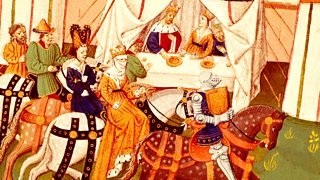
Le Morte d'Arthur
The thing about the Arthurian legend is that’s what it is – a legend. The clue, as they say, is in the title. But, since the Oxford Dictionary defines a legend as ‘a traditional story sometimes popularly regarded as historical but not authenticated’, it could be argued that a lack of authentication doesn’t, necessarily, make it untrue! Certainly it seems to ‘feel’ true, mainly because it’s about the passions and perils of being human: love and hatred, courage and cowardice, loyalty and betrayal… Why else would it have endured so long?
The accumulated legends of Arthur and his sword, Excalibur, Queen Guenever, Sir Lancelot and Merlin the magician were already several hundred years old before Malory put pen to parchment and have been repeatedly retold and reinterpreted ever since by legions of poets, novelists and playwrights, artists, musicians and the makers of film and television.
But one contemporary version stands out from all the others: a tetralogy of novels by T.H. White (1906-1964) taking their collective title from that fabled tomb inscription, The Once and Future King.
Once and Future King
'The Matter of Britain’, as the medieval literature on Arthur & Co. is often called, comprises dozens of manuscripts and fragments dating back at least to the 6th century and possibly earlier. Appropriately, perhaps, T.H White’s more recent telling went through a complex series of rewrites to become the 800-page classic we know today.
It began in 1938, with the world on the brink of a Second World War, when former public schoolmaster, Terence Hanbury White, wrote what he called ‘a preface to Malory’, The Sword in the Stone, in which Merlyn (spelled with a ‘y’ not an ‘i’) educates a young orphan, nicknamed ‘Wart’ – aided by the liberal use of shape-changing enchantments – in preparation for the day when he pulls forth the title sword and finds himself proclaimed ‘Rightwise King of All England’.
Noted for its quirkiness – Merlyn lives backwards through time thus allowing the author to add an array of sly anachronisms – the book was an immediate, critically-acclaimed bestseller and Walt Disney instantly snapped up the film rights, although the animated movie of the same name wouldn’t reach the screen until 1963.
Two sequels followed: The Witch in the Wood (1939) about the rebellious family of King Lot of the Orkneys and his enchantress wife, Queen Morgause; and, the following year, The Ill-Made Knight, telling the story of Lancelot, his devotion to Arthur and his illicit love of Guenever.
Then, in 1958, White tinkered extensively with the first two books, eliminating or replacing whole sequences in The Sword in the Stone (such as the fantastical wizards’ duel between Merlyn with the wicked Madam Mim); cutting The Witch in the Wood to the bone, darkening its tone and renaming it The Queen of Air and Darkness; and adding a fourth volume, The Candle in the Wind, which recounts the disintegration of the Round Table and the collapse of Arthur’s noble ideals of chivalry. The complete cycle now bore the title The Once and Future King and inspired the 1960 Lerner and Loewe stage musical, Camelot.
A planned fifth volume, The Book of Merlyn, remained unknown until its posthumous publication in 1977. Now usually included as a coda to the one-volume edition, it focuses on a last meeting between Arthur and Merlyn on the eve of the King’s final, crucial battle with his bastard son, Mordred. In these closing chapters, the two men consider the nature of human conflict and the eternal struggle between good and evil – a debate that proves as topical and timely as it ever was.These recollections of the monarch and the magician provided me with a framing device for my radio dramatisation – a night-time conversation in which they re-live the achievements and failings of Arthur’s reign and – as the fatal dawn draws ever nearer – reflect on with the price of peace and the cost of war…
The influence of T.H. White’s The Once and Future King has been extensive and diverse: from Marvel’s X-Men Comics (the book is a favourite of Professor X), via George A Romero’s Knightriders and TV’s Merlin, to the Harry Potter novels of J.K. Rowling, who acknowledged the similarities between her Albus Dumbledore and White’s Merlyn and who referred to Wart as ‘Harry's spiritual ancestor’.
For me, the book has been a constant companion since, prompted by the Disney film, I first read it, fifty years ago. And for thirty-something of those years, I've wanted to bring it to radio.

Paul Ready and David Warner
Now, at last, with a powerful cast, headed by Paul Ready as Arthur and David Warner as Merlyn, The Once and Future King is set to conjure for the listening audience the magic, romance and tragedy of White’s compelling Arthurian dream.
Listen to The Once and Future King.
