
Editor's note: In Thursday's programme Melvyn Bragg and his guests discussed King Solomon. As always the programme is available to listen to online or to download and keep - PMcD
Hello
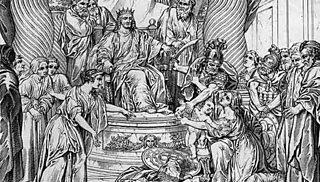
There's a sense in which the programme this morning reminded me in its form of Solomon and his decision to slice the baby in two, in order to discover who was the real mother. Although I don't think we discovered who was the real mother. Our slicing was between minimalists and maximalists.
The last three weeks have had the subtext (on In Our Time) of scholarship about scholarship. When we discussed Marco Polo, part of the discussion was - could we believe much of what he said and, indeed, had he said it?
When we discussed the Trojan War, similar problems of the authenticity of the written and the archaeological evidence came through. And again this morning, the records about Solomon were written three or four hundred years after his death, at a time of ideological emphasis in Israel when, as Martin Palmer pointed out, they were determined to have the great man that they thought Solomon had been.
The maximalists rely quite strongly on the Scriptures, however late they were written. The minimalists tend to point out the paucity of archaeological evidence. One thing that was missing entirely was a consideration of oral evidence, although I don't know how one gets at this.
The fact seems to be that in many of the greatest of the old civilisations - the Celts would be a fine example - oral evidence was the main source of historical, mythological and cultural continuity within a society. It is galling, to say the least, that we have no access to this.
What I would contend is that although the Scriptures in the Old Testament in which Solomon was mentioned were written three or four hundred years after his death, it is not impossible that a strong and carefully schooled oral tradition (such as we know the Celts to have been), could have taken through the main points of that story, even over that long time.
Formal oral traditions prided themselves on their accuracy. In fact, one of the reasons they would not have things written down was because they thought the written word could be so easily twisted and turned, whereas the spoken word, spoken by people who had been disciplined to learn accurately, was far more reliable.
And so out into the rain this time. Went down to St James's Park yesterday to see the dismantlement of that monument to scaffolding which looked like a Meccano set. Still crowds going up the Mall, perhaps just for the sake of going up a Mall free of traffic, between the Union Flags, and a final act of homage, or more likely, I think, a continuation of the sense of amiable, congenial, decent people in large numbers, quietly enjoying themselves, without extrovert bluster and over-organised pleasure. Very pleasant. But walking in the rain in central London is always pleasant. There's always somewhere you can duck into and shelter for a while. A convenient doorway.
Best wishes
Melvyn Bragg
- Download this episode to keep from the In Our Time podcast page
- Visit the In Our Time website
- Follow Radio 4 on Twitter and Facebook
