
Dr Janet Topp Fargion, lead curator of world and traditional music at the British Library, previews the second week of Noise: A Human History. The thirty-part series explores the role of sound in the past 100,000 years of human history.
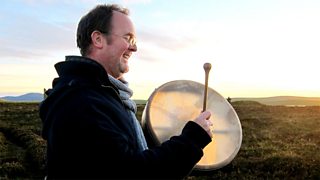
Prof David Hendy
Noise: A Human History talks a great deal about the ancient world and what that world might have sounded like. What I find so interesting is that so many of the ancient soundscapes described still exist today.
For example when presenter David Hendy, in episode 8, conjures up soundscapes of Ancient Rome, referring to the mix of languages and "noise" of everyday life in a cosmopolitan city, I’m reminded of my own home soundscape in north London: Turkish neighbours playing the saz (plucked lute) late at night, the Greek orthodox Easter procession passing along my street, the West African evangelist service on a Sunday.
And when David Hendy refers to singer/poets reciting epic verse, or to other forms of oral literature, I think it’s important to note that these are not forms only of the past, but they still exist within literate and modern-day society.
So, the Indian epic poem Mahabharata is now performed as an immensely popular TV series - in 94 episodes screened between 1988 to 1990. And the 13th century Malian epic of Sunjata, referred to in episode 6, is still popularly performed by griots (or jaliya) including a household name in world music, and descendent of the great Sunjata himself, Salif Keita.
It’s perhaps an obvious point to make, but the nature of oral literature is that it exists as performance. The only 'documents' therefore are recordings.
One of my favourite collections in the world and traditional music section at the British Library contains documents/recordings of several epic praise poems of this kind, or ‘Ekyevugo’. Klaus Wachsmann was a musicologist and museum curator who worked in Uganda from the late 1930s to the mid-1950s. He recorded a vast range of performances all around the country, resulting in one of the most extensive collections of recordings of music from Uganda and forming the basis of decades of African music scholarship. His collection can be listened to on the British Library’s Sounds website.
These performances impart history and knowledge, and are intended to be listened to and repeated. This week’s episodes of Noise: A Human History go on to explore exactly that interaction between performer and audiences.
The recording below includes a kind of verbal punctuation provided by the listeners as they interject in a call-and-response pattern that sets up a dialogue with the performer. With literacy levels increasing in all countries around the world, these genres of oral literature remain as alive and relevant as ever before.
For example when presenter David Hendy, in episode 8, conjures up soundscapes of Ancient Rome, referring to the mix of languages and "noise" of everyday life in a cosmopolitan city, I’m reminded of my own home soundscape in north London: Turkish neighbours playing the saz (plucked lute) late at night, the Greek orthodox Easter procession passing along my street, the West African evangelist service on a Sunday.
And when David Hendy refers to singer/poets reciting epic verse, or to other forms of oral literature, I think it’s important to note that these are not forms only of the past, but they still exist within literate and modern-day society.
So, the Indian epic poem Mahabharata is now performed as an immensely popular TV series - in 94 episodes screened between 1988 to 1990. And the 13th century Malian epic of Sunjata, referred to in episode 6, is still popularly performed by griots (or jaliya) including a household name in world music, and descendent of the great Sunjata himself, Salif Keita.
It’s perhaps an obvious point to make, but the nature of oral literature is that it exists as performance. The only 'documents' therefore are recordings.
One of my favourite collections in the world and traditional music section at the British Library contains documents/recordings of several epic praise poems of this kind, or ‘Ekyevugo’. Klaus Wachsmann was a musicologist and museum curator who worked in Uganda from the late 1930s to the mid-1950s. He recorded a vast range of performances all around the country, resulting in one of the most extensive collections of recordings of music from Uganda and forming the basis of decades of African music scholarship. His collection can be listened to on the British Library’s Sounds website.
These performances impart history and knowledge, and are intended to be listened to and repeated. This week’s episodes of Noise: A Human History go on to explore exactly that interaction between performer and audiences.
The recording below includes a kind of verbal punctuation provided by the listeners as they interject in a call-and-response pattern that sets up a dialogue with the performer. With literacy levels increasing in all countries around the world, these genres of oral literature remain as alive and relevant as ever before.
A heroic or 'Ekyevugo' recitation recorded by Klaus Wachsmann in Ankole, Uganda in 1954.
