
Editor's Note: This episode of Bookclub is available to listen online or for download.
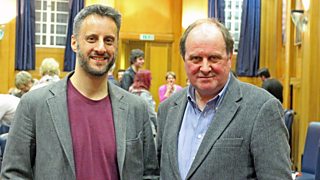
Let’s be blunt. Not every poet, however talented, can write a decent novel. So Adam Foulds is remarkable: he has achieved mastery of both forms, above all perhaps with his outstanding work, The Quickening Maze. This is not simply a novel that works; it’s a marvellous fusion of his poetic gifts and the natural urge of a storyteller. I first read the book six years ago when it was shortlisted for the Man Booker prize - I was chairing the judges, and therefore read it three times in the course of a few months. That particular year Hilary Mantel’s Wolf Hall held sway in the final reckoning but The Quickening Maze proved a memorable and haunting adornment on that list. When this month’s group of readers met Adam in Broadcasting House we had one of the happiest encounters of recent Bookclubs.
Partly, this was because Adam was talking about another writer, and his own sympathy for him. The subject of the novel is John Clare, the rural poet; the setting during his incarceration in an asylum on the edge of Epping Forest around 1840. Clare’s a man with a powerful feeling for landscape and the story of England and he’s tormented by the sensation of a world that’s slipping away. Agriculture was changing; the old ways had been turned upside down by the industrial revolution and in the midst of his own darkness - they called it madness in those days, of course - he finds it hard to see hope. Here’s how Adam described to us his own feeling for Clare. ‘My heart went out to him. As I think it does for many readers of poetry, and people who become familiar with John Clare’s story, there’s something about his journey through life that is transfixingly pathetic, eliciting pathos in your fellow feeling for him, as well as being glorious, luminous with imagination and vision that we see in his poetry.’
That gives you a good introduction to the passion that the author brings to the story. But we’re not talking here about some kind of disguised biography. The novel was inspired when Adam was an undergraduate and discovered in a biography of Tennyson that he and Clare had been brought together by chance when the future poet laureate’s brother, Septimus, was himself committed to an asylum because he suffered what the family called ‘the bad blood of the Tennysons’ That throw of the dice was enough to stir the story-teller in Adam, and years later he produced the tale, where the two men are under the care of the eccentric dominating figure of the Rev Dr Matthew Allen - a man who ‘wobbles on the pivot point between the Regency and Victorian period: someone who’s had a skittishly entrepreneurial scientific past, as a phrenologist, then was in prison for debt and for selling soda water without a licence’. With Allen’s daughter Hannah - an invention by Adam - the story takes shape.
It does so with the help of the enfolding mysteries of Epping Forest, through which Adam used to wander as a boy, and which houses among other excitements an encampment of gypsies, who provide a wild and hypnotic counterpoint to the strange regime of Dr Allen’s asylum. There is a passage in the book in which they strip the flesh from a deer which is one of the finest evocations of a raw life on the land that you will ever read.
The Quickening Maze is a short novel, but it bursts with passion and human endeavour. Adam’s account of Clare’s journey across the countryside to home in Northamptonshire (there to be incarcerated again) is melancholy but uplifting, a hymn of praise to a poet who found the world around him too much. It is a beautiful book.
I hope you enjoy hearing Adam Foulds talking about it.
Happy reading
Jim
Jim Naughtie presents Bookclub on BBC Radio 4
