
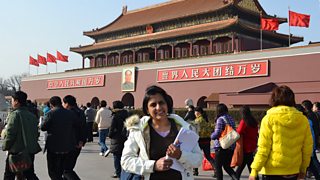
Ritula Shah in Tiananmen Square.
Yu Gang said he'd received a phone call from the police, soon after we contacted him to arrange a meeting. They rang, he said, to invite him for a cup of tea. An intense, quietly spoken man in his forties, Gang was quite relaxed about the whole thing. "The police just told me not to see you." He ignored their advice. Gang describes himself as a democracy campaigner; he's sold his house to fund his work. He shrugs dismissively when I ask if he's scared of getting into trouble.
Hu Yun Fei is in her thirties. She too is a political activist and took part in recent demonstrations in support of greater media freedom. But Yun Fei describes "democracy" as too big an aim. Instead, she says, China must progress in small steps, tackling one issue at a time. Yun Fei tells me she recently discovered her phone calls had been monitored for years.
Although the number of protests is growing, most Chinese people probably don't spend their days contemplating their lack of political rights - they're worrying about their jobs, their families, their health - just like most of the rest of us. In the southern city of Shenzhen, the young job seekers I interviewed all want interesting, well-paid work, with prospects for promotion. Their aspirations strike me as being rather similar to their western counterparts. But sometimes, even these everyday concerns become tangled with politics.
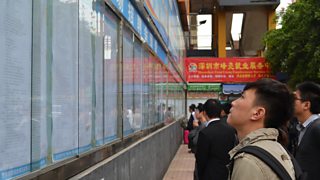
Looking for work in Shenzhen
I went to the village of Wukan in the southern province of Guangdong, where there were massive protests against the sale of their communal land by local officials. Activist Zhang Jian Xing showed me a densely typed letter, written to persuade the villagers to join the cause, against the local authorities. Eventually, they succeeded in ousting the established village committee and held democratic elections to choose a new leadership. One year on, they haven't got much of their land back but their actions demonstrate that ordinary Chinese people are willing to stand up for their rights. And sometimes, the authorities decide they have little choice but to give in.
Ritula Shah reports from the village of Wukan in southern China.
In Beijing, the shopping malls are busy, the highways are choked with traffic and people are going about their business. In some ways it's all quite unremarkable and it's hard to believe that saying or doing the wrong thing here can still get you into an awful lot of trouble. But as protests grow over everything from land rights, to official corruption and media freedom, will the Chinese leadership have to think again about how they maintain stability?
Editor's note: Ritula Shah is in China to report on the key challenges facing the new leadership. Hear her reports all this week on The World Tonight
The World Tonight
Profile: Xi Jinping
Ritula Shah's profile page
