
Editor's note: In Thursday's programme Melvyn Bragg and his guests discussed Romulus and Remus. As always the programme is available to listen to online or to download and keep - AI.
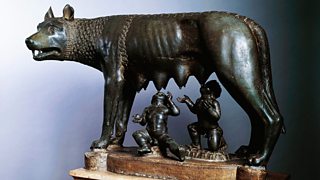
Romulus and Remus (for In Our Time)
Hello
Once again, doing a programme about the deep past, I was frustrated by the fact that written history was introduced so late in civilisation to any great and, frankly, historically useful extent. This leads us to relying on oral history, which leaves us basically having very little - or to put it another way, nothing at all - to rely on. Yet we do have the residues of oral history in the early literary history. I've always thought that oral history was vastly underrated in our particular phase of what might - with a stretch - be called civilisation. The civilisations which depended on oral history (the Celtic, for example) did not turn to writing because they thought that writing could be twisted and misinterpreted in ways that conscientious oral history, with trained people to memorise it correctly, could not be. We all have experience of stories being related over the years and, of course, related differently by different people. But what's the difference between that and written history? If there was only some way we could uncork oral history and begin to rely on it, it might make programmes like In Our Time more entertaining. And, of course, more interesting.
Aeneas got short shrift this morning, I'm afraid. There was an attempt to relate Aeneas and Ascanius and their flight from Troy to the small town of Alba Longa near Rome, which Ascanius was supposed to have become first king of, and one of his descendants was the progenitor of the mother of Romulus and Remus, thereby giving Rome a connection way back to the mythical Homeric past which so many European states, civilisations, principalities and even countries aspire to.
It was good to see Mary Beard in good form after sweeping away the vicious, libellous, unconstrained battering she'd received from the people who blog anonymously on websites and Twitter and so on. Obviously these sites are very useful for sensible people. But they are also, without question, a vent of malice for the envious and the nasty. Unless there's a way of corking this then I think it's bound to die on the hoof, or at the very least, anybody with any sense will simply withdraw their participation and their interest.
One of the things that I most enjoyed about this morning was that we had serious disagreements between the three academics and it was developed in a seriously polite and courteous way. That's one of the things I like about the programme. These people have put their entire lives to the service of scholarship and very often to a theory, or a few theories, about the field to which they have dedicated themselves. When challenged head-on, they don't scream and shout - like -politicians - or bicker and squeal - like crypto-politicians - they slightly raise the temperature of their tone but bat it back with great courtesy. It's terrific.
Been a busy time for myself. On Wednesday I was down at Hever Castle, the home of Anne Boleyn, where her chaplain was made Archbishop of Canterbury, which somehow (one never knows how these things work!) enabled Henry VIII to get a divorce so that he could marry her. Hever Castle is almost a picture-book castle, most magnificently Tudor inside and like a model, complete with moat and drawbridge and topiary gardens outside. Lord Astor took it over at the same time as he took over Cliveden and gave it an Italian garden and lake, and it is full of the complete painted works of the Tudors who now seem to dominate our history. Our history seems to be 1066, the Tudors, Hitler and out. Or perhaps that is a little too rash.
It's very sad to leave Anna Cox and Ian and Rhys, the small crew who have tracked Tyndale through freezing Europe over the last few weeks, and even when we went to Hever it was freezing. I'm now off to boiling Israel to do a film about Mary Magdalene. Somehow or other, these temperatures seem appropriate for the two subjects concerned.
Best wishes
Melvyn Bragg
Download this episode to keep from the In Our Time podcast page
Visit the In Our Time website
Follow Radio 4 on Twitter and Facebook
