Editor's note: In Thursday's programme Melvyn Bragg and his guests discussedQueen Zenobia. As always the programme is available to listen to online or to download and keep.
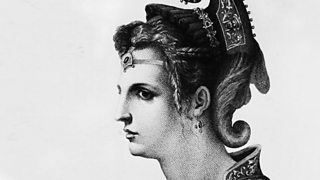
Queen Zenobia
Hello
You never cease to wonder how people got inspired to do what they do in the first place. I think we've cracked this one with Edith Hall. As a teenager in a guesthouse near St Andrews where she was making a vacation living, she worked in a place called The Palmyra. Undoubtedly that sowed the seeds of her characteristic, wonderful exuberance and waterfall of information which flooded through this morning's programme. Equally enthusiastic was Kate Cooper – in fact, at one stage I thought either one of them could have done the entire programme by themselves without pausing for breath – but Richard Stoneman stood his ground. I was a bit miffed that Kate stole in before me to say that the reason Zenobia is not well enough known is because Shakespeare did not write a play about her! I should have got it in earlier. Richard was a bit miffed (in the way that academics are academically miffed) by not getting in the fact that when Aurelian went back to Rome he built a temple of the sun, the Unconquered Sun, Sol Invictus, and named as the sun king's birthday the 25th of December. Christianity was soon to become the official religion of Rome.
There was much about women in ancient history, including the ten Amazonian archers on horseback who took part in Aurelian's great triumph in Rome and the cohort of women whose place has yet to be properly recognised in ancient as in modern history. Kate, after the programme, wanted to talk about the Mary Magdalene television programme I did, saying that she hoped I didn't associate Mary with the Gnostics and, as she put it, "weirdos", but Mary Magdalene was central for the whole enterprise. Which is what I thought I'd said in the programme.
Well, away we go, filming John Ball and the misnamed Peasants' Revolt of 1381. Down to Rochester in the teeming rain of late May, that fantastic ruined fortress which still seems formidable and clambering all over it were French children, excited and speaking perfect French! I could have been in St James's Park. But, blow me down, a couple of days later I was in Canterbury at the place where the rebels offered John Ball the archbishopric (he turned it down) and scampering all over the rain-sodden grounds were – yes, scrums of eager, young, French children! Is it me? Is it them? Is it half term? Is it places which were built by the Normans which attracts them?
I think that all our political leaders should go to Canterbury Cathedral at once in order to learn about visions for the future. The cathedral was begun in the late eleventh century and only completed two hundred years later. Now that’s a vision for the future. That's what we need. I didn't know that the actual stone to build it came from Cannes (yes, film festival Cannes)*. It was brought round by sea, then up the river and then on horseback. All that stone! AND when they need to repair it or replace stone they go back to the original quarries at Cannes.
Best wishes
Melvyn Bragg
* [EDITOR'S NOTE]Thanks to the listeners who've pointed out that the stone at Canterbury in fact came from Caen, not Cannes!
Download this episode to keep from the In Our Time podcast page
Visit the In Our Time website
Follow Radio 4 on Twitter and Facebook
The BBC is not responsible for the content of external websites
