Editors note. In Thursday's programme Melvyn Bragg and guests discussed the microscope. As always the programme is available to listen to online or download to keep.
Hello,
Who’d have thought that the electron microscope could be so much fun?
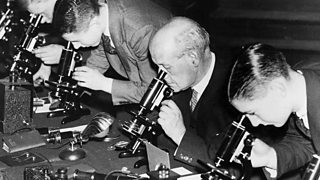
It’s odd sometimes that the mix of academics we invite on to the programme gel in a way that is totally unanticipated. Unanticipated consequences (if they are happy and positive!) are always a pleasure.
We had an Earth-changing example this morning. Professor Thomson in the late nineteenth century in Cambridge, pottering along, with his pipe, as I imagine, in his small, cluttered, Heath Robinson laboratory, discovered the electron. Perhaps four or five people thought “good on you” and celebrated with an extra half a bitter at the local pub.
About forty years later this was taken up as a method of increasing the efficiency of microscopes. About twenty or thirty years after that, the electron finds itself more or less ruling the world, in chips, in computers, in Rolls-Royce engines, in the way we have our being. Who’d have put a bet on it in the 1880s?
It’s been a bit of a day. After doing the programme on the microscope I bolted off to another studio to record a programme on the Medici, one of the two programmes we will put to bed so that we can stay in bed ourselves over the Christmas/New Year break. I’ve written enough about the difference of doing recorded programmes.
One of the things this programme brought to mind was the remark by Orson Welles in The Third Man that the Italians had had centuries of strife and violence and general nastiness and produced the Renaissance, and the Swiss had had centuries of peace and produced the cuckoo clock. (Most unfair, in fact: the Swiss were the most celebrated mercenaries in Europe, and the cuckoo clock was invented in the Black Forest).
After that I belted down to the House of Lords for a debate. I mean belted. I’d worked out that the traffic situation in London at that time of the morning, with the Changing of the Guard and the rain and the general gridlock down Regent Street, was appalling, so if I legged it I could get to the House of Lords in half an hour and be there in time for the broadcast debate. A sweaty person, i.e. myself, did arrive in time.
These Thursday debates are interesting. This one included John Birt, Joan Bakewell, Alan Watson, Jane Bonham-Carter, Alan Sugar and others who had direct experience of the subject in hand – broadcasting. Experience in the sense of having worked in it for many years. A bit different from the House of Commons.
Best wishes
Melvyn Bragg
Download this episode to keep from the In Our Time podcast page
Visit the In Our Time website
Follow Radio 4 on Twitter and Facebook
The BBC is not responsible for the content of external websites
